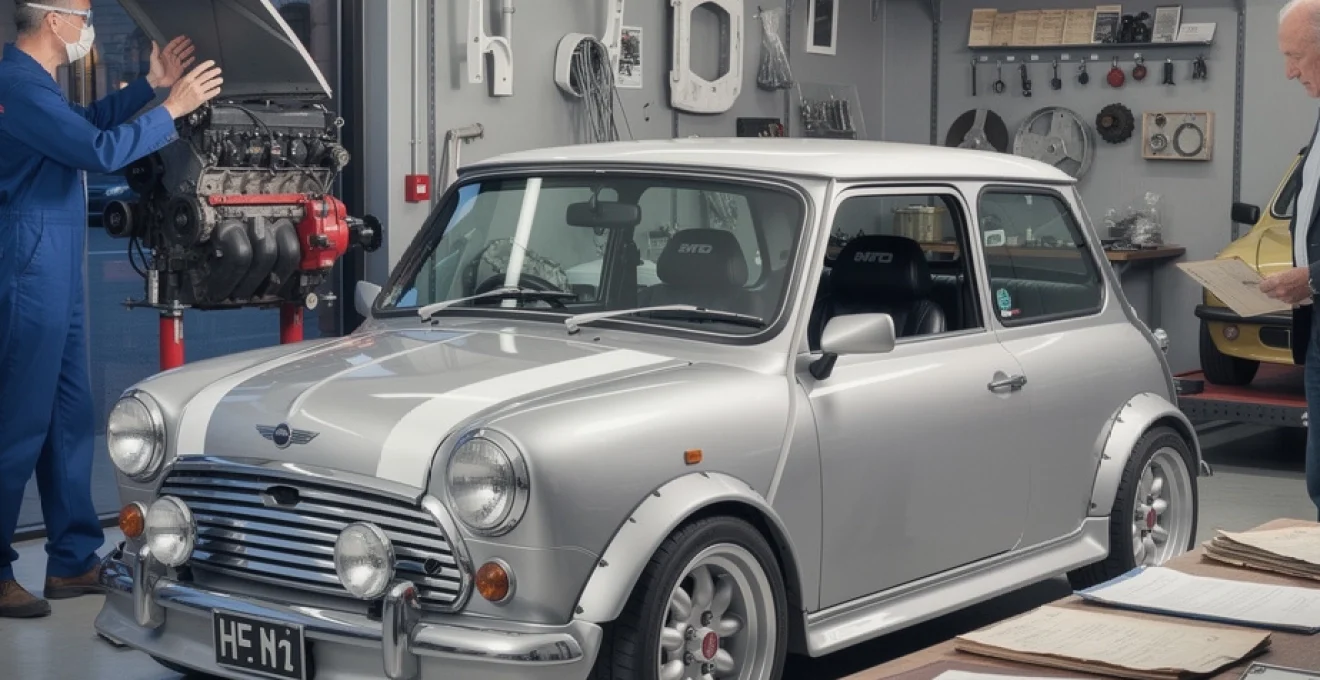
The 1999 Mini Cooper Sport represents a pivotal moment in automotive history, standing as one of the final iterations of Sir Alec Issigonis’ revolutionary design before BMW’s reimagined Mini arrived in 2001. As production at Longbridge wound down, Rover Group engineered what many enthusiasts consider the most refined interpretation of the classic Mini formula. With only moderate production numbers and a specification list that included the most sophisticated equipment ever fitted to a factory Mini, the 1999 Cooper Sport has transitioned from used car to serious collector’s item in remarkably short order. Values have appreciated considerably over the past decade, with pristine examples now commanding prices that would have seemed inconceivable when these cars were merely three or four years old. For collectors seeking an accessible entry point into classic British motoring or enthusiasts wanting the driving experience that defined an era, understanding what makes the 1999 Cooper Sport special requires examining its engineering, performance characteristics, and position within the broader classic Mini marketplace.
1999 mini cooper sport production specifications and rover group engineering
By 1999, the Mini had evolved considerably from its utilitarian 1959 origins. Under BMW ownership since 1994, Rover Group invested in refinements that elevated the final classic Minis beyond mere nostalgia projects. The 1999 Cooper Sport benefited from decades of incremental improvements whilst retaining the fundamental architecture that made the original Mini revolutionary. Understanding these specifications provides essential context for appreciating how far the design had progressed whilst remaining faithful to Issigonis’ vision.
Multipoint fuel injection 1.3-litre A-Series engine performance metrics
The 1999 Cooper Sport utilised a 1,275cc A-Series engine equipped with multipoint fuel injection, marking a significant departure from the carburetted units that powered earlier generations. This fuel-injected configuration produced 63 bhp at 5,500 rpm and 71 lb-ft of torque at 3,000 rpm. Whilst these figures appear modest by contemporary standards, the engine’s character defined the Cooper Sport experience. The multipoint injection system improved throttle response and fuel economy compared to earlier single-point systems, delivering approximately 42.8 mpg in combined driving. Cold starting became more reliable, and the engine maintained consistent performance across varying ambient temperatures. The A-Series unit retained its characteristic eager willingness to rev, with peak power arriving high in the rev range, encouraging drivers to exploit the full performance envelope. Oil changes required careful attention, as the gearbox shared lubrication with the engine in the traditional Mini configuration, making regular maintenance absolutely critical for longevity.
Sport pack enhancements: 13-inch alloys and Twin-Point fuel injection
The Sport Pack specification distinguished Cooper Sport models from standard Cooper variants through several key upgrades. Thirteen-inch alloy wheels replaced the smaller items fitted to base models, providing improved grip and filling the wheelarches more purposefully. These larger wheels necessitated the distinctive Sportspack wheelarch extensions, which became one of the Cooper Sport’s most recognisable visual signatures. The twin-point fuel injection system, whilst not as sophisticated as later multipoint setups, represented a substantial improvement over carburettors. Sports suspension utilised firmer damper settings and revised geometry to reduce body roll, complementing the wider track created by the wheelarch extensions. The brake servo assistance improved pedal feel whilst maintaining the direct, mechanical connection that characterised Mini driving dynamics. Interior appointments included supportive seats with enhanced bolstering, leather-trimmed steering wheels on many examples, and comprehensive instrumentation that provided far better information than earlier Minis offered.
Body-in-white construction and subframe modifications
The monocoque body-in-white construction remained fundamentally unchanged from earlier Minis, though manufacturing quality improved substantially during the BMW era. Seam welding received particular attention, with more consistent application of protective coatings helping combat the corrosion that plagued earlier examples. The front subframe, which carried the engine, gearbox, and front suspension, benefited from reinforcements addressing weakness areas identified through decades of production experience. Rear subframe mounting points received additional strengthening, as these areas had proven vulnerable to corrosion-related structural failure on older Minis. The body-in-white weighed approximately 580 kg
in bare form, with the additional mechanical components and interior trim bringing a typical 1999 Mini Cooper Sport to around 686 kg on the road. This low mass, combined with the compact body-in-white shell, underpins much of the Mini’s famed agility. Compared with early cars, the shell incorporates side-impact bars in the doors and strengthened sills, reflecting tightening safety regulations without dramatically increasing overall weight. BMW-era quality control also meant tighter panel gaps and better paint application, something collectors now value when assessing originality and condition. For anyone considering a 1999 Cooper Sport as a classic purchase, understanding these subtle body and subframe changes helps explain both its durability and its desirability.
Limited slip differential and sports suspension geometry
Unlike many modern hot hatches, the standard 1999 Mini Cooper Sport did not leave Longbridge with a factory-fitted limited slip differential (LSD). Most cars used an open differential, relying instead on low weight, narrow tyres, and well-judged suspension geometry for traction. That said, some dealer- and specialist-installed performance packages, particularly John Cooper Garages’ S Works conversions, could be specified with aftermarket LSD units aimed at more enthusiastic drivers. Where fitted, these differentials tightened up corner exit behaviour and reduced inside-wheel spin, especially on wet or bumpy roads. For collectors, a period-correct LSD is a desirable yet subtle upgrade, provided documentation confirms it as an authentic period modification rather than a recent track-oriented alteration.
The sports suspension geometry of the Cooper Sport is central to its reputation. Firmer dampers, slightly altered front camber, and the wider track created by the 13-inch wheels all contribute to a more planted feel than earlier, narrower Minis. Rover’s engineers balanced these changes carefully to avoid overwhelming the classic rubber-cone springing with excessive stiffness. On a flowing B-road, the result is a car that feels eager to change direction yet remains predictable at the limit, a combination that keeps the 1999 Cooper Sport competitive in modern classic track days and hillclimbs. When evaluating a car today, checking that the suspension geometry remains close to factory specifications is vital; overly aggressive aftermarket settings can make the car twitchy and accelerate tyre wear.
Driving dynamics: track performance and handling characteristics
On the road or on circuit, the 1999 Mini Cooper Sport delivers the distilled essence of the classic Mini driving experience with a layer of refinement absent from earlier versions. You still sit close to the wheel, with pedals offset and the steering column angled bus-like, but the car’s responses feel sharper and more cohesive. Rover’s late-1990s upgrades to the brakes, steering, and fuel-injected engine transformed the Mini into a machine that could keep pace with contemporary superminis on twisty roads, even if its outright speed lagged behind. For many enthusiasts, this balance of usable performance, compact dimensions, and analogue feedback is exactly what makes the late Cooper Sport such an appealing classic in 2025.
Hydrolastic suspension vs sport dry cone rubber setup
Earlier Minis experimented with Hydrolastic fluid suspension, but by the time the 1999 Cooper Sport rolled off the line, Rover had long since standardised on dry rubber cone suspension. For prospective owners, this is good news: the dry cone setup is simpler, lighter, and easier to maintain than the interconnected Hydrolastic system. On the Cooper Sport, the cones work in concert with gas dampers and the aforementioned sports geometry to provide that legendary “go-kart” feel, albeit with a decidedly firm ride. On rough urban roads, you’ll feel every imperfection, but on smooth tarmac the car seems to skim across the surface, reacting instantly to steering and throttle inputs.
In practice, the dry cone system behaves a little like a progressive spring, firming up as it compresses. This gives the Mini its trademark combination of initial compliance and tight body control, much like a well-tuned track car with road-friendly manners. Enthusiasts seeking to preserve originality should ensure that replacement cones and dampers are high-quality items matched to factory specifications. Cheaper pattern parts can leave the car sitting too high or crashing over bumps, diminishing the very handling characteristics that make the 1999 Mini Cooper Sport so special to drive.
Go-kart handling physics and 10.1-inch disc brake configuration
The “go-kart handling” cliché is frequently applied to small cars, but with the 1999 Cooper Sport it is more of an engineering fact than a marketing slogan. With a wheelbase of just over 2 metres, minimal overhangs, and the engine mounted transversely over the driven front wheels, the Mini’s mass is concentrated close to its centre. This reduces polar moment of inertia, meaning the car resists understeer and reacts rapidly to steering inputs, much like a racing kart pivoting around its middle. You feel this instantly in tight corners: small steering corrections yield immediate changes in direction, encouraging you to carry speed where larger, softer cars would roll and wash wide.
Braking duties for the Cooper Sport are handled by 8.4-inch front discs on most UK-market cars, but many enthusiasts and tuners retrofit 10-inch or 10.1-inch disc conversions behind smaller wheels for improved bite and period appearance. The factory servo assistance introduced in the late 1980s ensures the brake pedal feels reassuringly firm without requiring excessive leg effort. On track, a well-maintained system provides consistent stopping power, although repeated hard laps will reveal the limits of the relatively small discs and pads. For spirited road use, however, the braking package suits the Mini’s weight and performance, delivering strong deceleration and excellent pedal modulation, allowing you to trail-brake into bends with confidence.
Power-to-weight ratio analysis at 63 bhp
On paper, 63 bhp may not sound like much, but in a car weighing under 700 kg, the power-to-weight ratio becomes more compelling. The 1999 Mini Cooper Sport offers around 90 bhp per tonne, comparable to many warm hatches from the early 2000s. Thanks to short gearing and the A-Series engine’s willing nature, acceleration feels more urgent than the 11.8-second 0–60 mph figure suggests. The key is to keep the revs in the engine’s sweet spot between 3,000 and 5,500 rpm, where torque and noise combine to create a sense of speed that far exceeds the numbers on the speedometer.
Why does this modest power output translate into such vivid performance? The answer lies in inertia. With so little mass to move, the engine’s efforts are not wasted hauling unnecessary weight, so changes in throttle position bring immediate changes in pace. On a twisty B-road, a light, responsive car like the Cooper Sport can embarrass heavier, more powerful machinery that cannot match its braking distances or cornering speeds. For collectors and drivers alike, this power-to-weight equation is a major part of the 1999 Mini Cooper Sport’s enduring appeal as a usable classic.
Wheelbase dynamics and front-wheel drive traction control
The Mini’s short wheelbase is both its greatest strength and, occasionally, its challenge. On the one hand, it allows the car to pivot eagerly into corners, making tight switchbacks and hairpins feel like a playground. On the other, the short distance between axles means the car can feel nervous on uneven surfaces or at motorway speeds in strong crosswinds. The 1999 Cooper Sport’s slightly taller gearing helps here, calming the engine at a cruise and making long journeys more realistic than in earlier, lower-geared Minis, though you will still notice more fidget and wander than in a modern supermini.
In terms of traction, the front-wheel drive layout and modest power output mean electronic traction control was never deemed necessary. Instead, grip is managed the old-fashioned way: through tyre choice, suspension setup, and the driver’s right foot. On damp roads, you can occasionally spin an inside front wheel exiting tight junctions, especially if the car wears older or budget tyres, but this is more a character trait than a flaw. Many owners report that switching to high-quality modern tyres transforms wet-weather performance, making the Cooper Sport feel as secure as many far newer cars. For those considering occasional track days, a specialist alignment and fresh rubber are two of the most cost-effective upgrades you can make.
Collector market valuation and classic mini appreciation trends
Over the past decade, the late Rover Minis – and the 1999 Mini Cooper Sport in particular – have moved decisively from quirky used cars to recognised modern classics. Market observers report that values for the best examples have more than doubled since the mid-2010s, outpacing many mainstream classics. This growth reflects a confluence of factors: the car’s status as one of the final iterations of the Issigonis design, relatively low production numbers, and an enthusiastic global fanbase. For collectors wondering whether the 1999 Cooper Sport still represents good value in 2025, examining price guides and auction results is essential.
Hagerty price guide analysis for final edition models
Although specific figures vary by market, classic insurance specialists and valuation tools such as the Hagerty Price Guide consistently show upward trends for late 1990s Minis. A standard 1.3i Cooper in good condition typically sits in the mid-range of Rover Mini values, while the Cooper Sport, especially with factory Sport Pack, often commands a premium of 10–20%. Exceptional low-mileage, fully documented cars – particularly those with one or two owners from new – can exceed £20,000 in the UK, placing them alongside earlier 1960s cars in certain conditions. Hagerty’s data suggests that, while the steepest appreciation may be behind us, prices remain firm and are unlikely to regress significantly given the finite supply.
Final-edition models, including 1999 and 2000 Cooper Sports and the limited-run Cooper Sport 500, are singled out in valuation commentary as “collector grade” when original and rust-free. Auction houses have reported strong sell-through rates for these cars, often meeting or surpassing upper estimate ranges. For you as a potential buyer or investor, this means that paying a premium for the right example can be justified, provided you take a long-term view and ensure the car’s condition and paperwork support its valuation. As always with classics, originality, history, and structural integrity matter more than any single cosmetic upgrade.
Paul smith edition vs cooper sport 500 comparative investment potential
Among late Minis, two variants frequently attract attention: the 1998 Paul Smith Edition and the Cooper Sport 500 run-out cars. The Paul Smith Edition, limited in number and finished in its distinctive blue hue with unique trim details, appeals strongly to design-conscious collectors and those interested in fashion collaborations. The Cooper Sport 500, on the other hand, is celebrated as a mechanical and historical highlight, one of the last 500 Minis built to the original Sir Alec Issigonis design, complete with a dash plaque stating exactly that. How do these two stack up from an investment perspective?
Generally, the Paul Smith Edition commands a premium mainly driven by rarity and aesthetics, while the Cooper Sport 500’s value rests more on its status as a definitive final-series performance model. Long-term, many market watchers consider the Cooper Sport 500 the safer bet, particularly for enthusiasts who actually want to drive their investment. Its higher specification, four-lamp front end, and sportspack arches make it easier to verify and maintain as a performance variant. That said, a pristine Paul Smith Mini with all original accessories and low mileage can be just as strong an investment, especially if you believe in the enduring appeal of design-led special editions.
Original documentation: build sheets and heritage certificates
In a rising market, thorough documentation separates the best 1999 Mini Cooper Sports from the merely average. Original purchase invoices, stamped service books, and MOT or inspection histories all help establish a car’s provenance and mileage. Many owners also obtain a British Motor Industry Heritage Trust certificate, which confirms build dates, original colour, and factory-fitted options. For limited models like the Cooper Sport 500, such documentation is invaluable, especially when combined with the original glovebox plaque and period sales literature.
Why does paperwork matter so much? In short, it reduces uncertainty. With values climbing, the temptation to “recreate” a high-spec Cooper Sport from a lesser base model is very real. Build sheets and heritage certificates allow buyers to verify that a car left Longbridge as a Cooper Sport, rather than a Sprite or standard 1.3i later upgraded. When you are comparing two otherwise similar cars, the one with a thick file of period documents will almost always command a higher price – and be easier to sell when you decide to move it on.
Authentication and provenance verification for collectors
Given the rising values and strong demand for late Minis, authentication has become a crucial part of collecting. The 1999 Mini Cooper Sport sits in a slightly grey area for some buyers, as plentiful aftermarket parts make it easy to cosmetically upgrade a standard car to “Sport” specification. As a result, serious enthusiasts increasingly rely on a combination of visual inspection, VIN decoding, and archival research to ensure they are acquiring a genuine example. If you are new to the classic Mini world, working with marque specialists or clubs can dramatically reduce the risk of buying an incorrectly described car.
VIN decoding and longbridge production records
Every 1999 Mini Cooper Sport carries a unique Vehicle Identification Number (VIN) that encodes its model, engine, and production details. Learning how to decode this sequence is one of the simplest yet most powerful tools at your disposal. The VIN will confirm key attributes such as body type, engine type, and build year, allowing you to cross-check the car’s visible specification against what Rover intended. Discrepancies do not always indicate foul play – some Minis have had engines swapped during their long lives – but they do warrant closer scrutiny.
Longbridge production records, where available through heritage archives or club resources, add another layer of confidence. These records can sometimes verify build dates, colours, and even destination markets, which is particularly helpful when evaluating re-imported Japanese or European cars. If the stamped VIN on the scuttle panel or floor appears tampered with, or if there are inconsistencies between paperwork and physical numbers, the safest course of action is to walk away. In a buoyant market, there will always be another, better-documented 1999 Cooper Sport available.
Sport pack identification: white roof and bonnet stripes authentication
Visual cues play a big role in assessing a 1999 Mini Cooper Sport, especially the Sport Pack-equipped cars. Typical markers include a contrasting white roof, twin bonnet stripes, four front-mounted lamps, and those distinctive Sportspack arches covering 13-inch alloy wheels. However, because these parts are widely available, you cannot rely on appearance alone. When inspecting a car, check the quality of the arch fitment, the style and finish of the wheels, and whether the lamp wiring appears to be integrated neatly into the loom rather than added haphazardly.
Factory documentation and period brochures help clarify which colour combinations and trim options were officially offered. For example, British Racing Green with a white roof and stripes is a well-known factory pairing, while unusual colour/stripe combinations may indicate later repainting. None of this necessarily disqualifies a car as a genuine Cooper Sport, but originality does influence value. If your goal is a strong investment-grade example, prioritise cars whose exterior specification can be verified against build records and which show consistent paint depth and ageing across all panels.
Period-correct components: minilite-style wheels and interior trim verification
Inside the cabin, period-correct trim is another key indicator of authenticity. The 1999 Mini Cooper Sport typically features half- or full-leather seats, often with contrasting piping, a leather-wrapped steering wheel, and a walnut- or alloy-effect dashboard depending on specific trim. Over the years, many owners have swapped out seats, steering wheels, and gear knobs for aftermarket items, so finding an unmolested interior is increasingly rare. When you do, it is worth a premium, much like original artwork compared to a reproduction print.
Similarly, the factory 13-inch Minilite-style alloy wheels are an important part of the car’s visual identity. Check for correct design details, casting marks, and paint finish, and be wary of cheap replicas that lack the crispness of the originals. Period audio equipment, original carpets, and correct door cards all contribute to a cohesive, authentic feel. If you are not sure what should be present, marque clubs and specialist forums are excellent resources, with members often able to identify correct and incorrect components from photos alone. Investing time in this research stage can save you from costly surprises later.
Restoration considerations and parts availability
One of the great advantages of choosing a 1999 Mini Cooper Sport as a classic is the strength of the parts supply chain. Thanks to decades of continuous production and an active enthusiast community, almost every component, from complete body shells to tiny trim clips, is available new or refurbished. That said, restoration costs can still quickly outstrip a car’s market value if you start with a severely rusted or bodged example. Before you fall for gleaming paint or attractive wheels, it pays to understand where Minis rust and how to distinguish a cosmetic refresh from a thorough, well-executed restoration.
Rust prevention: a-panel corrosion and sill section integrity
Body corrosion remains the Achilles’ heel of any classic Mini, and late BMW-era cars are no exception. Common problem areas include the A-panels at the trailing edge of the front wings, the front scuttle beneath the windscreen, the door bottoms, and the sills. Rust here is more than a cosmetic issue: it can compromise structural integrity, especially when rot spreads into the inner sills and floorpans. At the rear, the subframe and its mounting points are notorious rust traps; significant corrosion in this area will lead to an immediate MOT or inspection failure in most jurisdictions.
When inspecting a 1999 Cooper Sport, we recommend lifting carpets to check for damp or soft spots, peering behind front wheels to inspect the A-panels, and getting the car safely on a lift to examine the sills, floorpans, and rear subframe. Preventative measures such as cavity waxing, underbody sealing, and storing the car in a dry, ventilated garage make a huge difference to long-term survival. Think of rust prevention like dental hygiene: regular small interventions are far cheaper and less painful than major surgery later on.
Original equipment manufacturer parts vs heritage reproductions
With so many suppliers now offering Mini parts, buyers often face a choice between original equipment manufacturer (OEM) components, new-old-stock (NOS) items, and modern heritage reproductions. OEM or NOS parts typically offer the best fit and finish, especially for trim and body panels, but they can be expensive or hard to find. Heritage reproductions range from excellent to merely adequate; quality often varies by brand and specific part. For safety-critical components such as suspension arms, brake parts, and steering components, paying for high-quality items from reputable suppliers is worth the extra cost.
How should you decide which route to take? As a rule of thumb, prioritise OEM or top-quality reproductions for anything structural or mechanical, and consider carefully where originality matters most for you. If you’re building a concours-standard 1999 Mini Cooper Sport, sourcing correct badges, switches, and interior fabrics becomes part of the challenge – and the satisfaction. If your goal is a reliable, presentable driver, practical upgrades such as improved lighting, electronic ignition, or better seat foam can make the car more enjoyable without significantly harming its long-term value.
Engine rebuild specialists and A-Series tuning houses
The venerable A-Series engine enjoys near-legendary support in the classic world, and the 1,275cc twin-point injection unit used in the 1999 Cooper Sport is no exception. Numerous specialists across the UK, Europe, and beyond focus on rebuilding and tuning these engines, offering everything from stock refreshes to high-compression performance builds. A properly rebuilt A-Series can comfortably exceed 100,000 miles with regular servicing, so an engine overhaul should be viewed as a long-term investment rather than an expense to be feared. When buying a car, evidence of a recent rebuild by a respected specialist is a major plus.
Tuning houses can also advise on sympathetic performance upgrades, such as improved cylinder heads, mild camshaft profiles, or freer-flowing exhausts that enhance drivability without compromising reliability. Some owners opt for period-correct John Cooper ‘S Works’ conversions, which lift power towards 80–90 bhp and transform the Cooper Sport into a genuine pocket rocket. As always, the key is documentation: if performance modifications are part of the car’s story, you’ll want invoices and dyno sheets to prove what has been done and by whom.
Ownership experience and running costs in 2025
Owning a 1999 Mini Cooper Sport in 2025 is a very different proposition from using one as a daily driver in the late 1990s. Today, most examples are cherished weekend cars, attending shows, classic runs, and occasional track days rather than slogging through year-round commutes. Running costs remain relatively modest compared to many classics, thanks to good fuel economy, plentiful parts, and reasonable insurance premiums for older drivers. However, you should budget realistically for preventative maintenance and the occasional larger job, such as suspension refreshes or bodywork repairs, to keep the car safe and enjoyable.
Classic car insurance premiums and agreed value policies
Insurance is one area where classic status works firmly in the Cooper Sport’s favour. Many specialist insurers offer classic car policies with limited annual mileage, garaging requirements, and membership discounts via Mini clubs. Premiums for a 1999 Mini Cooper Sport valued around £10,000–£15,000 can be surprisingly affordable, especially for mature drivers with clean records and another modern car for daily use. Policy add-ons such as breakdown cover and European travel are often inexpensive, making longer touring trips a realistic option.
One feature you should strongly consider is an agreed value policy. Rather than relying on a generic market valuation, this sets a specific insured value for your car, usually backed by photographs, an independent valuation, or club officer confirmation. With values of the best cars rising, an agreed value policy ensures you could replace your 1999 Cooper Sport in the event of a total loss, instead of receiving a payout based on an under-informed estimate. Review this agreed value every couple of years to keep pace with the classic Mini market.
Fuel economy realities: urban vs motorway consumption
Despite its sporting intent, the 1999 Mini Cooper Sport remains fundamentally economical by modern standards. Official combined figures hover around 42–43 mpg (UK), and many owners report real-world consumption in the high 30s to low 40s when driven sensibly. In urban use with frequent stop-start traffic, expect this to dip into the low 30s, particularly if you enjoy the A-Series engine’s rasp and rev-happy character. On steady motorway runs at legal speeds, fuel economy improves noticeably, although wind and engine noise are more intrusive than in a contemporary hatchback.
Given the car’s age and design, fuel economy is best viewed as a pleasant bonus rather than the primary reason to own one. Regular maintenance – especially timely oil changes, correct tyre pressures, and a properly functioning cooling and ignition system – helps keep consumption in check. If you are transitioning from a modern, tech-laden car, you may be surprised at how willing the Cooper Sport is to stretch a tank of fuel, provided you resist the temptation to drive everywhere at “Monte Carlo special stage” pace.
Specialist servicing networks and mini enthusiast communities
Perhaps the greatest asset you gain when buying a 1999 Mini Cooper Sport in 2025 is entry into a thriving global community. From UK-based clubs to international online forums, social media groups, and local meetups, Mini enthusiasts are famously welcoming and knowledgeable. Many owners rely on a trusted specialist workshop familiar with the quirks of late fuel-injected Minis, particularly the immobiliser systems and electronic engine management. Labour rates at such independents are often lower than main dealer prices for modern cars, and their expertise can save you money by diagnosing issues quickly and correctly.
If you enjoy getting your hands dirty, the Cooper Sport is also one of the more approachable classics for DIY maintenance. Routine tasks such as oil changes, brake pad replacement, and basic suspension work are within reach of a willing novice armed with a workshop manual and basic tools. Combined with the support of enthusiast communities, this makes ownership not just a financial investment, but a rewarding hobby. Whether you’re polishing your Cooper Sport for a show field or threading it through countryside lanes on a Sunday morning, the car continues to deliver the same simple, joyful experience that made the Mini a legend in the first place.