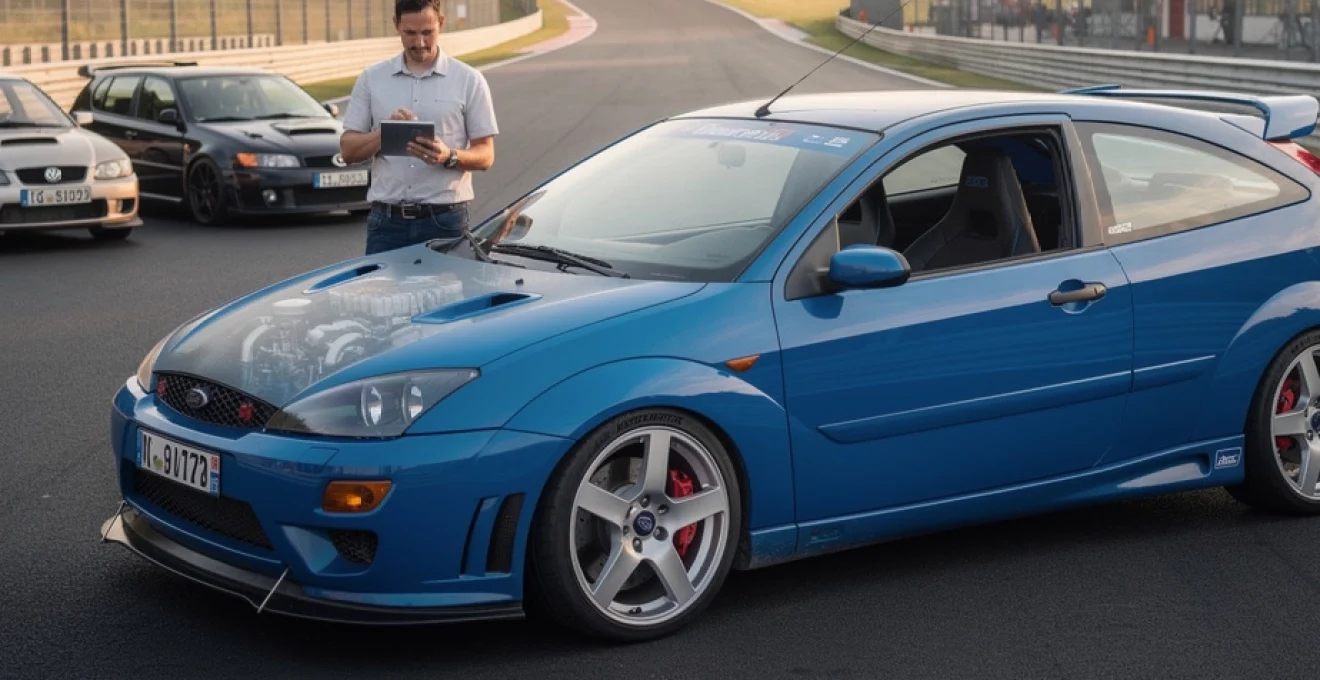
Twenty years after its debut, the 2003 Ford Focus RS remains one of the most compelling hot hatch propositions ever created. This rally-bred thoroughbred emerged from Ford’s motorsport division as a no-compromise performance machine that redefined what a front-wheel-drive hatchback could achieve. With its distinctive Imperial Blue paintwork, aggressive aerodynamic package, and motorsport-derived engineering throughout, the Focus RS established itself as a proper enthusiast’s car that continues to appreciate in value today. While modern hot hatches may offer more power and sophistication, few capture the raw, engaging character that made this Ford such a special driving experience.
Duratec RS engine architecture and performance specifications
The heart of the Focus RS lies in its heavily modified 2.0-litre Duratec engine, which underwent extensive development to transform it from a standard family car powerplant into a legitimate performance unit. Ford’s engineers essentially redesigned 70 per cent of the engine components to create a bespoke powertrain worthy of the RS badge. This comprehensive rebuild included forged connecting rods, modified pistons based on the WRC car’s design, and a completely reworked oiling system to handle the increased stresses of forced induction.
2.0-litre turbocharged Inline-Four configuration analysis
The Duratec RS engine maintains the same basic four-cylinder architecture as the standard unit but benefits from significant internal strengthening. The compression ratio was lowered to accommodate turbocharging, while the cylinder head received porting work to improve airflow characteristics. Ford retained the standard camshafts but upgraded the valve springs to handle higher RPM operation safely. The result is an engine that produces 212 horsepower at 5,500 RPM and 229 lb-ft of torque at 3,500 RPM – figures that were genuinely impressive for a front-wheel-drive hatchback in 2003.
Garrett GT17 turbocharger implementation and boost delivery
The Garrett turbocharger system represents one of the most critical components in the Focus RS’s performance equation. Unlike many contemporary hot hatches that suffered from significant turbo lag, the GT17 unit was carefully matched to the Duratec engine’s characteristics. The water-to-air intercooler system ensures consistent charge temperatures even during spirited driving, while the revised exhaust manifold optimises gas flow to the turbine wheel. This setup delivers a relatively linear power curve that makes the car accessible to drivers of varying skill levels.
Quaife automatic torque biasing differential integration
Perhaps no single component defines the Focus RS driving experience more than its Quaife automatic torque biasing differential. This sophisticated mechanical limited-slip differential actively redistributes torque between the front wheels based on available grip levels. When functioning correctly, it virtually eliminates wheelspin and provides remarkable traction out of corners. However, the system’s aggressive nature can make the car feel unsettled on uneven road surfaces, with the steering wheel occasionally fighting back against driver inputs. This characteristic behaviour separates well-maintained examples from poorly set up cars.
Power output comparison against subaru impreza WRX STI
When evaluated against its contemporary rivals like the Subaru Impreza WRX STI, the Focus RS’s 212 horsepower appears modest. The STI produced 265 horsepower and benefited from all-wheel drive traction, making it significantly faster in straight-line acceleration. However, the Focus RS’s lower weight and front-wheel-drive configuration created a more engaging driving experience on twisty roads. The car’s power-to-weight ratio of 169 horsepower per tonne delivered competitive performance while maintaining better fuel economy and lower running costs than its turbocharged all-wheel-drive competitors.
Chassis dynamics and suspension engineering
Ford’s chassis engineers completely reimagined the Focus platform to create the RS variant, implementing changes that fundamentally altered the car’s dynamic behaviour. The suspension geometry received extensive modifications to accommodate the increased performance potential while maintaining acceptable ride quality for daily use. These changes included revised mounting points
at the front, stiffer rear suspension, and a substantial increase in track width. Collectively, these upgrades turned an already capable family hatchback into one of the most focused front-wheel-drive performance cars of its era.
Macpherson strut front suspension geometry modifications
The standard Focus was already renowned for its sharp front-end response, but the RS pushed this further with significant geometry changes to its MacPherson strut layout. The front track was widened by 65mm, while bespoke aluminium hubs and revised control arms altered camber and caster to maximise tyre contact under load. Static camber was increased and roll centre heights were optimised to reduce body roll without resorting to overly stiff springs. Combined with a 25mm lower ride height, the 2003 Ford Focus RS felt far more keyed into the tarmac than its mainstream siblings, giving you the confidence to carry speed into corners that would unsettle lesser hot hatches.
These revisions did come with trade-offs. On poor road surfaces, the aggressively set-up front end can tramline and react to cambers, particularly when the Quaife differential is working hard. Owners who have had their suspension geometry checked and corrected to factory RS specs often report a dramatic improvement in stability and steering feel. If you are considering a used Focus RS today, confirming that the front-end alignment is correct is one of the most important checks you can make; a tired or misaligned chassis will mask much of the car’s latent talent.
Multi-link rear suspension setup with control blade technology
At the rear, the 2003 Ford Focus RS retained the clever multi-link Control Blade suspension that helped the standard car win so many handling awards, but virtually every key component was uprated. Stiffer springs and Sachs dampers were employed to better control vertical movement, while a more substantial anti-roll bar and firmer bushes reduced compliance. The result is a rear axle that remains impressively composed over mid-corner bumps, allowing the driver to lean on the car’s balance rather than constantly making corrections.
Compared with many rival hot hatches of the period, which relied on simpler torsion beam layouts, the Focus RS’s multi-link setup delivered superior wheel control and lateral grip. On a flowing B-road, you can feel the rear end subtly rotating to help the car turn, rather than simply following the front. This made the Focus RS feel more like a well-sorted rear-wheel-drive chassis in miniature, giving keen drivers that extra layer of adjustability on the throttle. Of course, the flip side is a firmer, more focused ride than a regular Focus, but for most enthusiasts the trade-off is well worth it.
Michelin pilot sport cup tyre compound selection
Tyres play a huge role in how any performance car behaves, and Ford worked with Michelin to develop rubber tailored to the Focus RS’s unique requirements. The original 225/40 R18 Michelin tyres offered a relatively soft compound for the time, designed to heat up quickly and generate strong lateral grip on both road and track. Paired with the wide-track suspension and aggressive alignment settings, these tyres allowed the RS to achieve cornering speeds that embarrassed more powerful machinery. They also contributed to the car’s distinctive steering feel, with a high level of feedback transmitted through the chunky three-spoke wheel.
Today, many owners upgrade to modern equivalents such as the Michelin Pilot Sport 4 or track-focused semi-slick options. While these can unlock even more performance, they also highlight why tyre choice is critical on a 2003 Ford Focus RS. A mismatched or budget tyre can exaggerate torque steer and dull the precision that makes the car so rewarding. If you are chasing the original factory feel, opting for a high-quality performance tyre with a compliant sidewall is often the closest you will get to that early-2000s Michelin development blend of grip and progressiveness.
Brembo ventilated disc brake system specifications
To cope with repeated hard use, the Focus RS was equipped with a serious braking package straight from the factory. Up front, 324mm ventilated discs were clamped by four-piston Brembo calipers, a specification more akin to contemporary sports cars than family hatchbacks. At the rear, 280mm solid discs completed the setup, integrated with ABS and electronic brakeforce distribution. On road, the result is strong initial bite and excellent fade resistance, even when you push the 2003 Ford Focus RS hard on a challenging downhill section.
Many owners and specialists still praise the RS braking system for its durability and consistency, especially compared with rival hot hatches that struggled with heat management on track. That said, after two decades it is common to find cars in need of refreshed calipers, new discs, or upgraded pads and fluid. If you plan to exploit the car’s performance regularly, investing in high-temperature brake fluid and a reputable fast-road pad compound is a wise move. This keeps pedal feel firm and consistent, ensuring that the braking performance matches the rest of the chassis.
Aerodynamic package and body modifications
Visually, the 2003 Ford Focus RS remains one of the most distinctive hot hatches of its generation, and those widened arches and deep bumpers are far more than simple cosmetic add-ons. Every major exterior panel, aside from the bonnet, doors, roof, and light units, was unique to the RS. The front bumper incorporated a larger lower intake for the water-to-air intercooler and radiator, while carefully profiled ducts channelled air to the front brakes. At the rear, an integrated bumper diffuser and roof spoiler helped tidy airflow and improve stability at motorway speeds.
Unlike many homologation-inspired cars that relied on composite panels, Ford chose to press the Focus RS’s blistered front and rear wings in steel. This decision improved structural rigidity and gave the car a reassuringly solid feel, but it has also made rust a serious concern for modern buyers. Corrosion can lurk behind the plastic sill covers and around the wheelarches, where trapped moisture and debris attack the metal from the inside out. Because replacement RS panels are no longer readily available, finding a car with clean, original bodywork is increasingly difficult—and a major factor in its long-term value.
Beyond the functional aspects, the RS bodykit struck a clever balance between aggression and subtlety. The Imperial Blue paintwork, OZ Racing 18-inch wheels, and discreet RS badging signalled intent to those in the know without resorting to outlandish wings or decals. Even today, it is a car that can fly under the radar in a supermarket car park yet draw a crowd at a track day. For many enthusiasts, that dual personality is part of the enduring appeal: you get the drama of a rally refugee without sacrificing everyday usability.
Interior cockpit layout and Driver-Focused features
Step inside a 2003 Ford Focus RS and it is immediately clear that this is no ordinary family hatchback. The most striking elements are the Sparco bucket seats, trimmed in blue and black leather and Alcantara, which provide excellent lateral support without being too extreme for daily driving. A blue-stitched Sparco steering wheel with a centre-top marker reinforces the motorsport theme, while aluminium pedals, gearknob, and handbrake handle add a purposeful, tactile feel to the key touchpoints. Despite these upgrades, the overall dashboard layout remains familiar Focus, with straightforward ergonomics and clear instrumentation.
The driver’s relationship with the controls is where the RS really shines. The gear lever operates a short-throw five-speed gearbox with bespoke ratios, giving each shift a precise, mechanical feel. The steering is weighty and communicative, particularly on smooth tarmac where the chassis feels most settled. Additional gauges integrated into the instrument cluster and centre console provide information on boost pressure and engine parameters, helping you keep an eye on the Duratec’s health when pushing on. In an era before oversized touchscreens and configurable menus, the simplicity of the RS cockpit feels refreshingly focused.
Of course, this driver-centric approach comes with some compromises by modern standards. The ride can be firm on broken urban roads, and the Sparco seats may feel narrow if you are used to more accommodating modern chairs. Cabin plastics are very much early-2000s Ford, with hard surfaces that emphasise durability over premium tactility. Yet for many owners, these quirks are part of the charm. If you are buying a 2003 Ford Focus RS today, you are not chasing the last word in refinement; you are seeking an authentic, analog driving environment that puts you at the centre of the experience.
Market performance against honda civic type R EP3 and volkswagen golf R32
When new, the 2003 Ford Focus RS found itself in a fiercely competitive hot hatch market dominated by cars such as the Honda Civic Type R EP3 and the Volkswagen Golf R32. On paper, the RS slotted neatly between its rivals: more powerful and more focused than the EP3, but lighter and more agile than the all-wheel-drive R32. The Civic Type R delivered around 197bhp from its high-revving naturally aspirated VTEC engine, while the Golf R32 boasted a 237bhp 3.2-litre VR6 and four-wheel drive. Each car offered a different interpretation of the ultimate early-2000s performance hatchback.
In period group tests, the Focus RS was often praised for its steering feel and front-end grip, areas where it could genuinely challenge or even outperform its Japanese and German rivals on the right road. However, its more specialised setup and occasionally unruly torque steer counted against it as an all-rounder. The Civic EP3, with its practical packaging and rev-hungry engine, won many buyers who wanted a usable daily driver that came alive above 5,800rpm. The Golf R32 appealed to those seeking a more premium interior and all-weather security. As a result, the RS remained the connoisseur’s choice: rarer, more intense, and arguably more rewarding when driven with commitment.
Nürburgring nordschleife lap time analysis
Direct factory-verified Nürburgring Nordschleife lap times for the 2003 Ford Focus RS are scarce, especially compared with modern hot hatches that are often developed with the ’Ring as a key benchmark. However, independent tests and owner reports suggest that, in stock form, the RS is capable of laps in the low-nine- to high-eight-minute BTG (Bridge to Gantry) range in the right hands. This puts it broadly in line with period rivals such as the Civic Type R EP3 and only marginally behind the heavier, more powerful Golf R32.
What makes the Focus RS particularly interesting on the Nordschleife is how its chassis balance and Quaife differential reward precision. On fast, flowing sections like Schwedenkreuz and Fuchsröhre, the car’s stability and strong front-end grip encourage you to maintain speed, while the LSD pulls you out of medium-speed corners like Bergwerk with surprising urgency. Unlike a modern four-wheel-drive hot hatch that flatters more modest skill levels, the RS demands concentration and mechanical sympathy. Get greedy with the throttle on bumpy exits and you will feel the steering tug in your hands—a vivid reminder that the car is working hard to put its power down.
Production numbers and collector vehicle market valuation
Ford built just 4,501 examples of the Mk1 Focus RS between late 2002 and 2003, with approximately 2,147 cars destined for the UK market. This relatively low production run, combined with the car’s motorsport-inspired engineering, has cemented its status as a modern classic. Over the last decade, values have risen steadily, particularly for low-mileage, unmodified cars with full service histories. As of 2024–2025, you can expect to pay from around £17,000 for an average example, £25,000 for a good, well-maintained car, and upwards of £35,000 for one in excellent, collector-grade condition.
The market strongly favours originality. Cars that retain their factory bodywork, interior trim, and mechanical specification tend to command a premium over heavily modified examples, even if those modifications improve outright performance. Rust-free shells are becoming increasingly rare, and documented restoration work by reputable specialists can add value rather than detract from it. If you are considering a 2003 Ford Focus RS as an investment, it pays to prioritise structural condition and history above mileage alone. In the current climate, well-kept cars are not only holding their value but, in many cases, continuing to appreciate.
Jeremy clarkson top gear review impact on sales performance
Media coverage played a significant role in shaping public perception of the Mk1 Focus RS, and few commentators were more influential than Jeremy Clarkson on Top Gear. Clarkson praised the RS for its raw pace and engaging chassis, but he was also openly critical of its wayward front axle on bumpy, twisting roads. His view that the aggressive differential made the car “too tricky” for some drivers arguably dampened mainstream enthusiasm, especially among buyers looking for a more forgiving hot hatch to use every day.
However, this slightly controversial reputation actually enhanced the car’s appeal among hardcore enthusiasts. The idea that the 2003 Ford Focus RS was a bit wild, a bit uncompromising, and not for the faint-hearted turned it into a cult hero. Subsequent coverage on Top Gear and other shows, including later series in which Chris Harris championed the RS as a future classic, further entrenched this image. In hindsight, Clarkson’s critiques helped filter the audience: those who wanted an easy, polished machine gravitated towards other models, leaving the RS to drivers who relished its quirks and demanded involvement from their car.
Comparison with renaultsport clio 172 cup specifications
No discussion of early-2000s hot hatches would be complete without mentioning the Renaultsport Clio 172 Cup, another cult favourite from the same era. On paper, the Clio Cup was a simpler, lighter proposition: a naturally aspirated 2.0-litre engine producing around 172bhp, driving the front wheels through a conventional open differential and manual gearbox. It weighed in at roughly 1,020kg, significantly less than the 1,275kg Focus RS, giving it a strong power-to-weight ratio despite its lower headline output. The Renault’s party trick was its ultra-agile chassis and playful, lift-off oversteer characteristics.
By contrast, the 2003 Ford Focus RS offered a more serious, motorsport-flavoured experience. Its turbocharged Duratec engine delivered 212bhp and 229lb-ft of torque, channelled through the Quaife differential to make the most of its wider track and more sophisticated multi-link rear suspension. Where the Clio rewarded flamboyant driving with big attitude at relatively modest speeds, the RS encouraged precision and commitment, feeling more like a scaled-down touring car or rally machine. For buyers, the choice often came down to priorities: if you wanted a lightweight, inexpensive track toy, the Clio 172 Cup was hard to beat; if you craved a more intense, homologation-style hot hatch with genuine tuning and investment potential, the Focus RS was—and remains—the more compelling option.