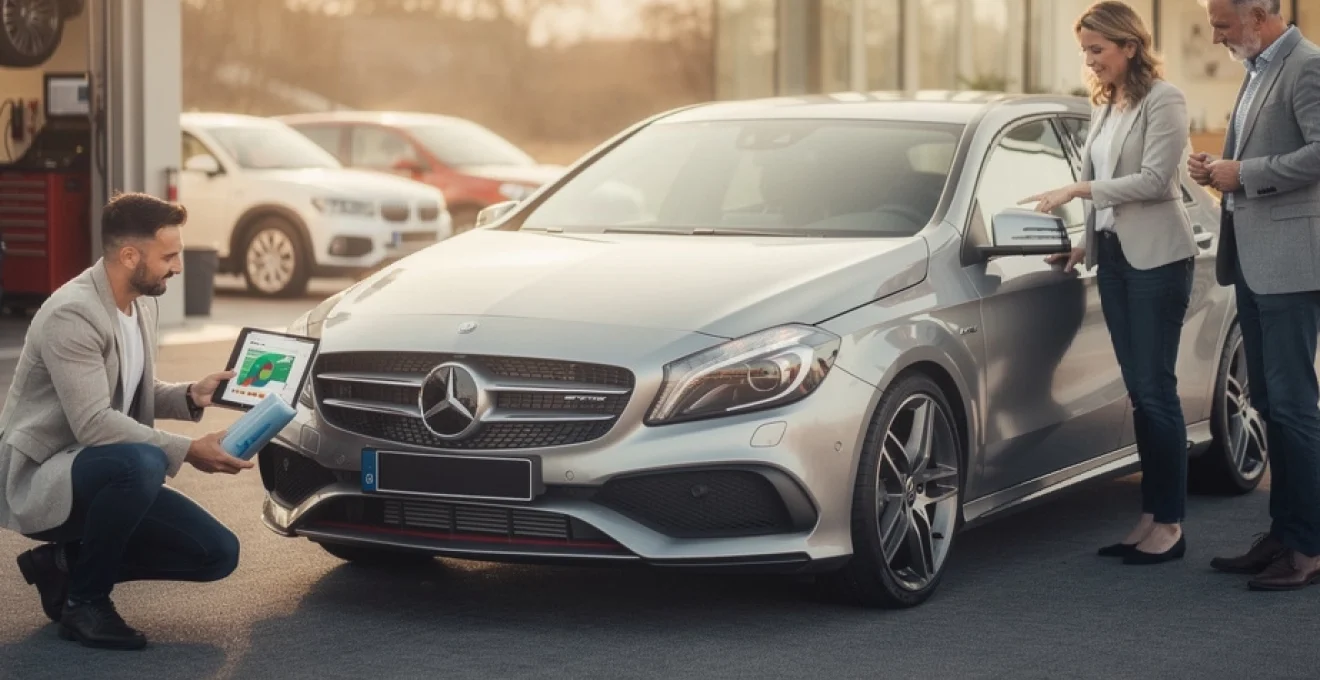
The 2017 Mercedes-Benz A-Class represents the final evolution of the W176 generation, a model that fundamentally transformed Mercedes’ approach to the premium compact segment. Seven years after its initial launch, this particular model year benefits from extensive refinements and represents a mature iteration of what was once considered a revolutionary departure from traditional Mercedes design philosophy. Understanding whether this vehicle remains a compelling proposition in today’s used car market requires examining its technical capabilities, ownership costs, and competitive positioning against both period rivals and contemporary alternatives.
The 2017 model year holds particular significance as it incorporates the most comprehensive updates applied to the W176 platform, including enhanced infotainment technology, revised suspension tuning, and improved build quality throughout. These refinements addressed many early criticisms whilst maintaining the distinctive character that made the A-Class a commercial success across European markets.
2017 Mercedes-Benz A-Class W176 generation performance analysis
The W176 generation marked Mercedes-Benz’s decisive entry into the mainstream premium hatchback segment, abandoning the previous generation’s tall, MPV-like proportions for a conventional three-box silhouette. This transformation required comprehensive re-engineering of the platform architecture, resulting in a vehicle that shared little beyond its nameplate with predecessors. The 2017 model year represents the culmination of ongoing refinements that addressed initial market feedback regarding ride quality, interior materials, and operational refinement.
Performance characteristics vary significantly across the engine range, with each powertrain offering distinct advantages depending on intended usage patterns. The platform’s fundamental engineering prioritises stability and comfort over outright handling precision, reflecting Mercedes’ interpretation of premium compact car expectations. This approach delivers measurable benefits in terms of refinement and long-distance comfort, though enthusiast drivers may find the chassis less engaging than alternatives from BMW or Audi.
A180 BlueEFFICIENCY M270 engine reliability assessment
The A180’s 1.6-litre M270 petrol engine represents Mercedes’ entry-level offering, producing 122bhp through a turbocharged four-cylinder configuration. This powertrain demonstrates generally robust reliability characteristics, with most mechanical issues arising from maintenance neglect rather than fundamental design flaws. The turbocharger system requires particular attention, as carbon build-up can affect performance if servicing intervals are extended beyond manufacturer recommendations.
Common maintenance points include regular oil changes using approved viscosity grades, timely replacement of the air filter element, and periodic inspection of the intercooler system for leaks. The M270 engine responds well to premium fuel usage, showing measurable improvements in refinement and economy when using higher octane petrol. Expected maintenance costs align with Mercedes’ premium positioning, though independent specialists can provide more economical servicing options for vehicles outside warranty coverage.
A200 CDI OM607 diesel powertrain longevity evaluation
The A200 CDI utilises Mercedes’ OM607 2.1-litre diesel engine, delivering 136bhp with exceptional fuel economy potential. This powertrain demonstrates particular strength in long-distance applications, where the diesel’s torque characteristics and efficiency advantages become most apparent. However, the engine requires careful maintenance attention, particularly regarding the diesel particulate filter system and exhaust gas recirculation components.
Reliability concerns centre around the DPF regeneration process, which requires regular motorway driving to complete successfully. Urban-only usage patterns can lead to DPF blockages, resulting in expensive remedial work. The fuel injection system demands high-quality diesel fuel and regular filter replacement to maintain optimal performance. AdBlue consumption adds ongoing running costs, though the system proves generally reliable when properly maintained.
A250 sport 4MATIC All-Wheel drive system durability
The A250 Sport 4MATIC represents the performance flagship of the standard A-Class range, combining a 218bhp 2.0-litre turbocharged engine with Mercedes’ all-wheel drive technology. The 4MATIC system employs an electronically-controlled multi-plate clutch to distribute torque between front and rear axles, providing enhanced traction without significant fuel economy penalties during normal driving conditions.
Long-term durability proves excellent when maintenance schedules are
Long-term durability proves excellent when maintenance schedules are followed, particularly regarding fluid changes for the rear differential and haldex-style coupling. Owners who regularly neglect these items may experience premature wear in the 4MATIC coupling, typically evidenced by vibration or inconsistent torque transfer under heavy acceleration. Suspension components on A250 Sport 4MATIC models, especially on cars fitted with larger 18‑ or 19‑inch wheels, can also show accelerated wear on poor road surfaces. That said, when properly maintained and driven with mechanical sympathy, the A250 Sport 4MATIC powertrain and all-wheel drive hardware are capable of covering high mileages with few major issues. For buyers seeking a used 2017 Mercedes A‑Class with genuine all-weather capability, this variant remains one of the more robust and confidence-inspiring choices.
7G-DCT Dual-Clutch transmission common issues and maintenance costs
The 7G-DCT dual-clutch transmission is central to the driving experience in many 2017 Mercedes-Benz A-Class models, particularly those sold in Western Europe and the UK. Unlike a traditional torque-converter automatic, the 7G-DCT uses two clutches to pre-select gears, allowing for faster shifts and improved fuel economy. In everyday use, this gearbox is generally smooth and responsive once up to temperature, but low-speed manoeuvring can feel hesitant or jerky, especially on early W176 examples. Prospective owners should view this behaviour as characteristic rather than automatically indicative of a fault, although a test drive in mixed conditions is essential to establish a baseline.
Common issues with the 7G-DCT in the 2017 A-Class include mechatronic unit faults, clutch pack wear, and occasional software glitches affecting shift quality. Symptoms can range from delayed engagement when selecting Drive or Reverse, to harsh upshifts, unexpected downshifts, or transmission warning lights. In some cases, a software update from Mercedes-Benz can significantly improve drivability, particularly in stop-start urban traffic. Where physical components have deteriorated, however, repairs can become expensive, highlighting the importance of documented transmission servicing in the vehicle’s maintenance history.
From a maintenance perspective, Mercedes originally promoted the 7G-DCT as a low-maintenance unit, but real-world experience suggests that regular fluid and filter changes are beneficial. Independent specialists commonly recommend an oil change every 40,000 to 60,000 miles, even if the official service schedule appears more relaxed. The cost of a 7G-DCT service at a main dealer typically ranges from £350 to £550 in the UK, while reputable independents can often complete the same work for 20–30% less. Considering the potential cost of a full transmission overhaul, which can exceed £2,500, this periodic servicing represents sensible preventative maintenance.
Buyers evaluating a used 2017 Mercedes A-Class with the 7G-DCT should pay close attention during the test drive to low-speed performance, hill starts, and stop-start traffic behaviour. Any grinding noises, strong vibrations under acceleration, or persistent warning messages warrant a professional diagnostic before purchase. When treated correctly, the dual-clutch transmission can offer many years of reliable service, but neglect quickly erodes its advantages. If you prefer a simpler ownership experience and anticipate mostly city driving, choosing a car that has clear evidence of regular gearbox servicing is arguably just as important as your choice of engine.
Current market positioning against contemporary premium hatchback rivals
Positioning the 2017 Mercedes-Benz A-Class in today’s used market means viewing it alongside both its original rivals and newer premium hatchbacks. Values have softened considerably since new, bringing well-specified examples into the same price bracket as more modestly equipped mainstream cars. This depreciation makes the A-Class attractive to buyers seeking an entry point into Mercedes ownership, but also raises important questions about long-term running costs and residual value. How does a seven-year-old A-Class now compare to equivalent BMW, Audi, Volkswagen, and MINI offerings in terms of total value?
Overall, the 2017 A-Class W176 still trades strongly on badge appeal and interior design, particularly in facelift form with the improved infotainment system. However, it can no longer claim a clear advantage in technology or efficiency over newer rivals, many of which offer more advanced driver assistance systems and cleaner engines. Instead, its current strength lies in offering a relatively affordable route into the premium segment, with an established servicing network and abundant independent specialist support. For buyers willing to accept slightly older technology in exchange for a lower entry price, the A-Class continues to represent a compelling proposition.
BMW 1 series F20 vs A-Class W176 depreciation comparison
The BMW 1 Series F20 is the most direct competitor to the 2017 Mercedes A-Class, particularly in markets where rear-wheel-drive dynamics historically attracted enthusiast buyers. In depreciation terms, both models have experienced similar percentage drops from their original list prices, though regional variations exist depending on engine and trim popularity. In the UK, for example, a well-maintained 2017 A180 or A200 often commands slightly higher asking prices than an equivalent 118i or 120d, reflecting Mercedes’ strong brand perception among private buyers. Fleet and company-car markets can skew this picture, but private sales data consistently shows a small premium in favour of the A-Class.
However, headline asking prices do not tell the entire story of depreciation and ownership value. The BMW 1 Series can sometimes be cheaper to insure and maintain, particularly on models equipped with simpler wheel and suspension combinations. Over a three-year ownership period from 2024 to 2027, it’s common to see the remaining value of both the F20 1 Series and W176 A-Class converge, especially once mileage climbs beyond 80,000. In other words, while you might pay slightly more upfront for a 2017 Mercedes A-Class, the gap in residual value compared with the BMW tends to narrow as both cars age.
Driving enthusiasts often lean towards the 1 Series due to its more engaging chassis and steering feel, which can indirectly influence depreciation by attracting a different type of buyer on the used market. Yet for many purchasers prioritising comfort, interior ambience, and perceived prestige, the A-Class retains a desirability advantage that helps support its used prices. When considering depreciation alone, the difference between the two is small enough that condition, service history, and specification should play a bigger role in your decision. Ultimately, choosing between the 2017 A-Class and the F20 1 Series comes down to personal priorities more than any clear financial winner.
Audi A3 sportback 8V ownership cost analysis
The Audi A3 Sportback 8V presents perhaps the most balanced alternative to the 2017 Mercedes-Benz A-Class, combining solid residual values with strong perceived quality. In terms of ownership costs, the A3 tends to offer slightly lower routine servicing prices at independent workshops, largely due to the ubiquity of Volkswagen Group components and procedures. Parts availability is excellent, and many wear items such as brakes and suspension components are competitively priced compared with their Mercedes equivalents. For a buyer seeking predictable running costs on a premium hatchback, the A3 8V remains one of the most appealing options.
Fuel economy comparisons between the A3 and A-Class depend heavily on engine choice, but like-for-like diesel and petrol engines are broadly similar in real-world consumption. Where the Audi can pull ahead is in the perceived robustness of its interior materials and slightly better suppression of wind and road noise at motorway speeds. Over a three-year ownership window from 2024 to 2027, this can translate into lower perceived ageing, helping the A3 feel fresher for longer. That said, the A-Class counters with a more distinctive interior design and, on many 2017 models, better standard equipment.
Insurance groups for equivalent A3 and A-Class models are usually comparable, although sporty S line trims and larger wheels can increase premiums on both sides. Where costs can diverge is in major out-of-warranty repairs: some Audi engines and S tronic gearboxes have known issues that can be very expensive to rectify if they arise. The 2017 A-Class is not immune to such risks, particularly with the 7G-DCT transmission, but neither car holds a decisive advantage in long-term reliability. If you value a conservative, solid feel and slightly stronger perceived build quality, the A3 may edge ahead; if design flair and brand appeal matter more, the A-Class justifies its similar ownership costs.
Volkswagen golf GTI mk7 performance value proposition
Comparing the 2017 Mercedes A-Class with the Volkswagen Golf GTI Mk7 might seem unusual at first glance, but many buyers cross-shop these models when considering a used premium hatchback. The Golf GTI focuses squarely on driver engagement and performance, offering a sharper chassis and more playful character than most A-Class variants short of the AMG A45. From a value perspective, used GTI prices often overlap with higher-spec A-Class trims such as the A250 Sport, especially when mileage and condition align. This raises an interesting question: do you prioritise outright performance, or the broader brand image and comfort-oriented philosophy of the A-Class?
On running costs, the Golf GTI can be surprisingly competitive despite its performance focus. Real-world fuel economy for a gently driven GTI can rival that of an A250, and service pricing at independent Volkswagen specialists is often more affordable than equivalent Mercedes maintenance. Where the GTI may incur higher costs is in consumables such as performance tyres and brakes, especially if the car has been driven enthusiastically or used on track days. As with any performance-oriented used car, a thorough inspection is vital to avoid inheriting hidden wear.
In terms of day-to-day usability, the GTI offers a more compliant ride than early W176 A-Class models, yet still manages to feel more agile on a twisty road. Interior quality is high, if more understated than the Mercedes, and infotainment technology on later Mk7.5 models compares well with the A-Class COMAND system. If you are choosing between a 2017 A-Class and a Golf GTI purely on performance value, the GTI arguably delivers more excitement per pound. However, the Mercedes counters with superior perceived prestige and a broader range of engine options, which can better suit buyers prioritising comfort and efficiency over pure speed.
MINI cooper S F56 premium features benchmark
The MINI Cooper S F56 occupies a slightly different niche to the 2017 Mercedes-Benz A-Class, but it remains a popular alternative for buyers seeking a premium compact car with character. Compared with the A-Class, the Cooper S is smaller and more overtly styled, prioritising fun and individuality over outright practicality. Nevertheless, in higher trim levels, the MINI offers a generous standard specification, including advanced infotainment features, quality upholstery options, and customisation packages that rival the A-Class for perceived luxury. When you consider a used MINI Cooper S beside a 2017 A-Class, you are effectively choosing between two distinct interpretations of the premium compact brief.
From a cost perspective, the MINI can be more affordable to buy initially, particularly if you are open to three-door models or those with more modest option packages. However, heavily optioned Cooper S examples can reach price parity with mid- to high-spec A-Class cars, reflecting their desirability among style-conscious buyers. Routine servicing and parts pricing are generally similar between the two brands, though independent MINI specialists are widely available and can help keep ownership costs under control. As with the A-Class, ensuring a complete service history is crucial, particularly for turbocharged petrol engines that can be sensitive to oil change intervals.
Where the MINI Cooper S clearly diverges is in driving dynamics and interior packaging. The Cooper S offers sharp, go-kart-like handling that many drivers find addictive, but rear-seat space and boot capacity lag behind the A-Class. If you regularly carry passengers or luggage, the Mercedes will feel like the more grown-up, versatile option. Conversely, if you prioritise enjoyment and distinctive design over outright practicality, the MINI delivers a premium experience that can match or even surpass the emotional appeal of the 2017 A-Class. In either case, both cars demonstrate that the premium hatchback segment is about more than simple transport—it is about how you want to feel every time you drive.
Pre-owned A-Class W176 technical inspection points
Evaluating a pre-owned 2017 Mercedes-Benz A-Class requires a structured inspection approach, particularly as many examples now approach or exceed 70,000–100,000 miles. Mechanical checks should begin with the engine, focusing on cold starting behaviour, idle stability, and any smoke from the exhaust. On petrol M270 engines, listen for timing chain noise on start-up and check for oil leaks around the valve cover and turbocharger lines. Diesel OM607 units deserve close attention to the diesel particulate filter and EGR system, especially if the car has predominantly low-mileage, urban usage in its service history.
During the test drive, transmission performance should be scrutinised, particularly on cars fitted with the 7G-DCT dual-clutch gearbox. Hesitation engaging Drive, jerky low-speed shifts, or warning messages on the instrument cluster are all red flags that warrant further diagnosis. Manual gearboxes, while less complex, should shift smoothly without crunching, and the clutch should bite consistently without excessive pedal travel. Regardless of transmission type, any unusual drivetrain vibration under acceleration may indicate worn engine mounts, driveshaft issues, or problems with the 4MATIC coupling on all-wheel-drive variants.
Suspension and steering components are another critical area in a used 2017 A-Class, given the firm factory setup and the prevalence of larger alloy wheels. Listen for knocking noises over speed bumps, which could signal worn drop links, dampers, or top mounts. Excessive tyre wear on the inner or outer shoulders may suggest alignment issues or tired suspension bushes, both of which can impact the car’s stable, secure road manners. On the steering side, ensure there is no excessive play or groaning from the electric power steering system when turning at low speeds.
Electrical and interior systems also deserve careful attention, as the W176 platform incorporates a substantial amount of electronic control units. Test all major functions, including the COMAND infotainment system, Bluetooth connectivity, climate control, and any optional features such as heated seats or panoramic roof blinds. Intermittent faults can be harder to detect, so it’s wise to cycle through menus and settings during the test drive to spot any glitches or slow responses. Pay particular attention to warning lights related to airbags, ABS, or stability control; resolving these can be costly if sensor faults or wiring issues are involved.
Externally, a thorough bodywork inspection can reveal past accident repairs or paintwork imperfections. Look for inconsistent panel gaps, overspray in door shuts, and mismatched paint texture between panels. Rust is not a widespread problem on the 2017 A-Class, but stone chips on the bonnet and front bumper can expose metal over time if left untreated. Finally, verify that all factory recalls and software updates have been completed by checking the service history and, if possible, confirming with a Mercedes-Benz dealer. A comprehensive pre-purchase inspection by a marque specialist can provide additional peace of mind, particularly on higher-mileage or performance-oriented variants.
Mercedes-benz COMAND APS infotainment system technology assessment
The COMAND APS infotainment system fitted to the 2017 Mercedes-Benz A-Class represents a transitional stage in Mercedes’ digital strategy, sitting between earlier basic displays and the later widescreen MBUX interface. In the W176 A-Class, COMAND typically appears as a tablet-style screen mounted prominently on the dashboard, controlled via a rotary dial and supplementary buttons on the centre console. While its graphics and menu layouts now appear dated compared with more recent systems, COMAND still delivers a coherent, feature-rich experience when properly configured. For many buyers, the presence of integrated navigation, Bluetooth streaming, and smartphone mirroring remains more important than cutting-edge visuals.
From a usability standpoint, the 2017 COMAND interface benefits from incremental software refinements introduced during the W176 lifecycle. Menu structures are relatively logical, and key functions such as audio source selection, navigation input, and telephone pairing are never more than a few steps away. Voice control capability is available on many models, though its recognition accuracy can lag behind the latest voice-assistant platforms. Some owners find that Apple CarPlay and Android Auto integration partially offset these limitations, allowing them to rely on familiar smartphone-based apps for navigation and media playback.
In terms of connectivity, later 2017 A-Class examples often support both USB and Bluetooth audio streaming, as well as hands-free calling with phonebook access. However, not all vehicles will be equipped with the full suite of COMAND options, as certain features originally formed part of expensive option packages. When viewing a used car, it is therefore wise to test specific functions that matter to you—such as DAB radio, live traffic updates, or smartphone mirroring—rather than assuming all cars share the same specification. Software updates released during the W176’s lifecycle can also improve performance or add minor enhancements, so checking that these have been applied is a sensible step.
Long-term reliability of the COMAND APS system in the 2017 Mercedes A-Class is generally good, but a few weaknesses are worth noting. Screen failures, dead pixels, or intermittent blank displays can occur, particularly on cars exposed to extreme temperature variations or prolonged direct sunlight. Control knobs and buttons can wear, leading to inconsistent inputs or sticky operation, though replacements are available through both Mercedes dealers and aftermarket suppliers. More serious issues, such as head unit failures or corrupted software, can be expensive to resolve if out of warranty, underscoring the value of an extended warranty or specialist repair services.
When assessing whether the 2017 A-Class infotainment still meets your expectations, it helps to think of COMAND APS as a solid, reliable operating system rather than a cutting-edge piece of consumer tech. It may not dazzles with ultra-high-resolution graphics or over-the-air updates, but it integrates cleanly with the vehicle, offers consistent performance, and supports the most important everyday functions. If your priority is a seamless smartphone-centric experience, you may prefer to rely on Apple CarPlay or Android Auto for navigation and media while using COMAND for core vehicle settings. For many used buyers, this hybrid approach offers the best of both worlds: modern app functionality sitting on top of Mercedes’ proven in-car platform.
2017 model year specific updates and factory recall history
The 2017 model year marked the final phase of the W176 A-Class lifecycle, and as such it benefitted from numerous incremental refinements introduced after the 2015 facelift. Suspension tuning was subtly revised to address criticisms of the early car’s overly firm ride, particularly on smaller-engine variants with comfort-oriented setups. Interior trim quality also saw quiet improvements, including better fitting of dashboard components and more robust switchgear. In practical terms, this means that a 2017 Mercedes A-Class often feels more solid and refined than earlier examples, even when mileage is similar.
Equipment-wise, 2017 models frequently gained enhanced standard features compared with their predecessors, depending on market and trim level. Many cars received larger infotainment screens, improved smartphone integration, and additional driver assistance options as standard or as part of more attractive option packages. Features such as reversing cameras, cruise control, and automatic wipers became increasingly common, making 2017 examples appealing to buyers who want a well-specified car without delving deeply into the options list. As a result, the 2017 model year can represent a sweet spot in the W176 range, offering late-life improvements without the higher purchase price of the succeeding generation.
Regarding factory recalls, the W176 A-Class, including the 2017 model year, was subject to several campaigns addressing safety and reliability concerns. These have included issues related to airbag deployment systems, steering components, and software updates for various control units. Not every individual car will have been affected by every recall, as applicability depends on production date, engine type, and specific option combinations. The positive aspect is that Mercedes-Benz typically addresses such issues promptly, and most cars will have had remedial work completed at no cost to the owner if serviced within the dealer network.
For a prospective buyer in 2024, confirming recall completion is a vital step in assessing a used 2017 A-Class. Dealers can check a vehicle’s VIN (Vehicle Identification Number) against the Mercedes-Benz database to verify whether all outstanding campaigns have been carried out. It’s helpful to think of this process as a health check for known factory issues, much like updating the operating system on a smartphone to patch security vulnerabilities. Ensuring that these corrections have been applied not only improves safety but can also prevent future reliability headaches that might otherwise appear without warning.
In summary, the 2017 model year stands out within the W176 generation for its maturity and completeness. Revised suspension tuning, subtle quality improvements, and a richer standard equipment list contribute to a more satisfying ownership experience overall. When combined with a clean recall history and thorough servicing records, a late W176 A-Class can offer much of the refinement and technology buyers expect from a modern Mercedes at a fraction of the original cost. For many, this blend of updated engineering and attractive pricing is what makes the 2017 A-Class such a compelling used purchase.
Total cost of ownership projection for 2024-2027 period
Projecting the total cost of ownership for a 2017 Mercedes-Benz A-Class from 2024 to 2027 involves considering depreciation, servicing, repairs, fuel, insurance, and tax. By this point, most 2017 models will be between seven and ten years old, meaning the steepest part of the depreciation curve is already behind them. Over the next three years, you can typically expect a steady but manageable decline in value, particularly if mileage is kept reasonable and maintenance is up to date. In practical terms, a well-bought A-Class today should still retain a useful proportion of its purchase price by 2027, especially if you choose a desirable specification and keep it in good condition.
Running costs for a 2017 A-Class will vary by engine and usage pattern, but some broad estimates can help you budget. Annual servicing at a main dealer often falls between £350 and £600, depending on whether a minor or major service is due and whether items like brake fluid or air conditioning re-gassing are included. Independent Mercedes specialists can usually trim these figures by 20–30% without compromising on quality, which is worth considering if the car is already out of warranty. Over a three-year period, allowing for two or three services plus routine consumables such as tyres, brakes, and wiper blades is a realistic approach.
Fuel costs depend heavily on your choice between petrol and diesel, as well as your driving habits. A diesel A200 CDI driven mostly on motorways can return real-world figures approaching 55–60mpg, making it a strong candidate for high-mileage drivers. Petrol A180 and A200 models typically average in the mid-40s mpg in mixed driving, while the A250 Sport can dip into the 30s if driven enthusiastically. Insurance premiums for a 2017 A-Class are moderate for a premium hatchback, with lower-powered models sitting in relatively accessible groups; however, younger drivers or those with limited no-claims history should obtain quotes before committing.
When planning for total cost of ownership, it’s prudent to set aside a contingency fund for unexpected repairs, particularly given the complexity of modern cars like the A-Class. Items such as the 7G-DCT gearbox, turbochargers, and advanced electronics are generally reliable but can be expensive to repair if they fail outside warranty. Allocating a notional £500–£800 per year for unforeseen expenses provides a safety margin, even if most owners will not need to spend this every year. Think of this as a form of self-insurance, giving you peace of mind that, should something go wrong, it won’t derail your overall running-cost budget.
Adding these elements together—depreciation, servicing, consumables, fuel, insurance, tax, and contingencies—a typical 2017 Mercedes A-Class owner in the 2024–2027 period might expect an annual total cost somewhere between £3,000 and £4,500, depending on mileage and engine choice. While this is higher than for some mainstream hatchbacks, it remains competitive within the premium segment, particularly when you factor in comfort, safety, and brand image. If you approach the purchase with a clear understanding of these costs, insist on a strong service and recall history, and consider an independent pre-purchase inspection, the 2017 A-Class can still be a rational, enjoyable, and financially manageable choice in the used market.