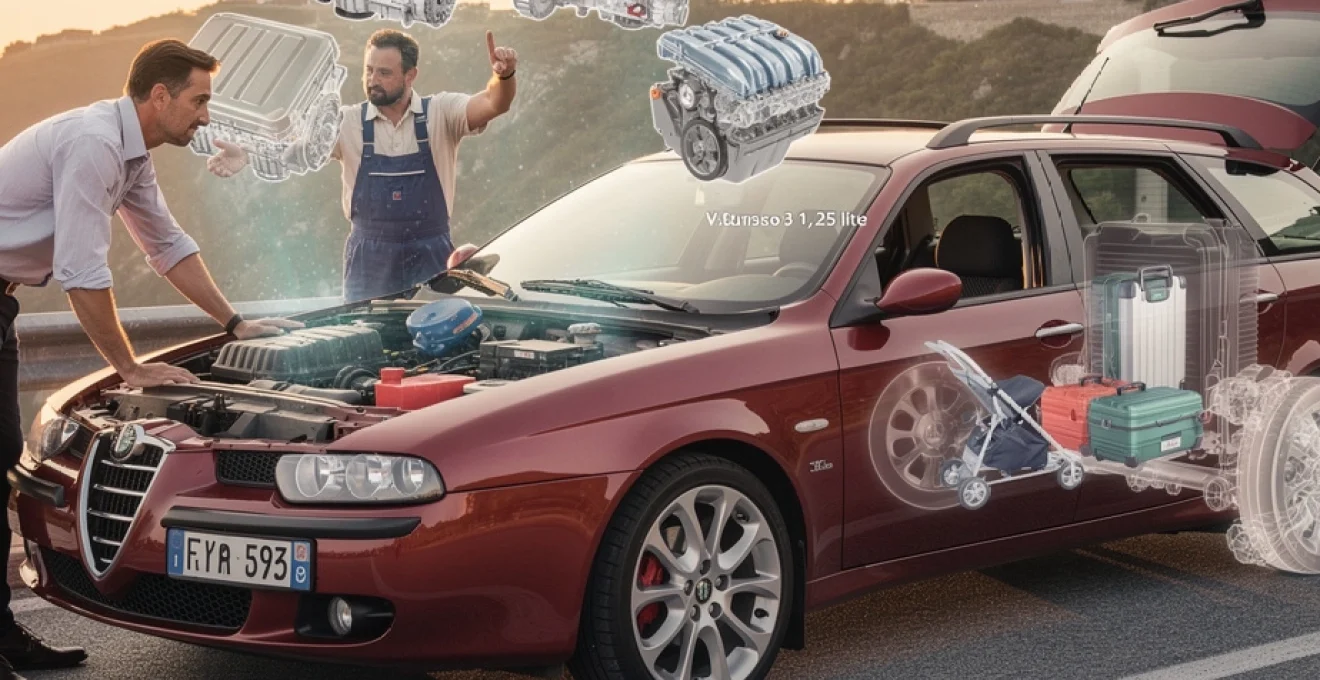
The Alfa Romeo 156 Sportwagon represents a fascinating chapter in automotive history, when Italian marques dared to challenge the German establishment with style, passion, and an engaging driving experience wrapped in practical bodywork. Launched in 2000 as the estate variant of the critically acclaimed 156 sedan, this wagon managed to combine genuine load-carrying capability with the kind of characterful performance that made enthusiasts forget they were driving a family hauler. With its distinctive Walter da Silva-influenced styling, throaty engine options including the legendary Busso V6, and a chassis that prioritized driver engagement over clinical perfection, the 156 Sportwagon carved out a unique niche in the executive estate segment. Today, as these Italian wagons become eligible for classic car import to markets like the United States under the 25-year rule, they’re experiencing a renaissance among collectors who appreciate their rarity, exclusivity, and the sheer visceral pleasure they deliver.
Twin spark and JTS engine architecture: power units behind the 156 sportwagon
The Alfa Romeo 156 Sportwagon offered a diverse powertrain lineup that ranged from economical four-cylinder units to the gloriously sonorous V6 options. Each engine reflected Alfa Romeo’s commitment to delivering spirited performance, even in their most practical models. Understanding the technical nuances of these powerplants is essential for anyone considering ownership of this Italian estate, as each variant offers distinctly different characteristics in terms of performance, running costs, and long-term reliability.
1.6 and 1.8 twin spark 16V naturally aspirated variants
The entry-level Twin Spark engines represented Alfa Romeo’s bread-and-butter powerplants throughout the 156’s production run. The 1.6-litre Twin Spark unit produced a respectable 118 bhp, making it the most economical choice for those prioritizing fuel consumption over outright performance. Despite its modest displacement, the engine featured dual spark plugs per cylinder—hence the Twin Spark designation—which improved combustion efficiency and throttle response. The 1.8-litre variant delivered 138 bhp and offered a more satisfying performance envelope without significantly compromising economy. Both engines utilized Fiat’s established architecture with double overhead camshafts and variable valve timing on the inlet side. While these units lacked the charisma of the V6 options, they provided adequate performance for everyday driving and were considerably cheaper to maintain, with parts availability remaining strong due to their widespread use across multiple Fiat Group models throughout the late 1990s and early 2000s.
2.0 JTS direct injection petrol technology
Introduced during the 2003 facelift, the 2.0 JTS (Jet Thrust Stoichiometric) engine represented Alfa Romeo’s foray into direct fuel injection technology. This 165 bhp powerplant replaced the earlier 2.0 Twin Spark and utilized a sophisticated injection system that sprayed fuel directly into the combustion chambers rather than the intake manifold. The technology promised improved fuel atomization, better combustion efficiency, and enhanced performance characteristics across the rev range. In practice, the JTS delivered stronger mid-range torque and a slightly more refined power delivery compared to its Twin Spark predecessor. However, the direct injection system introduced additional complexity and potential maintenance concerns, particularly regarding carbon buildup on intake valves—a common issue with early direct injection designs. The JTS engine required premium fuel to deliver its advertised performance figures and could prove somewhat thirsty when driven enthusiastically, making it a middle-ground option between the economical smaller Twin Sparks and the thirsty but charismatic V6 units.
2.4 JTD multijet common rail diesel performance
For buyers prioritizing torque delivery and fuel economy, Alfa Romeo offered the innovative 2.4 JTD five-cylinder diesel engine. This unique powerplant produced 172 bhp and delivered substantial mid-range punch that made the Sportwagon feel genuinely brisk in real-world driving conditions. The five-cylinder configuration was relatively rare in the diesel segment, giving the engine a distinctive character that differentiated it from the ubiquit
ous four-cylinder units used by German rivals. Thanks to common rail Multijet technology, the 2.4 JTD combined strong performance with impressive long-distance efficiency, often returning over 40 mpg on European combined cycles when driven sensibly. In the context of an Alfa Romeo 156 Sportwagon, this meant you could load the car with family, luggage, and still enjoy muscular in-gear acceleration that made overtakes effortless. As with any older diesel, buyers today should pay attention to turbocharger condition, injector health, and evidence of regular oil changes, but a well-maintained 2.4 JTD can easily cover starship mileages without complaint.
3.2 V6 busso engine: the flagship powertrain
Sitting at the very top of the 156 Sportwagon range was the legendary 3.2-litre Busso V6, most famously deployed in the 156 GTA. This naturally aspirated masterpiece produced around 247 bhp and is widely regarded as one of the finest-sounding production engines ever built, with polished induction runners and a hard-edged howl that transforms even a mundane commute into an event. In the Sportwagon, the 3.2 V6 turned Alfa’s estate into a genuine performance car, capable of sprinting from 0–60 mph in a little over six seconds, despite sending all its power to the front wheels. Unsurprisingly, fuel economy is not its strong suit, but for many enthusiasts the aural drama and throttle response more than justify the running costs.
From an engineering standpoint, the Busso V6 in the 156 retained its classic 60-degree bank angle, aluminium cylinder heads, and robust iron block architecture. It used variable inlet geometry and carefully tuned cam profiles to deliver both low-end flexibility and a rousing top-end surge, making it feel alive across the rev range. For would-be owners, staying on top of cambelt changes, water pump replacements, and high-quality lubricants is non-negotiable, as neglect can quickly turn this jewel of an engine into a very expensive paperweight. Yet when properly maintained, the 3.2 V6 is remarkably durable, and its charismatic nature is a huge part of why V6-powered 156 Sportwagons are increasingly seen as future classics.
Type 932 platform engineering and chassis dynamics
Beneath the seductive sheet metal, every Alfa Romeo 156 Sportwagon sits on the Type 932 platform, a front-wheel-drive architecture that blended mainstream practicality with unexpectedly sophisticated suspension engineering. Rather than chasing ultimate lap times, Alfa’s chassis team aimed to deliver a car that felt alive at normal road speeds, prioritising steering feel and mid-corner balance. The result was a wagon that could genuinely entertain on a twisting B-road while still coping with family duties, a balance that many modern crossovers struggle to achieve. If you’re wondering why so many enthusiasts still talk fondly about the way a 156 drives, the 932 platform is the answer.
Macpherson strut front suspension geometry
At the front, the Alfa Romeo 156 Sportwagon employed a variation of the MacPherson strut suspension layout, optimised for sharp turn-in and consistent tyre contact. While the basic concept is common, Alfa’s engineers paid particular attention to geometry, using carefully chosen steering axis inclination and caster to deliver that trademark responsive front end. Compared with many contemporary estates, the 156 Sportwagon feels more eager to change direction, almost like a hot hatch in disguise. This is one of the reasons why even the diesel and smaller Twin Spark versions still have a reputation for being fun to drive.
Of course, this agility comes with trade-offs. The front suspension bushes and lower wishbones work hard, especially on rough roads, and tend to wear faster than on more comfort-biased rivals. When components are tired, the crisp steering and precise geometry that define the Sportwagon can degrade into vague response and clunks over bumps. For buyers today, budgeting for a refresh of the front suspension—using high-quality parts rather than the cheapest available—is one of the best ways to restore the original handling magic. Think of it like replacing worn trainers before a marathon; the body is capable, but it needs the right support underneath.
Multi-link rear axle configuration and anti-roll bar setup
At the rear, the 156 Sportwagon uses a sophisticated multi-link axle design rather than a simple torsion beam, a decision that reflects Alfa’s commitment to driver engagement even in its estate models. This layout allows engineers to separately control camber, toe, and wheel travel, helping the car maintain stability under braking and composure over uneven surfaces. When you lean on the car through a long bend, the rear end offers reassuring support rather than the nervousness that can plague less advanced designs. Combined with a well-tuned anti-roll bar setup, the 156 Sportwagon strikes a satisfying balance between body control and ride comfort.
For owners who like to tinker, there is also scope to subtly improve handling with updated bushes or slightly firmer dampers, though going too stiff can upset the car’s inherently fluid character. Over time, rear suspension arms and bushes can suffer from the same wear issues as the front, leading to imprecise tracking or inner tyre wear. Before buying any used 156 Sportwagon, it’s worth having the rear underside inspected on a lift, checking for corrosion around suspension mounting points and perished bushes. With everything in good condition and a proper four-wheel alignment, the car rewards you with a planted, confidence-inspiring feel that’s rare in older estates.
Q2 electronic limited-slip differential integration
To help tame torque and improve traction, later and higher-powered versions of the Alfa Romeo 156 line-up could be equipped with Alfa’s Q2 system, an electronic limited-slip differential concept that worked alongside the traction control. Although not as mechanically pure as a dedicated clutch-type LSD, Q2 used the ABS and stability systems to brake a slipping inner wheel and redirect torque to the wheel with more grip. On twisty roads or in wet conditions, this meant the front-drive 156 could put its power down more effectively, especially in torquey diesel or V6 configurations. For an enthusiast, this translates into less wheelspin and more faithful responses when you push out of tight corners.
In everyday driving, Q2 operates in the background, and many drivers only become aware of its presence when they feel the car clawing forward instead of spinning away precious acceleration. It’s a bit like having an invisible co-driver gently modulating the front wheels to keep everything tidy. When shopping for a used Alfa Romeo 156 Sportwagon, it’s worth checking exactly which drivetrain and electronic systems are fitted, as not all cars share the same specification level. While retrofitting a mechanical limited-slip differential is possible for hardcore enthusiasts, Q2-equipped cars often provide enough traction aid for spirited road use without major modifications.
Steering rack ratio and variable assist systems
Ask any Alfisti what makes the 156 special, and the steering feel will come up within the first minute. The Sportwagon’s steering rack was relatively quick by the standards of the late 1990s and early 2000s, requiring fewer turns lock-to-lock than many of its estate rivals. This fast ratio gave the car a nimble, alert character, encouraging you to place it precisely on the road and adjust line with small inputs. Power assistance was tuned to be lighter at parking speeds yet weight up naturally as speeds increased, giving the driver a sense of connection that many modern electric systems struggle to replicate.
Over time, however, leaks from power steering hoses and pumps can dull that precision and introduce noise or heaviness. Some replacement hoses are no longer available directly from Alfa Romeo, but hydraulic specialists can fabricate new lines using the original fittings, so a leaking system is not a death sentence for ownership. When properly maintained, the steering system remains one of the Alfa Romeo 156 Sportwagon’s defining strengths, turning mundane school runs into opportunities to enjoy its unique character. If you’re test driving a candidate car, pay close attention to steering feel: does it respond cleanly off-centre, or is there play and inconsistency? The answer will tell you a lot about the car’s underlying health.
Giugiaro design language: exterior styling and aerodynamic features
Although the original 156 shape was largely credited to Walter de Silva and Alfa’s Centro Stile, the later facelifted models—many of which underpin the 156 Sportwagon market today—were influenced by Giorgetto Giugiaro’s Italdesign studio. The estate body retained the saloon’s distinctive pointed nose and offset number plate, but added a beautifully tapered rear section that sacrificed a little outright volume in favour of sleek proportions. With its hidden rear door handles, the 156 still looks more like a sporting coupe than a conventional wagon, a visual trick that helps explain why it continues to age so gracefully. Park one next to a contemporary German estate and you’ll see how much more drama the Alfa brings to everyday motoring.
Aerodynamically, the 156 Sportwagon was designed to balance stability, low wind noise, and cooling for its range of engines. The sculpted front bumper and integrated grille direct airflow efficiently into the radiator and around the sides of the car, while the gently sloping roofline and rear spoiler lip help reduce turbulence at the tail. This attention to airflow not only contributed to respectable fuel economy figures for the era, but also to the car’s stable high-speed behaviour on European motorways. Where some tall modern SUVs feel blunt and buffeted at speed, the low-slung Alfa Romeo 156 estate slices through the air with less effort, enhancing both refinement and driver confidence.
Small details further underline the design-led approach: the flush-fitting door handles, subtly flared wheel arches, and carefully framed side glazing all work together to create a cohesive, almost timeless aesthetic. Even today, many owners choose to preserve original wheel designs and ride heights because they complement the body so well; over-lowered or oversized-wheel cars can easily upset the delicate proportions. If you’re considering a 156 Sportwagon as a modern classic, it’s worth seeking out a car that hasn’t been visually modified too heavily. Much like a tailored Italian suit, the original design language is at its best when left mostly unaltered.
Load capacity specifications and practical estate functionality
For all its style and sporting intent, the Alfa Romeo 156 Sportwagon still had to function as an estate car, and in many respects it delivers a surprisingly usable package. Admittedly, Alfa prioritised form over absolute volume, so the boot isn’t as cavernous as some boxier rivals, but for most real-world tasks the car proves more practical than you might expect from its sleek profile. Families, dog owners, and weekend DIY enthusiasts all found that the Sportwagon offered a useful blend of rear seat space and luggage capacity, without forcing them to give up the pleasure of a genuinely enjoyable drive. The key is understanding how to make the most of its cleverly packaged interior dimensions.
405-litre boot volume with rear seats upright
With the rear seats in place, the Alfa Romeo 156 Sportwagon offers around 405 litres of boot volume, measured to the window line. On paper, that figure trails some of the more square-edged estates of its era, but in practice the space is well shaped, with a wide opening and relatively low loading lip. You can easily accommodate a weekly family shop, a couple of medium suitcases, or a folded pushchair without resorting to Tetris-level packing skills. The carpeted floor and side trim help protect both your luggage and the car itself from scuffs, adding to its appeal as a daily driver.
One important consideration is the height of the load area, which is slightly shallower than in more utilitarian wagons. If you often transport very tall items, you may need to fold the seats more frequently. That said, the 405-litre space with the rear bench upright strikes a decent compromise between passenger legroom and luggage capacity, especially for owners who mostly use the car for commuting and occasional trips. When assessing a used example, it’s wise to lift the boot floor carpet and inspect for signs of water ingress or rust—issues that can be invisible at first glance but are crucial for long-term ownership.
1,225-litre maximum cargo space with 60/40 split-fold configuration
Fold down the rear seats in their 60/40 split configuration, and the 156 Sportwagon’s load bay expands to a maximum of around 1,225 litres. This transforms the elegant Italian estate into a surprisingly capable load-lugger, easily swallowing flat-pack furniture, bicycles, or bulky musical equipment. Because the seat backs fold relatively flat, you can slide long items forward without them snagging, making it easier to take advantage of the full length of the cabin. For many owners, this dual personality—sporty estate during the week, weekend workhorse when required—is exactly what makes the car so appealing.
We should acknowledge, however, that competitors like the Volkswagen Passat Variant or Volvo V70 of the same era can offer slightly greater ultimate volume and more squared-off rear openings. If you routinely haul very large loads, those cars might suit you better. Yet for drivers who value an engaging drive as much as practicality, the Alfa Romeo 156 Sportwagon’s 1,225-litre capacity is more than adequate. When viewing a potential purchase, fold the seats yourself and check that the mechanisms work smoothly and the latches engage properly; years of use can occasionally lead to stiff hinges or misaligned catches that are best dealt with sooner rather than later.
Roof rails and aftermarket thule rack compatibility
To further boost versatility, many Alfa Romeo 156 Sportwagons were specified with integrated roof rails, which open up a range of carrying options for sporting and outdoor gear. Whether you need to transport bicycles, skis, or a roof box for a family holiday, the factory rails are compatible with a wide array of aftermarket crossbars, including popular systems from Thule and other reputable brands. This means you can keep the interior free from dirt and clutter while still exploiting the full carrying potential of the car. For long-distance touring, a well-fitted roof box can be a game-changer, particularly if you prefer to keep the rear seats upright for passengers.
When fitting any roof rack system, it’s important to follow manufacturer torque settings and weight limits to avoid damaging the rails or introducing wind noise and vibration. Properly installed equipment should feel solid and produce only a modest increase in aerodynamic drag, though you may notice a slight drop in fuel economy at motorway speeds. If the Sportwagon you’re considering doesn’t have factory rails, some aftermarket solutions can clamp to the roof, but they rarely look as integrated as the original equipment. As with many aspects of Alfa ownership, taking the time to source the right accessories pays off in both aesthetics and usability.
Selespeed automated manual transmission vs six-speed manual gearbox
Transmission choice has a major impact on how you experience the Alfa Romeo 156 Sportwagon, particularly in higher-powered versions. On one hand, you have the traditional five- or six-speed manual gearboxes, which offer a direct, mechanical connection and are generally regarded as the enthusiast’s choice. On the other, certain models—especially those with Twin Spark engines—were available with Alfa’s Selespeed automated manual system. This electro-hydraulically actuated gearbox uses a conventional clutch and gearset but automates their operation, allowing paddle or lever shifts without a third pedal. In theory, Selespeed promised the best of both worlds: manual efficiency with automatic convenience.
In practice, the six-speed manual tends to deliver a more satisfying and predictable experience, particularly for long-term ownership. The shift action is typically light yet precise, and when paired with the rev-happy engines or the torquey diesels, it allows you to fully exploit the chassis’ balance. Properly maintained, the manual transmissions are durable, with clutch wear being the main consumable cost—something that’s easy enough to budget for on a 20+ year-old car. For many drivers, a well-driven manual 156 Sportwagon feels like a larger, more sophisticated hot hatch, encouraging you to plan your shifts and enjoy the full rev range.
The Selespeed system, by contrast, can be more of an acquired taste. It offers quick shifts when working at its best and adds a certain early-2000s F1-style novelty, but it is also more complex and can suffer from issues with the actuator, pump, or accumulator as the car ages. Replacement parts are increasingly scarce and can be expensive, which is why many specialists recommend buying a manual car unless you are specifically drawn to the Selespeed’s character and prepared for potential repairs. If you’re test driving a Selespeed-equipped Alfa Romeo 156 Sportwagon, pay attention to shift speed, smoothness, and any warning lights; hesitation or erratic behaviour are red flags you shouldn’t ignore.
Common reliability issues: cambelt service intervals and suspension wear patterns
Like any ageing performance-oriented estate, the Alfa Romeo 156 Sportwagon has a set of known weak points that prospective owners should understand. None of these are insurmountable, but going in with your eyes open will help you avoid costly surprises and keep the car in fine fettle. Many problems stem from deferred maintenance rather than fundamental design flaws, which means that a well-looked-after car can be a faithful companion rather than a temperamental diva. If you treat it like a cheap disposable runabout, however, it will quickly remind you that it’s a finely tuned Italian machine.
Timing belt replacement at 72,000-mile intervals
One of the most critical maintenance tasks on any Alfa Romeo 156 Sportwagon is timely timing belt (cambelt) replacement. Alfa originally specified a 72,000-mile interval (or around five years), but over time most specialists have revised that recommendation to closer to 36,000–45,000 miles or three to four years, particularly for Twin Spark and V6 engines. The reason is simple: these are interference engines, so a snapped belt can lead to catastrophic valve and piston contact, turning a relatively modest service job into a full engine rebuild. Given that many 156s now have incomplete histories, confirming when the belt was last changed is vital before you commit to a purchase.
A proper cambelt service should also include replacement of the tensioners, idler pulleys, and on V6 engines, the water pump, which is often driven by the same belt. Skimping on these extra components is a false economy, a bit like changing only one shoe on a pair of running trainers and expecting consistent performance. Documentation from a reputable specialist or garage is a strong positive sign, and if there’s any doubt, it’s wise to factor a full belt service into your initial budget. The peace of mind it brings—especially if you plan to enjoy the upper reaches of the rev range—is well worth the investment.
Front wishbone bushes and drop link deterioration
As mentioned earlier, the Alfa Romeo 156 Sportwagon’s engaging handling is partly a result of its relatively firm and responsive suspension setup. The downside is that components like front lower wishbone bushes and anti-roll bar drop links are subjected to significant stress, particularly on potholed roads or when the car is driven enthusiastically. Over time, the rubber elements can crack, soften, or separate from their housings, leading to vague steering, knocks over bumps, and uneven tyre wear. Many owners first notice a deterioration in directional stability or a disconcerting clunk when turning at low speeds.
The good news is that replacement arms and drop links are widely available, with multiple aftermarket suppliers offering decent-quality components at reasonable prices. A full refresh of the front end isn’t cheap, but it can transform a tired car back into the sharp, confidence-inspiring estate it was when new. When test driving a 156 Sportwagon, listen for noises over rough surfaces and pay attention to how the car tracks on a straight road—does it wander or follow cambers excessively? Any such behaviour can be a negotiating point and a clue that suspension work is on the horizon.
Window regulator mechanism failures
Age has not been entirely kind to the 156 Sportwagon’s electric window systems, and regulator failures are now relatively common. The mechanism, which relies on cables and plastic guides, can become brittle or stretched over time, leading to slow operation, grinding noises, or windows that refuse to move altogether. In some cases, the glass can drop into the door unexpectedly, which is the last thing you want in the middle of a rainstorm or at a toll booth. If you’re viewing a car, it’s worth operating every window fully up and down to check for smooth, consistent movement.
Replacements and repair kits are available, though quality can vary, so choosing parts from reputable suppliers is advisable. Fitting a new regulator is a manageable DIY job for a confident home mechanic, but many owners prefer to entrust it to a specialist to avoid damaging interior trims. Think of the window mechanism as one of the car’s minor irritations rather than a major fault—annoying when it fails, but not terminal to the ownership experience. As with many aspects of the Alfa Romeo 156 estate, staying ahead of small issues prevents them from undermining your enjoyment of the car as a whole.
Airflow meter sensor problems on twin spark units
Owners of Twin Spark-powered Alfa Romeo 156 Sportwagons will often encounter issues related to the mass airflow meter (MAF) sensor at some point in the car’s life. A failing MAF can cause flat spots in acceleration, hesitant throttle response, or an overall lack of power, sometimes without triggering a check engine light. Because the ECU relies on accurate airflow data to calculate fuelling, a faulty sensor can make the car feel as if it has aged overnight. You might find yourself wondering where the once-eager performance has gone, even though the engine starts and idles normally.
Fortunately, diagnosing a bad MAF is straightforward for a competent mechanic, and replacement units are relatively affordable, especially from OEM-quality aftermarket brands. Cleaning the sensor with appropriate products can sometimes restore performance temporarily, but in many cases full replacement is the more reliable long-term fix. When test driving, pay attention to how the engine pulls through the rev range—does it accelerate cleanly and consistently, or does it stumble and surge? Addressing airflow meter problems promptly not only restores the car’s original sparkle but also helps protect the engine from running excessively lean or rich over extended periods.