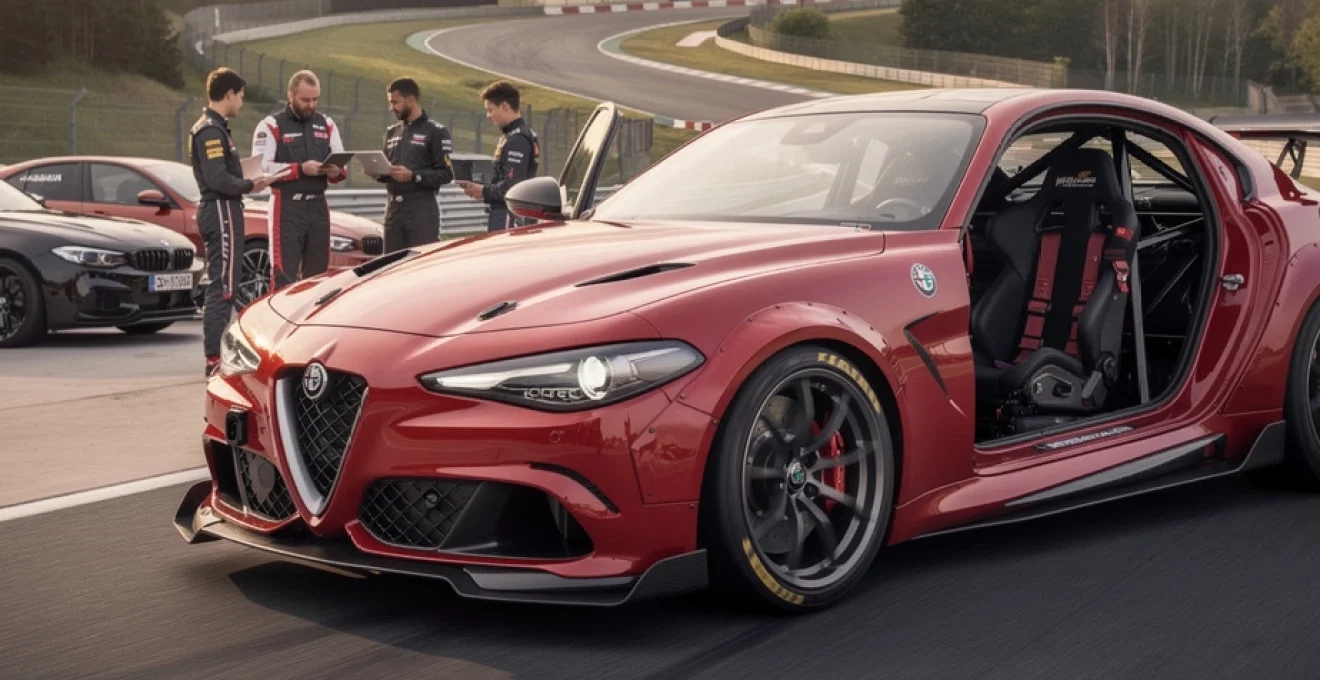
The Alfa Romeo Giulia GTA represents the pinnacle of Italian automotive engineering excellence, marking a triumphant return to the legendary GTA nameplate that dominated motorsport circuits in the 1960s. Standing for “Gran Turismo Alleggerita” (lightened grand tourer), this extraordinary machine embodies Alfa Romeo’s 110-year heritage of combining breathtaking performance with unmistakable Italian style. With production strictly limited to just 500 units worldwide, the Giulia GTA has emerged as one of the most exclusive and desirable performance saloons ever created. This tour de force of automotive engineering showcases cutting-edge Formula 1-derived aerodynamics, extensive carbon fibre construction, and a meticulously tuned powerplant that delivers an unprecedented 540 horsepower from its twin-turbocharged V6 engine.
Alfa romeo giulia GTA 500 technical specifications and engineering excellence
2.9-litre Twin-Turbo V6 BiTurbo engine performance metrics
At the heart of the Giulia GTA lies a thoroughly re-engineered version of the Ferrari-derived 2.9-litre V6 BiTurbo engine that has been meticulously calibrated to produce 540 horsepower and 442 lb-ft of torque. This represents a significant 30-horsepower increase over the standard Quadrifoglio variant, achieved through comprehensive internal modifications including revised piston cooling flows, redesigned connecting rods, and enhanced turbocharger boost mapping. The powerplant features an all-aluminium construction that contributes to the overall weight reduction strategy while maintaining exceptional durability under extreme operating conditions.
The engine’s performance characteristics have been optimised through collaboration with Bosch, which provides dual engine control modules that can operate independently for each cylinder bank. This sophisticated system allows selective bank deactivation when maximum torque isn’t required, resulting in improved fuel efficiency and reduced emissions during cruising conditions. The twin-turbocharger setup has been recalibrated with larger compressor wheels that enable higher boost pressures across the entire rev range, delivering linear power delivery that transforms the driving experience.
Carbon fibre monocoque construction and weight distribution analysis
The Giulia GTA’s commitment to weight reduction extends far beyond simple component substitution, encompassing a comprehensive materials science approach that achieves a remarkable 100-kilogram reduction compared to the standard Quadrifoglio. Carbon fibre components include the bonnet, roof panel, front bumper assembly, front wheel arch extensions, rear wheel arch inserts, and the complete driveshaft assembly. These components utilise advanced weave patterns that maximise strength-to-weight ratios while maintaining the structural integrity required for high-performance applications.
The weight distribution has been carefully calculated to achieve optimal front-to-rear balance, with the carbon fibre components strategically positioned to lower the centre of gravity and improve rotational inertia characteristics. Aluminium usage extends throughout the engine block, suspension components, and door panels, while composite materials are employed in various interior elements to achieve microscopic weight savings that collectively contribute to the vehicle’s exceptional power-to-weight ratio of 187 horsepower per litre.
Brembo Carbon-Ceramic brake system integration
The Giulia GTA features an advanced Brembo carbon-ceramic brake system as standard equipment, representing a significant performance advantage over conventional steel disc systems. These carbon-ceramic discs provide exceptional fade resistance during intensive track sessions while reducing unsprung weight by approximately 15 kilograms compared to traditional brake systems. The brake calipers feature six-piston front and four-piston rear configurations with customisable colour options including distinctive gold finishes that complement the vehicle’s exclusive aesthetic.
The braking system’s thermal management capabilities are particularly impressive, with the carbon-ceramic discs maintaining consistent performance characteristics even under extreme temperatures exceeding 800 degrees Celsius. This thermal stability ensures predictable braking response during aggressive driving scenarios, whether on public roads or dedicated racing circuits. The brake system integration includes sophisticated ABS and stability control calibration that optimises braking performance across varying surface conditions while maintaining directional stability during emergency braking situations.
Active aerodynamics package and downforce
calculations
The active aerodynamics package fitted to the Alfa Romeo Giulia GTA has been engineered with the same rigour as a modern GT racing car, using extensive wind-tunnel testing at Sauber Engineering’s state-of-the-art facility. The manually adjustable front splitter, fully faired underbody, carbon fibre rear diffuser and rear spoiler work together to generate substantial downforce without incurring excessive drag. In its most aggressive configuration, the GTAm variant is capable of producing up to three times the downforce of the already formidable Giulia Quadrifoglio, dramatically increasing grip at high speed and sharpening turn-in response.
From a performance perspective, this translates into higher cornering speeds, shorter braking distances and improved stability during rapid direction changes. Downforce builds progressively with speed, effectively “pressing” the Giulia GTA into the tarmac in the same way an aircraft wing works in reverse, generating negative lift rather than positive. While exact downforce figures vary depending on the splitter and wing positions, Alfa Romeo engineers have targeted a balance that keeps the car neutral at track speeds, minimising understeer and ensuring that the driver can exploit the 540 horsepower output with confidence. For owners who plan to use their Giulia GTA on track days, understanding and optimising this aero balance can unlock lap-time improvements that rival much more extreme track-only machinery.
Limited production run strategy and collector market positioning
500-unit global allocation and regional distribution matrix
Alfa Romeo’s decision to cap Giulia GTA and GTAm production at just 500 units worldwide is central to the model’s appeal as a limited edition performance car. Rather than chasing volume, the brand has adopted a targeted allocation strategy that prioritises key enthusiast markets such as Europe, the UK, North America and select regions in the Middle East and Asia-Pacific. Within this framework, allocations are further divided between the more road-oriented GTA and the track-focused GTAm, with some countries receiving only single-digit numbers of the latter.
This tightly controlled distribution matrix mirrors the approach used for high-end supercars, where scarcity is deliberately engineered to protect long-term values and ensure strong demand. In the UK, for example, only a handful of GTAm units were delivered, with even fewer finished in standout colours like Montreal Green. For collectors monitoring global supply, this means that the Giulia GTA 500 behaves more like a boutique motorsport homologation special than a conventional sports saloon, which in turn supports premium pricing on the secondary market and reinforces its status as a coveted automotive asset.
Certificate of authenticity and provenance documentation
To underpin its collector-grade status, every Alfa Romeo Giulia GTA and GTAm is delivered with a comprehensive documentation package that verifies authenticity and provenance. Each car is individually numbered, with this unique identifier referenced on the chassis plate, in the official production records and often echoed on optional accessories such as the included Bell racing helmet. This traceable identity becomes crucial as the car ages, enabling future buyers to confirm originality and specification with confidence.
Provenance documentation extends beyond simple build sheets to include purchase contracts, dealer delivery records and, where applicable, photographic or video evidence of handover events and factory visits. For serious collectors, retaining this paperwork in pristine condition is almost as important as maintaining the car itself. Why? Because an unbroken chain of documentation can add a substantial premium at auction, especially when paired with low mileage and minimal modifications. Owners who treat the Giulia GTA 500 as a long-term investment would be wise to archive every service invoice, recall notice and official correspondence to build a watertight historical record.
Exclusive livery options and personalisation programme
One of the most engaging aspects of the Alfa Romeo Giulia GTA 500 ownership experience is the extensive personalisation programme offered through Centro Stile Alfa Romeo. Buyers can select from heritage-inspired liveries that pay tribute to iconic racing Giulias of the 1960s and 1970s, featuring contrasting “masks” on the nose, longitudinal stripes and bold number roundels on the doors. These designs are not simple decal packs; they are carefully curated visual narratives that connect each modern GTA to Alfa Romeo’s motorsport triumphs.
Beyond the liveries, customers can customise exterior paint in GTA Red, Trofeo White or Montreal Green, as well as optional metallic and special finishes in some markets. Brake caliper colours, interior stitching, roll bar finishes (where fitted) and seat belt colours can all be tailored to the owner’s taste. This level of configurability means that two Giulia GTAs ordered in the same base colour can still look dramatically different in person. For those focused on collectability, choosing a rare livery or an unusual colour combination can enhance the car’s future desirability, much like a limited-run art print that gains value through its unique specification.
Heritage collection integration with historic GTA models
The Giulia GTA 500 does not exist in isolation; it is deliberately positioned as the spiritual successor to the original 1965 Giulia Sprint GTA. For Alfa Romeo, this makes the new GTA an anchor point in a broader heritage collection strategy that spans multiple decades of racing success. Enthusiasts who already own classic GTA or GTAm models can view the modern car as a bookend to their collection, creating a narrative arc from carburetted touring cars to turbocharged, electronically managed performance saloons.
In practice, this integration is supported by factory recognition and classic division engagement. Alfa Romeo’s heritage arm often showcases historic GTA race cars alongside the contemporary Giulia GTA at events, underlining the lineage and reinforcing the idea that these vehicles belong to the same family tree. For collectors, assembling a “GTA portfolio” that might include an original Sprint GTA, a 147 or 156 GTA and the latest Giulia GTA 500 not only provides immense personal satisfaction but could also create a curated set of assets that command a premium when sold together, much like a complete series of vintage racing watches or limited-edition artworks.
Track-focused chassis dynamics and suspension architecture
Multilink rear suspension with torsen limited-slip differential
Beneath its aggressive bodywork, the Alfa Romeo Giulia GTA 500 hides a highly sophisticated chassis, optimised for both road use and high-speed circuit work. At the rear, an independent multilink suspension architecture works in concert with a Torsen limited-slip differential to deliver exceptional traction and composure under power. Compared with the standard Giulia Quadrifoglio, track widths have been increased—by up to 50 mm at the rear on certain configurations—allowing for a wider stance and improved lateral grip.
The Torsen differential continuously redistributes torque between the rear wheels based on available traction, effectively “pushing” the car out of corners rather than allowing excessive inside-wheel spin. Imagine a relay race where the baton is always handed to the runner with the clearest path; the Torsen diff performs a similar role for torque, ensuring that power flows to the tyre best able to deploy it. On tight circuits or twisty mountain passes, this translates into a more neutral balance, sharper exits and the kind of playful adjustability that keen drivers crave.
Adaptive damping system and DNA drive mode calibration
Central to the Giulia GTA’s versatility is its adaptive damping system, which works in tandem with Alfa Romeo’s DNA Pro drive mode selector. Drivers can choose between Dynamic, Natural, Advanced Efficiency and Race settings, each of which recalibrates damper stiffness, throttle response, steering weight and stability control thresholds. In everyday use, Natural and Advanced Efficiency modes provide a surprisingly compliant ride, making the car usable even on broken urban tarmac, despite its track-focused brief.
Switch into Dynamic or Race mode, however, and the character of the Giulia GTA transforms. Damper rates firm up, body roll is further contained and the car feels more tightly tied to the road surface, like a racing shoe compared with a comfortable trainer. Race mode also relaxes electronic intervention to allow experienced drivers greater freedom on circuit, while still retaining a safety net through ABS and carefully tuned algorithms. This breadth of adjustability means that you can drive to the track in comfort, set a blistering lap time with full attack settings engaged, and then return home without feeling battered—something few cars with this level of performance can genuinely claim.
Michelin pilot sport cup 2 tyre compound selection
Tyre selection plays a critical role in unlocking the full performance of any high-output rear-drive car, and Alfa Romeo has equipped the Giulia GTA 500 with Michelin Pilot Sport Cup 2 tyres developed specifically for this application. These semi-slick tyres strike a careful balance between dry grip, wet performance and durability, using a dual-compound construction that places a stiffer, more temperature-resistant rubber on the inner shoulders and a more compliant compound on the outer edges. The result is precise steering response and consistent grip even under repeated high-load cornering.
For owners planning regular track use, monitoring tyre pressures and temperatures is essential to maintain optimal performance, as Cup 2s, like any track-oriented tyre, are sensitive to heat cycles. In cooler conditions or on damp surfaces, it is wise to build speed progressively, allowing both tyres and brakes to reach their ideal operating window. Think of the Giulia GTA’s tyres as the soles of a professional sprinter’s shoes: when warmed up and used correctly, they deliver extraordinary performance, but they demand respect and careful management to do so safely.
Roll cage structure and safety cell reinforcement
In the most extreme GTAm configuration, the rear seats are removed and replaced with an Alcantara-lined storage basin and an integrated roll cage structure. This cage is not merely cosmetic; it serves as a key reinforcement element that increases torsional rigidity and provides additional protection in the event of a rollover. The cage ties into the car’s existing safety cell, creating a lattice of high-strength steel that helps the chassis resist flexing under the immense loads generated during high-speed cornering and braking.
Complementing the roll cage are Sabelt carbon-fibre monocoque front seats with six-point harnesses, which keep the driver and passenger securely in place during aggressive driving. The use of fabric door pulls instead of conventional handles further emphasises the motorsport focus, reducing weight and simplifying the cabin layout. For owners who intend to participate in intensive track days or club racing events, this integrated safety package provides peace of mind that the Giulia GTAm has been engineered to meet the demands of serious performance driving, rather than merely styled to look the part.
Comparison analysis with BMW M3 competition and Mercedes-AMG C63 S
Positioned within the ultra-competitive performance saloon segment, the Alfa Romeo Giulia GTA 500 inevitably invites comparison with heavy-hitting rivals such as the BMW M3 Competition and Mercedes-AMG C63 S. On paper, all three deliver similar headline power figures, rear- or all-wheel-drive configurations (depending on specification) and blistering acceleration times in the sub-four-second bracket. However, the Giulia GTA differentiates itself through its radical focus on weight reduction and aerodynamics, resulting in a driving experience that reviewers often describe as closer to a touring car than a conventional road-going saloon.
Where the M3 Competition and C63 S position themselves as everyday performance all-rounders—offering ample space, extensive infotainment suites and, in some cases, all-weather all-wheel drive—the Giulia GTA 500 leans into a more purist philosophy. Its carbon-fibre-intensive construction, centre-lock wheels and limited 500-unit production run push it into quasi-supercar territory, both dynamically and in terms of rarity. You could think of the M3 and C63 as incredibly talented multi-instrumentalists, capable of playing every genre with ease, while the Giulia GTA is the virtuoso soloist, perfected for one main purpose: delivering the sharpest possible driving experience.
From an ownership perspective, this distinction matters. If you prioritise daily usability, rear-seat practicality and long-distance comfort, an M3 Competition or C63 S may appear the more rational choice. However, if your priority is exclusivity, emotional engagement and long-term collectability, the Giulia GTA’s limited production, bespoke engineering and deep historical roots give it a unique edge. In the same way that a limited-run track special from BMW’s M division or AMG’s Black Series commands a premium over the standard models, the Giulia GTA occupies a higher, more focused tier than mainstream performance saloons, and its market behaviour reflects that status.
Investment potential and resale value trajectory analysis
Given its constrained production numbers and clear lineage to one of Alfa Romeo’s most celebrated racing models, the Giulia GTA 500 has attracted significant interest from collectors and investors. Early allocation cars were often sold out before formal public ordering began, with some markets seeing waiting lists that exceeded local supply several times over. This initial demand spike set a strong foundation for residual values, with lightly used examples already trading at or above original list prices in several regions within a short timeframe of delivery.
When assessing investment potential, several factors play in the Giulia GTA’s favour: the 500-unit global cap, the inclusion of high-value standard equipment such as carbon-ceramic brakes and centre-lock wheels, and the extensive documentation and experience package that accompanies each car. Historically, limited-run, motorsport-inspired models from prestige brands—think BMW M3 GTS, Mercedes-AMG C63 Black Series or Porsche 911 GT3 RS—have demonstrated robust long-term value retention, particularly when maintained in original condition with low mileage. The Giulia GTA 500 aligns closely with this pattern, suggesting a favourable resale value trajectory, especially for the rarer GTAm variant.
However, potential buyers should also recognise that the collector car market can be cyclical. Macroeconomic shifts, changing regulations on internal combustion vehicles and evolving enthusiast tastes can all influence future valuations. To maximise the Giulia GTA’s investment case, owners are advised to adhere to factory servicing schedules, avoid irreversible modifications and preserve all accessories and documentation supplied at purchase. Treated in this way, the Giulia GTA 500 has every indication of becoming a blue-chip modern classic in the performance saloon category.
Circuit performance benchmarking at nürburgring nordschleife
No serious discussion of a high-performance European car would be complete without referencing the Nürburgring Nordschleife, widely regarded as the ultimate proving ground for chassis balance, braking endurance and powertrain durability. While official lap times can fluctuate depending on conditions and testing protocols, Alfa Romeo has made clear that the Giulia GTA 500’s development programme placed heavy emphasis on Nordschleife performance. Extensive testing allowed engineers to fine-tune spring rates, damper valving, aero balance and electronic calibration in one of the most demanding environments imaginable.
On track, independent testers have consistently reported that the Giulia GTA feels more composed and engaging than many competitors, with particular praise directed at its steering precision and mid-corner balance. The combination of active aerodynamics, lightweight construction and Cup 2 tyres allows the car to carry remarkable speed through high-load sections, while the Brembo carbon-ceramic brakes maintain confidence-inspiring performance lap after lap. In terms of lap time benchmarks, the Giulia GTA comfortably sits within the elite group of four-door production cars that can challenge or surpass the times set by previous-generation supercars, underscoring just how far the performance saloon has evolved.
For owners, this Nürburgring-honed capability offers both bragging rights and real-world benefits. Whether you intend to tackle the Nordschleife yourself, join local track days or simply enjoy spirited driving on challenging roads, you are benefiting from a chassis that has been stress-tested on one of the world’s toughest circuits. In effect, Alfa Romeo has done the hard work for you, distilling thousands of development kilometres into a package that is ready to perform at an exceptionally high level straight out of the showroom.