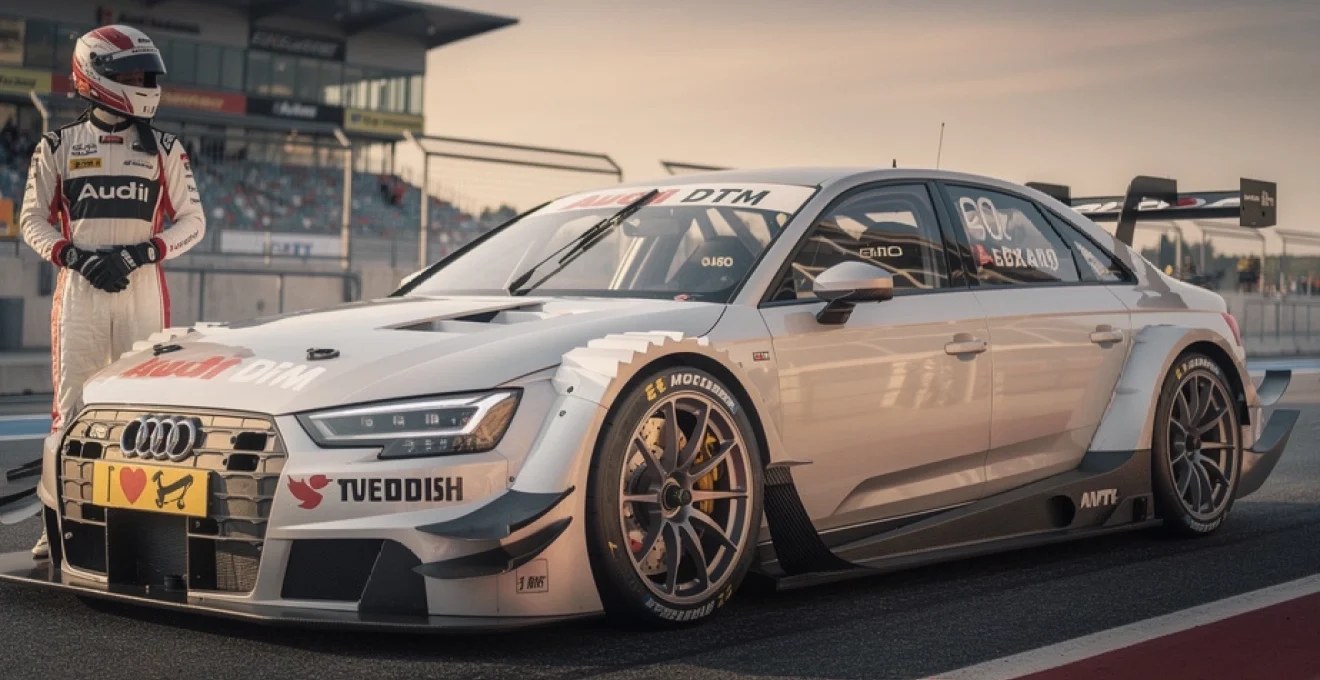
When Audi clinched both the Manufacturers’ and Drivers’ titles in the 2004 Deutsche Tourenwagen Masters (DTM) championship, the German automaker decided to immortalise this achievement with something tangible for enthusiasts. The result was the A4 DTM Edition—a limited-production saloon that translated racing glory into road-going reality. With just 250 right-hand-drive examples destined for the United Kingdom, this special variant represented more than mere marketing; it embodied Audi’s commitment to celebrating motorsport success whilst delivering a distinctive driving experience. For those who understand the significance of touring car racing and appreciate the engineering nuances that separate standard models from homologation specials, the A4 DTM Edition remains a compelling proposition in today’s collector car market.
DTM championship legacy: from audi V8 quattro to modern touring car dominance
The Deutsche Tourenwagen Masters represents one of Europe’s most prestigious touring car championships, with a history stretching back to the 1980s. Audi’s involvement in this highly competitive series has produced some of motorsport’s most memorable moments, establishing the brand’s reputation for engineering excellence and competitive tenacity. Understanding this context is essential to appreciating why the A4 DTM Edition holds such significance for enthusiasts.
Audi’s 1990-1991 DTM championship victories with Hans-Joachim stuck
Audi’s first major DTM success arrived with the imposing V8 quattro, which dominated the championship in 1990 and 1991. Hans-Joachim Stuck piloted the all-wheel-drive behemoth to consecutive drivers’ titles, demonstrating that Audi’s quattro technology could compete effectively against rear-wheel-drive rivals from BMW and Mercedes-Benz. The V8 quattro’s 426bhp output and sophisticated four-wheel-drive system gave it a decisive advantage in wet conditions and on technically demanding circuits. These victories established Audi as a serious touring car manufacturer and created expectations for future campaigns.
Regulatory changes and the super touring era transition
Following the early 1990s success, DTM regulations underwent significant changes that ultimately led to the series’ temporary suspension after 1996. The advent of Super Touring regulations favoured smaller, lighter vehicles with front-wheel drive, pushing manufacturers like Audi toward different championship formats. During this period, Audi focused its motorsport efforts on endurance racing, particularly at Le Mans, where the brand accumulated victories that would enhance its overall motorsport prestige. This hiatus from DTM lasted nearly a decade, but Audi’s return would prove spectacular.
Return to DTM: 2004-2020 audi sport ABT schaeffler campaign
When DTM was revived in 2000 with new regulations, Audi initially remained on the sidelines. However, by 2004, the manufacturer committed to a full factory-backed campaign with Audi Sport Team Abt Sportsline. That debut season proved extraordinarily successful—Mattias Ekström secured the drivers’ championship whilst Audi claimed the manufacturers’ title. The A4 race cars featured sophisticated aerodynamics, powerful V8 engines, and cutting-edge electronics that pushed the boundaries of touring car technology. This triumphant return to DTM provided the perfect justification for creating a special edition road car.
Five manufacturers’ championships and driver title statistics
Between 2004 and Audi’s departure from DTM in 2020, the manufacturer secured five manufacturers’ championships and supported drivers to six individual titles. These statistics demonstrate consistent competitiveness across nearly two decades of intense competition against BMW and Mercedes-AMG. The on-track success translated into valuable marketing opportunities and reinforced Audi’s performance credentials among consumers. Each championship victory strengthened the brand’s motorsport heritage and justified limited-edition models like the A4 DTM Edition.
A4 DTM edition mechanical specifications and performance engineering
The A4 DTM Edition’s mechanical package reflected Audi’s philosophy of delivering accessible performance rather than outright speed. Rather than installing a large-displacement engine or pursuing stratospheric power outputs, engineers focuse
d on enhancing responsiveness, traction and driver engagement. In period, Audi pitched the A4 DTM Edition as a “warm” performance saloon—a car that nodded to the full-blown touring car without sacrificing everyday usability. Rather than chasing headline-grabbing acceleration figures, the focus was on mid-range torque, all-weather security and subtle chassis tuning that would make a difference on real roads. For many enthusiasts, that blend of usable performance and motorsport flavour is precisely what makes the Audi A4 DTM Edition so appealing today.
2.7-litre biturbo V6 engine architecture and power output
While the road-going A4 DTM Edition was based around Audi’s proven 2.0-litre turbocharged four-cylinder engine, it is worth understanding how its character compares with the more exotic 2.7-litre biturbo V6 used in earlier performance Audis such as the B5 S4. The twin-turbo V6, with its complex plumbing and higher cylinder count, delivered a thicker torque curve and greater outright tuning potential, but at the cost of added weight and mechanical complexity. In contrast, the DTM Edition’s 2.0 TFSI (often quoted at around 217–220hp and 207lb ft) offered a more compact, lighter package mounted further back in the chassis, improving weight distribution and turn-in response.
From an engineering standpoint, the four-cylinder unit employed a single turbocharger, direct fuel injection and variable valve timing to deliver strong mid-range boost from around 1,800rpm. Owners often comment that the A4 DTM Edition feels particularly eager between 2,000 and 5,000rpm—exactly the rev band you use most on the road. Instead of the big-lunged surge you might associate with a larger biturbo V6, there is a more linear, progressive build of power that suits the car’s touring car-inspired brief. You could say the difference is like comparing a heavyweight boxer with a skilled middleweight: the latter might lack sheer punch, but can be quicker and more agile in real-world conditions.
Crucially for long-term ownership, the simpler single-turbo architecture tends to be easier and cheaper to maintain than a complex biturbo V6 configuration. There are fewer turbos to rebuild, less intricate pipework and better access in the engine bay, all of which matters as these cars age and specialist labour rates rise. For enthusiasts looking to enjoy an Audi with genuine motorsport heritage without inheriting a daunting maintenance schedule, the A4 DTM Edition’s powerplant is a sensible compromise. It may not boast the headline figures of an RS4, but in day-to-day driving it offers more than enough performance, especially given the traction available from the quattro system.
quattro permanent All-Wheel drive system configuration
One of the defining features of the Audi A4 DTM Edition is its quattro permanent all-wheel drive system. In this generation of A4, Audi used a Torsen T2 centre differential with a nominal 50:50 front-to-rear torque split. Under load, the differential could apportion torque dynamically to the axle with more grip, improving traction when accelerating out of tight corners or coping with slippery conditions. For a car intended to echo the engineering philosophy of a touring car, this setup created a secure yet exploitable handling balance.
On the road, the result is a saloon that feels sure-footed in conditions where rear-wheel-drive rivals can become nervous. Wet B-roads, greasy roundabouts and even light snow are dispatched with calm confidence; there is no drama, just an impression of infinite grip. That said, the A4 DTM Edition is not a drift machine in disguise. The Torsen-based quattro system tends towards neutrality and mild understeer at the limit, especially if you carry too much speed into a bend. The key, as with any all-wheel-drive performance car, is to adjust your driving style: trail-brake gently into the corner, rotate the car, then lean on the torque as you unwind the steering.
For buyers today, the permanent quattro system is one of the major selling points of the A4 DTM Edition as a usable modern classic. If you live in a region with changeable weather, the ability to enjoy the car year-round is a genuine advantage over many rear-drive alternatives. It also broadens the appeal beyond hardcore enthusiasts; families and commuters alike can appreciate the safety net of predictable all-wheel-drive behaviour. When you factor in the car’s relatively modest power output by modern standards, the package becomes about accessible performance you can actually use, rather than bragging rights you never fully exploit.
Sport suspension geometry and lowered ride height parameters
The chassis tuning of the Audi A4 DTM Edition is arguably where its motorsport inspiration is most evident. Compared with a standard A4 of the same B7 generation, the DTM Edition sits around 20mm lower on stiffer springs and revised dampers. This change in ride height lowers the car’s centre of gravity, reducing body roll and improving turn-in response. Additional tweaks to the suspension geometry and anti-roll bars help the car feel more tied down when you begin to explore its limits on a challenging road.
Of course, a firmer, lower setup brings trade-offs. Period road tests—and owners today—often mention that the ride can feel quite firm at low speeds, particularly on broken urban tarmac. Sharp-edged potholes and expansion joints can send a jolt through the cabin, reminding you that this is not merely an appearance package. Yet once the speeds rise and the road opens up, the suspension begins to make sense. The car feels composed over crests, resists wallowing in quick direction changes and communicates more clearly what the front tyres are doing.
If you are considering an A4 DTM Edition as a daily driver, it is worth honestly assessing your local roads and tolerance for a sportier ride quality. Think of it as the difference between a well-tailored suit and casual loungewear: both have their place, but the more structured option feels better when you are moving with purpose. The upside is that the chassis modifications add real depth to the driving experience, transforming the A4 from a competent executive saloon into something that invites you to seek out your favourite back road on a Sunday morning.
Brembo braking system upgrades and Six-Piston caliper integration
Braking performance is a critical component of any motorsport-inspired road car, and the A4 DTM Edition received meaningful upgrades over the standard model. While not all markets featured branded Brembo hardware or six-piston calipers, the essence of the package was consistent: larger diameter, cross-drilled front discs and uprated pads for improved fade resistance. Ventilated rotors allowed better heat dissipation during repeated heavy stops, mirroring the kind of punishment brakes endure in touring car competition.
The cross-drilled disc design also contributes to sharper initial bite in day-to-day driving. When you brush the pedal at motorway speeds, there is an immediate response that instils confidence, yet pedal modulation remains intuitive rather than grabby. Owners who take their A4 DTM Edition to occasional track days report that the brakes stand up well, provided high-quality pads and fluid are used. If you plan to drive your car enthusiastically, investing in fresh performance brake fluid and inspecting the discs for cracks around the drill holes is a sensible precaution as these cars age.
Even where specific Brembo six-piston calipers are not fitted, the philosophy behind the braking system echoes that of the chassis and engine: incremental, purposeful improvements rather than headline-grabbing hardware. You may not see gigantic multi-piston calipers peeking through the spokes, but the real-world stopping power is more than adequate for the car’s performance level. For many enthusiasts, that subtlety is part of the appeal—this is a car engineered to deliver, not simply impress in a spec sheet comparison.
Recaro sport bucket seats and interior ergonomics
Step inside the Audi A4 DTM Edition and the motorsport influence continues with a set of Recaro sport seats that strike a careful balance between support and comfort. Trimmed in a combination of leather and Nardia microfibre (Audi’s alternative to Alcantara), these chairs feature pronounced bolsters that hold you firmly in place during enthusiastic cornering. The grippy suede-like material prevents you sliding around, yet the cushioning and adjustability ensure long-distance comfort remains intact. It is an interior that feels more special than a regular A4 without becoming impractical.
Across the dashboard and door cards, you will find genuine carbon fibre inlays, finished in a subtle matte sheen rather than garish gloss. These details, along with DTM-branded sill kickplates and the microfibre-wrapped steering wheel and gearknob, create an ambience that feels both sporting and understated. Sit behind the wheel and you are greeted by clear analogue instruments, well-placed pedals and a gear lever that falls naturally to hand. For many enthusiasts, this era of Audi interior design represents a sweet spot—before touchscreens dominated, yet after cabin quality had become a brand hallmark.
Ergonomically, the driving position is low and adjustable, allowing you to find a comfortable relationship between seat, steering wheel and pedals whether you are commuting or carving through mountain passes. Visibility is good by modern standards, with relatively slim pillars and a clear view over the bonnet. If you are used to more recent performance cars with complex infotainment, you may even find the simplicity of the A4 DTM Edition refreshing. It is a cabin designed around the driving experience rather than an array of digital distractions, which fits neatly with the car’s analogue, driver-focused character.
Distinctive DTM edition exterior aerodynamic package
Visually, the Audi A4 DTM Edition walks a fine line between subtlety and motorsport theatre. At a glance, it could pass for a well-specced S line model, especially in understated colours like Avus Silver or Phantom Black. Look closer, however, and you begin to notice the unique aerodynamic details that set it apart. These are not wild, track-focused appendages, but carefully considered enhancements inspired by the aero work carried out on Audi’s DTM race cars. For many owners, part of the joy of the A4 DTM Edition lies in this “if you know, you know” aesthetic.
Front splitter design and downforce enhancement technology
The most immediately recognisable element of the DTM Edition’s exterior is its exposed carbon fibre front splitter. Sitting proud of the lower bumper, this component does more than simply look purposeful. By extending the lower edge of the front end, the splitter helps manage the airflow passing beneath the car, reducing lift at higher speeds and improving stability. In aerodynamic terms, it acts a little like the brim of a cap, redirecting airflow around the body rather than allowing it to spill under the chassis where it can generate unwanted turbulence.
On public roads, you are unlikely to explore the full aerodynamic benefit of the front splitter in the same way a racing driver might on the Norisring. However, owners do report that the car feels particularly planted at motorway speeds, with less of the lightness at the front axle sometimes felt in standard A4s at three-figure velocities (on unrestricted autobahns, of course). From a design perspective, the decision to leave the carbon fibre unpainted emphasises the limited-edition nature of the car and hints at the lightweight materials used in the DTM race programme. It is a functional flourish that sends a clear message to those who recognise it.
Carbon fibre side skirts and underbody airflow management
Complementing the front splitter, the A4 DTM Edition features deeper side skirts designed to visually lower the car and help tidy the airflow along its flanks. While these components are less dramatic than the front and rear aero pieces, they play an important role in smoothing the transition of air between the wheel arches and underbody. Think of them as a subtle fence, guiding the airflow where engineers want it to go rather than allowing it to spill turbulently beneath the car. In some markets, these skirts also incorporated carbon fibre elements, further underlining the motorsport connection.
From a practical standpoint, the side skirts are engineered to withstand everyday use, including the occasional brush with a high kerb or steep driveway. However, given the rising collectability of the A4 DTM Edition, many owners now take a more cautious approach to speed bumps and road furniture. Preserving original aero components can have a tangible impact on long-term value, so it is worth inspecting these areas carefully when considering a purchase. Intact, factory-fitted side skirts and splitters are a strong indication that the car has been cherished rather than abused.
Fixed rear wing assembly: angle of attack and drag coefficient
At the rear, the A4 DTM Edition trades the discreet lip spoilers of most executive saloons for a more purposeful aero solution. Depending on specification and market, you will find either an exposed carbon fibre lip spoiler or a small fixed wing integrated into the bootlid. While far more restrained than the towering elements used on full DTM race cars, these pieces are nonetheless carefully profiled to generate a modest amount of rear downforce without significantly increasing drag. The idea is to balance the effect of the front splitter, maintaining stability at speed without compromising fuel economy or refinement.
In aerodynamic testing, small changes to the angle of attack of a spoiler can have outsized effects on both downforce and drag coefficients. For a road car like the A4 DTM Edition, Audi’s engineers aimed for a sweet spot: enough rear-end stability to improve high-speed confidence, but not so much that the car became noisy or thirsty. In day-to-day driving, what you notice is a sense of composure during high-speed lane changes and long sweeping bends. The rear feels keyed into the tarmac, giving you the confidence to exploit the engine’s mid-range torque even when conditions are less than perfect.
Lightweight alloy wheel specifications: BBS and speedline options
No motorsport-inspired special would be complete without distinctive wheels, and the A4 DTM Edition is no exception. Factory cars left the assembly line on 18-inch multi-spoke alloys, often supplied by renowned manufacturers such as BBS or Speedline depending on market and production batch. These wheels were not chosen purely for aesthetics. Their lightweight construction reduced unsprung mass, allowing the suspension to respond more quickly to bumps and surface imperfections. The net effect is sharper steering response and improved grip, particularly on rougher roads.
Visually, the turbine-style design of the 15- or multi-spoke alloys evokes the ventilated racing wheels used on touring cars, while still appearing appropriate for an executive saloon. They fill the arches neatly without looking oversized, preserving the car’s subtle, factory-tuned stance. For prospective buyers today, wheel condition is a useful barometer of how an A4 DTM Edition has been treated. Kerbing, corrosion or heavy refurbishments can suggest daily use and less meticulous ownership, whereas original, well-preserved alloys often indicate a cherished example. Given the limited production numbers, sourcing correct-specification wheels can be costly, so originality here is a real plus.
Limited production numbers and market positioning strategy
When Audi launched the A4 DTM Edition, it was acutely aware that this was not a mainstream model. With only around 250 right-hand-drive examples earmarked for the UK—and similarly modest allocations in other European markets—the car was conceived as a halo product for enthusiasts rather than a volume seller. Priced at just under £30,000 in the mid-2000s, it carried a noticeable premium over a standard 2.0 TFSI quattro A4, yet sat well below the cost of the V8-powered S4 and RS4. This positioning allowed Audi to offer a taste of motorsport heritage at a relatively attainable price point.
From a marketing perspective, the A4 DTM Edition functioned as a bridge between mainstream models and full-fat RS products. It targeted customers who valued exclusivity and motorsport pedigree but did not necessarily need—or want—the expense and running costs of a V8. In this sense, it was a strategic move to broaden the appeal of Audi Sport without diluting the RS brand. The limited production run also created a sense of urgency; buyers who hesitated risked missing out, a tactic that has become increasingly common with modern manufacturers seeking to generate buzz around special editions.
In hindsight, the decision to cap production has had a pronounced impact on the car’s status in the used market. While values initially followed the typical depreciation curve of executive saloons, enthusiasts gradually began to recognise the A4 DTM Edition’s rarity and historical significance. Today, clean, low-mileage examples command a clear premium over equivalent standard models and can sit level with, or even above, some S4s of the same era. For those who bought new and held onto their cars, the strategy has paid off: what began as a niche variant has matured into a bona fide modern classic with genuine scarcity on its side.
Comparative analysis: A4 DTM edition versus BMW M3 E46 CSL
Any discussion of early-2000s touring car-inspired specials inevitably invites comparison with BMW’s iconic M3 E46 CSL. On paper, these two cars appear to occupy different segments: the M3 CSL is a stripped-back, track-focused coupe with a howling naturally aspirated straight-six, while the A4 DTM Edition is a subtler, four-door saloon with a turbocharged four-cylinder and all-wheel drive. Yet both exist to celebrate their respective brands’ touring car successes, and both use focused engineering changes to elevate already capable base cars into something more special.
The M3 CSL enjoys clear performance advantages: more power (around 360hp), lower weight thanks to extensive carbon fibre and lightweight glass, and a chassis honed for circuit work. Its lap times and on-limit behaviour have seen it widely regarded as one of BMW M’s all-time greats. By contrast, the A4 DTM Edition trades outright speed for usability. Its 0–60mph time of around 7.1 seconds is brisk rather than ballistic, and its quattro system prioritises grip and stability over tail-out theatrics. If the CSL is a scalpel, the DTM Edition is more akin to a well-balanced multi-tool: less specialised, but arguably more versatile in everyday life.
Price and positioning further underline the difference in philosophy. The M3 E46 CSL was built in much smaller numbers and cost significantly more when new, and that exclusivity has carried through to the present day with collector-grade examples regularly commanding six-figure sums. The A4 DTM Edition, while rare, has remained within reach of a broader enthusiast audience, with tidy examples still available at a fraction of CSL money. For many buyers, the question is not which is the better car in absolute terms—few would argue against the CSL’s dynamic brilliance—but which better suits their lifestyle. If you need four doors, year-round usability and a lower running-cost envelope, the Audi makes a persuasive case.
There is also a philosophical difference in how each car expresses its motorsport heritage. The BMW M3 CSL wears its intent on its sleeve with a louder exhaust, stripped-out interior and aggressive aero. It demands that you drive it hard to appreciate what it can do. The Audi A4 DTM Edition is more reserved; its touring car links are encoded in subtle carbon trim, tasteful aero and a chassis that comes alive when pressed but remains civil in daily use. In that respect, it reflects the broader character of each brand at the time: BMW as the purist’s choice, Audi as the master of understated performance. The right choice comes down to what you value more—raw excitement, or discreet capability with a motorsport backstory.
Collector vehicle valuation trends and motorsport heritage appreciation
As the classic car market has matured over the past decade, there has been a noticeable shift in attention towards modern classics from the late 1990s and early 2000s. Cars like the Audi A4 DTM Edition, which were once seen as slightly obscure special editions, are now benefiting from a broader reappraisal of this era. Enthusiasts who grew up admiring DTM and BTCC racing are reaching a point in life where they can afford to indulge those childhood heroes, and that emotional connection is a powerful driver of demand. Limited production numbers, strong mechanical fundamentals and a direct link to motorsport success only add to the appeal.
Valuation data from specialist auction platforms and enthusiast classifieds suggests that the very best A4 DTM Editions—low-mileage, original, unmodified cars with full documented history—have begun to separate themselves from the general A4 market. While high-mileage or heavily modified examples still trade at relatively modest sums, collectors are willing to pay a considerable premium for cars that tick all the right boxes. Over the past five to seven years, prices for top-tier examples have shown a gentle but steady upward trajectory, in contrast to the more volatile spikes seen in some speculative segments of the classic car world.
If you are considering an Audi A4 DTM Edition as an investment as well as a driver’s car, there are several practical factors to bear in mind. Condition and originality are paramount: seek out cars with intact carbon aero, factory wheels, unmolested interiors and minimal aftermarket tuning. Verify service history, paying close attention to timing belt intervals, suspension refreshes and brake maintenance. It can be tempting to chase the cheapest example available, but with a limited-production car, paying more upfront for a better example often proves cheaper in the long run. Remember, too, that the joy of ownership should be part of the calculation—this is a car designed to be driven, not merely stored.
More broadly, the A4 DTM Edition sits within a growing niche of motorsport-inspired road cars that enthusiasts are beginning to recognise as historically significant. Alongside machines like the BMW 320si, Alfa Romeo 156 GTA and various BTCC homologation specials, it tells a story about a particular moment in touring car history. As regulators continue to reshape motorsport and electrification gathers pace on the road, petrol-powered performance saloons with direct links to series like DTM are unlikely to be repeated in quite the same way. That scarcity, both in numbers and in concept, is at the heart of why the Audi A4 DTM Edition is steadily moving from interesting used buy to bona fide collectible.