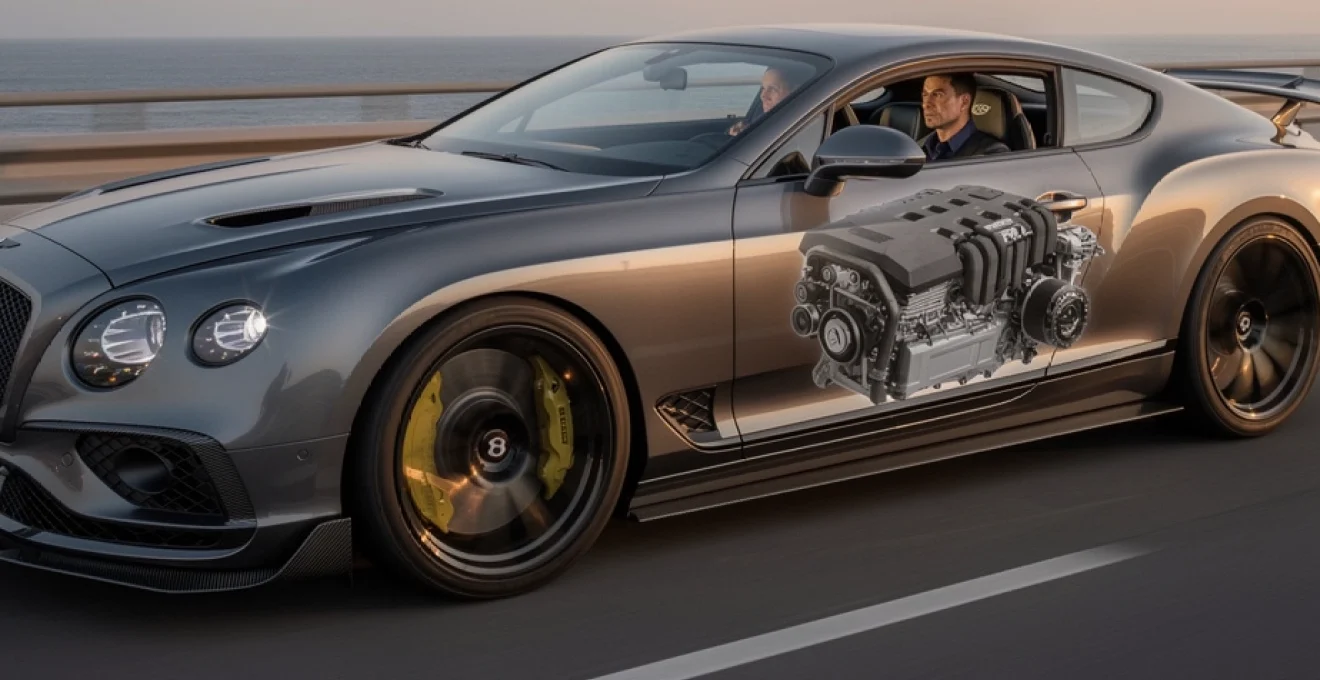
The automotive world has witnessed remarkable engineering achievements, but few vehicles epitomise the perfect fusion of uncompromising luxury and devastating performance quite like the Bentley Continental GT Supersports. This extraordinary grand tourer represents the pinnacle of British automotive craftsmanship, where traditional luxury meets cutting-edge technology in a symphony of speed and sophistication. With its formidable W12 engine producing 710 PS and achieving a staggering top speed of 209 mph, the Supersports stands as a testament to what happens when engineering excellence meets unbridled ambition. The vehicle’s development represents not merely an evolution of the Continental GT lineage, but a revolutionary approach to creating the world’s fastest four-seat luxury automobile, challenging conventional boundaries between comfort and performance.
W12 Twin-Turbocharged engine architecture and performance specifications
The heart of the Continental GT Supersports beats with an intensity that few engines can match. This powerplant represents the culmination of decades of engineering refinement, incorporating advanced materials science and precision manufacturing techniques to deliver extraordinary performance whilst maintaining the refined character expected from a Bentley.
6.0-litre TSI engine block construction and materials engineering
The foundation of the Supersports’ remarkable performance lies within its meticulously engineered 6.0-litre W12 engine block. Constructed using advanced aluminium alloy technology, the engine features a unique W-configuration that allows twelve cylinders to occupy a remarkably compact space. This innovative design provides superior weight distribution compared to traditional V12 layouts whilst maintaining optimal thermal management characteristics. The engine block incorporates reinforced cylinder linings manufactured from a proprietary iron-based composite, ensuring exceptional durability under extreme operating conditions.
Engineers have implemented sophisticated cooling channels throughout the block, utilising computational fluid dynamics to optimise coolant flow patterns. The crankcase construction features additional reinforcement ribs and mounting points, providing the structural integrity necessary to handle the immense forces generated by the twin-turbocharged configuration. Each cylinder bore undergoes precision honing to achieve surface tolerances measured in micrometres, ensuring optimal piston ring sealing and minimal friction losses.
Variable geometry turbocharger configuration and boost pressure dynamics
The Supersports employs a sophisticated twin-turbocharger system featuring variable geometry technology that adapts to changing engine demands with remarkable precision. Unlike fixed-geometry turbochargers, these units utilise moveable vanes within the turbine housing to optimise exhaust gas flow across the entire rev range. This technology eliminates traditional turbo lag whilst providing maximum boost pressure when performance demands require it.
Each turbocharger operates independently, with dedicated engine management systems monitoring exhaust gas temperatures, boost pressure levels, and compressor efficiency in real-time. The wastegate control systems feature electronic actuation rather than traditional pneumatic operation, providing millisecond response times and precise boost pressure regulation. Maximum boost pressure reaches 1.4 bar, generating the substantial airflow volumes necessary to support the engine’s extraordinary power output.
Power output analysis: 710 PS and 1,017 nm torque delivery
The Supersports generates an impressive 710 PS (700 bhp) at 6,000 rpm, representing a significant increase over previous Continental GT variants. However, the torque figure proves equally remarkable, with 1,017 Nm (750 lb-ft) available from just 2,050 rpm and maintaining this peak output across a broad powerband extending to 4,500 rpm. This torque characteristic ensures devastating acceleration from virtually any engine speed, making the Supersports exceptionally flexible in real-world driving conditions.
The engine management system employs advanced knock detection technology, utilising multiple sensors to monitor combustion characteristics and adjust ignition timing dynamically. Fuel injection operates through high-pressure direct injection systems capable of delivering precisely metered fuel quantities up to 350 bar pressure, ensuring optimal combustion efficiency under all operating conditions.
Acceleration metrics: 0-60 mph performance and Quarter-Mile times
Performance figures for the Continental GT Supersports demonstrate the devastating effectiveness of its powertrain configuration. The sprint
from 0-60 mph is dispatched in just 3.4 seconds, placing the Continental GT Supersports firmly in supercar territory despite its four-seat grand tourer layout. Independent testing has shown quarter-mile times in the low 11-second range, with trap speeds comfortably exceeding 125 mph, underscoring the immense traction afforded by the all-wheel-drive system and sophisticated launch control strategy. What makes these figures particularly impressive is the vehicle’s substantial kerb weight; the Supersports delivers repeatable, drama-free acceleration runs without the compromise in refinement often associated with track-focused machinery.
The eight-speed automatic transmission plays a critical role in achieving these acceleration metrics. Calibrated specifically for the Supersports, shift times are shortened and gear changes are executed with a firmness that feels decisive yet never harsh. In manual mode, drivers can hold gears up to the redline and rely on rapid, paddle-operated shifts that keep the W12 in its optimal torque band. This harmonious interplay between engine, gearbox, and all-wheel drive system enables the car to translate its colossal power into real-world, usable performance on a wide variety of road surfaces.
Top speed capabilities and aerodynamic limitations at 209 mph
A top speed of 209 mph (336 km/h) positions the Bentley Continental GT Supersports amongst the world’s fastest production grand tourers. Reaching and sustaining this velocity requires more than raw power; it demands a careful balance between aerodynamic drag, cooling efficiency, and high-speed stability. The Supersports’ aerodynamic package has been fine-tuned in wind tunnels and on high-speed proving grounds to ensure that lift is controlled and stability preserved as the car approaches its V-max.
At such speeds, even small aerodynamic disturbances can translate into significant forces on the chassis, so the Supersports employs a carefully sculpted body profile with integrated spoilers, diffusers, and underbody management. Cooling apertures are optimised to feed the engine, transmission, and brake systems while minimising drag-inducing turbulence. Ultimately, the car’s 209 mph top speed is limited less by power and more by the point at which the balance of drag, tyre capability, and thermal management converges to preserve safety, reliability, and the characteristic Bentley composure.
Advanced chassis engineering and suspension technology
While the powertrain headlines may capture the imagination, it is the Continental GT Supersports’ chassis engineering that turns immense power into exploitable performance. Beneath its sculpted bodywork lies a platform designed to deliver both long-distance comfort and track-capable dynamics, an equilibrium that very few manufacturers achieve. The use of advanced electronic control systems, lightweight materials, and sophisticated suspension geometry ensures that the Supersports remains composed whether you are crossing continents or clipping apexes on a circuit.
Bentley dynamic ride system with 48-volt anti-roll technology
At the core of the Supersports’ handling prowess is the Bentley Dynamic Ride system, an innovative 48-volt active anti-roll technology. Traditional anti-roll bars rely on passive steel torsion, which inevitably forces a compromise between body control and ride comfort. In contrast, Bentley’s system uses electric motors integrated into the anti-roll bars that can apply up to 1,300 Nm of torque in a fraction of a second, actively counteracting body roll in corners while relaxing in straight-line cruising.
This means that when you turn into a fast sweeping bend, the system instantly stiffens the outside of the car, keeping the body level and maximising tyre contact with the road surface. Yet, when you are travelling on a motorway or a poorly surfaced urban street, the anti-roll resistance is reduced, allowing the air suspension to absorb imperfections with typical Bentley plushness. The result is a car that feels remarkably agile for its size but never resorts to the harsh, uncompromising ride often associated with performance-focused suspension setups.
Carbon ceramic matrix braking system and six-piston caliper design
Slowing a car that can surge to 209 mph requires a braking system engineered to the same exacting standards as the powertrain. The Continental GT Supersports utilises carbon ceramic matrix discs, which offer several key advantages over conventional steel rotors: reduced unsprung mass, higher resistance to fade, and exceptional durability under repeated high-energy stops. The front discs measure a substantial 420 mm in diameter and are clamped by six-piston calipers, while the rear discs are paired with four-piston units for precise braking balance.
Carbon ceramic brakes excel in dissipating heat, meaning that even after multiple hard stops from high speed, pedal feel remains consistent and braking distances impressively short. For everyday driving, the system is calibrated to deliver smooth, progressive braking that suits urban environments and relaxed touring. The synergy between the carbon ceramic discs, performance brake pads, and intelligent brake force distribution ensures the Supersports inspires confidence whether you are navigating alpine passes or executing emergency braking manoeuvres on the motorway.
Pirelli P zero corsa tyre compound and forged carbon fibre wheel construction
Tyres form the only contact patches between the Bentley Continental GT Supersports and the road, making their specification critical to overall performance. Bentley has partnered with Pirelli to equip the Supersports with bespoke P Zero Corsa tyres, designed to provide an optimal balance between dry grip, wet weather security, and durability suitable for grand touring. The compound and tread pattern are tuned to cope with the high loads generated under acceleration, braking, and lateral cornering forces, without sacrificing refinement or noise levels.
Complementing the tyre technology are lightweight forged alloy or forged carbon fibre wheels, depending on specification. Forged construction enhances structural rigidity while reducing rotational mass, which in turn improves steering response and suspension performance. Reduced unsprung weight allows the Bentley Dynamic Ride system and adaptive dampers to react more swiftly to surface changes, improving both ride comfort and handling precision. For drivers seeking a more engaging, track-leaning setup, the P Zero Corsa and forged wheel combination transforms the Supersports into a surprisingly agile high-performance coupe.
Electronic stability control integration with torque vectoring differential
Managing over 1,000 Nm of torque in a way that feels secure and enjoyable requires sophisticated electronic integration. The Continental GT Supersports employs an advanced electronic stability control (ESC) system linked with a torque vectoring by brake strategy that was first introduced in the Continental GT3-R. Rather than simply cutting power when slip is detected, the system subtly brakes the inside wheels during cornering to help rotate the car into the apex, improving agility and rewarding precise driver inputs.
The all-wheel-drive system maintains a rear-biased torque split under normal conditions, typically sending 60% of power to the rear axle, but can adjust this distribution in milliseconds based on traction demands. In dynamic driving modes, ESC thresholds are raised, allowing the driver to exploit more of the car’s natural balance before intervention. The result is a driving experience that feels remarkably natural and fluid: you sense the safety net is there, but it remains discreet, permitting genuine engagement rather than numbing the connection between driver and machine.
Aerodynamic enhancement package and carbon fibre body modifications
At high speed, air becomes both an ally and an adversary. The Bentley Continental GT Supersports tackles this challenge with a carefully developed aerodynamic enhancement package that uses carbon fibre body components to manage airflow, increase downforce, and reduce lift without compromising the car’s elegant design. Each element, from the front splitter to the rear diffuser, has been honed to ensure that every contour serves a functional purpose as well as a visual one.
Front splitter design and downforce generation principles
The front splitter of the Supersports extends lower and further forward than that of the standard Continental GT, crafted from lightweight carbon fibre to minimise additional mass. Its function is to reduce the volume of air passing under the front of the car, effectively lowering front axle lift and generating downforce. By managing the pressure differential between the upper and lower surfaces, the splitter helps to “push” the front tyres into the road surface, improving turn-in response and high-speed stability.
Think of the splitter as a horizontal wing mounted upside down at the nose of the car. As speed increases, the air pressure on top of the splitter rises while the pressure beneath drops, creating a net downward force. This downforce works in harmony with the Bentley Dynamic Ride system and wide tyre contact patches, enabling the Supersports to feel planted even when exploring its exceptional top-end capabilities. Importantly, the splitter has been integrated seamlessly into the front bumper design, preserving the car’s refined aesthetic.
Rear spoiler configuration and high-speed stability management
To balance the aero load generated at the front axle, the Continental GT Supersports is equipped with an aerodynamically optimised rear spoiler. Available in fixed or deployable configurations depending on model and market, the spoiler’s primary role is to generate rear downforce and stabilise the car during high-speed cruising and rapid lane changes. By disrupting airflow over the rear deck and boot lid, it reduces lift that would otherwise lighten the rear axle at elevated speeds.
The spoiler works in conjunction with the rear diffuser and underbody sculpting to manage wake turbulence behind the vehicle. This not only improves straight-line stability but also contributes to a more predictable, confidence-inspiring feel when cornering at speed. As with the front splitter, Bentley’s designers have ensured that the spoiler does not appear as an afterthought; its subtle yet purposeful profile complements the car’s grand touring character while quietly signalling its higher performance envelope.
Side skirt aerodynamics and airflow channel optimisation
Side skirts are often overlooked in discussions about aerodynamics, yet they play a crucial role in controlling airflow along the car’s flanks. On the Continental GT Supersports, extended carbon fibre side sills help to reduce the amount of high-pressure air flowing underneath the car, working in tandem with the front splitter to maintain a stable low-pressure region beneath the chassis. This contributes to greater overall downforce and minimises aerodynamic “lift” that can reduce grip at high speeds.
The side skirts also help manage the wake generated by the front wheels, smoothing the air as it travels towards the rear diffuser. By guiding this airflow more effectively, drag is kept in check while lateral stability is enhanced. In practical terms, you experience a car that tracks more cleanly at motorway speeds, less affected by crosswinds or sudden steering inputs. For drivers who enjoy sustained high-speed touring, this subtle but important refinement translates into reduced fatigue and a greater sense of security.
Underbody panelling and ground effect enhancement
Much of the Supersports’ aerodynamic efficiency is hidden from view beneath the car. A near-flat underbody, constructed from carefully shaped panels, helps reduce turbulence and drag while enhancing ground effect. As air flows under the car, the smooth surface and controlled ride height encourage the formation of a low-pressure zone, effectively “sucking” the car closer to the road. This principle, borrowed from motorsport, allows Bentley to generate useful downforce without resorting to visually intrusive aero devices.
Strategic venting at the rear, in combination with the diffuser, ensures that air is smoothly reintroduced into the wake behind the vehicle, reducing vortex formation and improving stability. These underbody measures may not be immediately apparent when you admire the Supersports’ exterior, but they play a significant role in its ability to combine a 209 mph top speed with the reassuring composure expected from a luxury grand tourer. For discerning enthusiasts, this hidden engineering detail is part of what makes the Continental GT Supersports such a compelling proposition.
Luxury interior craftsmanship and technological integration
Open the door of the Bentley Continental GT Supersports and you are greeted by an interior that marries traditional craftsmanship with modern technology in a way few rivals can match. While this is the most performance-oriented Continental GT of its generation, Bentley has not compromised on the tactile richness and meticulous detailing that define the brand. Instead, the cabin becomes a vivid demonstration of how extreme performance and extreme luxury can coexist in harmony.
Hand-stitched leather, Alcantara, and carbon fibre veneers are combined in a unique tri-tone colour split exclusive to the Supersports. Diamond-quilted seat centres and door panels add visual depth and a sense of tailored sophistication, while subtle Supersports embroidery on the headrests and bespoke treadplates remind occupants of the car’s special status. For owners seeking an even more personalised environment, Bentley’s Mulliner division offers near-limitless customisation possibilities, from contrast stitching and piping to bespoke veneer inlays and colour-matched accessories.
Technologically, the cockpit integrates a high-resolution infotainment system with navigation, smartphone connectivity, and premium audio options, including an available Naim for Bentley sound system. The interface is designed to be intuitive and responsive, yet never overwhelming; key driving information is presented clearly, while secondary functions are accessed through logically structured menus. A driver-focused instrument cluster provides configurable displays for performance data, navigation, and assistance systems, ensuring that essential information is always within easy reach.
Comfort features remain fully in line with Bentley’s grand touring ethos. Multi-way adjustable seats with heating, ventilation, and massage functions support long-distance journeys with ease. Dual-zone climate control, ambient lighting, and acoustic insulation create a serene environment, even when the Supersports is travelling at high speed. This blend of race-inspired detailing and cosseting amenities means that you can enjoy the car’s immense performance on a spirited drive one day, and then settle into effortless cross-country touring the next without any compromise.
Heritage and evolution from continental GT3-R racing pedigree
The Continental GT Supersports does not exist in isolation; it is the product of a rich motorsport heritage that includes the Continental GT3 and the road-going GT3-R. Bentley’s return to GT racing in the 2010s provided invaluable data and experience in areas such as weight optimisation, aero efficiency, and powertrain durability under extreme conditions. Lessons learned on the track have filtered directly into the Supersports’ chassis calibration, torque vectoring strategy, and braking system design.
The GT3-R, a limited-run road car inspired by the GT3 race machine, introduced the concept of torque vectoring by brake and a more aggressive, driver-focused setup within the Continental family. The Supersports builds upon this foundation, combining even greater power with a more sophisticated iteration of these technologies. In many ways, it represents the ultimate expression of Bentley’s philosophy: taking race-bred engineering and refining it for everyday usability and long-distance comfort.
Historically, the “Supersports” nameplate has signified the pinnacle of Bentley performance. From the early 1920s models that broke speed records and helped establish the marque’s reputation, to the 2009 Continental Supersports that pushed the first-generation GT to supercar levels of power, each iteration has marked a significant step in the evolution of the brand. The modern Continental GT Supersports pays homage to this lineage while showcasing how contemporary engineering and digital control systems can elevate the concept even further.
For enthusiasts, this heritage matters because it gives the car context and authenticity. When you drive the Supersports, you are not simply experiencing an isolated engineering exercise; you are tapping into a century-long narrative of performance, endurance, and innovation. This continuity is part of what distinguishes the Bentley from many rivals that may match its numbers on paper but lack the same depth of story and character behind their badges.
Market positioning against McLaren 720S and aston martin DBS superleggera
In the ultra-high-performance segment, the Bentley Continental GT Supersports finds itself compared frequently to the McLaren 720S and Aston Martin DBS Superleggera. While all three cars deliver extraordinary speed and presence, they approach the brief from distinct philosophical standpoints. The McLaren 720S is a mid-engined, lightweight supercar that prioritises track agility and cutting-edge aerodynamics, while the DBS Superleggera blends muscular design with a front-engined V12 and a more traditional grand touring profile.
The Bentley Continental GT Supersports occupies a unique niche as the world’s fastest and most luxurious four-seat grand tourer of its era. It offers comparable straight-line performance to both rivals, with the added versatility of a genuinely usable rear seat and a cabin that emphasises opulence as much as outright pace. For buyers who want supercar performance but need the practicality and comfort to cover thousands of miles in absolute serenity, the Supersports presents a compelling alternative.
From a driving dynamics perspective, the Bentley leans slightly more towards refined cross-continent capability than track-day aggression. That said, its torque vectoring system, carbon ceramic brakes, and active anti-roll technology mean it can more than hold its own on challenging roads. The McLaren will likely remain the choice for those who prioritise lap times above all else, while the Aston Martin appeals to drivers seeking a more traditionally emotive V12 experience. The Supersports, however, uniquely blends extreme luxury and speed, appealing to those who value craftsmanship, heritage, and a sense of occasion as much as pure performance metrics.
In terms of ownership experience, Bentley’s extensive personalisation options and the cachet associated with the Continental nameplate add further weight to the Supersports’ appeal. When you consider the complete package—W12 twin-turbocharged power, advanced chassis engineering, carbon fibre aero enhancements, and an interior that rivals the finest lounges—the Continental GT Supersports stands out as a definitive statement car. It is not merely competing with the McLaren 720S and Aston Martin DBS Superleggera; it is redefining what a top-tier grand tourer can be in a world where extreme luxury and extreme speed no longer need to be mutually exclusive.