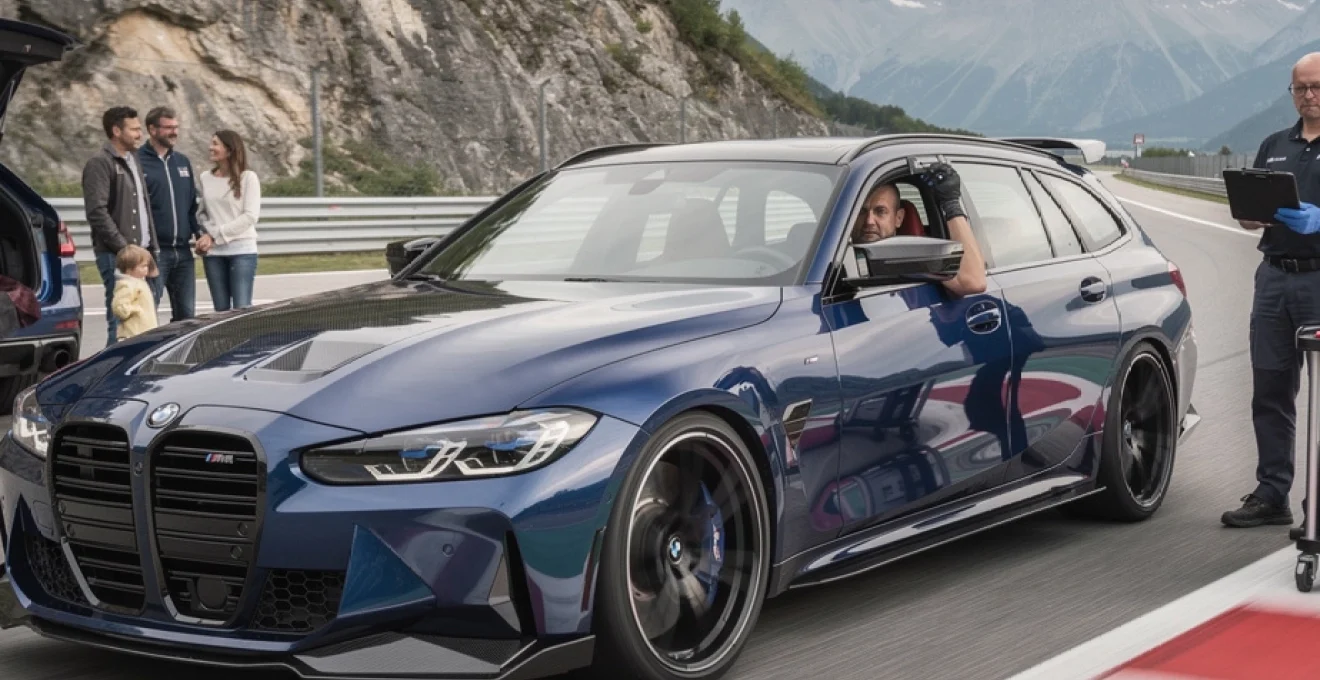
The BMW M3 Competition Touring represents a watershed moment in high-performance estate engineering, marking the first time BMW’s legendary M3 badge has adorned a wagon body style in the model’s illustrious 38-year history. This groundbreaking vehicle delivers the same exhilarating performance credentials as its saloon counterpart whilst offering the versatility and practicality that modern enthusiasts demand. With 503 horsepower channelled through an advanced all-wheel-drive system, the M3 Competition Touring challenges traditional automotive conventions, proving that blistering performance and everyday usability can coexist in perfect harmony.
BMW M3 competition touring S58 Twin-Turbo engine architecture and performance specifications
At the heart of the BMW M3 Competition Touring lies the formidable S58 powerplant, a masterpiece of engineering that represents the pinnacle of BMW’s inline-six cylinder development. This 2.993-litre twin-turbocharged unit produces an impressive 405 kW (551 hp) and delivers a substantial 650 Nm of torque, figures that place it firmly amongst the most potent engines in its class. The S58’s architecture builds upon decades of BMW’s straight-six expertise, incorporating advanced technologies such as closed-deck construction and forged internals to withstand the considerable forces generated during high-performance operation.
S58 3.0-litre Twin-Turbo Inline-Six power delivery and torque characteristics
The S58 engine’s power delivery characteristics exemplify modern turbocharging excellence, with peak torque available from just 2,650 rpm and maintained through to 6,130 rpm. This broad torque plateau ensures that the M3 Competition Touring delivers instantaneous throttle response across virtually the entire rev range, eliminating the traditional turbo lag associated with earlier forced-induction systems. The engine’s twin-scroll turbochargers operate in perfect synchronisation, with each turbo feeding three cylinders to optimise exhaust gas flow and minimise back-pressure.
BMW’s M TwinPower Turbo technology incorporates several sophisticated elements including high-precision direct injection, VALVETRONIC variable valve timing, and Double-VANOS continuously variable camshaft adjustment. These systems work in concert to deliver not only exceptional power output but also impressive fuel efficiency for such a potent engine. The result is a combined fuel consumption figure of 27.2-28.0 mpg, remarkable considering the engine’s 503-horsepower output.
M xdrive All-Wheel drive system integration and torque vectoring technology
The M xDrive all-wheel-drive system represents a fundamental shift from BMW’s traditional rear-wheel-drive M car philosophy, yet it enhances rather than compromises the driving experience. This intelligent system can distribute torque between the front and rear axles as conditions demand, with the ability to send up to 100% of power to the rear wheels when maximum performance is required. The system features three distinct operating modes: 4WD for maximum traction, 4WD Sport for a more rear-biased character, and 2WD for purist rear-wheel-drive dynamics.
The torque vectoring capabilities extend beyond simple front-to-rear distribution, with the system capable of directing power to individual wheels as needed. This sophisticated torque management allows the M3 Competition Touring to maintain exceptional stability during high-speed cornering whilst simultaneously delivering the agility and precision that defines the M3 driving experience. The system’s integration with the vehicle’s stability control and traction management systems ensures optimal performance across a wide range of driving conditions.
Active M differential and BMW M traction control performance optimisation
The Active M Differential serves as the cornerstone of the M3 Competition Touring’s dynamic capabilities, utilising an electronically controlled limited-slip differential to optimise rear axle traction. This system can vary lock-up from 0% to 100% depending on driving conditions, ensuring that power is always directed to the wheel with the greatest traction potential. The differential’s rapid response time allows it to react to changing conditions in milliseconds, providing seamless power delivery even under the most challenging
scenarios. Whether you are accelerating hard out of a tight bend or dealing with mixed-grip surfaces in poor weather, the Active M Differential works in harmony with the M xDrive system to keep the BMW M3 Competition Touring composed yet engaging. Rather than simply reigning in power with intrusive stability control, it proactively redistributes torque for a more natural, rear-driven feel.
Complementing this hardware is BMW M Traction Control, which offers up to ten levels of intervention. This allows you to tailor how much wheel slip is permitted, from secure grip in adverse conditions to a playful, track-oriented setup that lets you explore the chassis balance. Think of it as a finely graded dimmer switch for traction, rather than a simple on/off button. For drivers who enjoy fine-tuning their car’s behaviour, this combination of Active M Differential and M Traction Control transforms the M3 Competition Touring into a precision tool that can adapt to almost any road or circuit.
Competition package suspension tuning and adaptive M dampers calibration
The Competition specification of the BMW M3 Touring brings a bespoke suspension setup designed to handle both the considerable power of the S58 engine and the additional weight of the estate body. Spring and damper rates are tuned specifically for the Touring, with reinforced mounting points and revised elastokinematics that account for the longer roofline and extended rear overhang. The objective is clear: preserve the signature M3 agility and body control, while maintaining the stability and comfort expected from a premium performance estate.
Adaptive M dampers form the core of this suspension package, offering electronically controlled adjustment in milliseconds. Sensors constantly monitor wheel movement, body acceleration and steering inputs, enabling the system to vary damping force at each corner independently. In Comfort mode, the M3 Competition Touring rides with impressive compliance for a car on staggered 19- and 20-inch wheels, soaking up long motorway journeys with ease. Switch to Sport or Sport Plus, and the calibration tightens, reducing body roll and pitch to deliver the kind of flat, composed cornering you would normally associate with a dedicated sports car rather than a family estate.
Advanced chassis dynamics and M-Specific suspension technologies
Beyond its muscular engine and sophisticated all-wheel-drive system, the BMW M3 Competition Touring distinguishes itself through an advanced chassis package developed specifically for high-performance use. BMW M engineers have effectively built a track-capable machine around an estate shell, ensuring that every component from the front axle carrier to the rear subframe contributes to precision and stability. For enthusiasts who intend to exploit the car’s capabilities on both road and circuit, this chassis engineering is as important as the headline power figures.
One of the most impressive aspects of the M3 Competition Touring is how it manages to balance rigidity and ride quality. High levels of torsional stiffness allow the suspension to work with greater accuracy, while targeted use of lightweight materials helps keep mass in check. The result is a car that feels solid and predictable at high speed, yet responsive and alive when you push harder. If you have ever wondered how a 500+ hp estate can feel so composed on a challenging B-road, much of the answer lies in the M-specific suspension technologies working beneath the surface.
Adaptive M suspension professional with electronic damper control
Adaptive M Suspension Professional with Electronic Damper Control takes the concept of adjustable suspension to a higher level. While many performance cars offer simple “soft” and “firm” settings, the system in the BMW M3 Competition Touring uses a network of sensors and a sophisticated control unit to predict and respond to changing conditions in real time. It analyses steering angle, throttle position, braking force and body movement, then calculates the ideal damping force for each wheel. In effect, the car is constantly “reading” the road and your driving style, adjusting its posture accordingly.
This technology pays dividends on varied surfaces, such as typical British A-roads or Alpine passes, where smooth tarmac can quickly give way to patched repairs and mid-corner bumps. In Comfort mode, the M3 Touring glides over rougher sections with surprising suppleness for such a focused machine. Engage Sport or Sport Plus, and the dampers firm up to provide a more direct connection to the road, keeping the body flat and controlled even under heavy braking or rapid direction changes. For those who enjoy occasional track days, this ability to switch from long-distance comfort to circuit-ready composure at the touch of a button is a major advantage.
Variable sport steering ratio and M servotronic steering response
The steering system plays a crucial role in defining the character of any performance car, and in the BMW M3 Competition Touring it combines Variable Sport Steering with M Servotronic assistance. Variable Sport Steering uses a progressive rack that alters the steering ratio depending on how far you turn the wheel. Around the straight-ahead, the ratio is relatively relaxed for stability at motorway speeds; as you add more steering angle, the ratio quickens, making the car feel more agile in tight bends and during parking manoeuvres. It is rather like having two steering systems in one, optimised for both high-speed composure and low-speed responsiveness.
M Servotronic further refines the experience by adjusting power assistance according to road speed and selected driving mode. At low speeds, assistance is generous, so the M3 Touring feels light and effortless to manoeuvre, even in congested urban environments. As speed increases, assistance is reduced, giving a more weighty and communicative steering feel that keen drivers will appreciate. The tuning of the steering has been calibrated specifically for the Touring’s longer wheelbase and slightly higher mass, ensuring that you still get the classic M3 blend of accuracy and feedback, even when the boot is full and the family is on board.
Carbon fibre strut brace and aluminium space frame construction
To achieve the precise handling that defines the BMW M3 Competition Touring, BMW M has invested heavily in structural rigidity. A prominent example is the carbon fibre reinforced plastic (CFRP) strut brace that spans the front suspension towers. This lightweight component ties the upper sections of the chassis together, reducing flex under cornering loads and improving steering accuracy. Because carbon fibre offers exceptional stiffness-to-weight ratio, it strengthens the front end without adding unnecessary mass over the nose, which would otherwise compromise turn-in response.
Complementing the carbon brace is an aluminium space frame structure in the engine bay and additional bracing throughout the underbody. Together, these elements create a solid foundation for the suspension to work from, much like a well-built house needs a rigid frame before you can fine-tune the interior. You may not see these components from the driver’s seat, but you will certainly feel their effect when you tackle a series of fast, sweeping bends. The car resists twisting forces more effectively, keeping all four wheels planted and allowing the electronic dampers and M xDrive system to operate with maximum precision.
M compound braking system with blue painted callipers performance
With 503 hp on tap and a kerb weight in excess of 1,800 kg, the BMW M3 Competition Touring demands a braking system that matches its performance potential. The standard M Compound brakes feature large, ventilated discs and multi-piston fixed callipers at the front, with single-piston floating callipers at the rear. These components are designed to offer strong, consistent stopping power, even after repeated heavy braking on track. The distinctive blue painted callipers are not only a visual hallmark of M performance, but also a signifier of the system’s heat and fade resistance.
M Compound technology combines different materials to optimise performance and durability while keeping unsprung mass as low as possible. Lighter brake assemblies allow the suspension to react more quickly to bumps and surface imperfections, improving both comfort and grip. On the road, you will notice a firm, confidence-inspiring pedal feel, with progressive modulation that makes it easy to judge braking effort. Whether you are scrubbing off speed from motorway pace or trail-braking into a tight corner, the braking system works in harmony with the chassis and tyres to deliver precise, repeatable results. For drivers who demand even more, optional M carbon ceramic brakes are available in some markets, offering further improvements in fade resistance and reduced weight.
Estate practicality engineering and load space optimisation
While its performance credentials are impressive, the BMW M3 Competition Touring must also justify its estate badge with genuine practicality. Here, it delivers convincingly, offering a generous 500 litres of boot space with the rear seats in place and up to 1,510 litres when they are folded down. This puts it firmly among the most usable high-performance estates on the market. The boot floor is flat and wide, with a low loading sill that makes it easy to lift heavier items in and out. If you regularly transport bikes, pushchairs or bulky luggage, you will quickly appreciate how much more flexible this layout is compared to a conventional saloon.
BMW has also paid attention to the finer details of load space engineering. The rear seat backs fold in a 40:20:40 split, allowing you to carry longer items such as skis while still accommodating two rear passengers. Clever touches like load securing rails, luggage nets, shopping bag hooks and tie-down eyelets help keep items from sliding around during spirited driving. In some markets, the M3 Touring also features a separately opening rear window integrated into the tailgate, letting you access the boot without lifting the entire hatch. It is this blend of thoughtful practicality and high-speed stability that makes the M3 Competition Touring so appealing as a daily driver.
Competition package aerodynamics and carbon fibre body enhancements
The aggressive stance of the BMW M3 Competition Touring is not just for show; it reflects a carefully honed aerodynamic package tailored to the unique estate body. Compared with the standard 3 Series Touring, the M3 features a model-specific front apron with enlarged air intakes that channel cooling air to the engine, brakes and transmission. The frameless M-specific kidney grille, combined with a sculpted front splitter, helps manage airflow around the nose, reducing lift at high speed. Along the sides, flared wheel arches and pronounced side skirts smooth the transition between body and wheels, minimising turbulence.
At the rear, an aerodynamic diffuser and roof-mounted spoiler work together to enhance stability. The diffuser manages the airflow leaving the underbody, while the spoiler generates additional downforce over the rear axle. Optional carbon fibre exterior elements, such as the M Carbon exterior package, further sharpen both aesthetics and performance. These components include carbon mirror caps, a carbon rear diffuser and side inlays, all of which save weight high up on the car and contribute to a lower centre of gravity. For drivers who regularly explore the car’s higher speed capabilities, these subtle aerodynamic enhancements can mean the difference between a car that merely feels fast and one that feels planted and secure.
M drive professional technology and customisable performance modes
M Drive Professional is the digital brains behind much of the BMW M3 Competition Touring’s configurable character. Rather than locking you into a handful of fixed presets, it allows you to fine-tune the car’s behaviour to suit your driving style, your preferred roads or even a specific circuit. Engine response, damper stiffness, steering weight, brake feel, M xDrive mode and stability control intervention can all be adjusted independently. Once you have found a combination you like, you can save it to one of the red M1 or M2 buttons on the steering wheel for instant recall.
For those who enjoy occasional track use, M Drive Professional also introduces features such as M Laptimer and M Drift Analyser, which record performance data and provide feedback on your driving. Think of it as having a digital instructor on board, helping you understand where you are gaining or losing time. The system encourages you to hone your skills in a controlled environment, rather than on public roads, while still giving you access to the full breadth of the M3 Competition Touring’s adjustable setup. The result is a car that can feel civilised and relaxed one moment, then razor-sharp and track-ready the next.
M setup menu configuration and track mode calibration
Accessed via the central display, the M Setup menu is where you define the core personality of your BMW M3 Competition Touring. Within this interface, you can individually configure the engine (Efficient, Sport, Sport Plus), transmission shift logic, steering (Comfort, Sport), suspension (Comfort, Sport, Sport Plus), brake pedal feel (Comfort, Sport) and the M xDrive system (4WD, 4WD Sport, 2WD). You can also adjust the level of M Traction Control when stability systems are partially disabled. For enthusiasts, this level of granular control is a major attraction; it allows you to build a setup that feels uniquely yours.
Track Mode takes this configurability a step further by optimising the car’s systems specifically for circuit driving. When activated, non-essential driver assistance and comfort functions are dialled back or deactivated, and the central display focuses on performance metrics such as oil temperature, tyre pressures and lap timing. Instrument cluster graphics shift to emphasise revs and speed, giving you the critical information you need at a glance. If you plan to take the M3 Competition Touring to track days, experimenting with different M Setup configurations and Track Mode calibrations can help you unlock the car’s full potential while maintaining a safety net appropriate to your skill level.
Launch control system and M race track package integration
For those moments when you want to experience the BMW M3 Competition Touring’s full straight-line potential, the standard Launch Control system offers the most effective way to accelerate from a standstill. When engaged, Launch Control preconditions the drivetrain, optimising boost pressure, gearbox clutch engagement and traction control thresholds. All you need to do is hold the brake, floor the accelerator, and then release the brake when prompted. The result is a repeatable, explosive getaway that can consistently deliver the claimed 0–62 mph time of around 3.6 seconds in optimum conditions.
The optional M Race Track package, available in certain markets, is designed for drivers who regularly take their cars to high-speed events. It may include weight-saving features such as M carbon ceramic brakes, lighter wheels and reduced sound insulation, as well as extended performance data logging capabilities through M Drive Professional. By trimming unsprung mass and improving thermal management of key components, the package allows the M3 Competition Touring to sustain hard driving for longer without performance degradation. If you see your BMW as a genuine dual-purpose machine – family estate during the week, track tool at the weekend – this package is worth serious consideration.
Michelin pilot sport 4S tyre compound and 19-inch M forged wheels
Tyres are the only part of the car that actually touch the road, so their specification has a profound impact on how the BMW M3 Competition Touring behaves. From the factory, the car is typically equipped with Michelin Pilot Sport 4S tyres, chosen for their ability to blend dry grip, wet weather performance and everyday usability. These ultra-high-performance tyres provide the kind of lateral grip needed to make full use of the M3’s power and chassis, yet remain predictable and progressive at the limit. For a car expected to handle everything from school runs to spirited drives on challenging roads, this balance is critical.
The tyres are mounted on staggered 19-inch front and 20-inch rear M forged wheels, which are both lighter and stronger than conventional cast alloys. Reducing unsprung and rotational mass improves steering response, acceleration and ride compliance, as the suspension has less weight to manage. Visually, the intricate spoke designs highlight the car’s performance intent, especially when paired with the blue M Compound brake callipers or optional gold carbon ceramic callipers. For owners considering alternative tyre options, it is worth remembering that BMW’s development work with Michelin is extensive; sticking with a similar specification ensures you preserve the finely tuned dynamics that make the M3 Competition Touring so special.
Market positioning against audi RS6 avant and Mercedes-AMG C63 S estate
In the competitive world of high-performance estates, the BMW M3 Competition Touring occupies a distinctive niche. On paper, its closest rivals include the Audi RS4 Avant and Mercedes-AMG C63 S Estate, but many buyers will inevitably also consider the larger Audi RS6 Avant. Compared with the RS6, the M3 Touring is lighter and more compact, focusing on agility and driver engagement rather than outright size and presence. Its 3.0-litre twin-turbo inline-six may give away displacement to the Audi’s V8, but with 503 hp and 650 Nm, performance is virtually on par in real-world conditions, especially when you factor in the M3’s lower weight.
Against the outgoing Mercedes-AMG C63 S Estate with its V8, and the new hybrid four-cylinder C63 S E Performance, the BMW positions itself as the purist’s choice, retaining a classic six-cylinder layout without resorting to heavy electrification. This helps keep the kerb weight manageable, which in turn benefits steering feel, braking and chassis agility. For many enthusiasts, the appeal of a high-revving straight-six, paired with an eight-speed automatic and rear-biased all-wheel drive, will be stronger than that of a complex hybrid powertrain. If you value a more analogue, driver-focused experience in an increasingly electrified segment, the M3 Competition Touring stands out.
From a practicality standpoint, the BMW’s 500–1,510 litre load capacity compares favourably with its key rivals, easily accommodating family life, outdoor hobbies or long-distance touring. Running costs, of course, remain in line with what you would expect from a 500+ hp performance car, with fuel consumption in the high 20s mpg under WLTP conditions and CO2 emissions in the 230 g/km region. Yet for those who want a single vehicle that can deliver super-saloon performance, estate car practicality and genuine everyday usability, the BMW M3 Competition Touring presents a compelling proposition. It bridges the gap between traditional M3 saloon buyers and those who might otherwise have chosen a performance SUV, offering a unique blend of performance and practicality that few competitors can truly match.