The Aston Martin DB4 represents one of British automotive engineering’s most significant achievements, establishing the template for every subsequent Aston Martin model. Launched in 1958, this revolutionary grand tourer introduced groundbreaking Superleggera construction, Tadek Marek’s magnificent 3.7-litre straight-six engine, and Italian styling that defined automotive elegance for generations. With current market values ranging from £129,539 to £642,501 and a strong sell-through rate of 77%, the DB4 has evolved from a sophisticated sports car into a blue-chip investment opportunity. However, acquiring the right example requires extensive knowledge of production variations, technical specifications, and market dynamics that separate exceptional investments from costly mistakes.
Aston martin DB4 production history and series variations analysis
Series I through series V evolution and chassis modifications
The DB4’s production run from 1958 to 1963 encompassed five distinct series, each introducing significant mechanical and aesthetic refinements. Series I models, produced from October 1958 to January 1960, featured the original 240bhp 3.7-litre engine with twin SU carburettors and the characteristic uncowled round headlights that distinguish early examples. These inaugural models utilised a four-speed manual transmission without synchromesh on first gear, reflecting the era’s sporting character.
Series II development focused primarily on interior appointments and minor mechanical improvements, whilst Series III introduced more substantial changes including improved cooling systems and revised electrical components. The pivotal Series IV models, manufactured from September 1960 to October 1961, marked a watershed moment with the introduction of cowled headlights and the availability of the factory Vantage engine specification. This period also saw the launch of the convertible variant, adding another dimension to the DB4 family.
Series V represents the most evolved iteration of the DB4 platform, featuring a longer wheelbase, revised roofline, and enhanced aerodynamics that would directly influence the subsequent DB5 design. These final examples, produced from October 1961 to June 1963, incorporated lessons learned from competition experience and customer feedback, resulting in the most refined iteration of the original concept.
GT and zagato variants: rarity assessment and market premiums
The DB4 GT stands as perhaps the most desirable variant within the family, with only 75 examples constructed between 1959 and 1961. Built on a shortened wheelbase measuring five inches less than standard models, the GT featured extensive weight reduction measures, including thinner aluminium bodywork and stripped-out interiors. The competition-focused 302bhp engine specification utilised triple Weber carburettors and higher compression ratios to deliver genuine racing performance.
Even rarer are the 19 DB4 GT Zagato models, representing the pinnacle of 1960s British automotive craftsmanship. These bespoke creations featured unique bodywork penned by Ercole Spada, further weight reductions, and enhanced aerodynamics that enabled maximum speeds exceeding 150mph. Current market valuations for GT Zagato examples consistently reach seven-figure sums, reflecting their status as automotive art pieces rather than mere transportation.
The recent DB4 GT Continuation programme has introduced 25 additional examples built to original lightweight racing specifications, though these modern interpretations occupy a distinct market segment. Original period examples maintain their exclusivity and continue appreciating at rates exceeding broader classic car indices, making them suitable only for the most serious collectors with substantial financial resources.
Convertible models and limited production numbers impact
DB4 Convertible production remained deliberately limited, with only 70 examples manufactured between 1961 and 1963. These open-top variants featured structural reinforcements to compensate for the loss of roof rigidity, resulting in a marginal weight increase compared to their coupe counterparts. Touring of Milan’s styling expertise ensured that the convertible maintained the elegant proportions of the original design whilst providing genuine top-down motoring appeal.
The DB4 Convertible represents the ultimate expression of 1960s British grand touring philosophy, combining sophisticated engineering with the romance of open-
romance of open-air driving.
Within this already rare subset, the DB4 Convertible Vantage models occupy especially sought-after territory. With higher-compression engines, triple carburettors and subtle cosmetic changes, these cars deliver performance that rivals many contemporary sports cars while retaining full grand touring usability. Auction data since 2020 shows median prices in the £600,000–£650,000 range, with exceptional cars achieving in excess of £1.5 million, underscoring how scarcity and specification combine to amplify values.
The limited production numbers of all DB4 open cars create a strong floor under prices, even in softer market conditions. Unlike more common 2+2 coupés, convertibles rarely suffer from oversupply, and collectors often prioritise them for their dual appeal as both investment pieces and highly enjoyable weekend drivers. For buyers considering DB4 ownership primarily as a classic investment, the convertible’s constrained availability offers a compelling hedge against wider classic car market fluctuations.
Vantage specification engines and performance differentials
The Vantage specification transformed the DB4 from a fast grand tourer into a genuinely serious performance machine. While the standard Tadek Marek 3.7-litre engine produced around 240bhp with twin SU carburettors, Vantage variants adopted triple carburettor setups, higher-lift camshafts and, on some versions, revised cylinder heads and twin-plug ignition. In practical terms, this yielded power outputs edging towards or exceeding 266bhp in road trim and considerably more in GT specification.
On the road, the difference between a well-tuned standard DB4 and a genuine Vantage-spec car is immediately apparent. Vantage engines rev more freely, pull harder through the mid-range and feel notably more urgent at higher speeds, making the car far more suited to spirited driving or historic motorsport events. However, this extra performance does not come without trade-offs: carburettor balancing is more critical, fuel consumption increases, and maintenance must be more meticulous to preserve reliability.
From an investment perspective, correctly documented factory Vantage cars command a meaningful premium over standard-specification DB4s. Buyers must be aware that many cars have been retrospectively upgraded to Vantage tune over the decades, so paying “factory Vantage” prices demands watertight documentary evidence. As a rule of thumb, it is better to buy a well-documented, upgraded car at the right money than pay top-tier pricing for a purported Vantage with sketchy or incomplete records.
Pre-purchase technical inspection protocol for DB4 acquisitions
Superleggera construction assessment and structural integrity checks
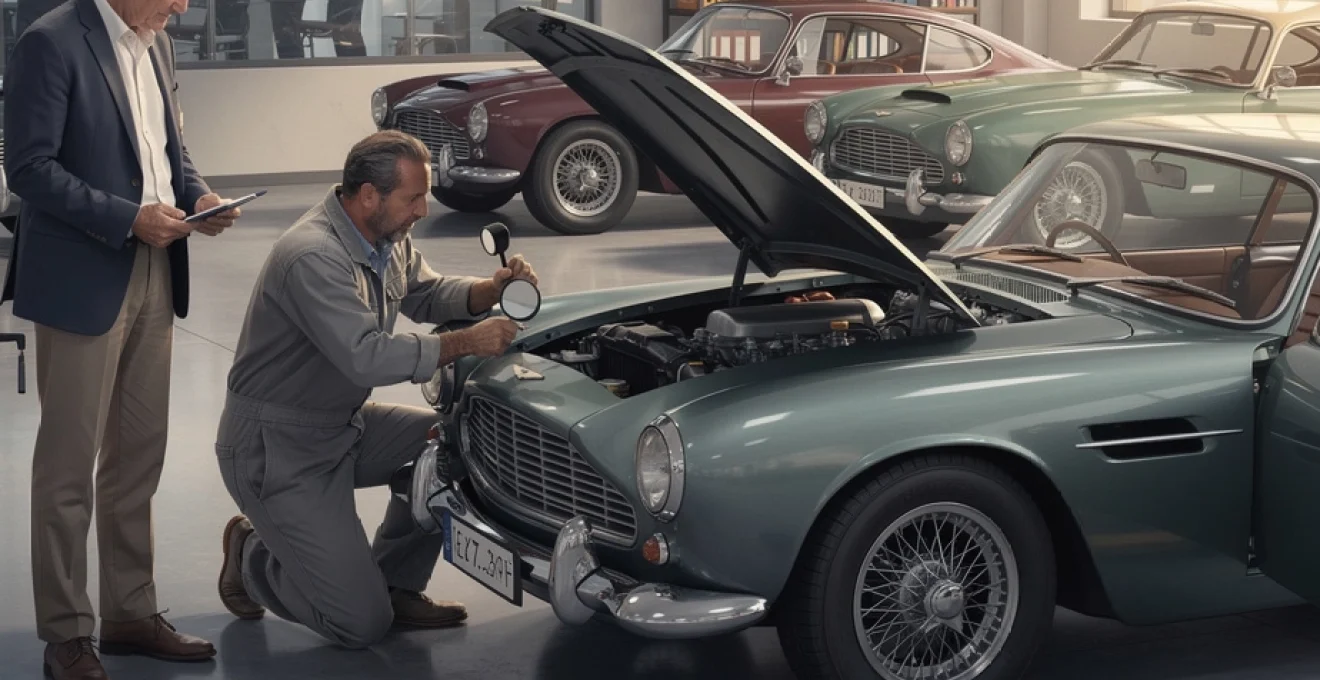
The DB4’s Superleggera construction, with aluminium panels over a tubular steel framework and steel chassis, is both its greatest strength and its most significant vulnerability. While the lightweight structure contributes to the DB4’s celebrated agility, it also creates multiple potential corrosion points where aluminium and steel meet, leading to electrolytic reaction over time. A proper pre-purchase inspection must therefore go far beyond a superficial check of paint quality and panel fit.
Begin with a careful examination of the sills, jacking points, front bulkhead, inner wings and the area where the floorpan meets the chassis rails. Any bubbling of paint, distortion of panel edges or misaligned doors can indicate underlying structural corrosion, often starting from the inside and working outwards. Inspect the lower door edges, rear wheel arches and spare wheel well, as these are classic water traps on a DB4.
Given the DB4’s values and construction complexity, you should always commission a marque specialist familiar with Superleggera Astons to undertake a detailed chassis and body inspection. This will typically involve removing undertrays, lifting carpets and, where appropriate, using a borescope to inspect box sections from the inside. Think of this stage as a structural survey on a period property: expensive, perhaps, but infinitely cheaper than discovering major rot after purchase.
Tadek marek 3.7-litre engine condition evaluation methods
The Marek-designed 3.7-litre straight-six is fundamentally robust, but neglect or poor maintenance can turn it into a costly liability. A systematic engine evaluation should start with a cold start, observing oil pressure rise, idle stability and any unusual noises such as timing chain rattle or bottom-end knock. Once warm, a healthy DB4 should hold oil pressure at or above roughly 65psi at 3,000rpm, and maintain even, smooth running without misfires.
Compression and leak-down tests are essential when buying a used Aston Martin DB4, particularly where there is no evidence of a recent engine rebuild by a reputable specialist. You should expect even readings across all six cylinders; significant variation may indicate worn rings, valve issues or head gasket problems. Pay close attention to cooling system behaviour as well: early DB4s were known to suffer from marginal cooling, and blocked coolant galleries at the rear of the block can lead to localised overheating and cracked heads.
Visual checks should include inspection for oil/water contamination, coolant staining around core plugs, and evidence of historic overheating such as discoloured paint or warped components. Confirm service history with particular emphasis on oil change intervals, timing chain replacement and carburettor overhauls. An engine that has been rebuilt once to a high standard is usually a safer long-term investment than one that appears untouched since the 1960s.
David brown gearbox and transmission system analysis
Most DB4s were equipped with a four-speed manual gearbox, with early units lacking synchromesh on first gear. Later cars and DB5/DB6 successors received the ZF five-speed unit, but many DB4 buyers still prefer the original David Brown gearbox for its period-correct feel. When test-driving, you should expect a firm, mechanical shift action that improves as the gearbox warms up; excessive baulking, graunching on upshifts or reluctance to stay in gear suggest wear in synchros, bearings or selector mechanisms.
A thorough transmission inspection for any used Aston Martin DB4 must also include the clutch, propshaft and differential. Listen for clonks or whines when taking up drive, especially when moving on and off the throttle at low speeds. Oil leaks around the rear axle or gearbox output seals are common with age but can be expensive to rectify properly if the car needs partial disassembly.
Borg-Warner three-speed automatic units were offered in period and, while generally reliable, can blunt the DB4’s character and are less favoured by purist collectors. If you are considering an automatic car, check for smooth, timely shifts and ensure kickdown functions correctly under load. As with manual cars, any slamming into gear, delay in engagement or slipping under acceleration indicates looming rebuild costs that must be factored into your purchase decision.
Girling disc brake system and suspension component inspection
The DB4’s all-round disc brakes were advanced for their time, offering superior stopping power compared to many contemporaries. Over the years, however, corrosion in caliper pistons, ageing flexible hoses and tired master cylinders can degrade braking performance. During inspection, ensure the car brakes in a straight line without judder, pulling or excessive pedal travel, and visually check discs for scoring, cracking or severe lip wear.
The suspension uses coil springs and wishbones at the front with a live rear axle, a layout that can still feel beautifully composed when correctly set up. Unfortunately, many DB4s now suffer from seized dampers, perished bushes and worn ball joints, leading to vague steering and poor body control. A specialist inspection should include checking all rubber components, steering box adjustment, and the condition of anti-roll bar mounts and rear axle location points.
Think of the DB4’s chassis and running gear as the foundation of your investment. A slightly tired interior is comparatively cheap to refurbish; a car requiring comprehensive suspension and brake work will quickly consume five-figure sums. When in doubt, prioritise structural and mechanical soundness over cosmetic perfection, especially if you plan to drive and enjoy your Aston rather than store it as a static exhibit.
DB4 market valuation methodology and price determinants
Hagerty price guide benchmarks and auction house comparatives
Establishing a realistic value for a used Aston Martin DB4 requires triangulating several data sources rather than relying on a single headline figure. Specialist valuation tools and insurers’ guides, such as the Hagerty Price Guide, provide useful benchmarks for different conditions (fair, good, excellent, concours) and body styles, but they must be cross-referenced with recent auction results and dealer asking prices. Since 2020, public sales have recorded DB4s changing hands between approximately £130,000 at the lower end and over £640,000 for exceptional examples, with a median around £280,000.
To refine your view, analyse results from major auction houses such as Bonhams, RM Sotheby’s and Gooding & Company, paying particular attention to specification, history and restoration status of each car. Are the highest prices being achieved by Series V cars, Vantage models, or early Series I examples with distinctive features? Does a freshly restored car by a top-tier specialist command a significant premium over an older, albeit honest, restoration? These nuances will help you understand why seemingly similar DB4s can differ in price by six figures.
One further factor is the relatively thin trading volume of DB4s; with only a limited number built and even fewer coming to market each year, individual results can distort perceived trends. That is why you should consider at least two to three years of sales data and focus on patterns rather than singular record-breaking headlines. In many ways, valuing a DB4 is closer to appraising fine art than to pricing a modern used car.
Matching numbers verification and documentation authentication
For investment-grade DB4s, verifying matching numbers is a critical step in protecting your capital. “Matching numbers” generally refers to the car retaining its original chassis, engine and, ideally, gearbox, as recorded on factory build sheets and heritage certificates. Over the decades, many DB4s have received replacement engines or major components, particularly when factory-rebuilt units were fitted in the 1960s–1980s without comprehensive record-keeping.
The best approach is to obtain documentation from Aston Martin’s heritage department or recognised marque archivists, cross-referencing stamped numbers on the car with official records. Be wary of any reluctance from the seller to share high-resolution photographs of number stampings or to allow independent verification during inspection. Minor period-correct components can be forgiven; unaccounted-for changes in major assemblies should be reflected in a lower purchase price.
Equally important is the authenticity of the paperwork itself. Always check for inconsistencies in registration dates, ownership timelines or mileage claims, and scrutinise old invoices and MOT records for continuity. In an era of rising classic values, forged documentation and restamped components are not unheard of, so a professional opinion from a trusted Aston Martin specialist is money well spent.
Restoration quality grading systems and concours standards
Not all restored DB4s are created equal, and understanding restoration quality is essential when comparing cars at similar headline prices. Some clubs, insurers and auction houses use an informal grading from Condition 1 (concours) to Condition 4 (driver/project), but the substance behind these labels can vary widely. A genuine concours-standard DB4 will have undergone a nut-and-bolt restoration by a reputable Aston Martin specialist, with photographic documentation, invoices and, often, awards to prove its calibre.
At the next tier down, a high-quality older restoration may show minor patina but still present superbly and drive as intended. These cars can be sweet spots for enthusiasts, offering close to concours quality without the full concours premium. Conversely, a cosmetic “refresh” hiding structural or mechanical issues can be a value trap for unwary buyers, especially if fresh paint and new leather mask underlying corrosion or tired running gear.
As you evaluate restoration quality, ask yourself: is this a car to show, to drive, or both? There is little point in paying show-car money if you intend to use the DB4 as a regular event car, accumulating stone chips and road grime. Understanding your intended usage will help you decide how much to pay for differing levels of finish and originality.
Provenance research and ownership history impact on values
Provenance can add a substantial premium to DB4 values, particularly where cars have notable first owners, period competition history or appearances in film and media. A DB4 Convertible once owned by a prominent entertainer, or a GT with documented period racing success, will naturally attract more interest and higher bids than an otherwise similar but anonymous car. In this sense, provenance acts like an additional layer of rarity on top of already limited production numbers.
However, provenance cuts both ways. Gaps in ownership history, murky import/export records or unresolved accident damage can depress values and complicate future resale. When researching an Aston Martin DB4 as a classic investment, look for continuous ownership chains, regular servicing by known specialists and, ideally, membership in the Aston Martin Owners’ Club with appearances at events and rallies.
Ultimately, you are not just buying a machine; you are acquiring a story. The richer, better documented and more verifiable that story is, the stronger the long-term demand will be when you eventually decide to sell.
Investment performance tracking against classic car indices
To judge how well a DB4 might perform as part of a diversified investment portfolio, it helps to view it alongside broader classic car indices such as those compiled by Historic Automobile Group International (HAGI) or similar trackers. Over the past decade, blue-chip collectable cars have generally outperformed many traditional asset classes in certain periods, albeit with higher volatility and lower liquidity. Within this context, DB4 values have shown robust growth punctuated by occasional plateaus and corrections.
When you compare the price trajectory of Aston Martin DB4s with the wider market, a pattern emerges: top-tier cars with the best provenance and restoration quality tend to follow or exceed the gains of general indices, while average examples can lag or prove more vulnerable in downturns. That is why the mantra “buy the best you can afford” carries particular weight in the DB4 market. If you treat your purchase as a long-term holding—five to ten years or more—the short-term fluctuations become less important than the underlying rarity and desirability of the model.
Practically, you can track performance by maintaining a simple record of comparable sales each year, noting specification, series, body style and condition of cars sold. This personal index, combined with subscription market reports and auction catalogues, will give you a more nuanced view than any single published graph. Remember, though, that unlike shares, you can drive this asset to a historic rally or concours event, which is a form of “dividend” no financial instrument can match.
Professional restoration costs and specialist workshop selection
Restoring an Aston Martin DB4 to a high standard is an expensive and time-consuming exercise, often costing significantly more than first-time buyers anticipate. Full, body-off restorations by leading UK or European Aston specialists typically fall in the £250,000–£350,000 range, and truly no-expense-spared projects can exceed this. As a result, it is usually far more cost-effective to buy the best completed car you can find rather than attempting to rescue a derelict project, unless you are specifically seeking a long-term restoration endeavour.
Choosing the right workshop is critical. Look for firms with a proven track record in DB4, DB5 and DB6 restoration, strong references from previous clients and a portfolio of finished cars visible at major events. A reputable specialist will welcome questions, provide detailed quotations and timelines, and supply progress photography throughout the process. Be wary of surprisingly low estimates or vague, open-ended pricing; with a Superleggera car, “scope creep” can turn a modest refurbishment into a major structural rebuild.
When budgeting, remember that restoration is not an all-or-nothing proposition. You might commission a targeted programme focusing on structural repairs, chassis and drivetrain, leaving interior trim and minor cosmetics for a later phase. This staged approach allows you to spread costs while ensuring the DB4 remains safe and mechanically sound. Regardless of scale, always formalise the scope of work in writing and agree clear milestones, so both you and the workshop share aligned expectations.
DB4 ownership economics and long-term appreciation forecasting
Owning a used Aston Martin DB4 is as much a lifestyle decision as a financial one, and the economics reflect this dual character. Annual running costs—including specialist servicing, insurance, storage and incidental repairs—can easily reach £3,000–£5,000 for a well-maintained example, with a prudent contingency for unexpected work on older restorations. Fuel consumption, tyre wear and classic insurance are modest concerns compared to the potential outlay for engine, gearbox or structural work if neglected.
On the upside, depreciation is not typically a significant factor with correctly bought DB4s. Unlike modern supercars, which often lose a substantial percentage of value in their first years, a well-chosen DB4 tends to hold its value and, over the medium to long term, has historically appreciated in line with or ahead of other blue-chip classics. Forecasting exact future returns is impossible, but the combination of limited supply, high cultural profile and increasing global interest in 1960s grand tourers suggests that quality cars will remain in demand.
How should you approach DB4 ownership from an investment standpoint? First, buy the best car you can comfortably afford, prioritising structural integrity, documented history and specialist care over superficial glamour. Second, treat maintenance as you would service charges on a prime property: an ongoing cost that protects the long-term value of the asset. Finally, take advantage of what makes classic car investment unique—you can enjoy the driving experience, social scene and sense of occasion that comes with every journey. In that sense, a well-chosen Aston Martin DB4 offers a return that goes far beyond the balance sheet.