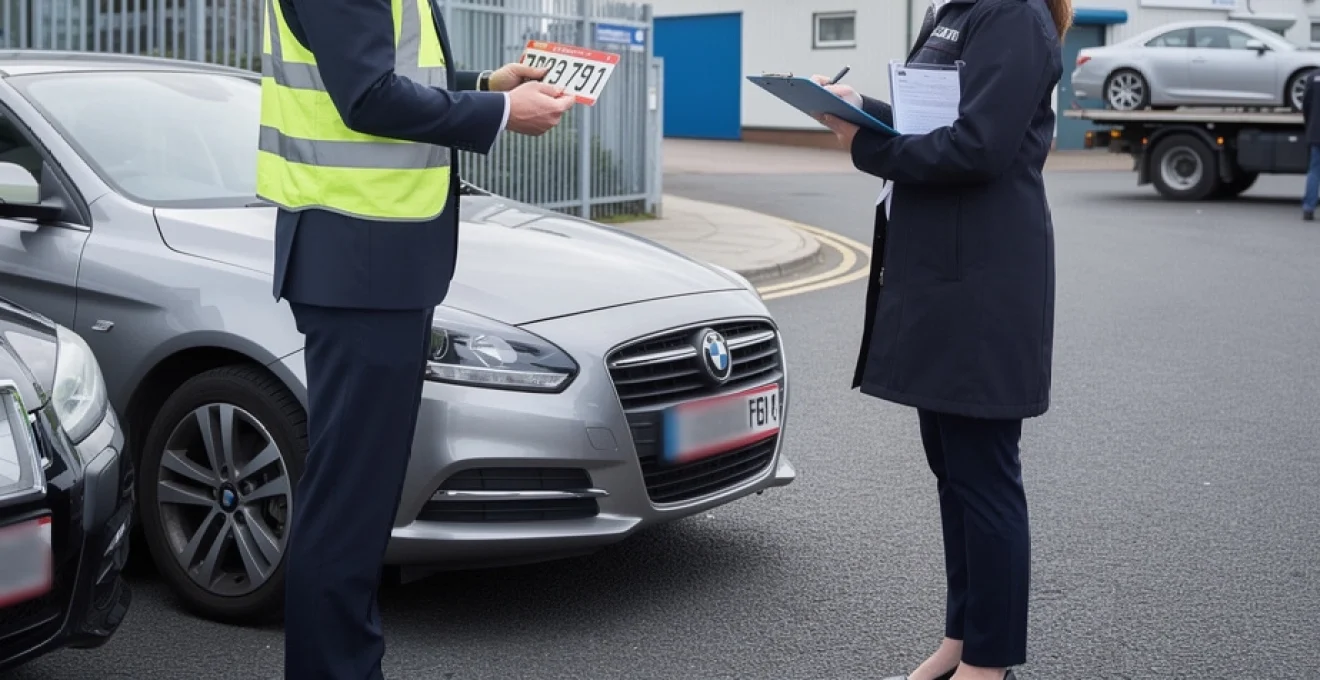
The question of borrowing trade plates in the UK represents one of the most misunderstood aspects of motor trade law, with potentially severe legal and financial consequences for those who get it wrong. Trade plates serve as temporary registration solutions for motor trade businesses, allowing the movement of unregistered or untaxed vehicles for specific commercial purposes. However, the legal framework surrounding their use is both complex and strictly enforced, creating significant risks for unauthorised usage.
Understanding the legitimate circumstances under which trade plates can be borrowed requires a thorough examination of current UK legislation, DVLA regulations, and motor industry compliance standards. The penalties for misuse are substantial, ranging from hefty fines to criminal prosecution, making proper knowledge essential for anyone considering temporary trade plate arrangements.
Understanding UK trade plates legal framework and DVLA regulations
The legal foundation governing trade plates in the United Kingdom operates under a comprehensive regulatory framework designed to prevent abuse whilst facilitating legitimate motor trade activities. This system requires strict adherence to specific conditions that determine who can lawfully use these temporary registration plates.
Motor dealers’ licences act 1975 requirements for trade plate eligibility
The Motor Dealers’ Licences Act 1975 establishes the fundamental criteria for trade plate eligibility, restricting their use to bona fide motor trade businesses. Under this legislation, only individuals or companies actively engaged in vehicle manufacturing, repairing, testing, or dealing can obtain trade plates. The Act specifically excludes private individuals from eligibility, regardless of their relationship with licensed motor traders.
This legislation creates a clear distinction between authorised motor trade professionals and general members of the public. The regulatory framework recognises that trade plates represent a privilege rather than a right, requiring ongoing compliance with specific business activities. Motor traders must demonstrate continuous engagement in qualifying activities, with the DVLA conducting periodic reviews to ensure ongoing eligibility.
DVLA form V796 application process and documentation standards
The application process for trade plates involves completing DVLA Form V796, which requires comprehensive documentation proving legitimate motor trade activities. Applicants must provide evidence of their business registration, motor trade insurance coverage, and specific details about intended plate usage. The documentation standards are particularly rigorous, reflecting the potential for abuse inherent in trade plate privileges.
Motor trade insurance represents a critical component of the application process, with policies specifically designed to cover trade plate usage. Standard private motor insurance policies typically exclude trade plate activities, creating potential coverage gaps that could leave users financially exposed. The DVLA requires proof of appropriate insurance before issuing trade plates, emphasising the importance of proper coverage arrangements.
Statutory conditions under vehicle excise and registration act 1994
The Vehicle Excise and Registration Act 1994 establishes statutory conditions governing trade plate usage, creating legally binding obligations for licence holders. These conditions specify permitted activities, display requirements, and record-keeping obligations that must be maintained throughout the licence period. Violation of statutory conditions can result in licence revocation and criminal prosecution.
Record-keeping requirements under the 1994 Act mandate detailed documentation of every journey undertaken using trade plates. This includes vehicle identification details, journey purposes, dates, times, and driver information. The comprehensive nature of these requirements reflects the regulatory emphasis on preventing unauthorised usage and ensuring accountability.
Distinction between red and silver trade plates legal classifications
UK trade plates operate under two distinct classifications: red plates for general motor trade use and silver plates for vehicle testing purposes. Red plates permit the widest range of activities, including vehicle demonstrations, delivery, and repair-related movements. Silver plates restrict usage to specific testing activities conducted by approved vehicle testing organisations.
The legal distinctions between plate types create different borrowing implications, with silver plates generally subject to more restrictive lending arrangements due to their specialised nature. Understanding these classifications becomes crucial when considering temporary usage arrangements, as activities permitted under one type may be prohibited under another.
Authorised trade plate borrowing scenarios under UK motor industry law
Despite widespread misconceptions about trade plate borrowing restrictions, specific circumstances exist where temporary usage arrangements may be legally permissible. These scenarios typically involve formal business relationships between licensed motor traders and require careful
documentation to ensure both parties remain within the scope of DVLA regulations. In nearly all lawful cases, the plates are not truly “borrowed” in a casual sense; instead, they are used under the control and responsibility of the licence holder, usually with formal agreements in place. If you are asking whether a private individual can simply take a trader’s plates for a day, the answer is almost always no.
To understand when trade plate sharing can lawfully occur, it helps to think of the plates as an extension of the licensed business, rather than a physical object that can be lent like a set of tools. Where another business or driver uses those plates, they are effectively operating as an arm of the licence holder, and the licence holder carries the legal risk for any misuse. This principle underpins every authorised trade plate borrowing scenario under UK motor industry law.
Vehicle recovery operations and breakdown service provider exemptions
One of the more nuanced areas involves vehicle recovery operators and breakdown services. In some cases, a recovery business may have its own trade plates for moving unregistered or untaxed vehicles as part of its commercial activities. Where that is the case, the recovery operator is not truly “borrowing” plates; they are using plates issued to their own business under their own motor trade insurance policy and DVLA licence.
Confusion often arises when a motor dealer asks a recovery company to move a vehicle using the dealer’s trade plates. Legally, this is only acceptable if the vehicle movement falls squarely within the dealer’s permitted uses and the driver is acting as an agent of the dealer for that journey. Think of it as the dealer “extending” their business arm to the recovery operator for that specific task. The plates remain under the dealer’s legal control, and the dealer can be held responsible for any misuse.
However, many reputable recovery firms prefer to avoid this arrangement altogether and instead use their own taxed and registered recovery trucks, or their own trade plates where appropriate. From a risk management perspective, this keeps liability clear and avoids arguments about whether a driver was properly authorised, whether the vehicle was insured, and whether the journey met DVLA trade use conditions.
Motor trader business partnership arrangements and liability transfers
Another scenario where trade plates might appear to be “borrowed” involves formal partnerships or joint ventures between motor trade businesses. For example, two dealers may collaborate on transporting stock between sites, or a specialist workshop may move vehicles on behalf of a main dealer. In these situations, can one business use the other’s trade plates? Potentially, but only under tightly controlled conditions.
Legally, the DVLA recognises only the licence holder named on the trade licence. Any driver using those plates must be acting on behalf of that licence holder, under their authority and within the permitted business purposes stated on the application. If a partner business uses another trader’s plates, they must do so as an agent of the plate holder, and the plate holder remains responsible for ensuring valid motor trade insurance, MOT compliance and journey records.
This is why robust written agreements and clear internal policies are so important. If something goes wrong – an accident, ANPR detection, or an insurance dispute – the question will not be “who had physical possession of the plates?” but “whose licence was being used, and were DVLA rules followed?”. Without documented authority and a clear paper trail, both parties may find themselves exposed to enforcement action.
Temporary vehicle testing and pre-registration movement protocols
Temporary vehicle testing and pre-registration movements represent another common source of confusion about borrowing trade plates. When a vehicle needs to be taken to a DVLA inspection, emissions test, or other regulatory check before registration, can someone else’s trade plates lawfully be used to cover that journey? In strict legal terms, only if the journey falls within the licence holder’s authorised motor trade activities and they maintain full control and responsibility.
Where a dealer, importer or specialist restorer arranges for a professional driver to move a vehicle on their trade plates, the driver is typically treated as an employee or contracted agent. The key is that the purpose of the journey – for example, taking a classic import to a DVLA office for identity verification – must be one of the permitted uses declared on the trade plate licence. Even then, the vehicle must be roadworthy, insured for that specific use, and (where required) have a valid MOT or exemption.
For private owners of kit cars, imported classics or restorations, this is where problems arise. You may be tempted to “borrow” a friendly trader’s plates for a one-off run to an inspection centre, especially if the car is insured and mechanically sound. However, if you are not part of that business and are driving purely for your own private purposes, you are outside the legal framework for trade plate use. In the event of a stop, you and the trader risk enforcement action, and your insurance may refuse cover on the basis of illegal use.
Auction house transportation and trade-to-trade vehicle transfers
Auction houses and trade-to-trade transfers are among the most frequent legitimate use cases for trade plates. Vehicles arrive at auctions untaxed and sometimes unregistered, and licensed traders move stock to and from these sites using their own plates. Where confusion sets in is when a non-licensed buyer asks, “Can I borrow your plates to drive my purchase home?”. In almost every case, the lawful answer is no.
What is often lawful is a trader or auction-related transport company moving the vehicle on its own plates, with one of their drivers behind the wheel. In this situation, the vehicle movement remains a business activity of the licence holder – for example, delivering auction stock to a customer or transferring it between trade premises. The buyer may pay for this service, but they are not themselves using the plates; they are paying a business that is operating within its licence conditions.
Consider an analogy: you are not “borrowing” a haulier’s Operator’s Licence when they carry goods for you; you are purchasing a service that operates under their licence and insurance. The same principle applies to trade plate movements. If an auction buyer wants to drive the vehicle personally on a trader’s plates, they step outside that framework and potentially into illegal trade plate use, even if everyone involved believes the arrangement is harmless.
Penalties and legal consequences for unauthorised trade plate usage
The penalties for unauthorised or improper trade plate use can be far more severe than many drivers realise. At the most basic level, misuse of trade plates can be prosecuted under the Vehicle Excise and Registration Act 1994 and related regulations, with fines that can reach several thousand pounds. In more serious cases, or where deliberate fraud is involved, criminal convictions and even custodial sentences are possible.
From a practical standpoint, there are three main layers of risk: criminal law, DVLA administrative sanctions, and insurance consequences. Criminal law addresses offences such as using a vehicle without valid vehicle excise duty, using trade plates for non-trade purposes, or permitting a vehicle to be driven in a dangerous or unroadworthy condition. DVLA sanctions include revoking or refusing to renew the trade licence, which can effectively shut down a motor trader’s core operations overnight.
Insurance implications can be equally serious. If a vehicle is involved in an accident while using trade plates illegally – for instance, a private driver using a dealer’s plates for personal transport – an insurer may argue that the policy does not respond because the vehicle was being used contrary to policy terms and DVLA rules. In such cases, the Motor Insurers’ Bureau may still compensate third parties, but they can seek to recover costs from the driver or business involved, leaving them with a substantial financial liability.
It is also worth considering the reputational and commercial damage that can follow from trade plate misuse. A business that loses its trade licence or faces a publicised prosecution may struggle to obtain affordable motor trade insurance in future, and customers may question its professionalism and compliance culture. When viewed against these risks, the perceived convenience of “borrowing” plates for a favour or one-off journey starts to look like a very expensive shortcut.
DVLA enforcement mechanisms and trade plate compliance monitoring
Given the potential for abuse, how does the DVLA actually monitor trade plate compliance? In reality, enforcement is multi-layered and increasingly data-driven. Automatic Number Plate Recognition (ANPR) systems, roadside checks by the police and DVSA, and targeted audits of motor trade businesses all play a role in identifying suspicious or non-compliant trade plate usage.
ANPR cameras can flag vehicles displaying trade plates in unusual patterns – for example, regular commuter-style journeys at the same times each day, or vehicles parked on the public highway overnight with trade plates attached. While trade plate use is not illegal in itself, these patterns may trigger closer scrutiny, particularly if they suggest plates are being used in place of proper vehicle taxation for personal transport.
On the ground, police officers are well aware of the potential for trade plate misuse and often adopt a “stop and check” approach where something looks amiss. Officers may ask for proof of the journey’s purpose, details of the motor trade business, and evidence that the driver is authorised to use the plates. This is where proper record-keeping – required under the Vehicle Excise and Registration Act 1994 – becomes essential. If a trader cannot produce journey logs or explain why a vehicle was being used, enforcement action becomes far more likely.
Behind the scenes, the DVLA also conducts periodic reviews of trade licence holders, checking that their business activities justify continued access to trade plates. Declining sales volumes, minimal workshop activity or inconsistent insurance arrangements can all raise red flags. In recent years, enforcement has become more robust, reflecting wider government efforts to tackle vehicle tax evasion and road safety issues. For traders, this means that a lax approach to plate usage and record-keeping is no longer just risky – it is actively unsustainable.
Alternative legal solutions for non-licensed vehicle movement requirements
For private individuals or businesses without a motor trade licence, the reality is simple: you cannot lawfully treat trade plates as a shortcut around registration and tax. So what legal alternatives exist if you need to move an unregistered, untaxed or imported vehicle? Fortunately, there are several legitimate options, each suited to different situations and budgets.
The most straightforward solution is often professional vehicle transport. Using a recovery truck, flatbed, or trailer operated by a licenced carrier keeps the vehicle off the road in legal terms, so trade plates, tax and registration are not required. You are paying for a service rather than borrowing a licence. This option is particularly appropriate for non-running projects, SORN vehicles, or cars that you know are not yet roadworthy enough for a test drive, even if insured.
Where a vehicle is roadworthy and insured, short-term or temporary cover can sometimes be arranged once a registration number has been allocated, even if the vehicle is not yet taxed. In some circumstances, you may be able to use the legal exemption that allows driving to and from a pre-booked MOT test without tax, provided the journey is genuinely for that purpose and all other legal requirements are met. However, this exemption is narrow and does not extend to general journeys or DVLA inspections unrelated to MOT testing.
In the case of imported or radically restored vehicles awaiting inspection, it may be possible to request that DVLA or its agents attend your premises, reducing or eliminating the need to drive the car on public roads before registration. While this is not guaranteed and may involve longer waiting times, it can be a safer route than trying to engineer a questionable journey using someone else’s trade plates. If in doubt, taking advice from a specialist import or kit car registration consultant can save you significant time and potential legal exposure.
Ultimately, if you do not hold a motor trade licence, the safest approach is to assume that you cannot legally borrow trade plates in the UK for your own use. Instead, focus on arrangements that keep responsibility with properly licensed businesses, maintain clear insurance cover, and comply fully with DVLA rules. It may involve more planning and modest extra cost, but compared to the financial and legal fallout of trade plate misuse, these lawful alternatives offer far better value – and far greater peace of mind.