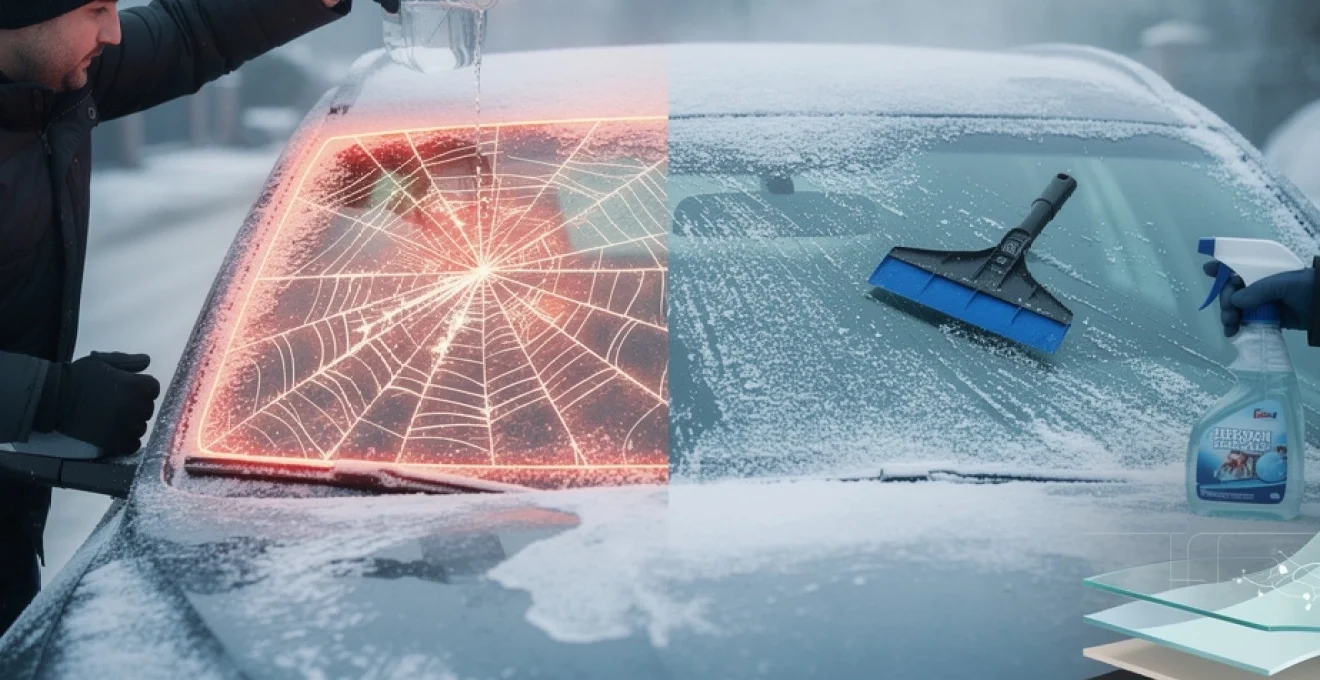
Winter mornings bring the inevitable challenge of frozen windscreens, leaving countless drivers wondering about the safest methods to clear ice from their vehicles. The temptation to reach for the nearest water source is understandable when you’re running late for work, but thermal shock poses significant risks to automotive glass. Understanding the physics behind glass fracture mechanics and proper de-icing techniques can save you from costly windscreen replacements and potential safety hazards. Modern automotive glass technology incorporates sophisticated laminated safety features, yet these protective elements can become vulnerabilities when subjected to extreme temperature differentials.
Professional automotive glaziers report thousands of windscreen replacement claims annually due to improper de-icing methods, with cold water application ranking among the most common causes of thermal damage. The relationship between temperature differential thresholds and glass failure rates demonstrates why industry experts consistently advise against water-based de-icing approaches. Whether you’re dealing with light frost or heavy ice accumulation, the principles of thermal expansion and contraction remain constant, making knowledge of proper de-icing methodologies essential for every vehicle owner.
Thermal shock physics: understanding glass fracture mechanics on frozen windscreens
The phenomenon of thermal shock occurs when materials experience rapid temperature changes that exceed their capacity for thermal expansion or contraction. In automotive windscreens, this process involves complex interactions between different glass layers, adhesive interlayers, and temperature gradients that can create catastrophic failure points. When you pour cold water onto a frozen windscreen, you’re essentially creating a thermal battlefield where microscopic stress patterns propagate through the glass structure at incredible speeds.
Automotive glass manufacturers design windscreens to withstand gradual temperature changes, but sudden thermal shocks can overwhelm these protective mechanisms. The crystalline structure of ice contracts at approximately 51 parts per million per degree Celsius, while standard soda-lime glass contracts at roughly 9 parts per million per degree Celsius. This differential creates uneven stress distribution across the windscreen surface, particularly around existing chip damage or installation stress points.
Temperature differential thresholds for automotive glass failure
Research conducted by automotive glass testing laboratories indicates that temperature differentials exceeding 40°C can initiate crack propagation in compromised windscreens. When frozen windscreens typically register temperatures between -5°C to -15°C, introducing cold tap water at 5°C to 10°C may seem relatively safe, but the rapid change still creates significant thermal stress. The critical factor isn’t necessarily the absolute temperature difference, but rather the rate of change and the presence of pre-existing stress concentrators in the glass.
Professional glaziers document that windscreens with existing stone chips measuring just 2-3mm in diameter can experience complete failure when subjected to thermal shock events. The stress concentration around these microscopic damage points amplifies the effects of thermal expansion, creating fracture initiation sites that can propagate across the entire windscreen surface within seconds.
Laminated safety glass stress distribution under rapid heating
Modern windscreens utilise laminated safety glass construction, incorporating two glass layers bonded with a polyvinyl butyral (PVB) interlayer. This design creates unique thermal stress patterns during rapid temperature changes, as each component responds differently to thermal expansion forces. The PVB interlayer maintains flexibility across a wide temperature range, but the glass layers can develop independent stress patterns that compromise overall structural integrity.
When cold water contacts the outer glass surface, thermal contraction occurs primarily in the outer layer while the inner layer remains relatively warm. This creates a thermal gradient that generates significant bending stresses perpendicular to the windscreen surface. Laboratory testing demonstrates that these bending stresses can exceed the tensile strength of automotive glass within milliseconds of water contact, particularly when ambient temperatures drop below -10°C.
Borosilicate vs standard Soda-Lime glass thermal expansion coefficients
While borosilicate glass offers superior thermal shock resistance compared to standard soda-lime automotive glass, cost considerations limit its widespread adoption in vehicle manufacturing. Borosilicate glass features a thermal expansion coefficient of approximately 3.3 parts per million per degree Celsius, significantly lower than the
standard soda-lime glass used in most windscreens, which typically ranges between 8 and 9 parts per million per degree Celsius. In practice, this means borosilicate glass can tolerate much steeper temperature gradients before internal stresses reach critical levels. However, the manufacturing infrastructure for automotive glazing is optimised around soda-lime formulations, and the additional cost and retooling required for borosilicate adoption would significantly increase vehicle prices. For everyday drivers, this reinforces why you should treat a frozen windscreen made from standard glass with care and avoid any aggressive hot-or-cold water tricks that rely on “getting away with it”.
The difference in thermal expansion coefficients also explains why some household glassware survives sudden temperature changes while a car windscreen might not. Laboratory beakers and premium cookware often use borosilicate glass specifically to resist thermal shock, but automotive engineers prioritise optical clarity, impact resistance, and cost over extreme thermal tolerance. When you pour cold water on a frozen windshield, you are effectively pushing soda-lime glass much closer to its thermal limits than most people realise, especially if there are hidden manufacturing stresses or previous repair zones in the glass.
Microscopic crack propagation patterns in sub-zero conditions
Even if a frozen windscreen looks flawless to the naked eye, microscopic flaws are almost always present within the glass matrix. Under sub-zero conditions, these micro-cracks behave like tiny fault lines that can suddenly activate when exposed to thermal stress from cold water or rapid heating. High-speed imaging studies show that once a crack begins to propagate, it can travel at speeds exceeding 1,000 metres per second, turning a small blemish into a full-width fracture in a fraction of a second. This is why many drivers report hearing a sharp “ping” followed by a spreading crack line immediately after pouring water on a frozen screen.
Temperature plays a critical role in how these microscopic cracks behave. In very cold weather, glass becomes slightly more brittle, reducing its ability to absorb and redistribute stress. Pouring cold or lukewarm water on a windscreen that is far below freezing introduces sharp temperature gradients across these weak points, concentrating tensile stress at the crack tips. Over time, repeated minor thermal shocks can lengthen existing micro-cracks even if no visible damage appears at first, making the glass more vulnerable to future impacts from road debris or another harsh defrosting attempt.
Professional de-icing methodologies for automotive windscreen management
Understanding the risks of thermal shock raises an important question: if water is risky, what is the best way to de-ice a car windscreen safely and efficiently? Professional de-icing methodologies focus on controlled temperature changes and chemical solutions that lower the freezing point of water, rather than brute-force heating. Automotive technicians and roadside assistance experts consistently recommend a combination of mechanical removal, chemical de-icers, and gentle warming from the vehicle’s own systems. When used correctly, these methods clear a frozen windshield quickly without exposing the glass to dangerous temperature differentials.
By adopting the same strategies used by fleet operators and emergency services, you can build a repeatable routine for winter mornings that is both safe for your car and efficient for your schedule. Instead of improvising with boiling kettles, salt, or makeshift scrapers, you rely on proven tools such as isopropyl alcohol solutions, commercial de-icer sprays, and purpose-built plastic scrapers. Not only does this reduce the risk of windscreen cracks, it also helps maintain visibility, protect wiper blades, and extend the lifespan of expensive driver-assistance sensors that are often integrated into modern windscreens.
Isopropyl alcohol solution ratios for safe ice removal
One of the most popular DIY options that aligns with professional practice is an isopropyl alcohol de-icing solution. Isopropyl alcohol (IPA) has a much lower freezing point than water (around -89°C), which makes it highly effective at breaking down ice on contact without introducing severe thermal shock. The key is to get the ratio right: too much water and the solution can refreeze; too much alcohol and you may waste product unnecessarily or risk damaging certain rubber components over time.
A widely recommended starting point is a mixture of two parts 70% isopropyl alcohol to one part water, with a small amount of mild dish soap (just a few drops per litre) to help the solution spread evenly across the glass. This ratio keeps the freezing point low enough for typical winter conditions while still being cost-effective for regular use. You simply pour the mixture into a spray bottle, apply it evenly over the frozen windscreen, and allow it to sit for 30–60 seconds before using a plastic scraper or wipers to remove the slush. Have you ever noticed how commercial de-icers seem to “magically” melt ice? Many rely on very similar alcohol-based chemistry.
Commercial de-icer spray applications: ethylene glycol vs propylene glycol
Commercial de-icer sprays offer a convenient, ready-made alternative to home-mixed alcohol solutions, but not all formulations are identical. Two common base ingredients are ethylene glycol and propylene glycol, both of which act as antifreeze agents by lowering the freezing point of water. Ethylene glycol has been used for decades in engine coolants and de-icing products due to its effectiveness, but it is toxic if ingested and can be harmful to pets and the environment if overused or improperly disposed of. Propylene glycol, by contrast, is less toxic and is often found in “safer” or more environmentally friendly de-icer options.
From a practical standpoint, both glycol types can melt ice effectively when sprayed onto a frozen windshield, but application technique matters as much as chemistry. You should hold the can or bottle 20–30 cm from the glass, spray a light, even coat, and allow the product to work for a minute before scraping. Over-spraying wastes product and may leave streaks that require additional cleaning. Always check the label to confirm compatibility with automotive paint, rubber seals, and plastics, and avoid aerosolising de-icer in confined garages where vapours can build up. Used properly, commercial de-icers can be a fast, low-effort solution that avoids the thermal risks associated with pouring water on a frozen windshield.
Lukewarm water temperature protocols for emergency situations
Despite all the warnings, there may be situations where water is the only realistic option—perhaps you are away from home without de-icer or scraper, and the windscreen is heavily iced. In these genuine emergencies, controlled use of lukewarm water can be safer than guessing with cold or hot water, provided you follow strict temperature protocols. Aim for water that is around 25–30°C, roughly the temperature you’d use for a baby’s bath: comfortably warm to the touch, but nowhere near scalding. Anything hotter dramatically increases the risk of thermal shock, especially when the glass is well below freezing.
Technique is just as important as temperature. Instead of pouring directly onto the centre of the frozen windshield, start by gently wetting a small area at the top or by pouring the water onto the painted metal roof just above the glass so it runs down gradually. This reduces the temperature gradient and allows the glass to warm more uniformly, much like letting a cold pan warm slowly on a low heat rather than plunging it into boiling water. Always be prepared for rapid refreezing if the air temperature is extremely low (below about -5°C), and immediately use the wipers or a scraper to remove the slush before it turns into an even tougher layer of ice.
Plastic ice scraper techniques to prevent surface scratching
Mechanical scraping remains one of the safest and most reliable ways to deal with a frozen windscreen when done correctly. However, using the wrong tool—or the right tool in the wrong way—can leave swirl marks, micro-scratches, or even deeper gouges in the glass and surrounding trim. That is why experts recommend purpose-built plastic ice scrapers with smooth, beveled edges rather than improvised tools like credit cards, metal spatulas, or dustpans. These plastic blades are designed to be firm enough to break ice but soft enough not to etch the glass.
For best results, hold the scraper at a shallow angle of about 30–45 degrees relative to the glass and use steady, overlapping strokes rather than aggressive stabbing or chiselling motions. Think of it like planing thin shavings of ice off a surface, not hacking at it with a chisel. Start at the bottom of the windscreen where ice tends to be thinner due to residual engine heat, then work your way up. If you’ve pre-treated the glass with de-icer or a warm air blower, you’ll often find that the ice comes off in large, satisfying sheets with minimal effort. Regularly check the scraper’s edge for nicks or burrs, as these can concentrate pressure and increase the risk of scratching.
Remote engine start systems for gradual cabin warming
One of the most elegant solutions to frozen windscreens doesn’t involve you standing outside at all: remote engine start systems and built-in preconditioning functions. Many modern vehicles, especially hybrids and electric cars, allow you to activate the climate control system from a key fob or smartphone app. When configured correctly, the car can begin warming the cabin, defrosting the windscreen, and even heating the seats while you finish your morning routine indoors. This gradual warming process is gentle on the glass because the temperature increase is controlled and originates from inside the vehicle, reducing steep gradients across the windscreen.
However, it’s important to use these systems responsibly. In conventional petrol or diesel cars, prolonged idling can be illegal in some jurisdictions, and insurers may deny theft claims if you leave the car running unattended and unlocked—an increasingly common crime known as “frost-jacking”. Whenever possible, lock the vehicle while it is running, stay within sight, and follow local regulations regarding idling. For electric vehicles, preheating while plugged in is often ideal, as it uses grid power rather than draining the battery’s driving range. Either way, remote preconditioning offers a safe alternative to risky quick fixes like pouring cold water on a frozen windshield.
Windscreen replacement cost analysis following thermal damage
Ignoring the risks of thermal shock can quickly turn a simple winter annoyance into a major expense. A cracked windscreen caused by pouring water on a frozen windshield often cannot be repaired with a small resin fill; instead, it frequently requires a full replacement. In the UK, typical windscreen replacement costs for mainstream vehicles can range from £300 to £700, depending on make, model, and whether advanced driver assistance systems (ADAS) such as lane-keeping cameras or rain sensors are integrated into the glass. Premium or specialist vehicles can exceed £1,000 for an OEM (original equipment manufacturer) screen.
These headline figures do not always tell the whole story. Modern windscreens often require calibration of cameras and sensors after installation, adding another £100–£300 to the bill. There is also the hidden cost of time: arranging the appointment, waiting for mobile technicians, and potentially being off the road if the vehicle cannot be safely driven until the replacement is complete. When you weigh these costs against the price of a decent scraper and a bottle of de-icer, it becomes clear that taking shortcuts with hot or cold water is a false economy.
Insurance implications of DIY de-icing damage claims
Many drivers assume that if a windscreen cracks while they are de-icing the car, their insurance will simply pick up the tab with minimal questions. In reality, the implications can be more complex, especially if unsafe practices are involved. Some insurers treat windscreen cover as a separate benefit with its own excess and claim rules, which may be more lenient than standard accident claims. However, if an investigation suggests that you caused the damage through negligent behaviour—such as pouring boiling water on a frozen windscreen or leaving the vehicle unattended with the engine running—your claim could be challenged or your excess increased at renewal.
There is also the issue of theft while de-icing, which has become so common that it now has its own nickname: “frost-jacking”. If you leave your car running on the driveway with the keys inside while you go back into the house, and someone steals it, many policies explicitly refuse to cover the loss. From an insurer’s perspective, knowingly increasing the risk to your vehicle is avoidable negligence. By using safe, recommended techniques—like scrapers, de-icer sprays, and supervised engine warm-ups—you not only protect your windscreen but also keep your insurance position as strong as possible.
Preventative windscreen protection systems for sub-zero climates
Of course, the most effective way to deal with a frozen windshield is to stop it freezing in the first place. Preventative windscreen protection systems focus on creating physical or chemical barriers between the glass and the frost-forming moisture in the air. Simple solutions include external windscreen covers that attach via door flaps or mirror hooks and can be removed in seconds to reveal clear glass beneath. For drivers with off-street parking, full car covers provide even wider protection against frost, snow, and ice buildup on every surface, not just the windscreen.
There are also coatings and treatments that claim to reduce ice adhesion, making any frost easier to remove in the morning. These hydrophobic products work a bit like non-stick cookware, encouraging water to bead and slide off rather than form a thick, bonded layer of ice. While they cannot eliminate freezing entirely, they can significantly cut scraping time and reduce the temptation to reach for risky shortcuts like pouring cold water on a frozen windshield. Combine this with sensible parking choices—such as facing the car away from prevailing winds or using the shelter of a building—and you can dramatically reduce winter stress on both your schedule and your glass.