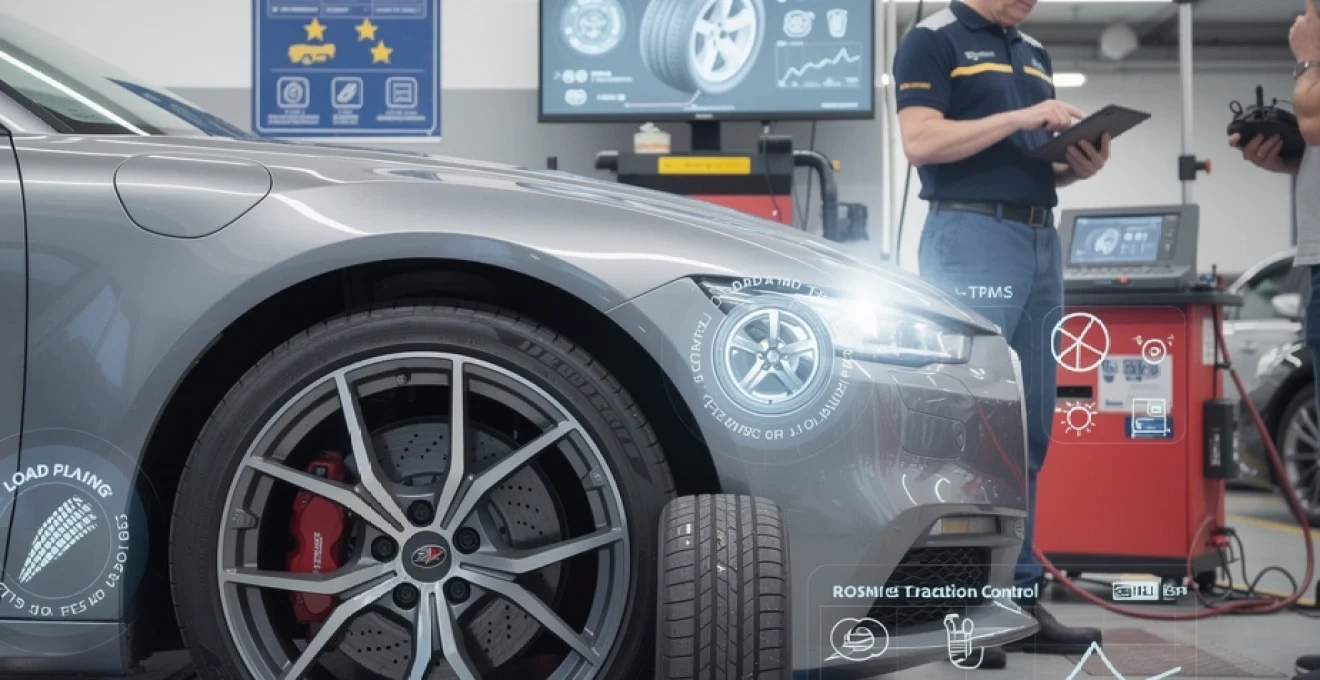
The question of running different tyres on front and rear axles has become increasingly relevant as motorists seek to optimise their vehicle’s performance while managing costs effectively. With modern vehicles featuring sophisticated electronic stability systems and varying weight distributions, understanding the implications of mixed tyre configurations is crucial for both safety and legal compliance. The practice, commonly referred to as tyre staggering, involves fitting different brands, tread patterns, or even tyre types between the front and rear positions, and while legally permissible in many circumstances, it requires careful consideration of multiple technical and regulatory factors.
Tyre staggering regulations and legal requirements across vehicle categories
The legal framework surrounding mixed tyre configurations varies significantly across different vehicle categories and jurisdictions. In the UK, the Road Traffic Act 1988 and subsequent regulations establish that tyres must meet minimum standards for construction, tread depth, and load capacity, but do not explicitly prohibit different brands or patterns between axles. However, the critical requirement remains that tyres on the same axle must be identical in terms of construction type, ensuring that radial and cross-ply tyres are never mixed on the same side of the vehicle.
DVSA MOT testing standards for mixed tyre configurations
The Driver and Vehicle Standards Agency (DVSA) has established clear guidelines for MOT testing when vehicles present mixed tyre configurations. During MOT inspections, testers focus primarily on ensuring that tyres on the same axle match in terms of construction type and meet minimum tread depth requirements of 1.6mm across the central three-quarters of the tyre width. The regulations do permit different brands or tread patterns between front and rear axles, provided each individual tyre meets the required safety standards.
Modern MOT testing protocols specifically check for dangerous mixing scenarios, such as combining radial and bias-ply construction types on the same axle, which can lead to unpredictable handling characteristics and potential vehicle instability. Testers also examine tyre condition more broadly, looking for signs of irregular wear patterns that might indicate alignment issues or inappropriate tyre mixing that affects vehicle dynamics.
Insurance policy implications of running different front and rear tyres
Insurance considerations for mixed tyre configurations often depend on whether the setup complies with manufacturer recommendations and legal requirements. Most comprehensive motor insurance policies do not explicitly exclude coverage for vehicles running different tyre brands front to rear, provided the configuration meets legal standards. However, insurers may scrutinise claims more closely if an accident involves a vehicle with non-standard tyre combinations, particularly if the mixing contributed to the incident.
Professional motor assessors increasingly evaluate tyre configurations during claim investigations, recognising that inappropriate mixing can affect braking distances, handling characteristics, and overall vehicle stability. Some specialist insurance providers offer specific coverage for modified vehicles with staggered tyre setups, acknowledging the performance benefits when properly implemented.
Manufacturer warranty void conditions for Non-Matching tyre setups
Vehicle manufacturers typically specify approved tyre specifications in their warranty documentation, with some explicitly stating that non-compliance may affect warranty coverage. Premium manufacturers like BMW, Mercedes-Benz, and Audi often provide detailed tyre recommendations, including approved brands and specifications for different driving conditions. Deviation from these recommendations, particularly in performance vehicles, may impact warranty claims related to suspension, drivetrain, or electronic stability systems.
However, most mainstream manufacturers acknowledge that tyre replacement is a consumable maintenance item and focus warranty restrictions on ensuring that replacement tyres meet minimum load index and speed rating requirements rather than mandating specific brands. The key consideration is whether the mixed tyre configuration affects vehicle systems that remain under warranty protection.
EU tyre labelling regulation ECE-R117 compliance requirements
The European tyre labelling regulation ECE-R117, which continues to apply in the UK post-Brexit, establishes standardised performance metrics for fuel efficiency, wet grip, and external rolling noise. When mixing tyres front and rear, understanding these performance ratings becomes crucial for maintaining balanced vehicle dynamics. Wet grip performance, rated from A to G, significantly affects braking distances and cornering stability, making it essential to avoid dramatic performance disparities between axles.
Rolling resistance coefficients, also standardised under ECE
Rolling resistance coefficients, also standardised under ECE-R117, directly influence fuel consumption and CO₂ emissions. When you run different tyres front and rear, you may be combining, for example, a low-rolling-resistance “A” rated tyre on one axle with a “C” or “D” rated product on the other. While this is not illegal, it can create an imbalance in the way the vehicle reacts under acceleration and deceleration, particularly in long, fast bends where subtle differences in grip and resistance become more apparent. For fleets and high-mileage drivers, understanding these labels and aiming for broadly comparable ratings across both axles is an important part of staying compliant and maintaining predictable handling.
Technical compatibility assessment between front and rear tyre specifications
Once the legal framework is understood, the next step is a technical compatibility check between your front and rear tyres. Mixing tyres front and rear is not just about brand names; it is about ensuring that critical specifications such as load index, speed rating, construction type, and tread pattern all work harmoniously with your vehicle’s weight distribution and chassis setup. Think of the tyre package as a matched set of running shoes for your car: you can wear different colours on each foot, but the sole stiffness, grip and size must still complement each other, or your “gait” will suffer.
Load index differential analysis and vehicle weight distribution
The load index is a numerical code that indicates the maximum weight a tyre can safely support at a given pressure. On many front-engined cars, the front axle carries a significantly higher static load due to the weight of the engine, steering components and, in some cases, the gearbox. As a result, the manufacturer may specify a higher load index for the front than for the rear, or vice versa on rear-engined and high-performance vehicles like some Porsche models.
When you run different tyres front and rear, it is essential that each tyre at least meets – and preferably exceeds – the manufacturer’s minimum load index for its axle. Fitting a lower load index tyre on a heavily loaded axle can lead to carcass overheating, premature wear and, in extreme cases, structural failure. If you are tempted to save money with a lower-rated tyre on the lighter axle, you should still consider dynamic loads: heavy braking, towing, or carrying passengers can shift significant weight forwards or rearwards, temporarily increasing load demands. A professional tyre service can perform a load distribution assessment, factoring in your typical usage, to ensure your mixed setup remains within a safe operating envelope.
Speed rating compatibility matrix for mixed tyre applications
The speed rating indicates the maximum sustained speed the tyre can tolerate under load, denoted by letters such as H, V, W, or Y. Legally, tyres must meet or exceed the vehicle’s maximum design speed, as stated in the handbook or on the vehicle’s specification plate. When running different tyres front and rear, the lowest speed rating in the set effectively determines the overall limitation, regardless of the higher ratings on the other axle.
From a safety and insurance standpoint, you should avoid combining a very high-speed-rated tyre on one axle (for example, a Y-rated performance tyre) with a significantly lower-rated tyre (such as an H or T rating) on the other, even if both technically exceed the legal minimum. In real-world terms, this can result in uneven heat build-up and divergent grip behaviour at motorway speeds. For consistency, many experts recommend matching speed ratings across all four positions; where that is not possible, ensure that both tyres on the same axle share the same rating, and that all ratings are at least equal to the manufacturer’s guidance.
Tread pattern directional flow and aquaplaning risk evaluation
Modern tyres use sophisticated tread designs – directional, asymmetric or symmetric – to channel water away from the contact patch and reduce aquaplaning. When you mix tyres front and rear with very different tread patterns, you are effectively giving each axle a different “water management strategy”. This can be acceptable, but you need to understand how it affects wet weather behaviour. For example, pairing a highly directional, wet-focused tread on the rear with an older symmetric pattern on the front may result in the rear axle evacuating water more efficiently than the front.
This imbalance can increase the risk of front-axle aquaplaning, where the steering tyres lose contact with the road while the rear retains grip, causing a sudden loss of directional control. Conversely, if your grip-biased tyres are on the front and older, shallower-tread tyres are on the rear, you may experience oversteer in heavy rain as the rear tyres aquaplane sooner. A useful analogy is skis with different bases: one pair glides smoothly while the other drags, making it harder to predict your line. To reduce these risks, aim to keep broadly similar tread philosophies (for example, asymmetric performance tyres) on both axles and always place the tyres with the deepest tread and best wet rating on the rear.
Rolling resistance coefficient variations and fuel economy impact
Rolling resistance describes the energy lost as a tyre deforms and recovers while rolling, expressed as a coefficient often summarised on the EU label. If you mix low-rolling-resistance eco tyres on the front with higher-resistance performance tyres on the rear, your fuel economy gains may be smaller than expected and your car’s balance under throttle can feel subtly different. On front-wheel-drive cars, for example, fitting low-resistance tyres on the driven axle can improve economy but also reduce mechanical grip compared with a grippier compound on the rear, potentially altering understeer and oversteer behaviour in fast corners.
For electric vehicles and hybrids, where efficiency is paramount, mixing tyres with significantly different rolling resistance can also affect range estimates and energy recuperation patterns. While there is no prohibition on such combinations, it is wise to check the fuel efficiency (or energy efficiency) ratings for each tyre and avoid extreme mismatches. In practice, selecting tyres with adjacent label grades (for instance, B and C rather than A and E) across both axles helps maintain predictable performance while still delivering a tangible fuel saving.
Sidewall construction differences between radial and cross-ply configurations
Modern passenger cars almost exclusively use radial construction, in which the reinforcing cords run perpendicular to the direction of travel with additional belt layers under the tread. Cross-ply (or bias-ply) designs, once common, arrange the cords at angles, giving a stiffer, more uniform sidewall. Mixing radial and cross-ply tyres on the same vehicle is strongly discouraged and is often outright illegal when done on the same axle, because the handling differences are profound. Radial tyres tend to offer more flexible sidewalls, better grip and improved comfort, while cross-ply designs can feel harsher and more abrupt at the limit.
If you were to run radial tyres on the front and cross-ply on the rear (or vice versa), the vehicle would react differently at each end to steering inputs, bumps and lateral loads, creating a “hinge” effect in fast corners. This is why regulatory authorities and MOT standards insist that tyres on the same axle share the same construction type, and most manufacturers recommend using the same construction across all four wheels. In practical terms, if your vehicle is already on radial tyres – as almost all modern cars are – you should stick with radials front and rear and avoid niche or agricultural cross-ply products that might appear to fit dimensionally but are not compatible dynamically.
Electronic stability systems integration with asymmetric tyre setups
Today’s vehicles rely heavily on electronic driver aids such as ABS, traction control and ESP (Electronic Stability Program) to keep you safe in a wide range of conditions. These systems monitor wheel speeds, steering angle, yaw rate and brake pressure, then intervene when they detect a loss of grip. When you run different tyres front and rear, you are effectively changing the grip envelope at each axle, which in turn can influence the way these systems interpret data. While the software is usually robust enough to cope with modest differences, extreme or poorly chosen combinations can make calibration less effective.
ESP calibration challenges with michelin pilot sport vs continental ContiSport contact combinations
Consider a performance car originally calibrated on a specific tyre model, such as Continental ContiSport Contact, now running Michelin Pilot Sport tyres on one axle and the original Continentals on the other. Both are premium, high-grip tyres with similar performance intentions, yet they differ in compound formulation, carcass stiffness, and ultimate grip levels. ESP systems are typically tuned around the baseline understeer and oversteer behaviour of a particular tyre “family”; altering that balance can shift the point at which the system intervenes.
In practice, you might notice ESP cutting in earlier during hard cornering if the rear tyres offer more grip than the front, or later if the opposite is true, allowing the car to slide slightly more before the system reacts. This does not mean such combinations are unsafe, but it does highlight the importance of keeping tyres with comparable performance characteristics at each end of the car. If you are mixing models – Pilot Sport at the rear and ContiSport at the front, for instance – try to stay within the same performance category and generation, and avoid combining a brand-new, ultra-grippy design with a much older model on the opposite axle.
ABS modulation frequency adjustments for mixed compound configurations
Anti-lock braking systems (ABS) prevent wheel lock-up by rapidly pulsing brake pressure when they detect that a tyre is about to skid. The system assumes broadly similar friction characteristics at all four corners; when you fit tyres with different compounds and tread depths front and rear, you change how quickly each tyre transitions from static to sliding friction. Softer, newer tyres on the rear might maintain grip longer than harder, worn tyres on the front, prompting earlier ABS activation at the front axle.
On a dry road, the impact may be minimal, but in wet or icy conditions the ABS control unit may have to work harder and cycle pressure more frequently. In extreme mix-and-match cases – for example, high-performance sports tyres on the driven axle and budget touring tyres on the non-driven axle – braking distances and stability can be compromised. For drivers who regularly undertake emergency stops (urban driving, taxi work, delivery fleets), keeping compounds and tread depths reasonably close between axles helps the ABS maintain optimal modulation and keeps stopping distances predictable.
Traction control algorithm adaptation requirements
Traction control systems limit wheelspin under acceleration by reducing engine torque and, in some cases, applying brake pressure to individual wheels. On rear-wheel-drive cars, fitting significantly grippier tyres on the rear than on the front can reduce the frequency of traction control interventions but may also mask an inherent front-end grip deficit, leading to increased understeer. Conversely, on front-wheel-drive cars, upgrading the front tyres while leaving worn or budget tyres on the rear can cause the rear axle to feel nervous in low-grip conditions as the front “pulls” the car around bends.
While most modern traction control algorithms are adaptive, they cannot fully compensate for severe mismatches in tyre performance. If you notice the system intervening more frequently after changing only one axle’s tyres – for example, the traction control light flickering during modest acceleration in the wet – it could be a sign that your mixed setup is pushing the software outside its comfort zone. In such cases, aligning tyre types and tread depths across axles, or consulting a specialist for advice on recommended combinations, is advisable.
TPMS sensor recalibration protocols for different tyre pressures
Tyre Pressure Monitoring Systems (TPMS) come in two main types: direct, which use sensors inside each wheel to measure pressure, and indirect, which infer pressure changes from wheel speed data. When you introduce different tyres front and rear, you may also run slightly different recommended pressures, particularly if the load index or tyre construction varies. This makes correct TPMS recalibration even more critical after fitting or rotating tyres, to avoid nuisance warnings or, worse, missed alerts when a genuine pressure loss occurs.
With direct TPMS, ensure that each sensor is correctly programmed to its new position if tyres are rotated, and that target pressures are updated according to the vehicle manufacturer’s table. For indirect TPMS, which relies on comparing rolling circumferences, mixing tyres with significantly different wear levels or constructions can trigger false low-pressure alerts as the system interprets normal differences in wheel speed as a deflation. After installing mixed sets, follow the recalibration procedure in your owner’s manual – typically a reset button or menu command – and monitor the system for a few days to confirm stable operation.
Performance motorsport applications of staggered tyre configurations
In motorsport and high-performance track driving, running different tyres front and rear – or, more commonly, different sizes and compounds – is not just accepted but often essential. Many rear-wheel-drive sports cars, such as the BMW M-series or Porsche 911 models, come from the factory with wider rear tyres to handle higher torque loads and provide better traction. Track-day enthusiasts may take this further by selecting grippier compounds or semi-slick tyres on the driven axle while maintaining slightly less extreme tyres at the front to fine-tune balance.
On a circuit, engineers use staggered tyre configurations to tune understeer and oversteer characteristics, taking into account track layout, ambient temperature and driver preference. For instance, a car that naturally understeers might benefit from a more aggressive front tyre to increase turn-in bite, while one that oversteers could gain stability from a more conservative rear tyre choice. However, these decisions are made with detailed data logging, experienced driver feedback and, often, bespoke suspension setup changes. For road users considering motorsport-style tyre staggering, it is important to remember that what works on a warm, predictable racetrack with run-off areas does not necessarily translate safely to wet public roads with unpredictable hazards.
Vehicle handling dynamics with asymmetric tyre compound selection
Even outside full motorsport environments, many drivers experiment with different tyre compounds front and rear to adjust handling behaviour. Asymmetric compound selection might involve fitting high-performance summer tyres on the rear and slightly more comfort-oriented tyres on the front, or vice versa. Each combination shifts the balance between grip, steering feel and ride quality. For a rear-wheel-drive coupe, grippier rear tyres can provide reassuring traction when accelerating out of bends, but if the front tyres are comparatively less capable, the car may feel reluctant to turn and exhibit safe but pronounced understeer.
On the other hand, fitting the most aggressive tyres on the front axle of a front-wheel-drive hot hatch can sharpen turn-in and braking, yet leave the rear end comparatively looser, particularly in the wet or during sudden lane changes. This scenario can catch out less experienced drivers, as the car may rotate more readily than expected if the rear tyres suddenly let go. A useful way to think about this is to imagine a shopping trolley with two different types of casters: if the front wheels grip more than the rear, direction changes become more abrupt. To maintain predictable everyday handling, most tyre professionals advise keeping compounds within the same performance “family” and ensuring the highest overall grip level is found on the rear axle.
Maintenance scheduling and replacement strategy for mixed tyre systems
Once you have decided to run different tyres front and rear, a structured maintenance and replacement strategy becomes even more important. Mixed tyre systems tend to wear at different rates depending on drivetrain layout, driving style and tyre compound, so simply waiting until all four tyres reach the legal minimum tread depth is rarely the best approach. Instead, you should plan regular inspections – ideally every month or every 1,000 miles – to monitor tread depth, sidewall condition and any emerging irregular wear patterns that might signal alignment or suspension issues.
When it comes to replacement scheduling, a common strategy is to replace tyres in axle pairs, always maintaining identical models on each side of an axle. If your front tyres wear out significantly faster, you may choose to keep your existing rear tyres and fit a fresh pair at the front, provided the performance profiles remain compatible. However, tyre experts increasingly recommend fitting new tyres to the rear axle, even on front-wheel-drive cars, to reduce the risk of oversteer in wet conditions. In practice, this often means rotating part-worn rear tyres to the front and installing the new pair on the rear, provided tread depths and wear patterns allow this safely.
Tyre rotation can still play a role with mixed setups, but it needs to be approached carefully. If you are using different brands or patterns front and rear, full cross-rotation (swapping front-left with rear-right, for example) is usually not advisable, as it would place mismatched tyres on the same axle. Instead, you may opt for front-to-rear rotation only when you replace tyres in pairs, or follow the vehicle manufacturer’s specific guidance if the car is supplied with staggered sizes as standard. Whatever strategy you adopt, keeping thorough records of tyre purchases, rotation dates and tread depth measurements will help you maintain a safe, legal and predictable mixed tyre configuration over the life of the vehicle.