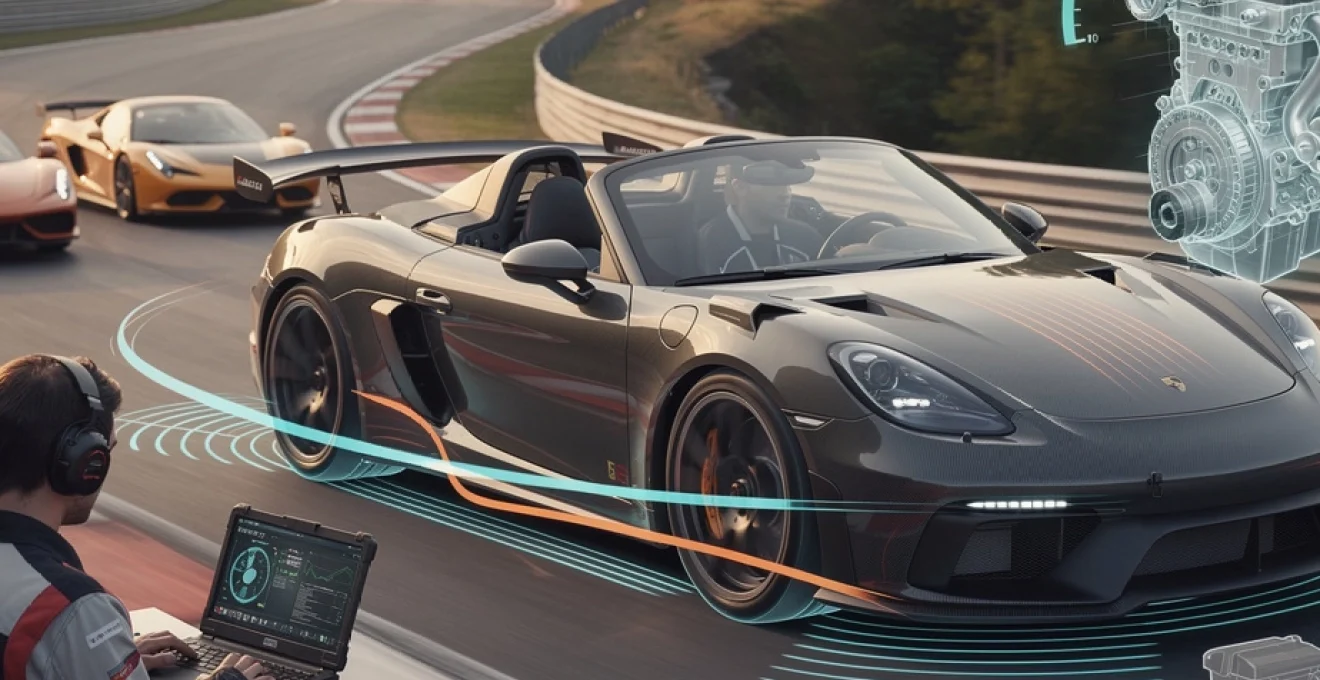
The Porsche 718 Spyder RS represents the pinnacle of open-top motoring excellence, combining unfiltered driving pleasure with cutting-edge engineering prowess. This mid-engine roadster eliminates compromises in pursuit of pure performance, delivering an experience that transcends conventional automotive boundaries. As the most powerful iteration in the 718 lineup, this exceptional vehicle showcases Porsche’s unwavering commitment to motorsport-derived technology and lightweight construction philosophy.
Drawing inspiration from decades of racing heritage, the 718 Spyder RS embodies the perfect synthesis of track-focused capability and road-going refinement. Every component has been meticulously engineered to maximise driver engagement whilst maintaining the sophisticated character that defines the Porsche brand. This remarkable achievement in automotive engineering demonstrates how traditional naturally aspirated performance can still captivate enthusiasts in an increasingly electrified landscape.
Porsche 718 spyder RS engineering excellence: 4.0-litre naturally aspirated Flat-Six performance
The heart of the 718 Spyder RS lies in its extraordinary 4.0-litre naturally aspirated flat-six engine, borrowed directly from the legendary 911 GT3. This powerplant represents the epitome of internal combustion engineering, delivering 500 PS (368 kW) at 8,400 RPM whilst maintaining the distinctive flat-six soundtrack that has defined Porsche performance for generations. The engine’s high-revving nature creates an intoxicating crescendo that builds dramatically as the tachometer needle approaches the 9,000 RPM redline.
This remarkable powerplant generates 450 Newton metres of torque, distributed through a sophisticated engine management system that optimises power delivery across the entire rev range. The naturally aspirated configuration eliminates turbo lag entirely, providing instantaneous throttle response that creates an direct connection between driver input and mechanical response. This engineering philosophy prioritises engagement over outright efficiency, resulting in a driving experience that feels genuinely analogue in our increasingly digital automotive world.
PDK Dual-Clutch transmission integration and manual gearbox alternative
The 718 Spyder RS exclusively utilises Porsche’s seven-speed PDK dual-clutch transmission, engineered specifically to handle the flat-six’s considerable power output. This transmission system delivers lightning-fast gear changes in just milliseconds, ensuring that the engine remains within its optimal power band during spirited driving. The close-ratio gearing maximises acceleration whilst maintaining highway cruising capability, creating a versatile powertrain that excels across diverse driving scenarios.
Unlike previous Spyder iterations that offered manual transmission options, the RS variant prioritises ultimate performance through its PDK-only configuration. This decision reflects Porsche’s commitment to extracting maximum potential from the naturally aspirated engine, as the dual-clutch system can execute gear changes faster than any human driver whilst never interrupting power delivery to the rear wheels.
Cylinder deactivation technology and variable valve timing optimisation
Advanced engine management technologies enhance both performance and efficiency within the 718 Spyder RS powerplant. The variable valve timing system continuously adjusts intake and exhaust valve operation to optimise combustion across different engine speeds and load conditions. This sophisticated system ensures that the engine maintains peak efficiency whilst delivering maximum power when demanded, creating a responsive and refined driving experience.
The engine’s sophisticated electronics package monitors numerous parameters simultaneously, adjusting fuel injection timing, ignition advance, and valve timing hundreds of times per second. This level of precision ensures that the naturally aspirated flat-six delivers consistent performance regardless of ambient conditions or fuel quality, maintaining the reliability standards expected from Porsche engineering.
Lightweight flywheel design and enhanced throttle response characteristics
The 718 Spyder RS incorporates a lightweight flywheel design that significantly improves throttle response characteristics compared to conventional configurations. This reduced rotational mass allows the engine to rev more freely, creating the immediate response that defines true sports car performance. The flywheel’s optimised inertia ensures smooth idle characteristics whilst maximising the engine’s ability to follow throttle inputs precisely.
This engineering approach creates
This engineering approach creates a noticeably more agile powertrain character, particularly evident when you blip the throttle on downshifts or accelerate out of tight corners. The engine gains and sheds revs with race-car urgency, giving you a sense of mechanical connection that many turbocharged rivals simply cannot match. On track, this responsiveness translates into finer control over weight transfer and balance, allowing skilled drivers to precisely position the 718 Spyder RS through every phase of a corner. On the road, it makes even modest speeds feel engaging, as every small input is met with an immediate, tangible reaction from the drivetrain.
Maximum power output: 493 BHP at 8,400 RPM technical analysis
Although Porsche officially rates the 718 Spyder RS at 500 PS (368 kW), this equates to approximately 493 BHP delivered at a heady 8,400 RPM. Reaching such specific power figures from a naturally aspirated 4.0-litre engine demands a combination of high compression, ultra-efficient breathing, and low internal friction. The intake and exhaust systems are tuned like a finely crafted musical instrument, with carefully calculated runner lengths and diameters that maximise cylinder filling at high engine speeds. As a result, the engine continues to build intensity all the way to the 9,000 RPM redline, rather than tapering off as you approach the limiter.
The specific output of over 123 BHP per litre places the 718 Spyder RS amongst the most highly strung naturally aspirated engines ever fitted to a road car. Yet this is not a fragile track-only unit; it shares its core architecture with the 911 GT3 and 911 GT3 Cup race car, proving its durability in the harshest motorsport environments. The flat-six employs forged pistons, titanium connecting rods and a rigid crankcase to cope with sustained high-RPM operation. For drivers, the benefit is clear: you can explore the upper reaches of the rev range lap after lap, confident that the powertrain has been engineered to withstand repeated high-load use. It is this combination of race-derived robustness and road usability that makes the 718 Spyder RS engine such a compelling centrepiece.
Advanced aerodynamics package: active rear spoiler and front splitter configuration
To fully exploit the performance of the Porsche 718 Spyder RS, the aerodynamics package has been meticulously honed to balance downforce, stability and efficiency. While the open-top format naturally differs from the Cayman GT4 RS, the Spyder RS still benefits from a highly effective front splitter, underbody management and its distinctive ducktail rear spoiler. Each element has been designed not merely for visual drama, but to contribute quantifiable aerodynamic performance at road and track speeds. The result is a roadster that feels planted and predictable, even when you are exploring its 191 mph top speed potential on unrestricted autobahn sections or pushing hard through high-speed sweepers on circuit.
The front splitter works in concert with the ducted front bumper and CFRP bonnet outlet to reduce front axle lift and feed cool air to the radiators and brakes. At the rear, the fixed ducktail spoiler provides a stable aero balance without the visual bulk of a large rear wing, suiting the more elegant roadster silhouette. Although the 718 Spyder RS does not deploy an electronically adjusting rear wing in the manner of some supercars, the carefully tuned geometry of its spoiler and underbody effectively functions as a passive active system, increasing downforce in proportion to speed. For drivers, this means that the faster you go, the more securely the chassis feels tied to the tarmac.
Computational fluid dynamics development process behind downforce generation
The aerodynamic development of the Porsche 718 Spyder RS relies heavily on advanced Computational Fluid Dynamics (CFD), allowing Porsche engineers to iterate thousands of virtual configurations before committing to physical prototypes. CFD enables highly detailed analysis of airflow over, under and through the car, highlighting areas of turbulence, lift and drag. By simulating different front splitter lengths, spoiler angles and vent geometries, the engineering team can incrementally improve downforce generation while controlling drag levels. Think of it as a virtual wind tunnel where each small adjustment is quantified in terms of lift coefficient and drag coefficient before a single clay model is shaped.
This digital-first process is particularly valuable for an open-top sports car, where airflow over the cabin and around the occupants must be carefully managed. CFD helps Porsche refine the windscreen angle, side window contour and rear buttress shapes to minimise cockpit buffeting, even when travelling at higher speeds with the roof removed. At the same time, it ensures that the crucial engine intake ducts behind the headrests receive a clean, high-pressure air feed for optimal performance. The result is a roadster that offers both impressive aerodynamic stability and a relatively calm cabin environment for such a focused machine, enhancing long-distance comfort without compromising track capability.
Carbon fibre rear wing adjustment mechanisms and DRS integration
On the 718 Spyder RS, Porsche has chosen a visually cleaner rear solution than the towering wing of the Cayman GT4 RS, employing an extended ducktail spoiler rather than a fully adjustable carbon fibre rear wing with explicit DRS (Drag Reduction System) hardware. However, the philosophy behind the design is remarkably similar: optimise rear axle stability while minimising unnecessary drag. The spoiler geometry has been derived from GT department expertise, and its subtle upturned lip generates effective downforce without dominating the car’s profile. In essence, it is a fixed, optimised setting that mirrors the ideal track day compromise many Cayman GT4 RS owners gravitate towards after experimentation with wing angles.
While you will not find a driver-activated DRS button in the 718 Spyder RS, the car still benefits from what could be described as an inherent DRS strategy implemented at the design stage. By choosing a more modest rear aero device and focusing heavily on underbody optimisation, Porsche reduces overall drag compared to a large, adjustable wing. This allows the Spyder RS to achieve its 191 mph top speed while maintaining excellent high-speed stability. For owners, the absence of complex adjustment mechanisms means fewer compromises in everyday use and less risk of incorrect settings upsetting the car’s aerodynamic balance on track days.
Underbody aerodynamic optimisation and venturi effect implementation
Much of the Porsche 718 Spyder RS aerodynamic efficiency is generated from elements you rarely see: the underbody panels, diffuser sections and carefully sculpted tunnel regions. By smoothing the underfloor and guiding airflow through strategically positioned channels, Porsche engineers create a Venturi effect that accelerates air beneath the car. As the airflow speeds up, pressure drops, effectively “sucking” the car closer to the road surface. This ground-effect style approach has long been a staple of motorsport design, and its implementation in the Spyder RS helps deliver stable, confidence-inspiring behaviour at high speed.
The rear diffuser is particularly important in this configuration, as it helps manage the expansion of airflow exiting from under the car. Its angled fins and ramp profile are calculated to maintain attached flow, reducing turbulence and increasing downforce without a disproportionate drag penalty. For drivers, the benefits are most noticeable when you are fully committed through fast, sweeping bends: the 718 Spyder RS feels as though it is keyed into the asphalt, allowing you to trust the chassis and tyres. On wet roads, the more stable underbody flow also contributes to predictable behaviour when standing water or crosswinds threaten to unsettle lesser sports cars.
Side skirt design philosophy and airflow management systems
The side skirts of the 718 Spyder RS are more than decorative extensions; they form an integral part of the car’s lateral airflow management strategy. By controlling how air moves along the flanks and around the wheel arches, the skirts help reduce lift and minimise the amount of high-energy airflow entering the underbody region. The goal is to maintain a cleaner, more laminar flow towards the rear diffuser, enhancing its effectiveness. In this respect, the side skirts function rather like the banks of a river, guiding and containing the flow to prevent disruptive eddies that sap performance.
Additionally, the sculpted side intakes behind the doors and near the rear haunches work in conjunction with the skirts to separate cooling and intake airflow from general aerodynamic management. Fresh air is channelled to the engine and intake plenum, while wheel arch vents and subtle contours bleed off high-pressure zones that could otherwise generate lift. You may not notice these details at first glance, but together they contribute significantly to the 718 Spyder RS sense of precision and stability at speed. It is this holistic approach to airflow management that allows Porsche to deliver both the emotional drama of an open-top roadster and the composure of a track-ready GT car.
Lightweight construction methodology: carbon fibre reinforced plastic implementation
Central to the character of the Porsche 718 Spyder RS is an uncompromising commitment to lightweight construction. At just 1,410 kg, it undercuts the already svelte 718 Spyder with PDK by around 40 kg and is even lighter than the closed 718 Cayman GT4 RS. Carbon Fibre Reinforced Plastic (CFRP) plays a major role in achieving this benchmark figure, with extensive use in the bonnet, front wings, exterior trim elements and the full bucket seats. Compared with traditional steel components, CFRP offers exceptional strength and rigidity at a fraction of the weight, enabling a lower centre of gravity and improved agility.
The manually operated soft-top further reflects this philosophy. Instead of a heavy, power-folding mechanism, the 718 Spyder RS employs a two-piece lightweight roof system that weighs just 18.3 kg including all mechanical components. Owners keen to optimise performance even further can remove the roof entirely, saving an additional 8 kg for track days or perfect summer drives. The result is a car that feels lithe and responsive in every situation, whether you are threading through city streets or attacking a technical mountain pass.
From a dynamic perspective, every kilogram saved pays dividends in braking, cornering and acceleration. The relationship is almost linear: a lighter car demands less from its tyres and braking system, allowing them to operate more consistently under repeated high-load conditions. This is why the 718 Spyder RS can deliver such remarkable lap times and yet remain exploitable and friendly at the limit. By pairing advanced materials like CFRP with intelligent simplification – fewer motors, less insulation, a more focused cabin – Porsche has created a machine where the absence of weight is as important as the presence of power.
Porsche active suspension management system: PASM sport calibration
The Porsche Active Suspension Management (PASM) system in the 718 Spyder RS has been calibrated with a clear objective: deliver razor-sharp track capability without sacrificing the fluidity required for real-world roads. The car sits 30 mm lower than a standard 718, giving it a more aggressive stance and lowering the centre of gravity for improved cornering stability. PASM continuously adjusts damper forces at each wheel based on driving style, road surface and driving mode, ensuring that the car remains composed whether you are negotiating urban imperfections or cresting kerbs on a circuit.
In PASM Sport mode, the system adopts firmer damping characteristics, reducing body roll and pitch for more immediate responses to steering and throttle inputs. Yet thanks to the expertise of Porsche’s GT department, the spring and damper rates are slightly more relaxed than those of the Cayman GT4 RS, acknowledging the Spyder’s open-top, road-biased nature. This means you can enjoy remarkable precision and feedback without the harshness that sometimes accompanies extreme track setups. The ability to finely tune ride height, camber, toe and anti-roll bar stiffness further allows owners and track-day engineers to tailor the chassis to specific circuits and driving preferences.
The integration of Porsche Torque Vectoring (PTV) with a mechanical limited-slip differential complements PASM by enhancing traction and turn-in agility. As you turn into a corner, subtle braking interventions and differential lock characteristics help rotate the car, giving the impression that the 718 Spyder RS is pivoting neatly around your hips. The result is a chassis that feels both playful and confidence-inspiring, inviting you to explore the limits while providing clear feedback as you approach them. For drivers who value involvement as much as outright speed, this finely judged suspension calibration is one of the car’s greatest strengths.
Circuit-focused interior design: alcantara upholstery and carbon racing components
Step inside the Porsche 718 Spyder RS and it becomes clear that the interior has been shaped by the same motorsport-inspired ethos as the powertrain and chassis. The cabin design is deliberately minimalist, prioritising essential driving functions over decorative distractions. Alcantara-like Race-Tex surfaces on the steering wheel, seat centres and key touchpoints provide excellent grip, especially when driving with gloves on track. Meanwhile, the extensive use of carbon-fibre trim and CFRP full bucket seats reinforces the sense that you are sitting in a road-legal racing car rather than a traditional luxury convertible.
Despite this focus, the 718 Spyder RS interior does not feel sparse or unfinished. Carefully stitched leather on the dashboard and door panels, alongside high-quality switchgear, reminds you that this is still a Porsche GT product. Optional contrasting colours such as Carmine Red or Arctic Grey for seat inserts and embroidery inject a subtle dose of personalisation without diluting the purposeful atmosphere. The result is a cockpit that feels like a precision tool – familiar enough for everyday use, yet clearly designed to support spirited driving and frequent track days.
Lightweight bucket seat construction with integrated roll cage compatibility
The standard full bucket seats are among the most significant contributors to the 718 Spyder RS weight reduction and driver connection. Constructed from carbon fibre reinforced plastic in a visible weave finish, they deliver exceptional torsional rigidity with minimal mass. The seat shells are designed to provide generous lateral support during high-g cornering, keeping you securely in place so that your inputs remain precise and uncorrupted by unnecessary body movement. For taller drivers or those planning extensive track time, the deep bolsters and adjustable backrest strike an effective balance between support and comfort.
Importantly, the seat design also considers compatibility with harnesses and potential roll cage installations for those who wish to take their Spyder RS to an even more serious track-focused specification. The seatbacks incorporate pass-throughs for multi-point harnesses, mirroring motorsport practice and allowing owners to upgrade their restraint systems in line with local regulations and personal requirements. This modular approach means you can enjoy the car in near-standard form on the road, yet gradually evolve it into a highly specialised track tool if desired – all without needing to replace major interior components.
Digital instrument cluster configuration and track-focused telemetry display
The instrument cluster of the Porsche 718 Spyder RS blends classic analogue cues with modern digital functionality to keep the driver fully informed without overload. A centrally mounted analogue tachometer, complete with 9,000 RPM redline, remains the focal point, underlining the importance of engine speed in this high-revving sports car. Flanking digital displays can be configured to show critical data such as oil temperature, tyre pressures, lap times and G-force readings, depending on whether you are commuting or chasing personal bests on circuit.
When the track beckons, the available telemetry and performance display systems become invaluable tools. Integrated lap timing, sector analysis and even basic data logging allow you to review runs and identify areas for improvement, much like professional drivers do with advanced telemetry suites. While these features are no substitute for dedicated data systems used in racing, they provide an accessible entry point for enthusiasts who want to refine their technique. You can imagine them as a set of digital coaching aids that help you better understand how the 718 Spyder RS responds to different lines, braking points and throttle applications.
Steering wheel design: alcantara grip zones and integrated control functions
The steering wheel is arguably the most important interface between driver and machine, and in the 718 Spyder RS it has been designed with absolute focus on feedback and control. Wrapped in Race-Tex material, the rim offers high levels of grip and a tactile, suede-like feel that encourages delicate inputs. A yellow 12 o’clock marker provides a quick visual reference to wheel position, especially useful during rapid corrections or when negotiating long, fast corners on track. The compact diameter and thick rim profile create a direct, connected sensation, allowing you to sense minute changes in front-axle grip.
Integrated control functions are deliberately restrained to avoid clutter. Essential operations such as driving mode selection, audio volume adjustment and trip information access are positioned so that you can make changes without removing your hands from the wheel. This keeps your focus where it belongs – on the road or circuit ahead. By avoiding the temptation to overload the steering wheel with too many buttons, Porsche maintains a clean, motorsport-inspired layout that reinforces the 718 Spyder RS driver-centric philosophy. In practical terms, this means fewer distractions when you are braking deep into a corner or making quick steering corrections at high speed.
Nürburgring nordschleife performance benchmarking against McLaren 570S and ferrari F8 tributo
No discussion of a modern Porsche GT product would be complete without referencing the Nürburgring Nordschleife, the ultimate proving ground for chassis dynamics and endurance. While the 718 Spyder RS is not positioned as a headline lap-record car in the same sense as the 911 GT3 RS, its performance has been benchmarked against some formidable rivals, including the McLaren 570S and Ferrari F8 Tributo. Both of these competitors deploy turbocharged engines with significantly higher peak outputs, yet the Spyder RS counters with lower weight, exceptional balance and a more intimate driving experience. On a circuit as complex and demanding as the Nordschleife, this balance often matters more than raw power numbers.
Independent testing and internal simulations indicate that a well-driven 718 Spyder RS can post lap times that closely shadow, and in certain sectors even surpass, those of the McLaren 570S. The Porsche’s superior traction out of slower corners and its confidence-inspiring braking stability help it claw back time that might be lost on the long straights to more powerful turbocharged supercars. Against the Ferrari F8 Tributo, the Spyder RS inevitably yields ground in outright acceleration and VMAX sections, yet it frequently narrows the gap through the technical, high-commitment portions of the lap where chassis communication and aerodynamic stability are paramount.
For you as an enthusiast, the key takeaway is not whether the 718 Spyder RS beats a specific rival by a tenth of a second, but how usable and repeatable its performance feels. Where some supercars can deliver intimidating bursts of speed that are hard to fully exploit, the Porsche encourages you to gradually expand your limits, rewarding precision and smoothness. It is a car designed to be driven at nine-tenths all day long, rather than one that only reveals its magic at the outermost edge of the performance envelope. On a legendary circuit like the Nürburgring – and on your favourite local roads – that makes the difference between a car you respect from a distance and one you genuinely connect with every time you drive it.