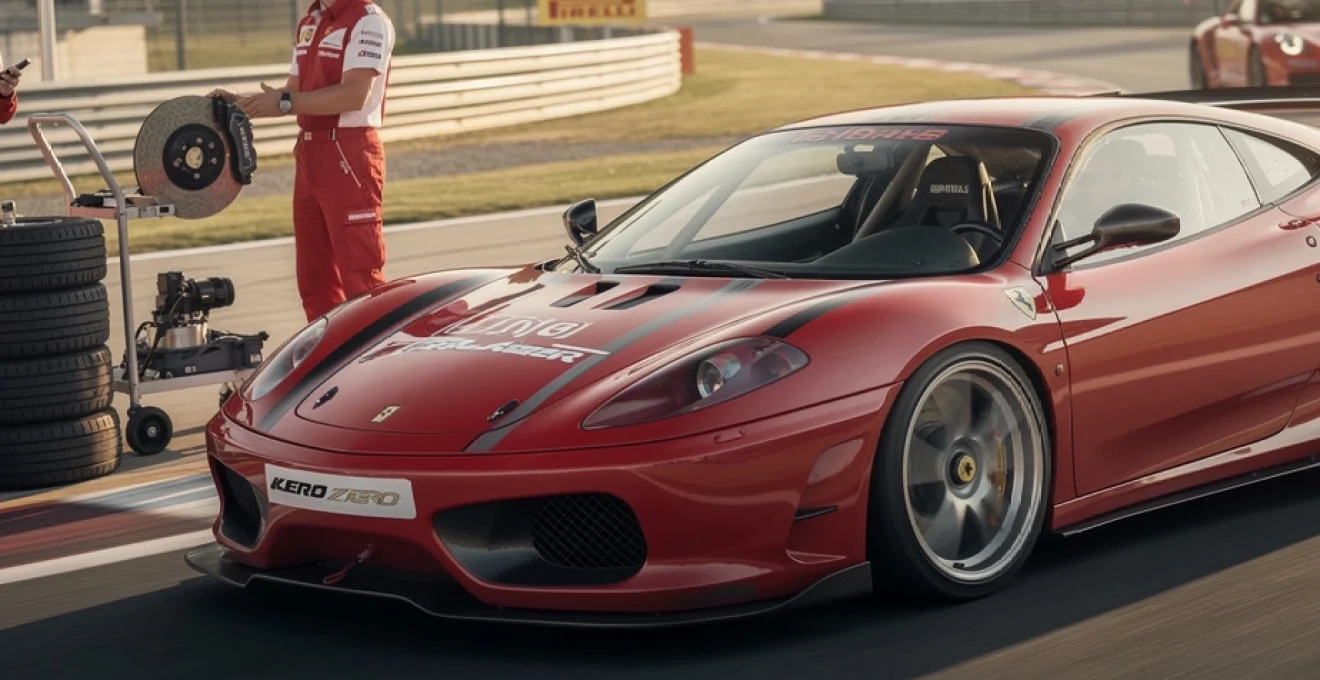
When Ferrari unveiled the 360 Challenge Stradale at the 2003 Geneva Motor Show, the Italian marque wasn’t simply presenting another variant of its mid-engined V8 sports car. Instead, this was a watershed moment that would define an entire philosophy for track-focused road cars—a philosophy that continues to influence Ferrari’s special series models more than two decades later. Stripped of unnecessary comforts, engineered with competition-derived components, and calibrated for the driver who demands uncompromising performance, the Challenge Stradale represented Ferrari’s most focused production car of the modern era. With just 1,288 examples produced worldwide, this exceptional machine established the template for every subsequent track-oriented V8 Ferrari, from the 430 Scuderia through to the 488 Pista and beyond.
The Challenge Stradale wasn’t created in isolation. It emerged directly from Ferrari’s extensive experience in one-make racing championships and GT competition, where engineers developed solutions that simply couldn’t be justified in a standard road car. Every component, from the titanium suspension springs to the Enzo-derived braking system, reflected a single-minded pursuit of performance efficiency. The result was a car that weighed 110 kilograms less than the standard 360 Modena whilst producing 25 additional horsepower, creating a power-to-weight ratio that fundamentally altered the driving experience.
Ferrari challenge stradale 360: engineering genesis and motorsport DNA
The Challenge Stradale’s development story is inextricably linked to Ferrari’s motorsport programmes of the early 2000s. Engineers drew upon knowledge gained from the Ferrari Challenge Trofeo Pirelli series and FIA GT racing to create a road car that genuinely embodied racing technology. This wasn’t marketing hyperbole—the Challenge Stradale featured solutions tested and proven in competitive environments, then adapted for road legality without compromising their essential character. The close relationship between competition and production created a feedback loop where track demands directly informed engineering decisions for the road car.
Ferrari’s technical team focused on three overlapping development areas to achieve the Challenge Stradale’s remarkable specifications: advanced materials selection, innovative construction technologies, and comprehensive optimisation of every component. Nothing escaped scrutiny. From the largest structural elements to the smallest fasteners, each part underwent analysis to determine whether it could be lighter, stronger, or eliminated entirely. This obsessive approach to weight reduction became the hallmark of Ferrari’s special series models, establishing benchmarks that competitors would struggle to match for years afterwards.
F131E V8 engine architecture and naturally aspirated performance characteristics
At the heart of the Challenge Stradale sits the F131E engine, a 3.6-litre naturally aspirated V8 that represents the pinnacle of Ferrari’s atmospheric engine development from this era. Mounted longitudinally behind the cabin and integrated with the gearbox and differential, this 90-degree V8 produces 425 horsepower at 8,500 rpm—an impressive specific output of 118.5 horsepower per litre. The power increase over the standard Modena came partly from enhanced breathing characteristics and a two per cent increase in supercharging at maximum engine speed, allowing the powerplant to rev freely to its stratospheric redline whilst maintaining robust low-end torque of 38 kilogram-metres at 4,750 rpm.
The throttle response is razor-sharp, with minimal lag between pedal input and engine reaction. This directness stems from optimised intake manifold geometry and revised engine management calibration that prioritises immediate response over progressive power delivery. You feel the engine’s eagerness from the moment you press the starter button—another innovation that the Challenge Stradale introduced to Ferrari’s production lineup. The exhaust note, often cited as the finest sound produced by any Ferrari V8, combines mechanical aggression with musical harmonic richness, creating an auditory experience that rivals the car’s dynamic capabilities.
Aluminium Space-Frame construction and weight reduction methodologies
Ferrari employed aluminium extensively throughout the Challenge Stradale’s construction, capitalising on this material’s specific weight being approximately one-third that of steel. The aluminium space-frame chassis provided exceptional rigidity whilst maintaining minimal mass, creating the structural foundation for the car’s dynamic precision. Both chassis elements and bodywork components utilised aluminium construction,
but aluminium was only the starting point. Engineers also integrated titanium components for the suspension springs and fasteners, along with extensive use of carbon fibre for both structural and cosmetic elements. Inside the cabin, carpets, heavy sound-deadening materials and many comfort features were removed entirely, replaced with lightweight alternatives or deleted to save precious kilograms. Even the rear side windows could be specified in Lexan on a tiny subset of cars, echoing the iconic Ferrari F40 and shaving yet more weight from the upper structure.
This holistic approach to weight reduction meant that the Ferrari Challenge Stradale 360 delivered its performance not merely through power, but via ruthless efficiency. The 110 kg saving over the 360 Modena equates to roughly a 7 per cent reduction in mass, which you feel in every steering input, every braking event and every change of direction. It is the difference between a quick car and a genuinely sharp one. For owners today, preserving this original lightweight specification—avoiding heavy aftermarket stereo systems or non-standard wheels—is crucial to maintaining the car’s intended character and long-term collectability.
Aerodynamic modifications: front splitter, rear diffuser and fixed rear wing integration
While the 360 Modena was already a significant step forward in terms of aerodynamic efficiency, the Challenge Stradale took these principles considerably further. Ferrari’s aerodynamicists reprofiled the front bumper to incorporate a more pronounced splitter and larger air intakes, increasing downforce over the front axle while feeding additional cooling air to the radiators and brakes. Along the flanks, redesigned side skirts helped manage airflow towards the rear of the car, reducing turbulence and enhancing stability at high speeds.
At the rear, a deeper diffuser with revised strakes worked in harmony with the iconic mesh “Challenge” grille to improve both downforce and thermal efficiency. The grille allowed hot air to escape more effectively from the engine bay, while the diffuser generated a low-pressure zone beneath the car, effectively “sucking” it towards the tarmac. Interestingly, the Challenge Stradale did not rely on a large, flamboyant fixed rear wing as some rivals did; instead, it used subtle geometric changes to achieve a claimed 50 per cent increase in overall downforce versus the standard 360 Modena, all while maintaining a relatively low drag coefficient for an analogue supercar of this era.
If you’re used to modern supercars festooned with active aero and towering wings, the Ferrari Challenge Stradale 360 might appear understated at first glance. Yet the aerodynamic revisions are akin to a finely tailored suit: nothing is excessive, but every line serves a purpose. On a fast circuit, such as Monza or Silverstone, this translates into reassuring high-speed stability and a steering feel that remains communicative even as the car approaches its 300 km/h top speed. It is a reminder that effective aerodynamics do not always need to shout to be heard.
Derivation from ferrari 360 modena competition programme
The Challenge Stradale’s DNA is inseparable from the 360 Modena Challenge race cars that competed in Ferrari’s one-make Trofeo Pirelli series. Rather than simply raiding the competition parts bin, Ferrari’s engineers used the race programme as a rolling laboratory, validating ideas under the intense pressure of GT racing. Components such as the stiffer springs, recalibrated dampers, lighter wheels and revised braking system all trace their lineage directly to the Challenge and GT variants, where durability and performance had already been proven.
This close relationship between road and race meant that the Ferrari Challenge Stradale 360 was effectively a distilled version of the competition car, reinterpreted for public roads. Elements like the longer right-hand shift paddle, Lexan side windows on a handful of examples, and the minimalist interior with exposed welds all reflect this motorsport heritage. For enthusiasts, this tangible connection to Ferrari’s factory race programme is a major part of the car’s appeal. You’re not just driving a fast road car; you’re piloting a machine whose core technologies have been tested wheel-to-wheel in real competition.
Transmission and drivetrain specifications: f1-derived electrohydraulic system
Matching the high-revving F131E V8 is an electrohydraulic transmission system derived from Ferrari’s contemporary Formula 1 technology. The Ferrari Challenge Stradale 360 was offered exclusively with the F1-style gearbox—no manual option was ever available—underlining its focus on ultimate lap-time performance rather than nostalgic engagement. Gear changes are actuated via large aluminium paddles mounted behind the steering wheel, allowing the driver to keep both hands on the rim during aggressive cornering and braking.
While later dual-clutch transmissions would surpass it in outright speed and smoothness, the Challenge Stradale’s single-clutch automated manual remains one of the most characterful F1-style systems Ferrari ever produced. Shift quality varies notably between modes, with the electronics and hydraulic pressure adjusting strategies for sport or race driving. This variability gives the transmission a mechanical, almost analog feel, reminding you that significant hardware is at work every time you pull a paddle. For many owners, learning to work with the gearbox—timing throttle inputs and understanding its behaviour—is an integral part of the ownership experience.
Six-speed F1 gearbox with carbon-ceramic clutch assembly
The six-speed gearbox in the Ferrari Challenge Stradale 360 is fundamentally similar in layout to that of the 360 Modena, but paired with more advanced control software and a clutch system tailored for more aggressive driving. The single-plate clutch is managed by an electrohydraulic actuator, modulating engagement based on throttle position, engine speed and selected driving mode. Though often colloquially referred to as an “F1 gearbox”, the underlying mechanism is still a conventional manual transmission—what changes is how it is controlled.
One of the key durability advantages of the Challenge Stradale over some earlier F1 systems is its calibration for harder track use. Clutch engagement is firmer and quicker in Race mode, reducing slip and heat build-up during aggressive upshifts. This has implications for owners today: treat the car as it was intended, with decisive inputs and minimal low-speed creeping, and clutch life can be surprisingly robust for such a focused supercar. Conversely, extensive urban use with frequent stop-start traffic and gentle throttle inputs can accelerate wear, so it’s worth considering how and where you’ll drive if you are looking to purchase a Ferrari Challenge Stradale 360 for mixed road use.
Shift time optimisation and launch control functionality
When launched, the Challenge Stradale boasted shift times as low as 150 milliseconds in its most aggressive settings—remarkably rapid for an early 2000s single-clutch system. This optimisation came from both hardware and software: higher hydraulic pressure for the actuators, faster pump response, and refined algorithms that pre-emptively selected the next ratio based on driver inputs. In Race mode, the system prioritises speed and directness above smoothness, resulting in the kind of punchy upshifts that many enthusiasts still find addictively engaging today.
The introduction of launch control was another notable first for a road-going Ferrari. Activated via a dedicated button when certain conditions are met, the system manages engine revs and clutch engagement to deliver a hard, controlled launch off the line. Used correctly, it allows repeatable, aggressive starts without the same level of driver finesse previously required. Of course, as with any high-performance car, frequent use of launch control will increase mechanical stress. For modern owners, it is best treated as an occasional indulgence rather than a party trick to be demonstrated at every set of traffic lights.
Final drive ratio adjustments for circuit performance
To maximise the Ferrari Challenge Stradale 360’s effectiveness on circuit, engineers revisited the final drive ratio and overall gearing. While the exact ratios vary slightly between markets and software versions, the underlying philosophy was clear: prioritise acceleration and mid-range response over a headline top speed figure. The revised final drive enables the engine to remain closer to its power peak during hard driving, particularly when exiting medium-speed corners in second or third gear.
On track, this gearing strategy makes the car feel explosively responsive, pulling hard all the way to its 8,500 rpm redline, while still allowing a genuine 300 km/h top speed. On the road, it translates into vivid in-gear acceleration that can make even modern turbocharged machinery feel muted. Prospective owners who plan to use their Ferrari Challenge Stradale 360 extensively on track days will appreciate this optimisation; the car feels perfectly geared for European circuits, with fewer frustrating moments stuck between ratios than some of its period rivals.
Suspension geometry and braking technology enhancements
Chassis tuning was at the very core of the Challenge Stradale project. Ferrari’s engineers didn’t simply stiffen the existing 360 Modena setup; they rethought the entire suspension geometry, spring and damper calibration, and braking hardware to create a cohesive track-focused package. Aluminium double wishbones at each corner remained, but virtually every ancillary component was revisited with an eye towards reducing unsprung mass and enhancing response.
The centre of gravity was lowered by approximately 15 mm, aided by the lighter wheels, carbon-ceramic brakes and revised spring designs. Stiffer anti-roll bars front and rear, together with specific bushing compounds, sharpened body control without rendering the car unusable on imperfect road surfaces. In the context of modern track specials, the Ferrari Challenge Stradale 360 strikes a remarkably effective balance: firm and communicative, yet not so uncompromising that you dread the drive to the circuit.
Brembo carbon-ceramic brake system with drilled rotors
One of the headline features of the Challenge Stradale was its standard carbon-ceramic brake system, developed in collaboration with Brembo. At a time when even many supercars relied on steel discs, Ferrari’s decision to equip this track-focused V8 with technology closely related to that of the Enzo hypercar was genuinely bold. The CCM (Carbon Composite Material) discs offer significant advantages: reduced unsprung weight, dramatically improved fade resistance and more consistent performance under repeated heavy braking.
Each disc is cross-drilled for improved gas evacuation and cooling, while the aluminium calipers provide a strong, rigid platform for the pads. On circuit, the difference compared to the 360 Modena’s steel brakes is night and day: you can brake later, harder and more consistently, lap after lap. For road use, the chief benefit is confidence. Knowing that you have Enzo-level stopping power at your disposal changes how you approach overtakes, fast corners and sudden hazards. That said, replacement costs are high, so any buyer considering a Ferrari Challenge Stradale 360 should carefully inspect disc condition and verify service history before committing.
Recalibrated damper settings and spring rate modifications
To complement the lighter mass and enhanced aerodynamics, Ferrari substantially revised the damper and spring setup for the Challenge Stradale. Both front and rear springs are stiffer than those of the 360 Modena, with titanium construction reducing weight while maintaining the necessary structural integrity. The dampers themselves received bespoke valving, optimised through extensive testing at Fiorano and on European circuits, to ensure precise control of body movements during hard cornering and braking.
You notice the results the first time you turn into a bend with commitment. The car resists roll more tenaciously, loads up its outside tyres more predictably, and settles into a neutral, confidence-inspiring attitude. In Race mode, damper settings become more assertive, sharpening responses further without crossing into the harshness you might expect from a full-blown race car. On less-than-perfect roads, the Ferrari Challenge Stradale 360 does communicate every imperfection, but it stops short of punishing its driver—an impressive balancing act given its uncompromising brief.
Track-width adjustments and anti-roll bar configuration
To further refine handling balance, subtle adjustments were made to the track widths and anti-roll bar configuration. While the basic suspension architecture remained consistent with the 360 Modena, the Challenge Stradale benefits from slightly widened tracks and re-optimised alignment settings. These changes work hand-in-hand with the stiffer springs and dampers to deliver a front end that responds more eagerly to steering inputs and a rear axle that remains composed under high lateral load.
Anti-roll bars of increased diameter were fitted front and rear, reducing body roll and ensuring a flatter cornering stance. This pays dividends under heavy load transitions—think rapid direction changes through a chicane or a fast sequence of bends. For the driver, the effect is akin to switching from a touring cycling frame to a race-tuned machine: the underlying geometry may look familiar, but the immediacy and precision of response are transformed. When properly aligned and set up, the Ferrari Challenge Stradale 360 remains one of the most rewarding analogue chassis to explore near its limits.
Pirelli P zero corsa tyre specifications and compound selection
No discussion of the Challenge Stradale’s dynamics would be complete without considering its tyre package. The car was originally equipped with Pirelli P Zero Corsa tyres, semi-slick rubber developed to bridge the gap between road usability and track performance. Mounted on 19-inch “Challenge” wheels that are lighter than the 18-inch items fitted to the Modena, these tyres provide a broad, sticky contact patch and a progressive breakaway characteristic when pushed beyond their grip envelope.
In period, the combination of Corsa rubber and the car’s lightweight construction allowed the Ferrari Challenge Stradale 360 to generate impressive lateral grip numbers for a road car, approaching or exceeding 1 g in steady-state cornering. Today, owners face choices: stick with original-spec Corsas for authenticity, or opt for modern equivalents that may offer improved wet-weather performance and longevity. Whichever route you choose, maintaining correct pressures and alignment is critical. Treat the tyres as you would a set of high-performance running shoes—check them regularly, warm them properly on track, and replace them before age or wear compromises the car’s abilities.
Interior specification: alcantara, carbon fibre and racing-oriented ergonomics
Open the lightweight aluminium door of a Ferrari Challenge Stradale 360 and you immediately understand its intent. Where the 360 Modena offers leather, carpets and a degree of plushness, the Stradale pares everything back to the essentials. Much of the cabin is trimmed in Alcantara, chosen for its low weight, abrasion resistance and excellent grip when driving with racing gloves. Exposed aluminium floor panels replace traditional carpets, with simple rubber mats providing just enough practicality for everyday use.
Carbon fibre is omnipresent: door cards, centre console, instrument binnacle and the beautifully sculpted bucket seats all feature the material, mirroring the design language of Ferrari’s contemporary GT racers. These fixed-back seats offer superb lateral support and can be paired with four-point harnesses in some specifications, further blurring the line between road and race car. The steering wheel is compact and purposeful, with the distinctive asymmetrical paddles—longer on the right for easier upshifts when unwinding lock out of a corner—falling naturally to hand. It is an interior that prioritises function over form, yet the overall effect remains unmistakably Italian and, in its own minimalist way, deeply luxurious.
Many Challenge Stradales were specified with little in the way of luxury equipment, though a radio and basic air conditioning could be ordered to improve long-distance usability. For collectors today, originality is key: unmolested interiors with intact carbon trim, correct Alcantara patterns and factory harnesses are particularly prized. If you’re considering a car for regular use, it’s worth checking seat bolster condition and pedal wear, both of which can reveal how intensively a given example has been driven. In any case, the cabin of a Ferrari Challenge Stradale 360 remains one of the most evocative environments in which to experience a naturally aspirated V8 at full song.
Performance metrics: nürburgring nordschleife benchmarks and contemporary rivals
On paper, the Ferrari Challenge Stradale 360’s performance figures may not seem outrageous by the standards of modern twin-turbo supercars. Yet numbers only tell part of the story. What sets the Stradale apart is the way it deploys its 425 horsepower through a lightweight chassis, advanced aerodynamics and a highly developed tyre and brake package. The result is a car whose real-world pace—and more importantly, its driver engagement—still holds its own two decades after launch.
Independent testing in period recorded 0–100 km/h times in the low 4-second range, quarter-mile passes in the high 11s to low 12s, and a top speed close to 300 km/h. Around Ferrari’s own Fiorano test circuit, the Challenge Stradale lapped several seconds faster than the standard 360 Modena, encroaching on times set by more powerful V12 models. At the Nürburgring Nordschleife, unofficial lap times in the region of 7 minutes 56 seconds placed it firmly among the elite group of early-2000s track-focused machinery, trading blows with the Porsche 996 GT3 and later 997 GT3 variants.
0–100 km/h acceleration and quarter-mile data versus porsche 911 GT3
Perhaps the most natural rival for the Ferrari Challenge Stradale 360 is the contemporary Porsche 911 GT3, particularly the 996-generation cars. Period tests typically recorded the Stradale’s 0–100 km/h sprint at around 4.1–4.3 seconds, depending on conditions and methodology. The quarter mile was dispatched in approximately 12.3 seconds at close to 190 km/h. The 996 GT3, by contrast, usually posted 0–100 km/h in the mid-4-second bracket and quarter-mile times only a few tenths behind, despite carrying less outright power.
So where does the Ferrari gain its edge? Much of the difference lies in its power-to-weight ratio and gearing. With 425 horsepower and a kerb weight in the region of 1,280 kg, the Challenge Stradale enjoys a notable advantage over most rivals of its era. In-gear acceleration, especially from 100–200 km/h, feels especially vivid, aided by the F1 gearbox’s rapid shifts in Race mode. While the Porsche might be marginally easier to exploit at ten-tenths thanks to its rear-engine traction advantage, many drivers still regard the Ferrari as the more emotional and memorable companion when driving at or near the limit.
Fiorano lap times compared to standard 360 modena
Ferrari has long used its Fiorano test circuit as an internal benchmark, and the Challenge Stradale’s performance there is particularly revealing. Officially, the car is around 3 seconds quicker than the standard 360 Modena over a typical Fiorano lap, a substantial margin given that both cars share the same basic platform and engine displacement. That improvement stems not from raw power—remember, the Stradale gains only 25 horsepower—but from its integrated approach to weight reduction, aerodynamics, braking and chassis tuning.
This Fiorano delta also illustrates how effective the development programme was in translating racing knowledge to the road. In motorsport terms, finding multiple seconds over a relatively short lap length without a major power increase is a serious achievement. For owners, it means that a Ferrari Challenge Stradale 360 driven with conviction will comfortably outpace not only a standard Modena, but many later and ostensibly more powerful sports cars on a technical circuit. It is, in many ways, the archetype of a “slow-in-straights, fast-in-corners” track weapon, prioritising balance and consistency over brute-force acceleration.
Top speed analysis and aerodynamic efficiency coefficients
Officially, the Ferrari Challenge Stradale 360 is quoted with a top speed of around 300 km/h (186 mph), slightly below that of some period rivals but more than sufficient for all but the fastest circuits and unrestricted autobahn sections. The interplay between downforce and drag is crucial here. By increasing total downforce by roughly 50 per cent versus the 360 Modena, Ferrari inevitably accepted a modest rise in drag coefficient. However, thanks to careful optimisation of airflow around the body and undertray, the overall efficiency remained impressive for a car with no active aero components.
In practical terms, what does this mean for the driver? Above 200 km/h, the Stradale feels planted and reassuring, with the steering gaining reassuring weight as aerodynamic loads build. Long, fast bends that might feel marginal in a less developed car become enjoyable, flowing challenges rather than white-knuckle ordeals. It is here that the synergy between the F131E engine, the F1-derived gearbox, and the carefully tuned aerodynamics becomes clear: the Ferrari Challenge Stradale 360 is not chasing numbers for their own sake, but delivering a cohesive, confidence-inspiring experience across a broad range of speeds.
Collector market valuation and production rarity analysis
From a collector’s perspective, the Ferrari Challenge Stradale 360 occupies a particularly interesting position in the marque’s modern history. It is the first of the track-focused V8 “special series” cars and, uniquely among its bloodline, was never offered in open-top Spider or Aperta form. With just 1,288 units produced worldwide, it remains the rarest of the breed, adding a compelling scarcity factor to its dynamic and emotional appeal. Over the last decade, these attributes have translated into a marked appreciation in market values across Europe, North America and Asia.
During the early 2010s, you could still find well-maintained Challenge Stradales trading for only a modest premium over standard 360 Modenas. As the collector community increasingly recognised the car’s significance—the purity of its naturally aspirated drivetrain, its motorsport connection, and its relatively low production numbers—prices began to climb. Today, a Ferrari Challenge Stradale 360 in excellent condition with low mileage and strong provenance can command multiples of its Modena counterpart, positioning it alongside the later 430 Scuderia and even the 458 Speciale in the hierarchy of sought-after modern Ferraris.
1,288-unit production run and chassis number significance
The oft-quoted figure of 1,288 units encompasses global production of the Challenge Stradale between 2003 and 2004, covering all markets and configurations. Within that total, there are further layers of rarity: cars equipped with the iconic Lexan sliding side windows, examples finished without the characteristic central racing stripe, and those specified in less common colours such as Nero or Grigio Titanio. Some markets also received specific equipment variations, making detailed knowledge of factory options and original build sheets invaluable for serious collectors.
Chassis numbers (VINs) allow enthusiasts to trace build sequences and identify particularly early or late-production cars, both of which can carry additional appeal. For instance, very early press or display cars, as well as “last off the line” examples, sometimes attract a premium at auction. If you’re evaluating a Ferrari Challenge Stradale 360 for purchase, noting its production month and comparing it against known registries can provide insight into its place in the overall run. Matching-numbers cars with original paint, interior and mechanical components remain the gold standard for investment-grade examples.
Current market pricing trends at RM sotheby’s and bonhams auctions
Recent auction results from major houses such as RM Sotheby’s and Bonhams provide a useful snapshot of current Ferrari Challenge Stradale 360 values. In Europe, exceptional low-mileage examples with desirable specifications have achieved hammer prices in the €260,000–€320,000 range in the mid-2020s, with some ultra-rare, highly documented cars pushing beyond that. In the United States, similar cars have crossed the block in the $280,000–$350,000 bracket, depending on history, colour combination and originality.
Of course, not every car commands top-tier money. Higher-mileage examples, cars with incomplete histories, or those showing modifications away from factory specification typically trade at a discount, sometimes in the €200,000–€240,000 range. The broader trend, however, has been one of steady appreciation rather than speculative spikes. As more collectors seek out analogue, naturally aspirated Ferraris with clear motorsport links, demand for well-preserved Challenge Stradales has remained robust. For buyers, this suggests that while the days of “bargain” Stradales are firmly in the past, there is still room for long-term value retention—provided you choose the right car.
Provenance documentation and ferrari classiche certification process
With values rising and the Ferrari Challenge Stradale 360 now firmly established as a modern classic, provenance and documentation have become critical considerations. A complete history file—comprising stamped service book, invoices, MOT or inspection records, and any period sales documentation—adds significant confidence for prospective buyers. Original items such as the tool kit, tyre repair kit, leather document pouch, both factory keys and even the OEM radio can all make the difference when comparing two otherwise similar cars.
Ferrari’s own Classiche certification programme plays an increasingly important role in this context. Through a detailed inspection and archival research process, Ferrari Classiche confirms that a given car retains its original chassis, engine, gearbox and key components, issuing a Red Book certificate if it passes. For a Ferrari Challenge Stradale 360, Classiche certification not only enhances resale appeal, but also reassures owners that their car is an authentic representation of the model as it left Maranello. If you’re considering investing in a Stradale—particularly at the upper end of the market—allocating budget for Classiche certification and a thorough pre-purchase inspection is a wise, long-term decision.