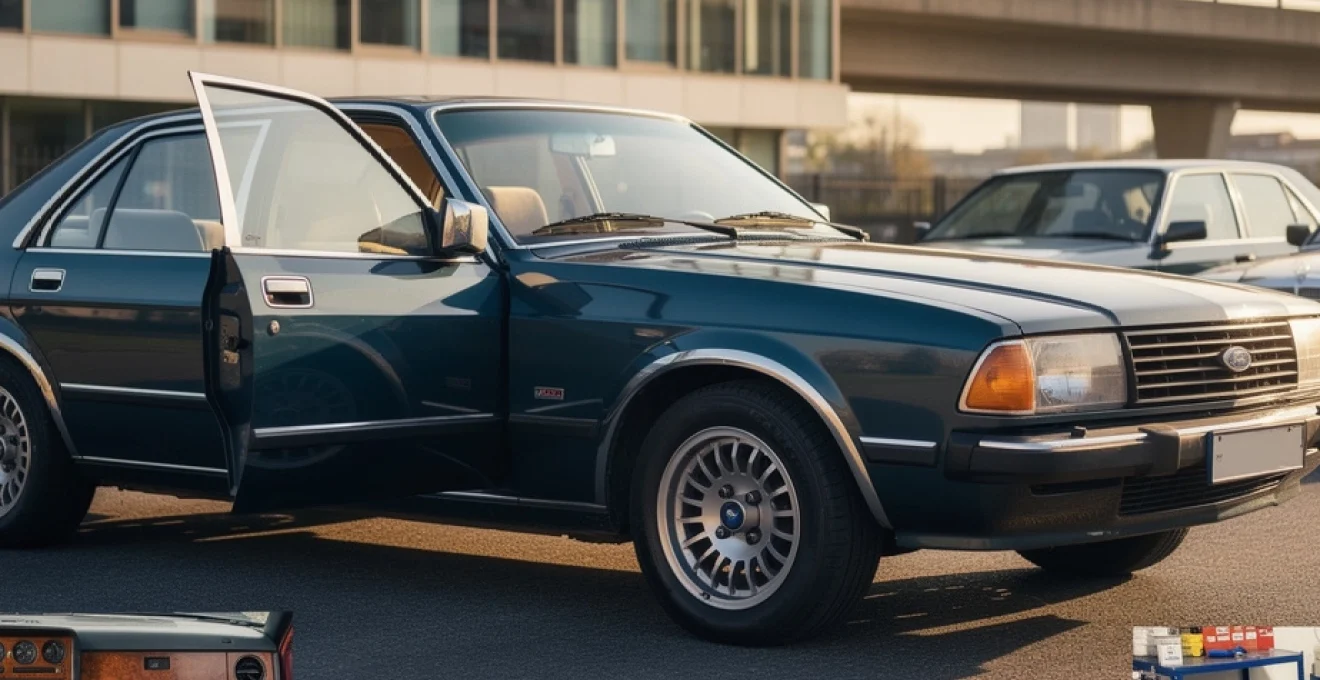
The Ford Granada 2.8i Ghia X represented the pinnacle of British executive motoring during the early 1980s, offering a compelling blend of V6 power, continental refinement, and genuine luxury at a price that undercut its German rivals significantly. This flagship variant of Ford’s Mk2 Granada range combined the smooth thrust of fuel-injected performance with sumptuous interior appointments that could genuinely rival anything from Bavaria or Stuttgart. For company directors, government officials, and discerning private buyers alike, the Ghia X delivered business-class comfort without the premium marque price tag, establishing itself as the thinking person’s executive saloon during an era when British fleet buyers still dominated the large car market.
What made the 2.8i Ghia X particularly special was its ability to deliver genuinely sporting performance whilst cocooning occupants in an environment of wood, leather, and velour. The fuel-injected Cologne V6 provided effortless acceleration that could embarrass contemporary BMWs, whilst the comprehensively equipped cabin offered every conceivable luxury feature available in the early 1980s. Today, these refined Granadas have become increasingly collectible, with enthusiasts appreciating their blend of period charm, robust engineering, and surprising dynamic capability.
Ford granada mk III evolution: from 1977 cologne platform to 1985 facelift
Ford introduced the second-generation Granada in 1977, representing a significant departure from the more curvaceous Mk1 design. Under the direction of designer Filippo Sapino, the Mk2 adopted Ford’s new angular, sharp-edged aesthetic that had already proven successful with the Fiesta and would later influence the Cortina Mk4. Despite its substantially different appearance, the Mk2 was essentially an evolution of the original platform rather than an entirely new design, demonstrating Ford’s mastery of the comprehensive mid-cycle refresh. This approach allowed the company to deliver a contemporary-looking product whilst controlling development costs and maintaining proven engineering solutions.
The new Granada featured crisp, clean lines that looked thoroughly modern compared to its predecessor’s 1960s-inspired curves. Every panel was new, with larger glass areas improving visibility and giving the cabin a more airy feel. The drag coefficient improved marginally, though at 0.44, the Granada couldn’t match the aerodynamic efficiency of rivals like the Citroën CX. Production moved entirely to Germany, with Cologne becoming the sole manufacturing site, marking the end of Dagenham’s involvement in Granada assembly. This consolidation streamlined production and ensured consistent build quality across all European markets.
Throughout its production life from 1977 to 1985, the Mk2 Granada received several important updates. The 1981 facelift brought revised front and rear styling, with a more integrated bumper design and updated lighting clusters. This mid-life refresh also coincided with the introduction of the fuel-injected 2.8i models, which would become the performance flagships of the range. The final examples rolled off the Cologne production line in 1985, by which time an impressive 918,969 units had been manufactured, demonstrating the model’s commercial success and broad appeal across diverse European markets.
Cologne V6 2.8i engine architecture and fuel injection system
The heart of the Granada 2.8i Ghia X was Ford’s venerable Cologne V6 engine, a cast-iron powerplant that had proven its durability and refinement across numerous applications since its introduction in 1962. In 2.8-litre form, the engine featured a bore and stroke of 93mm x 68.5mm, creating a relatively oversquare configuration that favoured higher-revving performance. The 60-degree V-angle represented a compromise between compactness and smooth operation, though it did necessitate a balance shaft to counter secondary vibration. This robust engine architecture had already proven itself in everything from commercial vehicles to high-performance Capris, earning a reputation for longevity that few contemporary power units could match.
The addition of Bosch K-Jetronic fuel injection transformed the character of the 2.8-litre V6, liberating an additional 10bhp compared to the carburetted version whilst simultaneously improving throttle response, fuel economy, and cold-
start behaviour. Where the carburetted 2.8 could occasionally feel a little woolly off-idle, the injected 2.8i responded crisply to small throttle inputs, making the big Granada feel lighter on its feet than its size would suggest. Importantly for the executive market, the fuel injection system also reduced the impact of cold starts and short journeys on both driveability and economy, something fleet managers and high-mileage users quickly came to appreciate.
Bosch K-Jetronic mechanical fuel injection technology
Bosch K-Jetronic was a continuous mechanical fuel injection system, quite different from the fully electronic setups that would arrive later in the decade. Rather than pulsing injectors electronically, it metered fuel using a precision airflow sensor plate and a fuel distributor, delivering a constant spray to each cylinder. Think of it as a finely tuned mechanical watch, relying on springs, diaphragms and hydraulic pressure instead of microchips and software. In the Granada 2.8i Ghia X, this system proved remarkably reliable when properly maintained, with many owners reporting decade-long service lives from original components.
The advantages over a traditional carburettor were considerable. Because K-Jetronic measured the actual volume of air entering the engine, it could meter fuel more accurately across different temperatures and altitudes, improving both emissions and fuel consumption. Cold starting was aided by an auxiliary air valve and warm-up regulator, which enriched the mixture smoothly as the engine came up to temperature. For today’s classic car enthusiast, understanding and maintaining K-Jetronic is essential; while it can appear intimidating at first glance, in reality it is a logical, robust system that rewards careful setup with superb drivability.
However, age has introduced some predictable weak points. Perished vacuum hoses, tired fuel pumps and partially blocked injectors can all lead to rough idling or hesitant acceleration, issues often misdiagnosed as “worn engines”. A methodical approach, starting with fuel pressure checks and inspection of the metering head, usually restores proper behaviour. If you are considering a Ford Granada 2.8i Ghia X as a classic, budgeting for a thorough K-Jetronic service is wise; once refreshed, the system typically remains stable for many years, even with modern unleaded fuels.
160 BHP power output and torque characteristics
In 2.8i trim, the Cologne V6 developed around 160 bhp at 5700 rpm and approximately 162 lb ft of torque at 4300 rpm, healthy figures for an early 1980s executive saloon. On paper, they placed the Granada 2.8i Ghia X firmly in BMW 528i and Mercedes 280E territory, but at a noticeably lower purchase price. More important than peak numbers, though, was the way the engine delivered its power. The broad, flat torque curve meant that strong pulling power was available from as little as 2000 rpm, making brisk progress effortless without constant gearchanges.
On the motorway, this translated into relaxed, low-rev cruising with ample reserve for overtakes. Contemporary road tests recorded 0-60 mph times of around nine seconds for the manual version, with top speeds nudging 120 mph, placing the fuel-injected Granada among the faster executive cars of its era. Yet the engine was just as happy to potter quietly through town, its smooth V6 beat barely audible thanks to extensive sound deadening in Ghia X trim. For many owners, this dual personality – quiet sophistication one moment, strong acceleration the next – was the defining appeal of the 2.8i Ghia X.
Even today, when modern turbocharged four-cylinders dominate, the naturally aspirated V6 offers a more characterful experience. The linear response and mechanical soundscape give the driver a clear connection to what the car is doing, rather than the slightly anodyne feel of many modern drivetrains. If you are coming from a contemporary car, you may be surprised by how muscular and immediate the Granada 2.8i feels once the revs pass 3000 rpm, a reminder of why so many period road tests compared it favourably with more exotic machinery.
Weber carburettor vs fuel injection performance comparison
Before the adoption of fuel injection, the 2.8-litre Cologne V6 in the Granada relied on a twin-choke Weber carburettor. In carburetted form, output typically hovered around 150 bhp, with slightly less torque and a softer throttle response. While the Weber setup was robust and well understood by mechanics across the UK, it could never quite match the precision of Bosch K-Jetronic, especially under transient conditions like rapid throttle openings or sudden load changes. As a result, carb-fed Granadas often felt a touch lazier, particularly when climbing steep gradients or overtaking from motorway speeds.
By contrast, the injected 2.8i delivered power more cleanly and consistently across the rev range. Owners reported improved fuel economy of 1–2 mpg in real-world use, not a dramatic saving but welcome given rising fuel prices in the early 1980s. Emissions were also reduced, helping Ford comply with tightening regulations without sacrificing performance. For drivers who valued smoothness above all, the more stable idle and quick warm-up characteristics of the injected engine made day-to-day use more pleasant, especially in colder climates.
That said, some classic enthusiasts still favour the simplicity of the Weber carburettor. If you enjoy hands-on tuning and want a system that can be fettled with basic tools, a carburetted 2.8 has its charms. The fuel-injected Granada, however, is the choice if you want original 2.8i Ghia X specification and the best blend of performance, economy and refinement. When viewing a prospective purchase, it is worth driving both types if possible; you will quickly feel how Bosch K-Jetronic sharpens the car’s responses, making the executive saloon feel closer to a GT in spirit.
Engine block durability and common cylinder head issues
The 2.8 Cologne V6 earned its reputation as a tough, long-lived engine, and in block terms it is almost over-engineered for the demands placed upon it in a Granada 2.8i Ghia X. The cast-iron construction, generous bearing surfaces and relatively low specific output mean that bottom-end failures are rare, even at high mileages. Engines that have seen regular oil changes with quality lubricants often surpass 150,000 miles without major internal work, a testament to the design’s inherent strength. For many owners, this durability is a key reason to choose a Ford Granada 2.8i as a usable classic rather than a purely occasional toy.
Where issues do arise, they typically relate to the cylinder heads and associated cooling system. Overheating, often the result of neglected radiators or failed viscous fans, can lead to warped heads or blown head gaskets, particularly if the car is repeatedly driven while hot. Cracked exhaust manifolds and tired valve stem seals are also common on high-mileage engines, manifesting as ticking noises on cold start and light blue smoke on overrun. None of these problems are unique to the Granada, but they are worth checking for carefully during a pre-purchase inspection.
Preventative maintenance is the best defence against these age-related woes. Ensuring that the coolant system is flushed regularly, radiators are free-flowing, and thermostats operate correctly will go a long way to preserving head integrity. If you are planning a full restoration or engine rebuild, upgrading to modern valve stem seals and having the heads pressure-tested is sound practice. Treated properly, the Cologne V6 remains one of the more dependable classic engines on the road, capable of delivering its smooth V6 power for decades to come.
Ghia X specification package and interior appointments
Where the Ford Granada 2.8i Ghia X really distinguished itself from lesser models was in its lavish interior and generous standard equipment. In an era when many executive cars still offered wind-up windows and vinyl trim, the Ghia X specification felt positively decadent. Ford understood that company car drivers and private buyers wanted an environment that projected success, and the Ghia badge had become synonymous with that aspirational feel. Open a Ghia X door today and you are greeted by a time capsule of early-1980s luxury, complete with deep carpets, wood veneer and a forest of buttons.
Importantly, the Ghia X package was not just about superficial ornamentation. Many of its features genuinely enhanced comfort on long journeys, helping the Granada win over fleet buyers whose drivers might cover 20,000 miles a year or more. Electrically operated windows, mirrors and aerials reduced effort, while improved sound insulation and more sophisticated seat designs cut fatigue on extended motorway runs. For the buyer of a Ford Granada 2.8i Ghia X, the cabin was as much a selling point as the fuel-injected V6 under the bonnet.
Recaro velour upholstery and electric seat adjustment
One of the most recognisable elements of the Ghia X interior was its seating. Selected models were fitted with Recaro-designed front seats clad in distinctive ribbed velour, often in rich shades of blue, brown or grey that perfectly captured the period executive aesthetic. These seats provided far better lateral and lumbar support than the flatter chairs found in lesser Granadas, making spirited driving and long trips much more comfortable. For many enthusiasts, the sight of that deeply sculpted velour is as evocative of the era as a box-arched Capri or a pin-striped power suit.
Electric seat adjustment was offered on some Ghia X cars, further enhancing the sense of luxury and allowing drivers to fine-tune their seating position at the touch of a switch. Height, recline and sometimes lumbar support could be altered, ensuring that drivers of different sizes could find a relaxed and commanding posture behind the wheel. In the early 1980s, such equipment was still relatively rare outside high-end German marques, so its presence in a Ford made a strong statement about the Granada’s ambitions. For today’s owners, ensuring that these motors and switches still function correctly is an important part of preserving the car’s premium feel.
Over time, the once-plush velour can suffer from fading, wear on bolster edges and, in some cases, sagging foam beneath the fabric. Fortunately, specialist trimmers and enthusiast communities have stepped in to reproduce original patterns and materials, making sympathetic restoration feasible. When viewing a potential purchase, take time to sit in the car and assess how supportive the seats feel; a Ford Granada 2.8i Ghia X with freshly refurbished Recaros can feel surprisingly modern in terms of comfort, transforming longer drives into genuinely relaxing experiences.
Burr walnut veneer dashboard and centre console trim
The dashboard of the Granada 2.8i Ghia X combined functional Germanic layout with traditional British luxury cues. Burr walnut veneer panels adorned the main fascia and centre console, softening the otherwise angular design and lending a warmth that many contemporaries lacked. This wood trim was more than mere decoration; it served as a visual reminder that you were sitting in the top-of-the-range Granada, not a base-model fleet special. Combined with chrome-ringed instruments and clear, legible switchgear, the overall effect was one of understated sophistication.
Of course, time has not always been kind to these veneers. Exposure to sunlight can cause fading and cracking, while moisture ingress or previous poor-quality repairs may lead to lifting or bubbling. Restoring wood trim is a specialist job, but when done properly it can transform a tired interior. Some owners choose to source better-condition panels from donor cars, while others commission complete re-veneering in period-correct finishes. Whichever route you choose, preserving the burr walnut is vital if you want your Ford Granada 2.8i Ghia X to present as it did in period.
Interestingly, the combination of German engineering and faux-British clubroom ambience gave the Granada a unique character versus its German rivals. Where a BMW E28 could feel clinical and a Mercedes W123 austere, the Ghia X cabin had a more relaxed, lounge-like atmosphere. For many British buyers in the 1980s, this blend of Continental solidity and familiar warmth was a key reason to stay loyal to Ford, even as German marques aggressively targeted the same executive market.
Philips cassette player and premium audio system integration
No early-1980s executive saloon would be complete without a quality in-car entertainment system, and the Granada 2.8i Ghia X did not disappoint. Many examples left the factory with a Philips radio-cassette unit neatly integrated into the centre console, complete with auto-seek tuning and, in some cases, separate fader controls for front and rear speakers. In an age before streaming and Bluetooth, the ability to slide in your favourite cassette and enjoy decent sound quality on a long motorway drive was a genuine luxury. Period road tests often remarked on the clarity and volume available, especially when compared with the tinny systems fitted to lesser models.
From a modern perspective, the original audio setup may appear modest, but for the classic car purist it is part of the Granada’s charm. Retaining the factory head unit and adding a discreet auxiliary input or hidden amplifier can provide the best of both worlds: period-correct looks with more usable sound performance. Some specialists now offer refurbished Philips units with updated internals, allowing you to enjoy digital media while preserving the correct aesthetic. If you are seeking a Ford Granada 2.8i Ghia X as a show car, originality in this area can add significant appeal.
That said, daily drivers may prefer a sympathetic upgrade, perhaps hiding modern speakers behind original grilles or using under-seat subwoofers to boost low-end response without cutting trim. Whatever route you take, remember that the quiet, well-insulated cabin of the Ghia X provides an excellent acoustic environment. Get the system right and your Granada becomes not just a classic to look at, but a wonderfully relaxing place to listen to music on your favourite B-road or motorway run.
Automatic climate control and digital instrumentation options
One of the more advanced features available on the Granada 2.8i Ghia X was its automatic climate control system, a significant step up from the simple heater sliders found on lesser models. Using a combination of temperature sensors and electronic controls, the system could maintain a chosen cabin temperature with minimal input from the driver. For long-distance commuters and motorway-cruising executives, this “set and forget” approach reduced fatigue and made the car feel genuinely ahead of its time. In winter, quick demisting and consistent warmth were especially appreciated on early starts and late-night returns.
Complementing this was the availability of digital instrumentation and trip computer functions on some higher-specification cars. Drivers could access information such as average fuel consumption, estimated range and outside temperature via a small LCD display, a novelty in an era when most rivals still relied purely on analogue dials. While these readouts seem basic by modern standards, they added a touch of futuristic flair and gave company car drivers additional tools to monitor efficiency – no small consideration given the fuel costs of running a 2.8-litre V6.
With age, however, these electronic features can present challenges. Faulty sensors, cracked solder joints and failing displays are all increasingly common, and replacement parts are not always readily available off the shelf. Enthusiast forums and specialist repair services have become invaluable for keeping these systems alive, and if originality matters to you, it is worth seeking out a car where the climate control and digital instrumentation still function correctly. When working as intended, they remind you just how forward-thinking the Ford Granada 2.8i Ghia X was in its heyday.
Macpherson strut front suspension and Semi-Trailing arm rear geometry
Underneath its sharp-edged bodywork, the Granada 2.8i Ghia X employed a suspension layout designed to balance comfort with unexpectedly capable handling. At the front, MacPherson struts combined coil springs and telescopic dampers in a compact assembly that freed up space for the V6 engine while maintaining precise control of wheel movement. At the rear, independent semi-trailing arms replaced the live axle architecture still found on some rivals, allowing each wheel to react more individually to bumps and surface imperfections. The result was a big Ford that could genuinely be hustled along a twisting road without drama, yet still glide serenely down the motorway.
The 2.8i models, particularly in Ghia X trim, benefited from carefully tuned spring and damper rates, along with wider wheels and, on some versions, Michelin TRX tyres that were cutting-edge at the time. Contemporary road testers often commented on the Granada’s confidence-inspiring behaviour, noting that it could match or even surpass some German rivals in real-world cross-country pace. Body roll was present – this was still a comfort-oriented executive car – but it was well controlled, and the car’s responses were progressive and predictable. For drivers used to earlier Zephyr and Zodiac models, the leap in sophistication must have felt dramatic.
Today, the age of these suspension components is a key consideration for anyone eyeing a Ford Granada 2.8i Ghia X. Perished bushes, tired dampers and corroded spring seats can all erode the car’s original composure, leading to vague steering and wayward handling. The good news is that, with fresh components and proper alignment, a Granada can still deliver the refined yet engaging ride that so impressed period reviewers. If you are planning a restoration, it is worth treating suspension refurbishment as a priority rather than an afterthought; transform the way the car rides and corners, and you will be reminded why it was once considered a credible alternative to a BMW 5-Series.
Granada 2.8i ghia X market position against BMW E28 5-series and Mercedes-Benz W123
When the Ford Granada 2.8i Ghia X arrived on the market, it stepped into a fiercely competitive executive segment dominated by prestige German brands. The BMW E28 5-Series and Mercedes-Benz W123 were widely regarded as the benchmarks for build quality and engineering, but they carried price tags to match. Ford’s strategy with the Granada was to offer comparable space, performance and equipment at a significantly lower cost, appealing to cost-conscious fleet managers and private buyers who wanted luxury without the badge premium. In many ways, the Ghia X was the classic “thinking person’s choice” – less showy than its German rivals, but arguably better value.
Performance figures told only part of the story. The injected 2.8i engine gave the Granada similar straight-line pace to a BMW 528i, while the plush interior and extensive standard kit undercut many Mercedes options lists. Yet the Ford retained a certain understatement; it did not shout about its capabilities, and for some buyers that discretion was a virtue. For others, of course, the draw of a BMW roundel or Mercedes three-pointed star was irresistible, and Ford had to work hard to convince them that its top-spec Granada could genuinely compete.
Price point analysis: undercutting german premium marques
Price was one of Ford’s most powerful weapons in the early 1980s executive car wars. A well-specified Granada 2.8i Ghia X typically undercut an equivalent BMW E28 or Mercedes-Benz W123 by a meaningful margin, sometimes several thousand pounds once options were taken into account. For fleet buyers running dozens or even hundreds of vehicles, those savings added up quickly, especially when you considered the Granada’s competitive performance and equipment levels. In effect, Ford was offering near-premium capability at an upper-mid-market price, a proposition that resonated strongly with British companies.
To put this in perspective, consider that a BMW 528i or Mercedes 280E of the period often required costly extras to match the Ford’s standard Ghia X specification. Items such as electric windows, alloy wheels, quality audio and velour or leather trim were frequently optional in Germany, whereas Ford bundled many of these features into the Ghia package. The result was that a showroom-fresh Granada could look and feel more lavish than a sparsely optioned German rival, even if the latter carried a more prestigious badge. For buyers focused on the experience rather than the logo, the Ford Granada 2.8i Ghia X made a compelling case.
Of course, residual values and perceived durability also played into purchasing decisions. German cars had a reputation for holding their worth, but Ford mitigated this with attractive finance terms and strong fleet discounts. For companies looking at total cost of ownership over a typical three-year replacement cycle, the Granada often emerged as the more economical choice. If you were a fleet manager tasked with keeping your drivers happy and your accountants satisfied, the 2.8i Ghia X was hard to ignore.
Fleet sales dominance in UK executive market 1982-1985
Between 1982 and 1985, the Granada became a familiar sight in British company car parks, motorway service areas and hotel forecourts. Its combination of space, performance and value made it a default choice for many large fleets, particularly in sectors such as pharmaceuticals, engineering and financial services. Company car culture was at its peak, and the size of your allocated Granada often said as much about your status as your job title. For middle and senior managers, a Ford Granada 2.8i Ghia X in the driveway was a clear sign that they had “arrived”.
Ford’s dealer network played a crucial role in this dominance. Extensive coverage across the UK, strong relationships with fleet buyers and efficient servicing infrastructure all helped reassure companies that running Granadas in large numbers would be straightforward. Parts availability and relatively modest maintenance costs compared favourably with more exotic German alternatives, further reinforcing the business case. In some years, Ford’s share of the UK executive segment exceeded 40%, with the Granada shouldering most of that volume.
From a modern perspective, this ubiquity has an interesting side effect: many people of a certain age have personal memories associated with Granadas, whether as passengers in a parent’s company car or as young professionals receiving their first executive saloon. That nostalgia factor is now feeding into the classic market. If you grew up being ferried to holidays in the velour-lined rear seats of a Ghia X, the chance to own a well-preserved example today can be hard to resist.
Police specification variants and motorway patrol deployment
The performance and stability of the 2.8i drivetrain did not go unnoticed by law enforcement agencies either. Across the UK, police forces adopted the Granada 2.8i – often in more basic trim than the Ghia X – as high-speed motorway patrol and traffic cars. With its strong mid-range acceleration, secure high-speed handling and large luggage area for equipment, the Granada was ideally suited to the demands of motorway policing. It could rapidly close the gap to speeding offenders while providing officers with a comfortable workspace during long shifts.
Police specification cars typically featured uprated cooling systems, heavy-duty electrical installations and calibrated speedometers, along with roof-mounted light bars and radio equipment. Interiors were often more utilitarian than the plush Ghia X, but the underlying chassis and powertrain were essentially the same. If anything, the punishing duty cycles of police work provided a real-world stress test of the Granada’s durability, and the results strengthened its reputation for toughness. Contemporary police drivers often praised the car’s stability at three-figure speeds and its predictable behaviour in evasive manoeuvres.
For today’s enthusiasts, ex-police Granadas can be an intriguing proposition. Some have survived with detailed service histories and period equipment, offering a fascinating slice of motoring and policing history. However, buyers should be aware that years of hard use can take their toll, so careful inspection is vital. Whether you favour the velvet-gloved luxury of a Ghia X or the blue-light heritage of a traffic car, the fact that the Granada served both boardrooms and constabularies speaks volumes about its breadth of ability.
Restoration challenges: NVH issues, rust prone areas, and parts availability
As with any four-decade-old executive saloon, restoring and maintaining a Ford Granada 2.8i Ghia X presents a unique set of challenges. While the underlying engineering is robust, time, mileage and British weather have taken their toll on many survivors. Noise, vibration and harshness (NVH) levels that were once impressively low can creep up as bushes, mounts and sound-deadening materials deteriorate, subtly eroding the car’s original refinement. At the same time, rust remains the Granada’s most serious enemy, lurking in structural areas that are not always immediately obvious during a casual viewing.
Yet none of these issues are insurmountable if you approach ownership with open eyes and a realistic budget. The upside is that, once sorted, a well-restored 2.8i Ghia X can feel remarkably modern to drive, with smooth V6 power and supple suspension providing an experience that many newer cars struggle to replicate. The key is to prioritise structural integrity and mechanical health over cosmetic perfection when evaluating potential projects. After all, replacing a wing or repainting a bonnet is far easier than reconstructing rotten sills or hunting for unobtainable trim.
Sill panel corrosion and rear subframe mounting point deterioration
Rust is the single biggest threat to the longevity of any Granada, and the 2.8i Ghia X is no exception. Sill panels are particularly vulnerable, especially around the jacking points and where the inner and outer sections meet. Moisture, trapped by ageing underseal and dirt, can quietly eat away at metal from the inside out, leaving what appears to be solid paintwork hiding significant corrosion. If you are inspecting a car, always get underneath with a torch and probe these areas carefully; what you find there can make the difference between a straightforward restoration and an expensive bodywork saga.
Just as critical are the rear subframe mounting points and suspension pick-up areas. These carry major loads and, if compromised by rust, can render the car unsafe. Repairing them properly often involves significant disassembly and careful welding, ideally carried out by a specialist familiar with the Granada’s construction. Some owners liken the process to restoring a historic house: you may have to strip back to the “foundations” before rebuilding with confidence. Skimp on this stage and you risk chasing alignment, handling and NVH issues indefinitely.
Other known rust hotspots include the front inner wings, wheel arches, boot floor around the spare wheel well, and the lower edges of doors and tailgate. A thorough pre-purchase inspection by someone who knows these cars can be money well spent. While the days of finding rust-free, low-mileage examples for a song are largely gone, solid shells do still exist – and starting with the best body you can find will always be the most cost-effective route to a satisfying Ford Granada 2.8i Ghia X ownership experience.
Ford granada owners club resources and specialist suppliers
One of the biggest advantages you have today, compared with the 1980s, is the strength of the enthusiast community surrounding the Granada. Owners’ clubs, online forums and social media groups provide a wealth of knowledge, from technical how-tos on Bosch K-Jetronic tuning to tips on sourcing rare interior trim. Joining a dedicated Ford Granada owners club is highly recommended if you are considering purchase or restoration. Not only will you gain access to collective expertise, but you will also tap into a network of trusted suppliers and specialists who understand the car’s quirks.
Specialist parts suppliers now reproduce many previously unobtainable items, including rubber seals, suspension bushes and even certain body panels. While not every component is off-the-shelf, the situation is far better than it was even a decade ago, thanks largely to sustained demand from enthusiasts. Some club members also organise group buys or commission small batches of rare parts, spreading costs and ensuring continued support for the model. If you have ever tried restoring a more obscure or low-volume classic, you will appreciate just how valuable this ecosystem can be.
Events, shows and meet-ups also play a role, allowing you to see well-restored cars up close and talk to their owners about what is involved. Many are surprisingly candid about the time and money invested, which can help you set realistic expectations before taking on your own project. In short, you do not have to tackle a Ford Granada 2.8i Ghia X restoration alone; a whole community stands ready to offer guidance, share stories and, occasionally, provide that impossible-to-find switch or piece of trim from a carefully hoarded spares stash.
C4 automatic gearbox rebuild considerations and manual conversion options
While many enthusiasts prize the four-speed manual Granada 2.8i for its driver engagement, a significant number of Ghia X models were specified with automatic transmissions. In the UK, this often meant a three-speed automatic based on Ford’s C3/C4 family, chosen for its smooth shifting and relaxed cruising characteristics. For executive buyers in the early 1980s, the ability to waft through city traffic and glide effortlessly along the motorway without touching a clutch pedal was a major selling point. However, four decades on, these gearboxes can require careful attention to keep performing as intended.
Typical age-related issues include worn friction materials, tired seals leading to fluid leaks, and sluggish or harsh shifts caused by contaminated ATF or sticking valve bodies. A full professional rebuild can restore crisp, predictable operation, but it is not a cheap undertaking, so factoring this into your restoration budget is wise. Think of it like overhauling a fine automatic watch: once done properly, it should give years of dependable service, but cutting corners will almost certainly lead to recurring problems. Regular fluid changes and cooler inspections are essential if you want to maximise longevity.
For those who prefer a more involved driving experience, manual conversion remains an option, typically using period-correct Ford gearboxes and associated hardware. A properly executed conversion can transform the character of the car, making the most of the 2.8i’s strong mid-range and allowing you to keep the V6 on the boil through a series of bends. Purists may prefer to retain original specification, especially on rare or highly original Ghia X examples, but for others the tactile pleasure of a manual shift outweighs concerns about absolute originality. Whichever route you choose, ensuring that all linkage, mounts and propshaft components are correctly matched is vital for reliability and NVH control.
Period-correct BBS alloy wheels and tyre specifications
Wheels and tyres play a crucial role not only in how your Granada 2.8i Ghia X looks, but also in how it rides and handles. Many enthusiasts favour period-correct BBS alloy wheels, whose intricate cross-spoke designs were the height of executive fashion in the early 1980s. Fitted in appropriate sizes – typically 14 or 15 inches – they complement the Granada’s sharp-edged styling and subtly evoke the era’s touring car aesthetic. Crucially, they also allow you to run modern tyre sizes that offer better grip and availability than some of the original, now-obscure fitments.
When choosing tyres, it is tempting to fit the widest rubber that will physically clear the arches, but this can upset the carefully tuned balance of ride comfort and steering feel. Sticking close to original rolling diameters and load ratings is usually best, especially if you want to preserve the car’s long-distance composure. Quality brands in sizes around 195/65 R14 or 205/60 R15 (depending on wheel choice) tend to work well, maintaining the supple ride that made the Ghia X such an accomplished motorway cruiser. Remember: you are not building a track car, but restoring an executive saloon designed to cover big miles in comfort.
Finally, pay attention to wheel refurbishment and correct centre caps if originality matters to you. Freshly powder-coated BBS rims with the right period logos can dramatically lift the appearance of a Granada, making even a largely standard car look sharp and purposeful. Combine that with correctly specified tyres, properly aligned suspension and a well-sorted drivetrain, and you will have a Ford Granada 2.8i Ghia X that not only looks the part, but also delivers the refined, confident driving experience that made it such a standout executive saloon in its heyday.