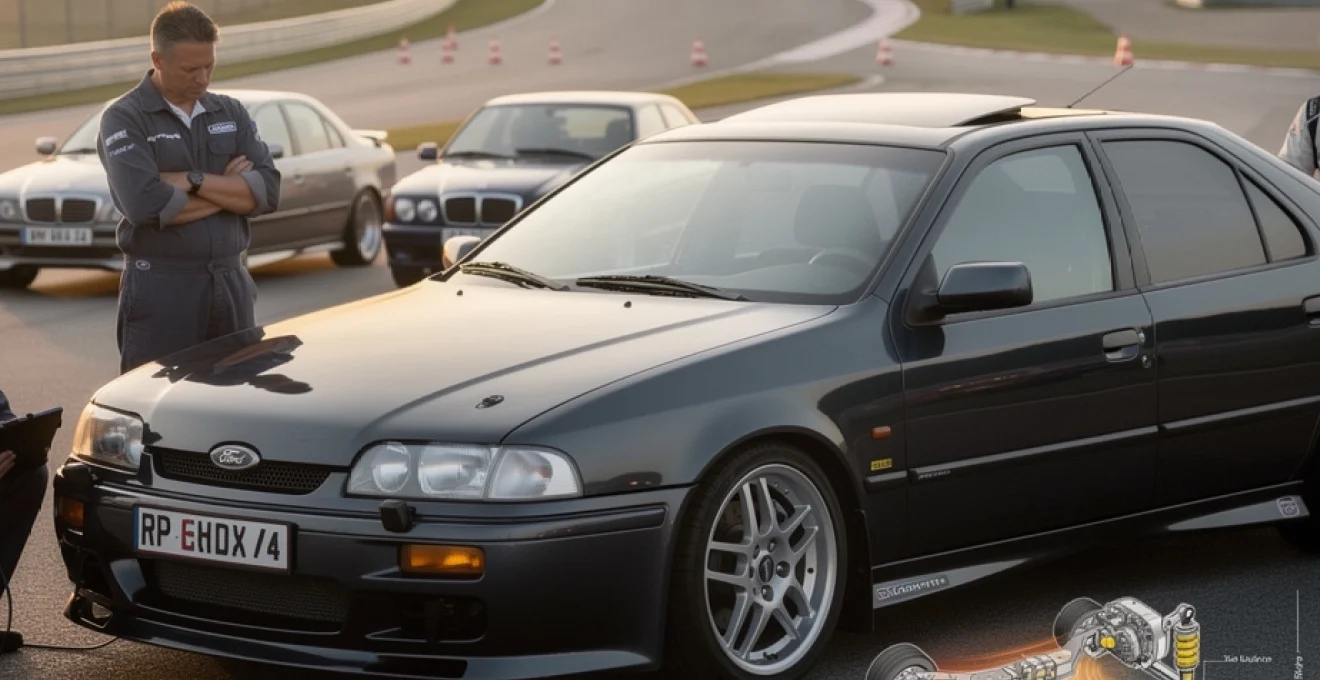
The Ford Granada Scorpio Cosworth stands as one of the most intriguing and underappreciated performance saloons of the 1990s. While Ford’s reputation for building fast cars was firmly established through models like the Escort RS Cosworth and Sierra RS Cosworth, the Granada Scorpio represented a bold departure into the executive car market. This ambitious project transformed Ford’s staid family flagship into a genuine high-performance machine capable of challenging established German rivals.
What makes the Granada Scorpio Cosworth particularly fascinating is how it emerged from Ford’s collaboration with legendary engine builder Cosworth Engineering. The partnership resulted in a sophisticated powertrain that elevated the otherwise mundane Granada platform into something genuinely special. With its 24-valve V6 engine producing 195bhp, the Scorpio Cosworth offered performance credentials that seemed almost impossible to reconcile with its conservative exterior styling.
The car’s significance extends beyond mere performance figures. It represented Ford’s serious attempt to compete in the premium executive saloon segment, traditionally dominated by BMW and Mercedes-Benz. Yet despite its impressive engineering credentials and refined driving dynamics, the Scorpio Cosworth remained something of a hidden gem, overshadowed by more glamorous sports cars and constrained by Ford’s somewhat dowdy corporate image in the luxury segment.
Ford granada scorpio development history and engineering philosophy
The development of the Granada Scorpio series began in the late 1980s as Ford recognised the need to replace the aging third-generation Granada. The project team faced a significant challenge: how to create a car that could compete effectively against BMW’s 5 Series and Mercedes-Benz E-Class while maintaining Ford’s reputation for value and reliability. The solution lay in a comprehensive engineering approach that prioritised driving dynamics and refinement over flashy styling.
Ford’s engineering philosophy for the Scorpio centered on creating what they termed a “world car” – a vehicle sophisticated enough to succeed in demanding European markets while remaining accessible to traditional Ford customers. This approach required significant investment in new technologies, including advanced suspension systems, sophisticated engine management, and improved aerodynamics. The result was a car that drove far better than its conservative appearance suggested.
Sierra RS cosworth platform evolution to scorpio application
The Sierra RS Cosworth’s success provided valuable lessons that Ford applied to the Scorpio development programme. Engineers recognised that high-performance versions required more than just powerful engines – they needed comprehensive chassis modifications to handle the additional power effectively. The Sierra’s advanced four-wheel-drive system and sophisticated suspension tuning became the template for creating a more refined performance saloon.
Adapting Sierra RS Cosworth technology to the larger, heavier Scorpio platform presented unique challenges. The longer wheelbase and increased weight required recalibrated suspension settings and modified power delivery characteristics. Ford’s engineers spent considerable time refining the torque curve to ensure the Scorpio delivered its performance in a more civilised manner than its rally-bred siblings.
Ford special vehicle engineering collaboration with tickford
Ford’s partnership with Tickford Engineering proved crucial in developing the Scorpio’s performance variants. Tickford’s expertise in small-volume manufacturing and performance tuning complemented Ford’s mass-production capabilities perfectly. This collaboration allowed Ford to create limited-run models with bespoke engineering solutions that would have been economically unfeasible for mainstream production.
The Tickford relationship enabled Ford to experiment with advanced technologies and manufacturing techniques. Hand-finished interior components, precision-tuned suspension systems, and carefully calibrated engine management systems all benefited from Tickford’s artisanal approach to automotive engineering. This attention to detail elevated the Scorpio Cosworth above typical Ford products of the era.
YB engine series integration and transmission adaptations
Integrating the renowned YB engine series into the Scorpio required extensive modifications to accommodate the larger, more powerful units. The 24-valve V6 variant demanded significant changes to the engine bay layout, cooling systems, and exhaust routing. Ford’s engineers worked closely with Cosworth to ensure optimal performance while maintaining the refinement expected in an executive saloon.
Transmission adaptations proved equally challenging, as the standard Granada gearboxes were inadequate for the increased power output. Ford developed reinforced manual transmissions and rec
alibrated automatics capable of handling the extra torque while still delivering the smooth shifts expected in an executive saloon. Final-drive ratios were carefully chosen to balance brisk acceleration with relaxed motorway cruising, allowing the Ford Granada Scorpio Cosworth to feel both urgent and effortlessly long-legged. In effect, Ford and Cosworth created a drivetrain that married the robustness of a high-performance power unit with the refinement of a luxury saloon drivetrain.
Production timeline between 1994-1998 manufacturing phases
The Ford Granada Scorpio Cosworth’s most intense development and production window fell between 1994 and 1998, coinciding with Ford’s broader repositioning of its executive car line. Early development mules appeared in the early 1990s, using modified Granada shells and prototype Cosworth engines to validate cooling, NVH and durability targets. By late 1994, limited-production runs ramped up, with most cars hand-finished in low volumes compared with mainstream Scorpio models.
Throughout 1995 and 1996, Ford refined the Cosworth specification in response to dealer feedback and emerging competition from German performance saloons. Minor running changes to engine mapping, suspension bushings and braking hardware were introduced without major publicity, meaning later cars often feel more polished than the earliest examples. By 1997, market demand for large, thirsty petrol saloons was fading in favour of smaller, more efficient models, and Ford quietly wound down Cosworth-specific production.
By the time the Scorpio range was phased out during the second half of 1998, the total number of Ford Granada Scorpio Cosworth cars built remained modest compared with mainstream Granadas. This relatively short production window, combined with limited public awareness, helps explain why surviving examples are now regarded as rare performance saloons. For enthusiasts seeking an understated fast Ford with genuine period authenticity, that narrow 1994‑1998 manufacturing phase is a key part of the car’s appeal.
Cosworth YBT turbocharged engine specifications and performance analysis
While most buyers associate the Ford Granada Scorpio Cosworth with its silky 24‑valve V6, the Cosworth YBT turbocharged four-cylinder represents the spiritual link back to the Sierra RS Cosworth. In engineering terms, the YBT engine family embodied Cosworth’s philosophy of extracting high specific output from relatively modest displacement, using advanced turbocharging and electronics. For the executive‑class Granada Scorpio, this meant adapting race-bred hardware to deliver smooth, tractable power suitable for everyday use.
The focus was not only on peak horsepower, but on how that power was delivered across the rev range. Cosworth engineers sought to provide the kind of effortless mid‑range torque that makes a big saloon feel light on its feet, while still preserving the exhilarating top‑end surge enthusiasts expect from a turbocharged Cosworth. As you might imagine, achieving this balance required meticulous control over boost, fuelling and ignition timing.
2.0-litre DOHC 16-valve turbo configuration details
The YBT powerplant at the heart of Ford’s performance saloon strategy was a 2.0‑litre, double overhead camshaft, 16‑valve inline‑four derived from the earlier YB engines. Cosworth used a robust cast‑iron block paired with an aluminium cylinder head, allowing the engine to withstand high cylinder pressures associated with turbocharging. Four valves per cylinder improved breathing, while carefully sculpted combustion chambers enhanced swirl and mixing for efficient burn.
In Granada Scorpio application, compression ratios were moderated compared with naturally aspirated units to accommodate forced induction without compromising reliability. Forged pistons and reinforced connecting rods were employed to ensure long-term durability even under sustained high‑load motorway use. The result was an engine that felt as tough as it was sophisticated, capable of delivering sustained performance that belied its relatively small displacement.
Compared with the 24‑valve V6 found in many Ford Granada Scorpio Cosworth road cars, the 2.0‑litre turbo configuration placed a stronger emphasis on tunability and outright performance potential. For enthusiasts, the appeal lay in the combination of classic Cosworth engineering details—belt‑driven cams, cross‑flow head design, and robust internals—with the practicality of a modern executive saloon. It was, in many ways, the best of both worlds: race‑inspired technology wrapped in a discreet four‑door body.
Garrett T25 turbocharger system and intercooling technology
To deliver the desired blend of response and top‑end power, Cosworth paired the YBT engine with a compact Garrett T25 turbocharger. The T25 unit was chosen for its relatively low inertia, which helped reduce turbo lag and provided strong boost from mid‑range revs. In an executive saloon like the Ford Granada Scorpio Cosworth, quick spool‑up was essential; drivers expected instant acceleration for overtaking, not just a dramatic surge at the red line.
The turbocharger fed charge air through a front‑mounted intercooler, which reduced intake temperatures and allowed higher, more stable boost pressures without risking detonation. Cooler, denser air equates to more oxygen in each cylinder, enabling more fuel to be burned efficiently—this is where much of the Cosworth’s effortless mid‑range punch originated. The intercooler core and ducting were carefully integrated into the Scorpio’s nose, balancing cooling performance with the need to maintain respectable drag figures and noise levels.
From a driver’s perspective, the Garrett T25 and intercooling package meant the Ford Granada Scorpio Cosworth felt eager and responsive in real‑world conditions. Rather than behaving like a peaky, old‑school turbo car that woke up only in a narrow rev band, the Cosworth turbo system delivered torque like a well‑sorted, large‑capacity engine. It’s a bit like having the shove of a big V8 without the associated fuel bills or nose‑heavy handling compromises.
Weber-marelli engine management and fuel injection mapping
Electronics played a crucial role in taming the YBT’s performance for executive saloon duty. Cosworth employed Weber‑Marelli engine management, a sophisticated system for its time, providing precise control over fuel injection, ignition timing and boost regulation. Each parameter could be adjusted across a wide range of operating conditions, ensuring the Ford Granada Scorpio Cosworth remained smooth, tractable and emissions‑compliant even when driven hard.
Multi‑point fuel injection delivered fuel directly to each cylinder’s intake port, allowing very fine control over mixture strength. This was particularly important under boost, where small deviations in fuelling can lead to detonation or power loss. The mapping strategy prioritised a rich yet safe mixture under full load, while leaning out at cruise to preserve fuel economy—another essential trait in a motorway‑oriented performance saloon.
For owners and tuners, the Weber‑Marelli system offered a degree of flexibility akin to having a configurable “brain” for the engine. With the right expertise, it was possible to recalibrate maps to suit higher boost levels, upgraded intercoolers or freer‑flowing exhausts. That tuning potential further underlined the Ford Granada Scorpio Cosworth’s status as a hidden gem among fast Fords, providing a platform that could evolve well beyond factory specifications.
Power output comparison against contemporary BMW M5 and mercedes 500E
To appreciate the Ford Granada Scorpio Cosworth’s position in the 1990s performance saloon landscape, it helps to compare its power figures with contemporary German heavyweights. Period BMW M5 models, such as the E34 generation, produced around 315‑340bhp from a naturally aspirated straight‑six. Mercedes‑Benz’s 500E, developed in partnership with Porsche, delivered approximately 320bhp from its 5.0‑litre V8. On paper, the Ford was outgunned in absolute terms.
However, the Scorpio Cosworth’s appeal lay in its value proposition and accessible performance. With around 195bhp from the 24‑valve V6 and a broadly similar output from turbocharged YBT applications, it sat below the headline‑grabbing German figures but offered brisk real‑world pace. A 0‑62mph time of sub‑9 seconds and a top speed in the 140mph region meant it was anything but slow, especially when you consider its price advantage against the BMW M5 and Mercedes 500E.
Moreover, Ford’s decision to focus on mid‑range torque and everyday usability gave the Granada Scorpio Cosworth a different flavour. While the M5 and 500E were positioned unequivocally as flagship performance icons, the Ford targeted buyers who wanted discreet speed and executive comfort without paying a premium for a prestige badge. In that sense, it was the thinking person’s fast saloon—a car for those who valued engineering over image.
Torque delivery characteristics and boost pressure parameters
Ask any enthusiast what makes the Ford Granada Scorpio Cosworth so satisfying to drive, and you will often hear the same answer: torque. Thanks to its turbocharging strategy and careful camshaft selection, the Cosworth engine delivers a broad plateau of torque rather than a single peak. Boost typically builds from low‑to‑mid revs, swelling rapidly into a strong, sustained shove that makes overtakes feel effortless.
Factory boost pressures were deliberately conservative, prioritising durability and heat management over headline numbers. In typical YBT setups, maximum boost hovered in the region of 0.7‑0.9 bar, depending on market and calibration. This was enough to give the big Ford a muscular feel without overstressing the drivetrain, radiators or intercooler during prolonged high‑speed cruising—an important consideration on unrestricted German autobahns and fast European motorways.
The character of this torque delivery set the Ford Granada Scorpio Cosworth apart from many naturally aspirated rivals. Where a high‑revving BMW M5 encouraged you to explore the upper reaches of the rev counter, the Cosworth saloon rewarded short‑shifting and relaxed driving, with strong acceleration available almost regardless of gear. It was rather like having a strong tailwind at all times; you didn’t always notice it, but it was there whenever you needed an extra push.
Chassis dynamics and suspension engineering modifications
Power is only half the story in any performance saloon, and Ford knew that matching the Granada Scorpio Cosworth’s engine to an appropriately capable chassis was essential. The standard Scorpio already offered a comfortable, compliant ride, but that alone was not enough to rival sharper European handling benchmarks. As a result, engineers undertook a comprehensive reworking of suspension geometry, damping and tyre specification to transform the car’s road manners.
The goal was subtle but ambitious: maintain the supple long‑distance comfort that existing Granada owners appreciated, while injecting precision and control worthy of the Cosworth badge. Achieving this balance required significant investment in testing across a wide variety of road conditions. From British B‑roads to high‑speed proving grounds, the Ford Granada Scorpio Cosworth chassis was tuned to cope with both everyday commuting and enthusiastic driving.
Independent rear suspension geometry versus standard scorpio setup
The Scorpio platform already benefited from independent rear suspension, but the Cosworth variants received notable refinements to geometry and bushing. Engineers adjusted camber and toe characteristics to provide better stability under power and improved turn‑in response. Under hard acceleration, the revised setup helped keep the rear tyres more square to the road surface, maximising traction and reducing the tendency to squat excessively.
Subframe mounts and suspension bushes were stiffened compared with the standard Scorpio, limiting unwanted movement without introducing excessive harshness. This gave the Ford Granada Scorpio Cosworth a more tied‑down feel at speed, while still allowing the rear axle to absorb surface imperfections. In wet or uneven conditions—a common reality on British roads—the result was greater confidence and predictability.
From a driver’s seat perspective, the changes manifested as a more composed, less floaty rear end when cornering or changing lanes quickly. Whereas the regular Scorpio could feel a little soft and detached, the Cosworth‑tuned geometry communicated more clearly what the rear tyres were doing. It was akin to tightening up the strings on a musical instrument: the basic structure remained the same, but the responses became sharper and more controlled.
Bilstein damper calibration and spring rate specifications
One of the key upgrades that separated the Ford Granada Scorpio Cosworth from its mainstream siblings was the adoption of Bilstein dampers. Bilstein’s reputation for combining firm control with sophisticated valve technology made them an ideal partner for this sort of high‑performance saloon. The dampers were carefully calibrated to work with stiffer springs, producing a chassis that resisted roll and pitch without becoming skittish or nervous.
Spring rates were increased over the standard Scorpio, lowering the ride height marginally and reducing body movement in fast corners. However, engineers avoided the temptation to go too stiff, recognising that many owners would spend hours on motorways rather than racetracks. The end result was a setup that allowed the Granada Scorpio Cosworth to change direction with far more enthusiasm than its size suggested, yet still soak up long‑distance journeys with minimal fatigue.
For those accustomed to the slightly wallowy feel of earlier Granadas, the transformation was striking. The Cosworth‑spec chassis offered a sense of precision and composure reminiscent of contemporary BMW and Mercedes offerings, while retaining a distinctively Ford flavour. It was proof that with the right dampers and spring tuning, even a large executive saloon could feel agile and engaging.
Anti-roll bar dimensions and handling balance optimisation
To fine‑tune handling balance, Ford made targeted changes to the anti‑roll bars front and rear. Thicker bars were fitted compared with the standard Scorpio, reducing body roll and helping the car remain flatter through high‑speed bends. The exact front‑to‑rear stiffness ratio was carefully chosen to promote mild, progressive understeer at the limit—a safer, more predictable characteristic for a powerful rear‑drive saloon.
By limiting roll, the upgraded anti‑roll bars also allowed the tyres to maintain a more consistent contact patch with the road surface. This improved grip and steering precision, especially during fast transitions such as roundabouts or lane changes. For drivers stepping up from lesser Granadas, the Ford Granada Scorpio Cosworth felt significantly more composed and confidence‑inspiring when driven with enthusiasm.
Importantly, the suspension team avoided creating a nervous, oversteer‑prone setup simply to please magazine testers. Instead, the handling balance was engineered to be forgiving and exploitable, rewarding smooth inputs and clean driving lines. Think of it less as a track refugee and more as a consummate grand tourer—capable of serious pace, but happiest devouring long distances with unflustered ease.
Michelin pilot sport tyre specifications and wheel configurations
Tyres are often overlooked when discussing classic performance saloons, yet they play a critical role in shaping the driving experience. The Ford Granada Scorpio Cosworth benefitted from wider alloys and performance‑oriented rubber compared with lesser models. Period cars frequently ran on 16‑inch wheels shod with tyres in the 225‑section range, striking a compromise between grip, comfort and rolling resistance.
Michelin Pilot Sport tyres, or their period equivalents, were commonly recommended for owners seeking to preserve the car’s original handling balance. Their relatively stiff sidewalls and advanced tread compounds provided the steering precision and wet‑weather traction that a powerful, rear‑drive saloon demands. In today’s market, choosing high‑quality tyres remains one of the most effective ways to keep a Ford Granada Scorpio Cosworth feeling as its engineers intended.
For enthusiasts, wheel and tyre selection offers a subtle way to modernise the car’s dynamics without compromising originality. While some owners prefer larger aftermarket wheels, sticking close to the original rolling radius and quality tyre brands generally yields the most satisfying results. After all, what use is a Cosworth‑tuned chassis if its potential is dulled by budget tyres?
Exterior aerodynamic package and visual identification features
One of the most intriguing aspects of the Ford Granada Scorpio Cosworth is how discreet it appears compared with many performance saloons of its era. While hot hatches and coupes often wore bold body kits and oversized spoilers, the Cosworth‑tuned Granada remained largely understated. Subtle aerodynamic tweaks and carefully chosen trim details differentiated it from regular Scorpios, rewarding keen‑eyed enthusiasts who knew what to look for.
This understated approach suited the car’s executive brief. Rather than shouting about its performance credentials, the Ford Granada Scorpio Cosworth preferred a quiet confidence, much like a well‑tailored business suit hiding an athlete’s physique. The aerodynamic package focused on stability, cooling and high‑speed refinement rather than dramatic visual statements.
Front spoiler integration and cooling duct functionality
At the front, the most obvious change on Cosworth‑equipped Granadas was a subtly deeper front spoiler integrated into the bumper design. This splitter helped manage airflow under the car, reducing lift at motorway speeds and improving stability in crosswinds. By guiding air more cleanly around the front end, it also contributed slightly to reduced aerodynamic drag, aiding both performance and fuel economy.
Functional cooling ducts were incorporated to feed additional air to the radiator, oil cooler and, where appropriate, the intercooler. High‑output engines generate significant heat, particularly under sustained boost or during spirited driving in warm climates. The revised front end ensured that the Ford Granada Scorpio Cosworth could maintain safe operating temperatures without resorting to noisy, high‑speed fans that would compromise refinement.
To the casual observer, these changes might have gone unnoticed, blending seamlessly into the Scorpio’s rounded styling. Yet for those who paid attention, the slightly more purposeful front valance and the neatly integrated grille apertures hinted that this was no ordinary executive Ford. It was an object lesson in subtle, function‑led design.
Rear wing design and downforce generation characteristics
At the rear, aerodynamic enhancements were kept deliberately modest. Some markets received a discreet lip spoiler on the boot lid, designed more to tidy airflow separation than to generate dramatic levels of downforce. On a heavy, long‑wheelbase saloon like the Ford Granada Scorpio Cosworth, the priority was stability and low wind noise rather than racetrack‑style grip at extreme speeds.
This small spoiler helped reduce turbulence behind the car, marginally lowering drag and improving high‑speed straight‑line stability. While the gains in absolute downforce were relatively modest, the subjective improvement in confidence at motorway pace was noticeable. Drivers reported a calmer, more planted feel, especially in gusty conditions or when following large vehicles.
In keeping with the car’s overall philosophy, the rear wing treatment avoided the flamboyance seen on models like the Escort RS Cosworth. The result was a car that could blend unobtrusively into a company car park, yet deliver impressive composure when unleashed on an empty stretch of road. For many owners, this dual personality was a core part of the Granada Scorpio Cosworth’s charm.
Side skirt aerodynamics and ground effect considerations
Along the flanks, side skirts were subtly reprofiled to smooth airflow between the front and rear wheels. While far from the aggressive ground‑effect treatments seen on pure sports cars, these panels helped reduce the amount of turbulent air flowing underneath the car. Reducing under‑body turbulence brings two main benefits: improved stability and slightly lower drag, both valuable in a high‑speed cruiser.
The side skirts also served a secondary, aesthetic role, visually lowering the car and giving it a more planted stance without compromising ground clearance. For everyday use on speed‑hump‑strewn urban streets and uneven rural roads, this was essential. The Ford Granada Scorpio Cosworth remained entirely practical, capable of tackling multi‑storey car parks and rougher surfaces without drama.
Think of the side skirts as the aerodynamic equivalent of a well‑designed pair of running shoes: not wildly eye‑catching on their own, but crucial in helping the whole package perform at its best. Their contribution may not have generated magazine headlines, but they played a quiet, important part in the car’s overall high‑speed refinement.
Cosworth badge positioning and unique trim elements
For those in the know, a handful of visual cues distinguished the Ford Granada Scorpio Cosworth from lesser derivatives. Small but significant Cosworth or 24v badges, depending on market and specification, appeared on the boot lid and occasionally on the front wings. These emblems were deliberately restrained—more like the signature on a painting than a gaudy logo—reinforcing the car’s understated image.
Unique alloy wheel designs, often in 16‑inch form with multi‑spoke patterns, further set the Cosworth model apart. Combined with slightly lowered suspension and the aforementioned aerodynamic tweaks, they gave the Granada Scorpio a subtly more purposeful stance. Inside, higher‑grade leather, additional wood trim and specific instrument graphics completed the picture of a discreet performance flagship.
For today’s collectors, these trim elements and badges are crucial in verifying authenticity. With values of classic fast Fords rising steadily, ensuring that a car is a genuine Ford Granada Scorpio Cosworth rather than a cosmetically enhanced replica has become a key consideration. Original badges, correct wheels and period‑accurate interior trim all add to a vehicle’s desirability and long‑term investment potential.
Production numbers and market positioning against european performance saloons
Unlike mass‑market Granadas and Scorpios, the Cosworth‑tuned versions were produced in relatively small numbers. Exact production figures vary by market and specification, but it is widely accepted that total output of genuine Ford Granada Scorpio Cosworth models sits in the low thousands rather than tens of thousands. This scarcity has contributed to the car’s status as a rare performance saloon, especially when compared with more prolific contemporaries.
When new, the Granada Scorpio Cosworth occupied a niche between mainstream executive cars and full‑blown performance flagships. Priced below the BMW M5 and Mercedes‑Benz 500E, it offered similar interior space and comfort, along with strong straight‑line performance, at a more attainable cost. This value‑oriented positioning made it particularly attractive to company car drivers and private buyers who prioritised performance but could not justify a premium badge.
However, that same positioning also worked against the car in image‑conscious markets. Many buyers who could afford an executive saloon with near‑M5 performance simply opted for the real thing, leaving the Ford Granada Scorpio Cosworth somewhat overlooked. Today, that relative lack of period glamour has turned into an advantage: enthusiasts can still find examples at prices far below those of equivalent German icons, despite the Ford’s growing recognition as a future classic.
Contemporary road test results from autocar and what car magazine reviews
Period road tests from respected publications such as Autocar and What Car? provide valuable insight into how the Ford Granada Scorpio Cosworth was perceived when new. Testers frequently praised the car’s blend of performance and refinement, noting that its 0‑62mph times in the high‑eight‑second range and 140mph‑plus top speed were more than adequate for an executive saloon. More importantly, they highlighted the car’s composure at speed and its impressive motorway manners.
Autocar reviewers often commented on the Scorpio Cosworth’s surprisingly agile handling, especially given its size and comfort‑oriented brief. They noted that while it lacked the razor‑sharp turn‑in of the very best sports saloons, it delivered secure, confidence‑inspiring dynamics with plenty of grip. Braking performance and fade resistance also drew positive remarks, an important factor when evaluating a powerful family car.
“Regardless of what you think of the looks, the Scorpio drives brilliantly and prices are tempting.” – Contemporary summary attributed to Jonathan Crouch
What Car? and similar consumer‑focused titles emphasised the Ford Granada Scorpio Cosworth’s value for money, generous equipment levels and low running costs relative to its performance peers. Insurance and servicing typically undercut those of BMW and Mercedes rivals, yet the Ford still offered heated leather seats, advanced electronics and a genuinely luxurious cabin. If you were willing to look past the controversial styling, it represented a compelling ownership proposition.
Looking back, these period reviews helped cement the car’s reputation as an underrated hero in the fast‑Ford lineage. While it never achieved the cult status of the Escort or Sierra RS Cosworth in the eyes of rally fans, the Granada Scorpio Cosworth quietly built a following among drivers who valued its blend of comfort, pace and subtlety. Today, as enthusiasts rediscover the charms of 1990s performance saloons, those early road tests read almost like a set of buying recommendations for a future classic waiting to be appreciated.