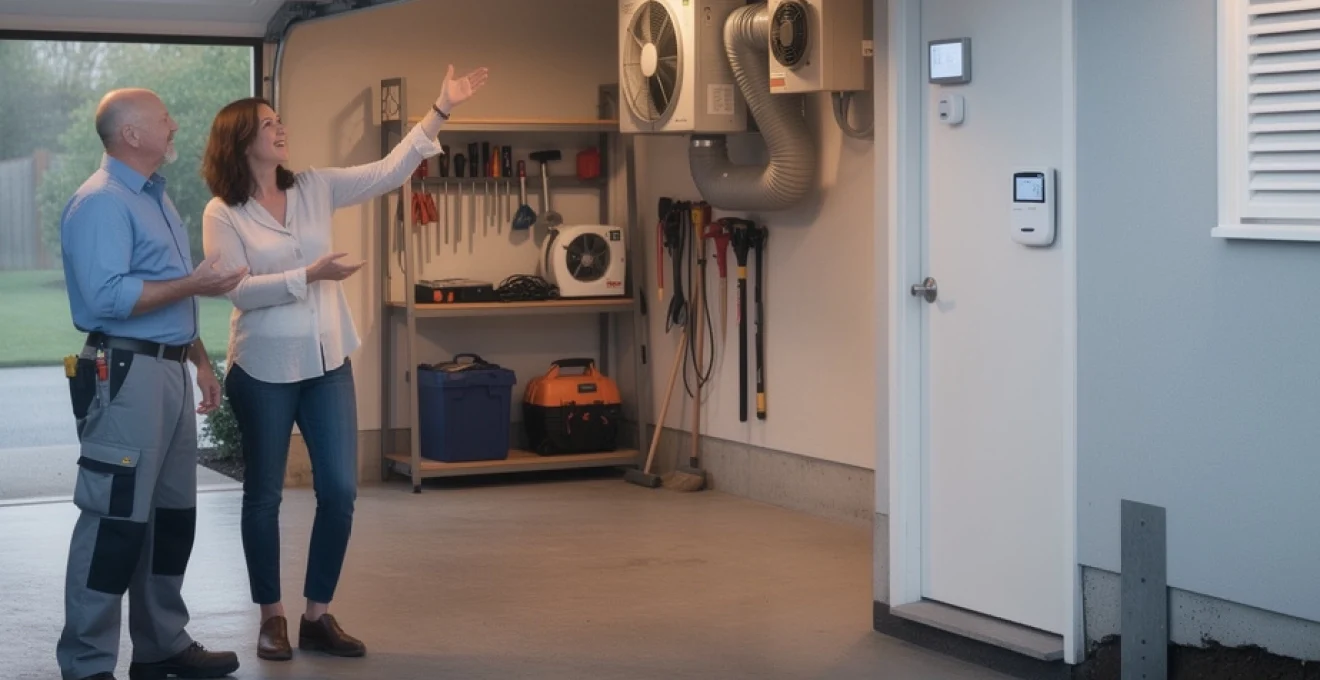
Poor garage ventilation transforms what should be a functional space into an uncomfortable, potentially hazardous environment plagued by musty odours, excessive moisture, and harmful fumes. Many homeowners underestimate the critical role that proper airflow plays in maintaining their garage’s structural integrity and creating a healthier living environment. Without adequate ventilation, garages become breeding grounds for mould growth, accelerated corrosion of tools and vehicles, and the accumulation of volatile organic compounds that can migrate into adjacent living spaces.
The consequences of inadequate garage ventilation extend beyond mere discomfort. Excessive humidity levels can reach 70-80% in poorly ventilated garages, far exceeding the recommended 45-55% range necessary for preventing moisture-related damage. This elevated humidity creates ideal conditions for mould spores to flourish, particularly in corners and ceiling areas where warm air meets cold surfaces. Additionally, chemical fumes from stored petrol, paints, and cleaning products can accumulate to dangerous levels without proper air exchange systems.
Modern garage construction often prioritises energy efficiency through airtight building techniques, inadvertently creating spaces with minimal natural air exchange. This approach, whilst beneficial for temperature control in living spaces, can prove problematic in garages where moisture from vehicles, outdoor equipment, and seasonal weather conditions requires continuous removal. Understanding the principles of both natural and mechanical ventilation systems enables homeowners to create comprehensive solutions tailored to their specific requirements and climate conditions.
Natural ventilation systems for garage moisture control
Natural ventilation harnesses the power of wind pressure and thermal buoyancy to create continuous air movement without mechanical intervention. This passive approach relies on strategically positioned openings that work together to establish consistent airflow patterns throughout the garage space. The effectiveness of natural ventilation systems depends heavily on local wind patterns, temperature differentials, and the careful placement of intake and exhaust openings.
The fundamental principle behind natural garage ventilation involves creating a pressure differential that encourages air movement. Cool, fresh air enters through lower openings whilst warm, moisture-laden air exits through higher openings, establishing a continuous cycle that prevents stagnation. This process, known as the stack effect, becomes more pronounced during colder months when temperature differences between indoor and outdoor environments are greatest.
Ridge vent installation techniques for peak airflow management
Ridge vents represent one of the most effective natural ventilation solutions for garages with pitched roofs. These continuous ventilation systems run along the roof’s peak, providing unobstructed exhaust for rising warm air. Professional installation requires precise cutting of the ridge board and careful sealing to prevent water infiltration whilst maintaining optimal airflow.
The effectiveness of ridge ventilation systems depends on complementary intake vents positioned lower in the structure. Without adequate intake openings, ridge vents cannot function properly, creating negative pressure that may actually draw moisture-laden air into the garage through unintended gaps. Proper ridge vent sizing typically requires 1 square foot of ventilation area per 150 square feet of garage floor space.
Soffit vent positioning and Cross-Ventilation optimisation
Soffit vents provide essential intake airflow for natural ventilation systems, drawing fresh air into the garage at low levels. These vents should be positioned to create cross-ventilation patterns that sweep across the entire garage floor area before rising and exiting through ridge or gable vents. The spacing and size of soffit vents directly impact the system’s overall performance.
Optimal soffit vent placement considers prevailing wind directions and potential obstructions from stored vehicles or equipment. Installing continuous soffit ventilation along the garage’s windward side ensures consistent air intake even during calm weather conditions. The ventilation area of soffit vents should match or slightly exceed the exhaust vent area to maintain balanced airflow.
Louvre vent selection for Wall-Mounted air exchange systems
Wall-mounted louvre vents offer versatile solutions for garages requiring targeted ventilation in specific areas. These adjustable vents allow homeowners to control airflow direction and volume based on seasonal requirements and prevailing weather conditions. High-quality louvre vents feature weather-resistant materials and gravity-operated dampers that prevent backdraft during adverse weather.
When selecting louvre vents for wall-mounted garage air exchange systems, pay careful attention to their free area rating rather than just their external dimensions. A vent with a higher free area allows more air to pass through with less resistance, improving natural airflow and reducing the need for oversized mechanical fans. Position louvre vents at both low and high wall levels where possible to promote vertical air movement and to target known moisture pockets, such as behind parked vehicles or near stored garden equipment.
Passive stack effect principles in garage design
The passive stack effect is the driving force behind most natural garage ventilation strategies, particularly in taller spaces or garages with pitched roofs. Warm, moisture-laden air naturally rises and seeks an escape path at high level, drawing in cooler, drier air from lower openings as it exits. By deliberately designing this pathway, you can turn your garage into a self-ventilating space that requires minimal user intervention.
Effective stack effect design in a garage typically combines low-level intake vents (such as soffit vents, airbricks, or low wall louvres) with high-level exhaust points (ridge vents, gable vents, or high wall vents). The greater the vertical distance between intake and exhaust, the stronger the natural draft, especially when there is a significant temperature difference between indoors and outdoors. You can think of this as a chimney for your garage: the taller the chimney and the warmer the air inside, the more reliably it pulls moist air out.
To maximise the stack effect, avoid blocking vertical airflow paths with solid mezzanines, full-height storage units, or tightly packed shelving in corners where warm air tends to collect. If you need overhead storage, consider open-grid shelving or racking that allows air to pass through rather than creating stagnant pockets. In colder climates, combining a mild background heat source with a well-designed passive stack system can significantly reduce condensation on cold surfaces without resorting to high-energy mechanical drying solutions.
Mechanical ventilation solutions and exhaust fan specifications
While natural ventilation can handle background moisture in many garages, mechanical ventilation becomes essential where you deal with frequent wet vehicles, intensive DIY work, or high levels of fumes and odours. Mechanical garage ventilation systems use fans to control the direction and rate of air exchange, offering predictable performance regardless of external wind conditions. This control is particularly important in attached garages, where poor airflow can allow carbon monoxide and volatile organic compounds to migrate into adjacent living spaces.
Designing mechanical ventilation for a garage starts with understanding its volume, typical usage, and local climate. A workshop-style garage used for welding and painting will require far more aggressive extraction than a simple storage space with occasional vehicle use. Similarly, garages in humid coastal regions may need higher air change rates to prevent mould and corrosion than those in cooler, drier climates. By matching exhaust fan specifications to your actual garage ventilation requirements, you avoid both under-ventilation and unnecessary energy costs.
Centrifugal fan CFM calculations for garage volume requirements
Centrifugal fans are often the preferred choice for garage exhaust systems because they maintain stable airflow even against higher duct resistance or longer discharge runs. To size a centrifugal fan correctly, you first need to calculate your garage volume by multiplying floor area by ceiling height. Once you know the volume, you can determine the target number of air changes per hour (ACH) based on how intensively the space is used.
For a typical home garage focused on moisture and odour control, 4–6 ACH is usually sufficient, whereas a workshop with frequent engine running or chemical use might require 8–10 ACH. The required fan capacity in cubic feet per minute (CFM) can be calculated using the formula: CFM = (Garage Volume × ACH) / 60. For example, a 600 square foot garage with a 9-foot ceiling has a volume of 5,400 cubic feet. At 6 ACH, you would need approximately 540 CFM of exhaust capacity.
Once you have the CFM requirement, check the fan manufacturer’s performance curves at the static pressure created by your ducting, wall grilles, and backdraft dampers. A fan rated at 600 CFM “free air” may only deliver 400 CFM once installed in a restrictive duct system. This is why centrifugal fans, which tolerate higher static pressures better than axial units, are often recommended for ducted garage ventilation and for installations where the exhaust path includes bends or longer runs to the outside.
Axial flow fan installation in through-wall applications
Axial flow fans are a popular and cost-effective choice for through-wall garage exhaust applications where duct runs are short and resistance is low. These fans move air in a straight line along the axis of the impeller, making them ideal for situations where you can mount the unit directly through an external wall. In such installations, axial fans can deliver impressive airflow relative to their cost and power consumption, which suits many residential garages focused on basic moisture and odour control.
When installing an axial fan in a garage wall, position it high on the leeward side of the building to support the natural rise of warm, moist air. Pair the exhaust fan with a dedicated intake opening—such as a louvre vent or under-door grille—on the opposite or lower side to establish a clear airflow path across the space. Without a defined intake, the fan may pull air from unintended gaps, including door seals leading to the house, potentially drawing pollutants toward living areas.
Weather protection is another key consideration for through-wall axial fan installations. Use exterior hoods with integral backdraft dampers or gravity shutters to prevent wind-driven rain, snow, and pests from entering when the fan is off. In cold climates, consider insulated external covers or dampers that reduce heat loss when the fan is not running. Regularly inspect and clean the fan blades and grilles, as dust and cobwebs can reduce airflow and increase noise over time.
Humidity-controlled exhaust systems with honeywell and panasonic models
Humidity-controlled exhaust systems take much of the guesswork out of garage moisture management by automatically responding to changes in relative humidity. Many modern wall- and ceiling-mounted fans from manufacturers such as Honeywell and Panasonic include integrated humidistat controls that activate the fan when humidity exceeds a set threshold, typically adjustable between 40% and 80%. This automated approach is particularly effective in garages where wet vehicles, snowmelt, or damp equipment cause periodic spikes in moisture.
When selecting a humidity-controlled exhaust fan for a garage, focus on three key performance criteria: CFM rating, noise level, and humidity control range. Models designed for continuous or intermittent operation at around 100–300 CFM suit smaller single-bay garages, while larger or multi-bay garages may benefit from multiple units or higher-capacity fans in the 300–600 CFM range. Look for fans with ENERGY STAR ratings where available, as they offer better efficiency and quieter operation, making ongoing use more practical.
Correct placement of the fan’s humidity sensor is crucial for reliable operation. Ideally, the sensor should be exposed to the general air volume of the garage rather than being buried in insulation or mounted directly above a localized moisture source, such as a wash basin, that could cause frequent short cycling. In some Honeywell and Panasonic systems, remote humidistats can be wall-mounted away from the fan, allowing you to sample average conditions at chest height instead of directly at the ceiling, which often yields more representative readings.
Timer and motion sensor integration for automated ventilation control
Integrating timers and motion sensors with your garage exhaust fans allows you to automate ventilation based on actual use, improving both convenience and energy efficiency. A common strategy involves wiring the fan to run for a preset “run-on” period—typically 10 to 30 minutes—after you open the garage door or switch on the lights. This ensures that residual exhaust fumes and moisture are cleared even after you have left the space.
Motion sensors can further enhance this automated ventilation approach by detecting occupancy and triggering the fan whenever someone is working in the garage. This is particularly useful in workshop-style garages where power tools, paints, and solvents are used intermittently throughout the day. Combining a motion sensor with a timer-based run-on function ensures that ventilation continues for a suitable period after activity ceases, without requiring you to remember to switch anything off.
For more advanced control, you can integrate timers, motion sensors, and humidistats into a single control logic, either through a dedicated controller or a smart home system. For example, the fan might run at a low background speed when humidity exceeds 60%, switch to a higher speed when motion is detected, and then continue for 20 minutes before returning to standby. Such layered control helps maintain consistent garage air quality while keeping operating costs and noise to a minimum.
Moisture source identification and vapour barrier implementation
Before investing heavily in fans and vents, it is essential to identify and address the primary sources of moisture in your garage. Common contributors include wet vehicles, unsealed concrete slabs, leaking roofs or gutters, and landscaping that directs rainwater towards the garage walls. You may also find hidden moisture sources such as uninsulated cold water pipes, damp firewood storage, or poorly sealed junctions between the garage and adjoining structures.
A systematic inspection of your garage will quickly reveal where moisture is entering or accumulating. Look for tell-tale signs such as efflorescence on masonry, peeling paint at low wall levels, rust on metal shelving, and condensation on window panes. Use a moisture meter on suspect walls and floors if available, and check during or immediately after wet weather to see if water is tracking under doors or seeping through cracks. By tackling these issues at the source, you greatly reduce the workload placed on your ventilation system.
Vapour barriers play a critical role in controlling moisture migration from the ground and external walls into the garage interior. On concrete slabs without a proper damp-proof membrane, applying a high-quality concrete sealer or epoxy coating can significantly reduce vapour transmission and surface dampness. For walls, especially in older or single-skin constructions, consider installing internal studwork with a continuous vapour control layer on the warm side, combined with breathable insulation that allows any trapped moisture to dry to the outside.
It is important to balance vapour control with the risk of trapping moisture within the building fabric. Improperly placed or incomplete vapour barriers can force moisture into cold cavities where mould and structural damage develop unseen. As a rule of thumb, vapour barriers should be continuous, carefully sealed around penetrations, and positioned on the warm side of insulation in heated garages. In unheated or partially heated spaces, a more vapour-open construction combined with robust ventilation may be safer than heavy-handed sealing that cannot be perfectly executed.
Air quality monitoring and hygrometer-based environmental control
Proactive air quality monitoring turns garage ventilation from a reactive chore into a manageable, data-driven process. By measuring humidity, temperature, and pollutant levels, you gain a clear picture of how your garage behaves throughout the year and when intervention is needed. Simple devices such as digital hygrometers, combined with more advanced multi-sensor monitors, can highlight patterns like overnight condensation peaks or humidity spikes each time a wet vehicle is parked inside.
Once you understand these patterns, you can fine-tune your garage ventilation strategies rather than relying on guesswork. For instance, you may discover that running an exhaust fan for 30 minutes after each arrival is enough to keep humidity within the ideal 45–55% range, or that a small background dehumidifier is needed only during the dampest months. Over time, this targeted approach reduces both energy usage and the risk of moisture damage, while maintaining a more comfortable and odour-free environment.
Digital hygrometer placement for accurate humidity readings
Digital hygrometers are one of the most cost-effective tools for managing garage moisture, but only if they are placed correctly. To obtain reliable readings, mount or position your hygrometer at roughly chest height and away from direct sunlight, heaters, or cold exterior walls that could skew results. Avoid placing it directly above a wet car, sink, or dehumidifier outlet, where local microclimates do not reflect the overall conditions in the space.
In larger or L-shaped garages, consider using two or three hygrometers in different zones to identify uneven humidity distribution. For example, one unit might be placed near the garage door, another at the rear wall, and a third near any internal door leading to the home. Comparing readings over a few weeks will reveal which areas are most prone to condensation or dampness, guiding you in positioning fans, vents, and insulation for maximum effect.
Many modern digital hygrometers include data logging, max/min memory, or wireless connectivity, allowing you to track humidity trends over time. If you notice that relative humidity routinely exceeds 60% for prolonged periods, particularly in cooler weather, this is a strong signal that your current garage ventilation approach needs to be upgraded. Keeping humidity under better control not only reduces mould growth but also slows down corrosion of tools, bicycles, and vehicles.
Condensation point analysis and dew point temperature management
Understanding the dew point temperature in your garage helps explain why condensation forms on certain surfaces even when the overall humidity does not seem extreme. The dew point is the temperature at which the air becomes saturated and water vapour begins to condense into liquid. When cold surfaces—such as metal doors, uninsulated concrete walls, or vehicle bodywork—drop below the dew point, moisture will condense on them, leading to rust, peeling finishes, and mould growth.
You can use simple online calculators or smartphone apps to estimate the dew point based on your garage’s temperature and relative humidity readings. For example, at 10°C with 80% relative humidity, the dew point is around 6.6°C. Any surface colder than this will attract condensation. By comparing these values, you can see why uninsulated metal doors or thin masonry walls facing the outdoors are frequent problem areas in cooler months.
Managing dew point in a garage involves a combination of lowering humidity and raising surface temperatures. Improved ventilation reduces the moisture content of the air, while insulation and draught-proofing increase the temperature of cold surfaces, making them less likely to fall below the dew point. Even modest upgrades, such as adding insulated door panels or lining a single-skin wall with rigid foam, can significantly reduce condensation and subsequent mould growth when combined with a well-designed ventilation scheme.
Carbon monoxide detection integration with garage ventilation systems
Carbon monoxide (CO) is a colourless, odourless gas produced by incomplete combustion in engines, heaters, and some appliances, making it a critical safety consideration in any garage. Because CO cannot be detected by human senses, installing dedicated carbon monoxide detectors in attached or frequently used garages is non-negotiable. Position detectors on walls or ceilings according to manufacturer guidelines, typically at breathing height or slightly above, and away from direct exhaust outlets that may cause false alarms or sensor damage.
For enhanced safety, you can integrate CO detectors with your garage ventilation system so that elevated CO levels automatically trigger exhaust fans. Some smart detectors and building automation systems allow relay outputs or wireless signals to switch fans to high speed when CO reaches a preset threshold, then return to normal once levels fall. This approach is particularly valuable in garages where vehicles regularly idle for short periods, such as when loading or unloading in poor weather.
In attached garages, consider linking CO alarms to in-house notification systems so that any dangerous buildup is immediately apparent even if you are not in the garage. Regular testing and timely replacement of CO detectors are essential, as sensor elements degrade over time. Combined with reliable mechanical ventilation and sensible behaviour—such as never running engines for extended periods with doors closed—CO monitoring forms a robust defence against one of the most serious garage air quality risks.
Seasonal garage ventilation adjustments and climate-specific solutions
Garage ventilation requirements can change dramatically between seasons, so a one-size-fits-all approach often leads to either excessive heat loss in winter or insufficient moisture control in summer. In colder months, the primary challenge is preventing condensation on cold surfaces without wasting energy through constant high-rate ventilation. In warmer, more humid seasons, the focus shifts to limiting moisture-laden outdoor air from elevating indoor humidity while still clearing fumes and odours.
In winter, you may choose to reduce background ventilation rates and rely more on demand-controlled systems such as humidistat fans and short, intensive “purge” ventilation after bringing in wet vehicles. Combining modest insulation upgrades with targeted extraction often keeps humidity under control without leaving the garage uncomfortably cold. In very cold climates, some homeowners also introduce low-level background heating, which raises surface temperatures and enhances the stack effect, helping to dry out the space faster.
Summer garage ventilation strategies differ depending on whether your region is predominantly hot and dry or hot and humid. In dry climates, abundant natural ventilation through open doors, windows, and roof vents can usually keep both temperature and humidity within acceptable limits, especially if combined with ceiling or floor fans to promote air movement. In contrast, in hot and humid regions, drawing in large volumes of outside air during peak humidity can actually worsen condensation and mould problems, particularly on cooler internal surfaces.
To handle humid summers, consider using timed or humidity-controlled mechanical ventilation that operates during cooler, drier parts of the day, such as early morning or late evening. Some homeowners in these climates also deploy portable or fixed dehumidifiers in conjunction with sealed and insulated garage envelopes, treating the space more like a conditioned room than a semi-outdoor area. By tailoring your garage ventilation approach to the season and your specific climate zone, you maintain better control over both moisture and energy usage throughout the year.
Professional HVAC assessment and building regulation compliance for garage ventilation
As soon as you move beyond basic natural ventilation and standalone fans, involving a professional HVAC specialist can help ensure your garage ventilation system is both effective and compliant with local building regulations. Building codes often specify minimum ventilation rates, fire separation requirements, and restrictions on duct routing, particularly in attached garages where fumes and smoke could threaten adjoining living spaces. Ignoring these regulations not only risks safety but may also affect insurance coverage and property resale value.
A qualified HVAC professional can perform detailed calculations of your garage’s required air changes per hour, factoring in its use, volume, and connection to the rest of the building. They can also design balanced intake and exhaust systems that avoid creating negative pressure in the home, which can draw pollutants into living areas or interfere with combustion appliances such as boilers and water heaters. Where necessary, they may recommend heat recovery ventilators (HRVs) or energy recovery ventilators (ERVs) that maintain air quality while reducing heat loss.
Professional assessment is especially valuable if you plan to convert your garage into a hobby workshop, home gym, or semi-habitable space where you or your family will spend extended periods. In such cases, indoor air quality expectations become closer to those of living spaces, and regulations on ventilation, insulation, and fire safety become more stringent. An experienced consultant can help you navigate requirements around fire-rated doors, CO detector placements, and the separation of garage air from the main HVAC system.
Finally, working with professionals ensures that electrical connections for fans, controls, and sensors are safe and code-compliant, using appropriately rated circuits, protective devices, and weather-resistant fittings. Combined with a solid understanding of natural and mechanical ventilation principles, this expert input allows you to create a garage that stays dry, odour-free, and safe all year round, while aligning with legal standards and best-practice building science.