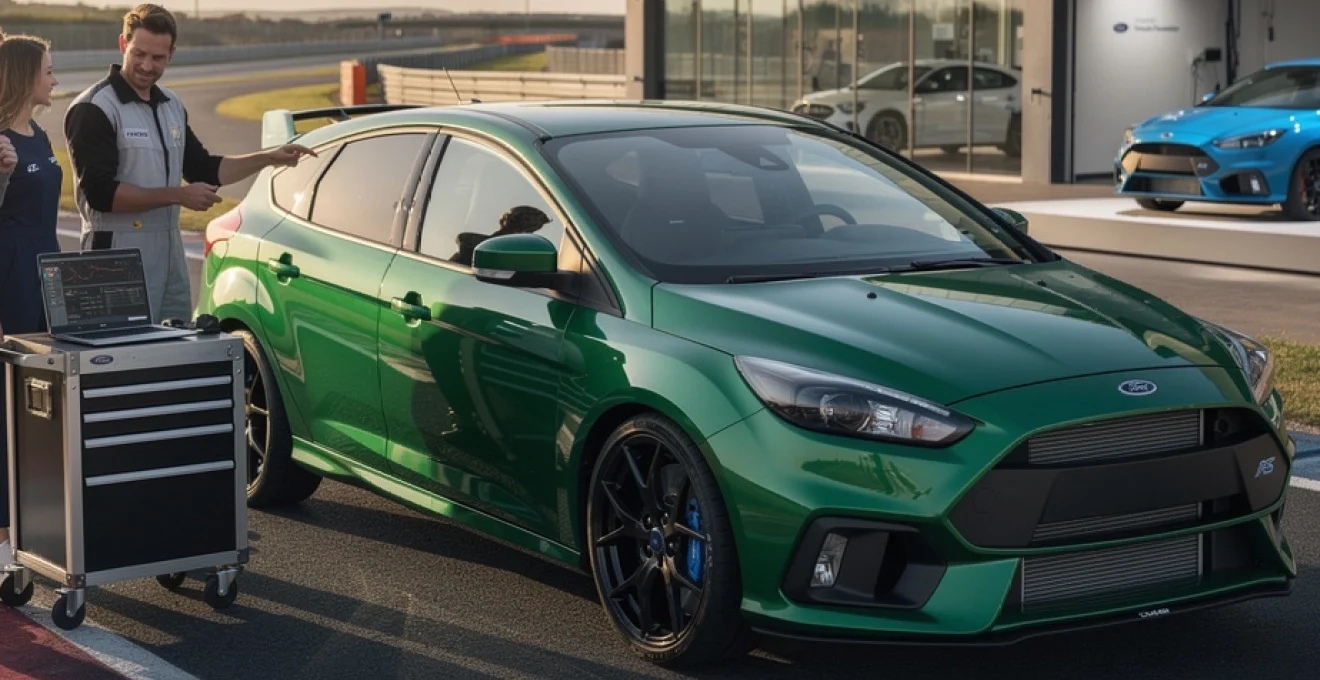
# Green Ford Focus RS: Rare, Eye-Catching and Powerful
The Ford Focus RS has always occupied a special place in the hearts of performance car enthusiasts, but there’s something particularly captivating about encountering one in green. While Ford offered the Mk3 Focus RS in several striking colours, green examples remain exceptionally uncommon on UK roads, making them highly sought-after amongst collectors and enthusiasts alike. This rarity, combined with the car’s formidable performance credentials and distinctive visual presence, has elevated certain green Focus RS models into a category of their own. The combination of aggressive styling, turbocharged power delivery, and that distinctive emerald finish creates an automotive presence that’s difficult to ignore, whether stationary at a car meet or thundering down a B-road.
Ford focus RS mk3 heritage: evolution of the green machine
The third-generation Focus RS arrived in 2016 as the culmination of Ford’s hot hatch evolution, building upon lessons learned from its predecessors. Unlike the Mk1 and Mk2 models that relied on front-wheel drive with clever differential technology, the Mk3 embraced all-wheel drive for the first time in Focus RS history. This fundamental change addressed the inherent traction limitations of front-drive performance cars whilst opening new possibilities for handling dynamics. The 2.3-litre EcoBoost engine produced a substantial 350hp as standard, representing a significant leap over the 305hp Mk2 RS. Ford’s engineers developed sophisticated torque vectoring capabilities that could distribute power rearward with remarkable precision, fundamentally transforming how the Focus RS attacked corners and delivered its considerable performance.
The original Focus RS from 2002 established the template with its 212hp Duratec engine and Quaife limited-slip differential, creating a front-drive hot hatch that punched well above its power-to-weight ratio through sheer mechanical grip. The Mk2 iteration brought the glorious five-cylinder Volvo-sourced engine producing 305hp in standard form, with the limited-run RS500 pushing output to 350hp. That five-cylinder soundtrack became legendary, creating an auditory experience that four-cylinder engines simply couldn’t replicate. However, managing 350hp through the front wheels alone proved challenging, even with Ford’s innovative RevoKnuckle suspension geometry designed specifically to combat torque steer and maximise traction during hard acceleration.
Nitrous blue vs ultimate green: factory colour specification analysis
Ford marketed the Mk3 Focus RS with several distinctive colour options, including the headline-grabbing Nitrous Blue that appeared in virtually all promotional materials. This vibrant blue became synonymous with the Mk3 RS, appearing on press cars, motor show displays, and marketing photography worldwide. Stealth Grey offered a more subdued option for those preferring understated aggression, whilst Frozen White provided classic contrast against the car’s black accents. However, factory green options remained conspicuously absent from Ford’s official UK palette for the standard Mk3 RS, making genuine green examples either custom resprays, special editions from specific markets, or potentially pre-production demonstration vehicles that occasionally surface.
The absence of an official green in the standard range adds considerable intrigue to any green Focus RS you might encounter. Some owners commissioned professional resprays in shades reminiscent of classic Ford RS heritage colours, including various greens that recall the Escort RS Cosworth or earlier Focus RS limited editions from continental markets. The quality and execution of these custom finishes varies enormously, from concours-standard professional applications indistinguishable from factory work to less convincing amateur attempts. Determining whether a green Focus RS represents a genuine special edition, a high-quality professional respray, or something in between requires careful examination of paint codes, build documentation, and originality verification.
RS500 limited edition precedent and collector appeal
The Mk2 Focus RS500 established important precedents for limited-production Focus RS variants with enhanced specifications and exclusive finishes. Ford produced exactly 500 examples globally, with each car receiving upgraded internals, a larger turbocharger, enhanced cooling systems, and a distinctive matte black bonnet graphic that became iconic. The RS500’s exclusivity and performance enhancements created substantial collector demand that persists
today, with well-preserved RS500s routinely trading for multiples of their original list price. This has a direct bearing on the green Focus RS Mk3 market. When collectors assess a rare colour or individually specified Focus RS, they frequently reference the RS500 playbook: limited numbers, a visually distinctive finish, and a clear story that separates the car from regular production. A Mk3 Focus RS in a unique or historically significant shade of green can therefore tap into that same appetite for exclusivity, especially when backed up by documented provenance and tasteful performance upgrades. For buyers who missed out on the RS500, a rare green Focus RS Mk3 represents an opportunity to secure a similarly special car with modern technology and all-wheel drive capability.
Production numbers: UK market allocation statistics 2016-2018
Understanding just how rare a green Ford Focus RS is in the UK requires context around Mk3 production numbers. Between 2016 and 2018, Ford sold roughly 12,000 Focus RS units across Europe, with the UK representing one of the strongest markets. Estimates suggest that around 4,000 to 4,500 Mk3 Focus RS models were officially registered in the UK during this period, the majority finished in Nitrous Blue, Frozen White or Stealth Grey. Because green was not a standard UK catalogue colour, genuine green examples account for a fraction of one percent of total registrations, making them far scarcer than even low-volume factory hues.
This statistical imbalance explains why you can attend multiple track days or cars and coffee events without ever seeing two green Focus RS Mk3s parked side by side. When one does appear, it often becomes a focal point of attention, with enthusiasts drawn by the combination of familiar shape and unusual paintwork. For collectors tracking UK registration data through enthusiast forums and DVLA records, it quickly becomes clear that a correctly documented green Focus RS is rarer in practical terms than many officially numbered special editions from other brands. If exclusivity on UK roads is a priority, production and allocation figures strongly support the case for seeking out a green car.
Mountune M380 and M400 upgrade compatibility
Many owners of the green Ford Focus RS Mk3 choose to enhance performance with official or warrantied upgrades, and Mountune’s M380 and M400 packages are among the most respected options. Developed in close cooperation with Ford, these kits retain the factory EcoBoost 2.3-litre engine architecture while optimising software, intake, and hardware components. The M380 package typically lifts output to around 380hp, improving mid-range torque and sharpening throttle response without compromising everyday drivability. Move up to the M400 upgrade, and you are looking at roughly 400hp in a well-sorted all-wheel-drive hatchback, turning an already rapid car into something that can trouble serious sports machinery on road and track.
Crucially, a rare green Focus RS that has been upgraded with Mountune parts and supported by full documentation can appeal strongly to knowledgeable buyers. Because these upgrades are widely recognised and often dealer-fitted, they tend to be viewed more favourably than obscure aftermarket tuning solutions when it comes to long-term reliability and residual values. Is a Mountune-equipped green RS the perfect balance between collectability and usable performance? For many enthusiasts, the answer is yes: you get the visual drama of a rare colour, combined with power levels that fully exploit the GKN Twinster all-wheel drive system without straying into risky, over-stressed territory.
Ecoboost 2.3-litre turbocharged powerplant technical architecture
At the heart of every Focus RS Mk3, green or otherwise, sits the 2.3-litre EcoBoost turbocharged four-cylinder engine, a powerplant that combines modern efficiency with old-school punch. Derived from the engine family used in the Mustang, the RS-spec unit features extensive revisions to suit high-performance hot hatch duty. Ford’s engineers strengthened the block, upgraded the cooling system and optimised the cylinder head for improved airflow, allowing the engine to sustain high boost pressures over repeated hard use. When you pair this robust architecture with the car’s advanced all-wheel drive system, you get a package that can put down power in a way earlier front-driven RS models could only dream of.
From an engineering perspective, the EcoBoost’s blend of direct injection, variable valve timing and high-pressure turbocharging creates a broad, useable torque band that is ideal for fast road driving. Whereas some older turbo engines felt binary—nothing, then everything—the 2.3-litre EcoBoost delivers its 350hp in a relatively progressive manner, especially in standard calibration. For owners of a green Focus RS, this means you can enjoy brisk B-road blasts and track days without constantly feeling like the car is trying to overwhelm its chassis. It is this cohesive blend of engine architecture and drivetrain that underpins the Mk3 RS’s reputation as one of the most complete modern hot hatches.
Twin-scroll turbocharger configuration and boost pressure mapping
A key part of the Focus RS’s character comes from its twin-scroll turbocharger configuration. Unlike a conventional single-scroll turbo, a twin-scroll design separates exhaust pulses from different cylinders as they enter the turbine housing, reducing interference and helping the turbo spool up more quickly. The result is improved low-end response and reduced turbo lag, so when you press the throttle in your green Ford Focus RS, the car reacts with less hesitation. This makes the RS feel more naturally aspirated in everyday driving, yet still capable of delivering a hefty mid-range surge when the boost builds.
Boost pressure mapping is equally important in defining how the car behaves. Ford’s calibration team carefully tuned the engine management system to deliver up to around 23psi (1.6 bar) of peak boost in certain conditions, while protecting the engine from excessive temperatures and detonation. Think of it like a well-conducted orchestra: each instrument—fuel, spark, boost, ignition timing—must play its part at exactly the right moment to produce harmonious performance. For owners exploring Mountune M380 or M400 maps, the underlying twin-scroll hardware provides enough headroom to handle the higher demands, provided supporting mods and maintenance routines are respected.
Forged internal components: piston and connecting rod specifications
To reliably handle the stresses associated with 350hp and significant boost pressure, the Focus RS’s EcoBoost engine benefits from strengthened internals. Ford employs high-strength forged steel connecting rods and robust pistons designed to cope with the elevated cylinder pressures that come with aggressive turbocharging. Forged components differ from cast equivalents in that the metal is compressed and worked into shape, aligning the grain structure and enhancing mechanical strength. This gives the 2.3-litre motor a solid foundation for both stock performance and moderate power increases from upgrades.
For a green Focus RS that might see regular track use or spirited driving, these forged internals offer peace of mind. When combined with proper warm-up procedures, quality oil, and adherence to service intervals, the engine can endure hard use without complaint. It’s a bit like choosing reinforced running shoes before you start marathon training; you may not feel the benefit on a short jog, but once you push harder and further, the added durability makes all the difference. Enthusiasts considering higher-output tunes should still be cautious, but in factory or Mountune-approved trim, the internal specification is more than up to the task.
Intercooler efficiency: air-to-air heat exchange performance
Turbocharged engines generate heat as a by-product of compressing air, and managing this heat is essential to maintain consistent power. The Focus RS Mk3 employs a large front-mounted air-to-air intercooler to cool the intake charge before it reaches the cylinders. Cooler air is denser, allowing more oxygen to enter the combustion chamber, which supports greater power and reduces the risk of knock. On a spirited drive in your green Focus RS, especially on a warm day, the intercooler’s ability to shed heat can make the difference between repeated full-throttle pulls and a power output that fades as temperatures climb.
Independent testing has shown that the factory intercooler performs reasonably well for standard power levels, but frequent track use or higher-output tuning packages may push it towards its limits. You can think of the intercooler as the car’s lung capacity; for casual exercise it’s adequate, but for sustained sprints, more capacity makes breathing easier. This is why many performance-focused owners upgrade to higher-efficiency aftermarket units, particularly when running M380 or M400 calibrations. For a rare green Focus RS intended to be both collectible and capable, a quality intercooler upgrade—ideally one that doesn’t require irreversible modifications—can improve thermal stability without undermining originality.
Torque vectoring dynamics: GKN twinster AWD system integration
The engine’s output would be wasted without an intelligent system to distribute it, and this is where the integration between the EcoBoost powerplant and the GKN Twinster all-wheel drive system becomes crucial. Unlike simpler haldex-style systems, the Twinster setup uses twin electronically controlled clutch packs on the rear axle to apportion torque not only between front and rear, but also side to side at the back. When you accelerate out of a corner in your green Ford Focus RS, the system can send more torque to the outside rear wheel, helping rotate the car and tighten your line. It’s a subtle but transformative effect, turning what could be a nose-heavy hatchback into something far more agile and adjustable.
Ford’s drive mode system alters how aggressively the torque vectoring behaves, with Sport and Track modes permitting more rear bias and livelier handling. When the powerplant and all-wheel drive system are working in harmony, the car feels as though it’s being gently pushed from behind through the bend, rather than dragged by the front axle alone. This dynamic behaviour is a key reason why collectors and drivers are drawn to the Mk3 RS over many rivals. For anyone considering a green Focus RS as both a weekend toy and long-term asset, understanding how this torque vectoring system shapes the driving experience is essential.
Dynamic torque vectoring all-wheel drive system mechanics
Diving deeper into the mechanics of the dynamic torque vectoring all-wheel drive system reveals just how advanced the Focus RS Mk3 really is. The GKN Twinster rear drive unit sits between the rear wheels and incorporates two multi-plate clutch packs controlled by an electro-hydraulic actuator. In normal driving, most torque flows to the front axle for efficiency, but the system can shift up to 70 percent rearwards in milliseconds when conditions demand more traction or a sportier balance. Unlike a traditional centre differential, there is no fixed torque split; instead, the control software continuously calculates where to send power based on throttle position, steering angle, yaw rate and wheel speed sensors.
This means that when you turn into a corner, the car can proactively send torque rearwards and outwards even before slip occurs, helping to offset understeer. In Drift Mode, the calibration becomes more aggressive, allowing the rear axle to take a dominant role and enabling controlled oversteer when driven by an experienced driver in a safe environment. Think of the system as a smart coach sitting alongside you, subtly adjusting how hard each wheel pushes or pulls to keep the car composed or playful, depending on your chosen setting. For anyone assessing the green Focus RS’s capabilities, this advanced all-wheel drive hardware is one of the strongest arguments in its favour compared with more conventional hot hatches.
Rarity factor: green focus RS market positioning and values
From a market perspective, the green Ford Focus RS occupies an interesting niche between mainstream performance hatchback and modern classic collector’s piece. Because green was not part of the standard UK colour catalogue, any example finished in a vivid green hue will immediately spark questions about origin and authenticity. Is it a high-quality custom respray? A special-order car from another market? Or a unique build commissioned by a dealer or previous owner? The answers to these questions have a direct impact on value, especially as more buyers treat the Focus RS Mk3 as an appreciating asset rather than a simple daily driver.
Over the past few years, we’ve seen clean, low-mileage Mk3 Focus RS examples maintain strong residuals, with certain colours and specifications commanding a premium. A well-presented green car, backed by photographic documentation of paintwork, service history, and, ideally, limited tasteful modifications, can attract a distinct subset of enthusiasts who value individuality as much as outright performance. If you are considering buying a green Focus RS today, you’re not just choosing a fast hatchback—you’re also entering a small, tightly defined segment of the used performance car market where rarity, provenance and presentation matter immensely.
Custom paint code analysis: factory vs aftermarket green finishes
Because Ford did not officially list a bright green for the UK Mk3 Focus RS, most green cars you encounter will be aftermarket repaints or vinyl wraps. Distinguishing between a factory-applied finish (from another market or special programme) and a custom job requires careful attention to paint codes, panel edges, and documentation. The first step is to locate the vehicle’s paint code on the door jamb or VIN plate and cross-reference it with official Ford colour charts. If the code doesn’t match any known RS Mk3 options for the UK, but aligns with recognised Ford or European-market hues, you may be looking at a rare factory special-order or imported example.
For custom resprays, high-end bodyshops often provide detailed invoices and photo records of the work, including stripping, preparation, primer coats and final clear coat application. A proper colour change should also involve painting door shuts, engine bay edges and hidden areas to avoid tell-tale signs of the original colour. When inspecting a green Focus RS, run your fingertips gently along rubber seals and trim edges; overspray, rough masking lines or colour mismatches are clear warning flags. In the best cases, a professionally executed custom green finish can enhance desirability, especially if the shade pays homage to iconic Ford colours like Ultimate Green from the Mk2 era, but buyers should always price in potential future repaint or correction costs if quality is questionable.
Auction results: bring a trailer and collecting cars sale data
Online auction platforms such as Bring a Trailer and Collecting Cars provide valuable insight into how the market views unusual colours and specifications. While true green Focus RS Mk3 sales remain relatively rare, we can still extrapolate from data on unique colours, special editions, and highly specified cars. On these platforms, low-mileage Mk3 RS models in desirable shades consistently achieve strong hammer prices, sometimes exceeding equivalent dealer retail values once buyer’s fees are included. Unique wraps or aftermarket paints can be a double-edged sword, however; some buyers appreciate individuality, while others prefer factory originality and may bid more cautiously.
For a rare green Focus RS, recorded sales that combine distinctive colour with low mileage, full service history, and tasteful upgrades like Mountune tuning or high-end suspension often achieve a notable premium over more common specifications. On the flip side, cars with poorly documented colour changes or signs of accident repair tend to struggle, reinforcing the importance of transparency and paperwork. If you’re planning to sell a green Focus RS via auction, investing time in professional photography, detailed descriptions, and scanned invoices can pay dividends. Prospective buyers on these platforms are typically well-informed; they will reward clear, honest presentation and penalise vague or incomplete histories.
Mileage impact on valuation: sub-10,000 mile examples
Mileage has a profound effect on the valuation of any performance car, and the Focus RS is no exception. Sub-10,000 mile examples are increasingly rare as the youngest Mk3 cars age, and when you overlay a rare green finish onto that low-mileage status, values can rise sharply. Collectors often treat such cars as long-term investments, using them sparingly to preserve condition while the broader market catches up with the model’s emerging modern-classic status. As a result, green Focus RS models with delivery-mileage or single-digit thousands on the odometer can command a substantial premium over higher-mileage counterparts, sometimes by several thousand pounds.
That said, buyers should not automatically dismiss cars with 20,000–40,000 miles, especially if they come with impeccable service records and evidence of conscientious ownership. A well-maintained, regularly used Focus RS can sometimes be a safer bet than a very low-mileage car that has spent long periods dormant without proper care. When assessing a green example, look for consistent MOT records, documented oil changes, and careful warm-up routines described by previous owners. Ultimately, mileage is only one part of the valuation puzzle, but in the context of a rare colour like green, it can tip the balance significantly for collectors seeking the most pristine examples.
Track-focused engineering: suspension geometry and damping
The appeal of the green Ford Focus RS isn’t limited to its eye-catching paintwork; beneath the vivid exterior lies a chassis tuned for serious driving. Ford’s Performance division reworked the standard Focus suspension geometry with stiffer springs, thicker anti-roll bars and revised bushings to deliver sharper turn-in and reduced body roll. The result is a car that feels eager and responsive on a fast B-road, yet still just about civilised enough for daily use, particularly if you resist the temptation to leave it in the firmest damper setting. For drivers who intend to exploit the car’s potential on track, this inherently capable baseline makes further optimisation straightforward.
Compared with many rivals, the Focus RS blends front-end bite with a surprisingly playful rear axle, thanks in part to its all-wheel drive torque vectoring. On track, this manifests as a car that can be driven with your right foot as much as the steering wheel, adjusting your line with careful throttle inputs. Have you ever driven a car that felt like it was working with you, rather than against you, when you push harder? The RS is very much that car. For green examples that may see regular circuit work, thoughtful upgrades to damping, tyres and alignment can elevate the already impressive factory setup into something truly track-ready.
Sachs performance dampers: compression and rebound settings
The Focus RS Mk3 is equipped with Sachs performance dampers featuring switchable modes, allowing drivers to choose between a standard setting for road use and a firmer calibration for track work. In simple terms, compression damping controls how quickly the suspension compresses over bumps or during weight transfer, while rebound damping governs how fast it returns to its original position. Ford’s engineers tuned these settings to keep the body tightly controlled during aggressive cornering, braking and acceleration, which is why the RS feels so composed when you link a series of bends together. However, in the stiffer mode, the ride can become very firm on typical UK roads, especially when combined with low-profile tyres.
For owners of green Focus RS models who value both performance and comfort, learning when to use each damper setting is key. Standard mode is generally better for everyday driving, offering enough control without transmitting every surface imperfection into the cabin. Track mode comes into its own on smooth circuits where the extra body control outweighs the harsher ride. Some enthusiasts also explore aftermarket damper solutions with independently adjustable compression and rebound for finer tuning. Think of it like tailoring a suit; the factory fit is good for most people, but a few strategic adjustments can create something that feels truly bespoke to your driving style and preferred roads.
Quaife limited-slip differential retrofit considerations
While the Mk3 Focus RS relies on its rear-biased all-wheel drive system for traction and agility, some owners choose to retrofit a Quaife limited-slip differential to the front axle for even greater front-end bite. A helical-gear LSD like the Quaife unit can help distribute torque more effectively between the front wheels during hard acceleration out of corners, reducing inside wheel spin and sharpening turn-in response. This modification echoes the philosophy behind the original Mk1 Focus RS, which used a Quaife differential to great effect in a purely front-drive configuration. When integrated correctly, it can make a green Focus RS feel even more sure-footed and engaging on track.
However, retrofitting an LSD is not a trivial undertaking. It requires removal and partial disassembly of the gearbox, which is both labour-intensive and potentially warranty-affecting on newer vehicles. Cost is another factor; while the hardware itself is relatively affordable, professional installation can be expensive. There’s also a balance to strike between enhanced traction and potential steering corruption; an overly aggressive front differential can introduce torque steer or alter the car’s natural balance. For most road-focused green Focus RS owners, the stock setup is more than adequate, but if you’re chasing lap times and have access to a reputable specialist, an LSD can be a worthwhile addition to a well-thought-out track build.
Michelin pilot sport cup 2 tyre setup for circuit applications
Tyres are one of the most transformative upgrades you can make to any performance car, and the Focus RS is no exception. Many track-day enthusiasts swap the standard road-biased rubber for Michelin Pilot Sport Cup 2 tyres, a semi-slick compound that offers significantly higher grip levels once up to temperature. On a green Focus RS used regularly on circuit, Cup 2s can deliver sharper turn-in, shorter braking distances and higher cornering speeds, allowing you to exploit the car’s chassis and torque vectoring system more fully. The trade-off is increased wear, reduced wet-weather performance and a harsher ride, especially on cold or broken surfaces.
If you’re considering Cup 2s, it’s wise to treat them as a dedicated track set, ideally mounted on a separate set of wheels. This allows you to preserve your road tyres and swap to the more aggressive rubber only when needed, minimising the compromises in everyday use. Proper tyre pressure management is crucial as well; pressures that feel fine on the road may balloon under sustained track heat, reducing grip and accelerating wear. Approached sensibly, a Cup 2 setup can make your green Focus RS feel as though it has moved up a performance class, turning in and gripping more like a lightweight sports car than a practical hatchback.
Brake system specifications: brembo caliper and disc configuration
To match its potent engine and chassis, the Focus RS comes equipped with a robust braking system featuring large ventilated discs and Brembo four-piston front calipers. The standard setup provides strong, repeatable stopping power for road use and occasional track days, with good pedal feel and confidence-inspiring performance. On a spirited drive, you’ll notice how quickly the RS can shed speed before a bend, allowing you to brake later and carry more momentum through the corner. For owners of green Focus RS models who plan frequent circuit sessions, however, upgrading fluid, pads and sometimes discs becomes an important consideration.
High-temperature brake fluid with a higher boiling point, combined with performance-oriented pads, can significantly improve fade resistance during extended hard use. Some enthusiasts also opt for grooved or two-piece discs, which better manage heat and can reduce unsprung weight. Imagine your braking system as the safety net that lets you explore the engine and chassis with confidence; the stronger and more reliable that net, the more relaxed and focused you’ll feel at the wheel. As with any modification on a collectible car, it’s sensible to choose reversible upgrades and keep original components, particularly if long-term value and originality are part of your ownership strategy.
Ownership considerations: maintenance schedules and common technical issues
Owning a green Ford Focus RS is as much about responsible stewardship as it is about enjoying performance. Regular maintenance and an understanding of common technical issues can dramatically improve both reliability and resale value. The RS follows a service schedule that typically requires oil and filter changes every 12 months or 12,500 miles, whichever comes first, though many enthusiasts prefer shorter intervals to protect the hard-working EcoBoost engine. Routine checks of brake fluid, coolant, and drivetrain oils are also essential, especially if the car sees regular spirited driving or track use.
Because the Focus RS Mk3 has been on the road for several years, patterns of issues and preventative measures are now well established in the enthusiast community. Addressing them proactively—rather than waiting for faults to appear—can save significant expense and downtime. This is particularly important for rare or highly specified cars like a green Focus RS, where future buyers will scrutinise history files more closely than average. A thick folder of invoices, MOT records and specialist inspections not only keeps the car running smoothly but also reinforces its status as a carefully maintained, investment-grade example.
Head gasket failure prevention: coolant system monitoring protocols
One of the most widely discussed technical concerns on the Focus RS Mk3 is head gasket reliability, particularly on early-build cars. Ford issued a service campaign to address instances where an incorrect gasket design contributed to coolant loss and, in worst cases, engine damage. For current and prospective owners, the key takeaway is not to panic, but to implement sensible coolant system monitoring protocols. Regularly check coolant levels when the engine is cold, inspect for any creamy residue under the oil cap, and keep an eye on temperature readings during extended drives or track sessions.
If you notice unexplained coolant loss, white exhaust smoke or overheating, it’s important to stop driving and have the car inspected by a Ford dealer or reputable specialist familiar with the RS. Many cars have already had updated gaskets or replacement engines fitted under warranty, and documentation of this work can actually reassure future buyers. Think of coolant system monitoring like regular health check-ups; catching a small issue early can prevent it from becoming a major surgery later. For a rare green Focus RS, staying ahead of potential head gasket issues is essential to preserving both performance and long-term value.
Drift mode clutch pack wear patterns and service intervals
The party piece of the Focus RS Mk3 is its Drift Mode, which allows controlled oversteer by directing significant torque to the rear axle. While it’s undeniably entertaining, frequent use places additional stress on the GKN Twinster rear drive unit and its clutch packs. Over time, aggressive driving with repeated launches or long oversteer sessions can accelerate wear, potentially leading to noises, juddering or reduced effectiveness of the torque vectoring system. For owners who enjoy Drift Mode on a green Focus RS, understanding these wear patterns is crucial to avoid unexpected repair bills.
Although the rear drive unit is designed to be robust, it is not maintenance-free. Regular fluid changes according to or ahead of the manufacturer’s schedule can help prolong clutch pack life, particularly on cars that see track time. Listening for unusual noises from the rear under load and paying attention to any changes in handling behaviour can provide early warnings of issues. As with any performance feature, moderation and mechanical sympathy go a long way; enjoying Drift Mode occasionally on suitable surfaces, rather than on every drive, is a smart compromise. If you’re buying a used green RS, it’s worth asking the previous owner about their driving habits and whether the rear unit has ever been serviced or inspected.
Insurance group 41E: premium costs and specialist underwriters
The Ford Focus RS Mk3 sits in insurance group 41E, reflecting its high performance and repair costs compared with regular hatchbacks. For owners, this translates into premiums that can be noticeably higher than those for standard Focus models or milder hot hatches. Factors such as driver age, postcode, annual mileage and security measures all influence the final figure, but even with a clean record, you should budget accordingly. A rare green Focus RS may also attract additional attention—both positive and negative—so investing in secure garaging, quality alarms and tracking systems is strongly advised.
To manage costs, many enthusiasts turn to specialist performance car insurers who understand the RS community and offer tailored policies. These underwriters often take into account limited annual mileage, club memberships and documented modifications such as Mountune upgrades or track-day usage. Some will even provide agreed-value policies, which can be particularly attractive for unique or appreciating assets like a green Focus RS. Before committing to a policy, it’s worth obtaining quotes from both mainstream providers and niche specialists, comparing not just price but also coverage for modifications, track use and salvage retention. In doing so, you protect both your enjoyment of the car and the investment you’ve made in one of the most distinctive modern hot hatches on the road.