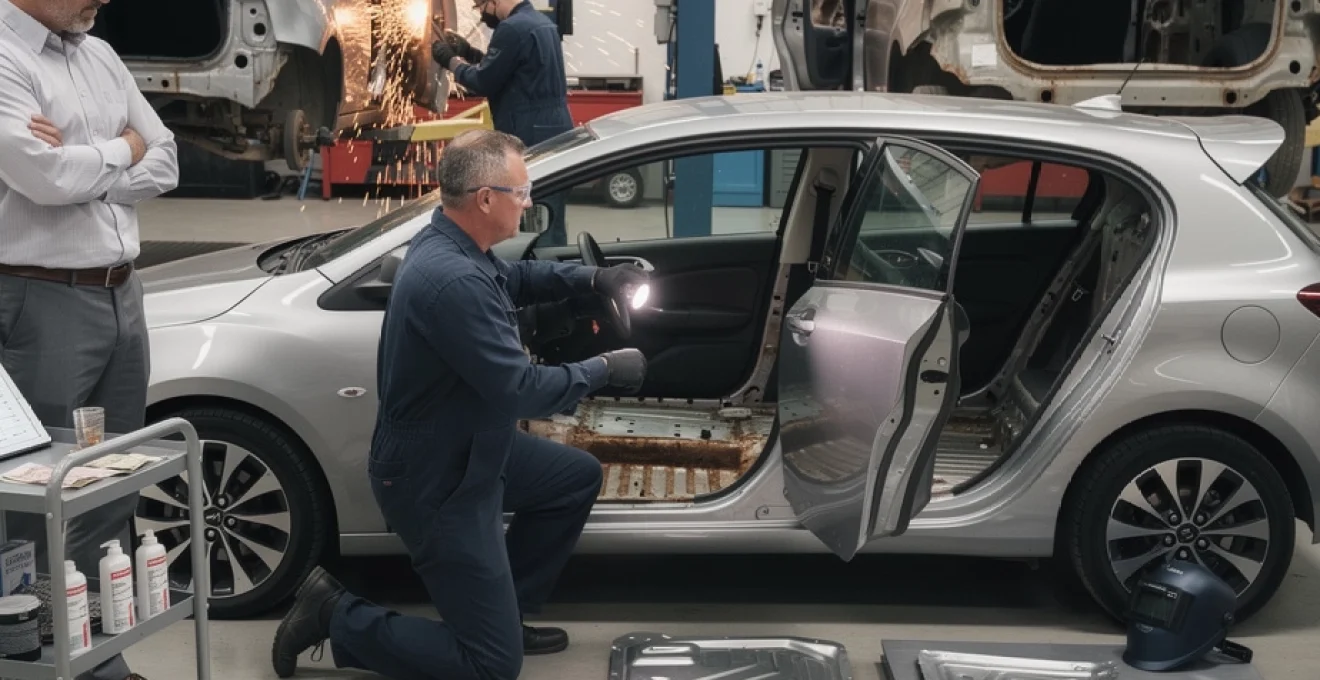
Car floorboard replacement represents one of the most significant bodywork investments you’ll encounter as a vehicle owner. When rust, corrosion, or structural damage compromises your vehicle’s floor panels, the repair costs can quickly escalate into thousands of pounds. Understanding these expenses beforehand enables better financial planning and helps determine whether restoration remains economically viable compared to purchasing a replacement vehicle.
The complexity of floorboard replacement varies dramatically depending on your vehicle’s age, make, and the extent of deterioration. Classic car enthusiasts often face particularly challenging decisions, as original equipment manufacturer (OEM) parts become increasingly scarce and expensive. Modern vehicles benefit from readily available aftermarket alternatives, though professional installation remains labour-intensive regardless of the parts chosen.
Vehicle restoration projects frequently reveal hidden damage that extends beyond initially visible corrosion. What begins as a straightforward floor pan replacement can evolve into comprehensive structural repairs involving chassis rails, sills, and support brackets. This escalation pattern makes accurate cost estimation challenging without professional assessment.
Cost breakdown for car floorboard replacement components
Understanding the individual component costs provides clarity when evaluating quotes from different workshops. Floor pan replacement involves multiple elements beyond the primary panels themselves, including adhesives, consumables, and protective coatings that contribute significantly to overall project expenses.
Pressed steel floor pan pricing for popular vehicle models
Floor pan pricing varies considerably across different vehicle manufacturers and model years. Ford Escort floor pans typically cost between £80-£150 per side, while BMW E30 series panels command £200-£350 due to their more complex pressing requirements. Volkswagen Golf variants fall within the £120-£250 range, reflecting the model’s popularity and aftermarket support availability.
Japanese vehicle floor pans often present excellent value, with Toyota Corolla and Honda Civic panels available from £90-£180 per side. Premium German marques like Mercedes-Benz and Audi demand significantly higher investments, with floor sections ranging from £300-£600 depending on the specific model and manufacturing tolerances required.
Classic British sports cars present unique challenges, as original-specification floor pans for models like the MGB or Triumph Spitfire can cost £200-£400 per side when sourcing from specialist heritage parts suppliers.
Aftermarket vs OEM floorboard material cost analysis
Aftermarket floor pans offer substantial cost savings compared to OEM alternatives, typically ranging from 40-70% less expensive depending on the manufacturer and quality grade selected. However, fitment tolerances may require additional fabrication work, potentially offsetting initial savings through increased labour charges.
OEM components guarantee precise fitment and maintain original vehicle specifications, crucial for insurance purposes and future resale value. The premium charged for OEM parts reflects superior steel quality, accurate pressing, and comprehensive testing procedures that ensure long-term durability.
Quality aftermarket manufacturers like Euro Car Parts or GSF provide intermediate options, offering improved fitment compared to budget alternatives while maintaining competitive pricing structures. These panels often feature enhanced corrosion resistance through improved coating processes.
Structural adhesives and welding consumables expenses
Professional floor pan installation requires specialist adhesives and welding consumables that add £50-£120 to material costs. Structural bonding agents ensure proper panel alignment during welding, while seam sealers prevent moisture ingress that could compromise long-term integrity.
MIG welding wire consumption varies based on panel complexity and existing metalwork condition. Expect £30-£60 in consumables for a complete floor replacement, including wire, gas, and cutting discs. Additional costs arise when extensive preparation work requires grinding wheels, primer, and rust treatment products.
Sound deadening and undercoat application costs
Proper floor pan installation includes sound deadening material application and protective undercoating that adds £80-£180 to component costs. These treatments significantly improve vehicle refinement while preventing future corrosion through moisture barrier creation.
Premium sound deadening materials like Dynamat command higher prices but deliver superior results compared to basic bitumen alternatives. Professional-grade underseal products provide decades of protection when applied correctly, just
as important as the steel itself, particularly on vehicles used all year round on salted UK roads. Skipping or downgrading this stage may save £50–£100 today but can easily lead to repeat floorboard replacement costs within a few winters.
Labour charges for professional floorboard installation
While parts and panels are easy to price, labour is where car floorboard replacement costs can vary the most. Two workshops using similar floor pans can still quote several hundred pounds apart, depending on their hourly rate, approach to rust repair, and how thoroughly they strip and refit the interior. Understanding how labour is calculated helps you compare quotes on a like-for-like basis and avoid unpleasant surprises once the vehicle is on the ramp.
Body shop hourly rates across different UK regions
Most UK body shops charge between £45 and £90 per hour for structural work, with independent specialists usually at the lower end of this range and dealer-affiliated repair centres at the top. In London and the South East, you might see rates of £70–£100 per hour, while in the North of England, Wales, and parts of Scotland, £45–£65 per hour is still common for welding and fabrication. Classic and motorsport restoration shops often command a premium due to their niche experience and slower, more meticulous approach.
When you’re calculating the total cost to replace car floorboards, these regional rate differences quickly add up. A 15‑hour job at £50 per hour is £750; the same work at £90 per hour is £1,350 before VAT. This is why some owners choose to travel to a reputable shop a little further away, especially for large projects such as full floor pan and chassis rail replacement. However, you should also factor in transport costs, time off work, and any recovery fees if the car is not roadworthy.
MIG welding and fabrication time requirements
Replacing car floor pans is not just a case of cutting out rust and stitching in new steel. A competent welder will spend time trial-fitting the panels, trimming edges, and ensuring the new floor aligns correctly with the sills, chassis rails, and seat mounts. For a typical modern hatchback with pre-pressed replacement pans, expect 6–10 hours of welding and fabrication per side if corrosion is limited to the flat floor sections.
On older classics, or where the original metal has been heavily patched in the past, that time can easily double. Bespoke fabrication of repair sections, rebuilding seat crossmembers, and recreating jacking points can push the welding element alone to 20–30 hours on a badly corroded shell. This is a key reason why quotes you see online for car floorboard replacement in enthusiast forums can vary from “a day’s work” to “two full weeks in the workshop” depending on the baseline condition.
Rust treatment and surface preparation labour costs
Surface preparation is the unglamorous but vital stage that often separates a cheap patch repair from a long-lasting floorboard replacement. Once rotten metal has been removed, any surrounding areas with surface corrosion must be wire-brushed, ground back, and treated with rust converters or zinc-rich primers. On a lightly corroded floor, this may add 2–3 hours of labour per side; on a heavily pitted shell, 6–8 hours of prep is not unusual.
Most body shops will build this time into a fixed estimate if the problem areas are obvious. However, where carpets and trim are still in place at the quotation stage, they may only be able to give an indicative cost. It’s common to see estimates structured as “X hours confirmed, plus Y hours provisional for rust treatment,” reflecting the reality that hidden rust can only be properly assessed once everything is stripped back to bare metal.
Interior trim removal and refitting charges
To gain full access to the floorboards, the interior must come out. This usually includes front and rear seats, centre console, carpeting, sound deadening, and often sections of dashboard trim and interior plastics. A straightforward hatchback or saloon may take 2–4 hours to strip and a similar time to refit; more complex vehicles with integrated wiring looms and airbags can take significantly longer.
Shops typically charge their standard hourly rate for this work, which can add £200–£400 to your floorboard replacement bill. If you’re confident and methodical, removing the interior yourself can reduce costs considerably, as illustrated by many owners on classic car forums who strip carpets and sound deadening at home, then deliver a bare shell to the welder. Just be sure to label every fixing, take photos as you go, and protect exposed wiring and modules from welding sparks and grinding dust.
Vehicle-specific floorboard replacement costs
Because no two vehicles are identical, floorboard replacement costs can only ever be estimated as a range. However, you can use some broad benchmarks to gauge whether the quotes you’re receiving are realistic. For example, a small, modern hatchback such as a Ford Fiesta or Vauxhall Corsa with moderate floor rust might cost £800–£1,400 in total, including parts, welding, and reassembly, assuming no significant chassis rail repairs are needed.
Mid-size saloons and estates, particularly premium German models like the BMW 3 Series or Audi A4, often sit in the £1,200–£2,000 bracket due to higher panel prices and more complex interiors. Classic cars and sports cars can vary even more: a common model with good aftermarket support, such as an MGB, may come in around £1,500–£2,500, while rare classics with limited parts availability or extensive bespoke fabrication can exceed £3,000–£4,000 for full floor and structural restoration. As a rule, if a quote to replace car floorboards approaches or exceeds the total market value of the car, it’s time to consider whether restoration is a labour of love rather than a financial investment.
DIY floorboard replacement investment requirements
Many enthusiasts ask whether it’s worth attempting a DIY car floorboard replacement to save money. The answer depends on your tools, skills, and appetite for learning metalwork. If you already own a suitable MIG welder, grinder, and safety gear, you can often cut the total bill by 50% or more, as you’re only paying for panels, consumables, and protective coatings. Floor pans themselves, as we’ve seen, may cost £100–£300 per side for many popular models, with perhaps another £150–£250 in consumables and coatings.
However, if you’re starting from scratch, the upfront investment in equipment can be substantial. A quality hobby MIG welder with gas capability, auto-darkening helmet, clamps, and basic metalworking tools can easily reach £600–£1,000. Add in a decent jack, axle stands, protective clothing, and fire safety equipment, and your initial outlay might approach what a budget body shop would charge for the entire job. On the positive side, you are left with tools that will serve you on future repairs and projects, which is why some owners view the first floorboard replacement as their “tuition fee” into welding.
Time is the other major investment. For a first-time DIYer, replacing a single floor pan can take several weekends of careful work, from stripping the interior and cutting out the rot to positioning panels, welding, grinding, sealing, and repainting. If the vehicle is your daily driver, you’ll need to plan for this downtime or arrange alternative transport. It’s also worth asking yourself an honest question: are you comfortable carrying out structural repairs that affect crash safety, or would you prefer to handle the prep and leave the structural welding to a professional?
Insurance claims and MOT compliance considerations
Even when the main concern is “how much does it cost to replace car floorboards?”, it’s important not to overlook insurance and MOT implications. Floor pans form part of the vehicle’s structural shell, and poor repairs can lead to MOT failures, invalidated insurance, and serious safety risks in a collision. Conversely, high-quality repairs carried out by recognised professionals can protect your vehicle’s value and keep you on the right side of both the DVSA and your insurer.
Category S and category N write-off thresholds
For insured vehicles, significant rust or accident damage to the floor can push repair costs high enough that the insurer deems the car a write-off. In the UK, a Category S (structural) write-off indicates that the structure, including chassis or monocoque, has been damaged, while Category N (non-structural) relates to cosmetic or non-structural issues. Extensive floorboard replacement usually falls into the structural camp, especially if seat mounts, chassis rails, or sills are affected.
Insurers make their decision based on the cost to repair versus the vehicle’s pre-incident market value. If the cost to properly replace the car floorboards, including labour at commercial rates, comes close to or exceeds 50–60% of the vehicle’s value, many insurers will lean towards a write-off. Owners sometimes decide to “buy back” a Category S vehicle and have the repairs done independently, but you must be sure the work is done to a high standard and correctly documented to avoid issues at resale or with future claims.
Structural integrity certification costs
After structural repairs such as floorboard and chassis rail replacement, it can be wise – and in some cases necessary – to obtain independent verification of the repair quality. This might take the form of an inspection by a specialist engineer, a recognised classic car restorer, or, for heavily modified or radically repaired vehicles, assessment under the DVSA’s Individual Vehicle Approval (IVA) framework. While not every floor pan replacement needs this level of scrutiny, having documentation can reassure future buyers and insurers.
Engineer’s reports typically cost between £150 and £400 depending on the complexity of the vehicle and the depth of inspection required. For heavily modified or previously written-off cars, some insurers may insist on such a report before offering comprehensive cover. Think of this as a structural “MOT plus”: a record that the critical underbody repairs were carried out safely, with appropriate materials and welding procedures, rather like a survey on a house that has had major underpinning work.
MOT testing requirements for modified floor structures
From an MOT perspective, testers are primarily concerned with corrosion or weakness within prescribed areas around seatbelt mountings, suspension pick-up points, and other load-bearing sections. If your car floorboards show excessive rust or contain thin, poorly welded patches near these zones, the vehicle is likely to fail. Replacement floor pans, properly seam-welded and protected, are usually viewed positively, but sloppy work – such as overlapping plates with minimal welds – will attract attention and potential advisories or failures.
If you significantly modify the floor structure – for example, to fit different seats, install a roll cage, or tub the rear arches – you must ensure that all seat belt anchorages and structural members remain at least as strong as the original design. While most sensible modifications will still pass a standard MOT, more radical changes might trigger the need for an IVA inspection, especially if the vehicle’s identity could be questioned under the DVLA’s points system. When in doubt, it’s worth discussing your planned floorboard replacement with both your MOT tester and your insurer before work starts, so you know the repaired car will remain road legal and fully covered once it’s back on the road.