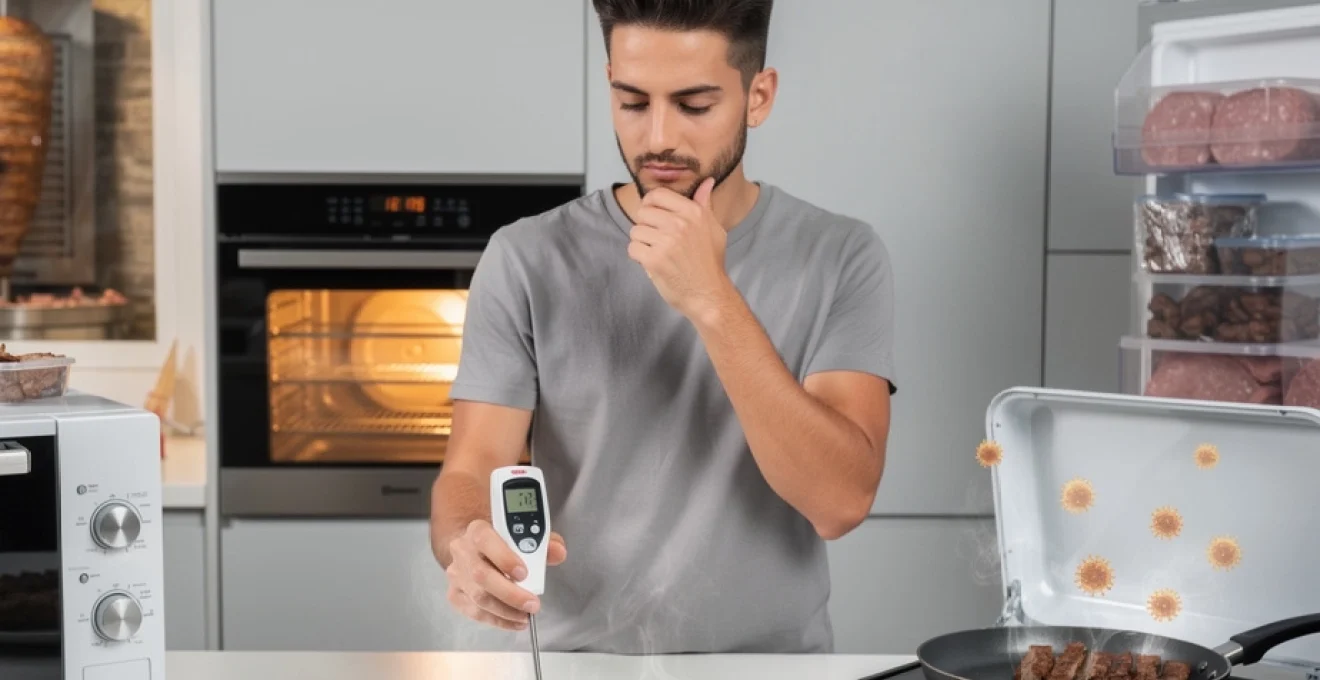
# Is it safe to reheat kebab meat? Food safety explained
Kebab meat—whether doner, shish, or seekh—remains one of Britain’s most beloved takeaway options, with millions consumed weekly across the UK. Yet the question of whether yesterday’s kebab can safely become today’s lunch continues to perplex consumers and food handlers alike. The answer involves understanding bacterial growth patterns, proper storage protocols, and critical temperature thresholds that determine whether reheated kebab poses health risks or provides a perfectly safe meal. With food poisoning bacteria capable of doubling in number every 20 minutes under favourable conditions, the stakes are considerably higher than simply preserving flavour and texture.
The kebab industry faces particular scrutiny from local authority environmental health officers, as the unique preparation method—layering seasoned meat onto vertical spits that rotate for hours—creates multiple opportunities for bacterial contamination. Understanding the science behind safe kebab reheating empowers you to make informed decisions about leftover takeaway meat whilst recognising when commercial establishments might be cutting corners with food safety protocols.
Bacterial growth parameters in cooked doner, shish, and seekh kebab varieties
The three primary varieties of kebab meat each present distinct bacterial risk profiles. Doner kebabs, constructed from compressed layers of seasoned lamb, chicken, or beef, undergo a gradual cooking process as the outer surface faces intense radiant heat whilst inner layers remain cooler. This temperature gradient creates conditions where Clostridium perfringens, Staphylococcus aureus, and Salmonella species can survive in partially cooked sections if the spit isn’t managed correctly.
Shish kebabs—skewered chunks of marinated meat—typically receive more uniform heat distribution during grilling, reducing the likelihood of cold spots harbouring bacteria. However, once cooked and stored, they become vulnerable to the same contamination risks as other prepared meats. Seekh kebabs, made from minced meat mixed with spices and formed around skewers, present heightened risks because the grinding process distributes surface bacteria throughout the entire product, similar to burgers and sausages.
Clostridium perfringens proliferation in room temperature lamb and chicken kebabs
Clostridium perfringens represents one of the most common culprits in kebab-related food poisoning incidents. This spore-forming bacterium thrives in oxygen-poor environments like the dense layers of doner meat. Spores can survive initial cooking temperatures, then germinate and multiply rapidly when meat enters the danger zone between 5°C and 63°C. Research indicates that C. perfringens can double its population every 10-12 minutes under optimal conditions in cooked meat products.
The bacterium produces enterotoxins in your intestinal tract after ingestion, typically causing symptoms 6-24 hours after consumption. Lamb doner, with its higher fat content and compressed structure, provides particularly favourable conditions for anaerobic bacterial growth. When kebab shops leave partially cooked spits at room temperature between service periods—a practice unfortunately common in some establishments—they create perfect incubation chambers for this pathogen.
Staphylococcus aureus contamination risks in pre-cooked rotisserie meat
Staphylococcus aureus commonly colonises human skin and nasal passages, making it a frequent contaminant in food handled by workers with inadequate hygiene practices. Unlike many foodborne pathogens, S. aureus produces heat-stable enterotoxins that survive reheating temperatures sufficient to kill the bacteria themselves. Once these toxins form in kebab meat stored at improper temperatures, subsequent reheating—even to 75°C or higher—won’t eliminate the poisoning risk.
The Food Standards Agency reports that S. aureus thrives between 7°C and 48°C, with optimal growth at 37°C—precisely the temperature range kebab meat might experience during slow cooling or prolonged holding periods. Pre-sliced kebab meat stored uncovered in refrigerated display units remains
particularly vulnerable, as repeated door opening and poor temperature control can allow the surface to sit in the danger zone for extended periods. If staff handle ready-to-eat salads, pitta bread and pre-cooked meat without washing hands or changing gloves between tasks, they can easily transfer S. aureus from their skin onto the kebab meat. Once toxins are formed, symptoms such as severe vomiting, abdominal cramps and nausea can appear within just a few hours of eating contaminated kebab, even if it has been thoroughly reheated at home.
Salmonella survival rates in insufficiently reheated poultry-based kebabs
Poultry-based doner and shish kebabs present a higher intrinsic risk of Salmonella contamination than red meat kebabs. While proper initial cooking to a core temperature of at least 75°C will destroy Salmonella, problems arise when kebab meat is cooled and later reheated unevenly. If the reheating step fails to bring the coldest part of the meat back up to a safe internal temperature, surviving bacteria can remain viable and may even multiply if the kebab sits warm but not hot for prolonged periods.
Studies on cooked poultry products show that Salmonella can survive short exposures to sub-lethal temperatures, particularly when protected by fat and dense meat structures, as found in compressed doner cones. For example, bringing the centre of a slice of chicken doner to only 55–60°C for a few minutes may not be enough to reduce bacterial numbers to safe levels. From a consumer perspective, this means that reheated kebab meat that feels hot on the outside but is merely lukewarm in the centre could still harbour infectious doses of Salmonella, especially if it has previously spent time in the 5°C–63°C danger zone.
Temperature danger zone: 5°C to 63°C time-limit thresholds for kebab storage
The concept of the temperature danger zone—5°C to 63°C—is central to understanding when reheated kebab meat is safe and when it becomes a food poisoning risk. Within this range, bacteria such as C. perfringens, S. aureus and Salmonella can multiply rapidly, sometimes doubling every 20 minutes. UK food safety guidance generally recommends that high-risk foods like cooked kebab meat should not be left in this temperature band for more than a cumulative four hours, including preparation, service and reheating stages.
In practical terms, this means that kebab meat kept warm on a counter, left cooling slowly on the kitchen side, or transported home from a takeaway in a lukewarm state all contribute to that four-hour allowance. Once you approach or exceed this time limit, even thorough reheating may not fully compensate for the toxins some bacteria produce. For home consumers, a simple rule of thumb is helpful: if your leftover kebab has been at room temperature for more than two hours before refrigeration—or has had multiple cycles of warming and cooling—it is safer to discard it rather than attempting another reheat.
Core temperature requirements for safe kebab reheating methods
Regardless of whether you are reheating doner, shish or seekh kebab, the critical safety principle is the same: the entire portion must reach a core temperature of at least 75°C for a short time. This reheating step is designed to destroy vegetative forms of common foodborne bacteria that may have grown during storage. Because reheating methods vary in how evenly they distribute heat, you need to adapt your technique to ensure that the thickest or densest pieces of meat reach the required internal temperature without drying out the kebab.
Using a digital food thermometer is the most reliable way to confirm safe reheating temperatures in kebab meat. Insert the probe into the thickest slice or into the centre of a pile of shredded doner; you are aiming for 75°C or above, and ideally to hold that for around two minutes. If you do not own a thermometer, you should at minimum ensure the meat is piping hot throughout, with no cold spots, and that steam is clearly rising when the kebab is broken apart. Remember, gently warming leftovers may preserve texture, but if the centre never reaches 75°C, the kebab may still be unsafe to eat.
Achieving 75°C internal temperature using microwave reheating techniques
Microwaves are often the first choice for reheating leftover kebab meat, but they can heat very unevenly. Hot and cold spots commonly develop, especially when reheating dense piles of doner slices or thick chunks of shish kebab. To safely reheat kebab in a microwave, you should spread the meat out in a single layer on a microwave-safe plate, breaking up large clumps so that steam can circulate and heat can penetrate more evenly. Covering the plate loosely with a microwave-safe lid or cling film helps retain moisture and promotes more uniform heating.
Start by reheating on high power for around 30–60 seconds, depending on portion size, then remove the plate and stir or turn the meat, redistributing pieces from the centre to the edges. Repeat these short bursts, stirring between each, until a probe thermometer shows at least 75°C in the thickest pieces. If you do not have a thermometer, look for meat that is uniformly steaming hot and too hot to touch comfortably. Because microwaves can create deceptive cold centres, you should avoid reheating very thick, stacked kebab portions in one go; instead, reheat smaller batches to reduce the risk of underheated cores.
Oven reheating at 180°C: time-to-temperature calculations for different meat thicknesses
Oven reheating at around 180°C provides a more even heat distribution than microwaving, making it a good option for larger portions of kebab meat. However, it is slower, so you need to allow enough time for the coldest part of the meat to reach 75°C. As a rough guide, thinly spread slices of doner (about 5–10 mm thick) placed on a baking tray in a single layer may reach a safe internal temperature in 8–12 minutes, whereas thicker chunks of shish or seekh kebab (2–3 cm thick) can take 15–20 minutes or longer, depending on the starting temperature and oven efficiency.
To promote even reheating, preheat the oven fully to 180°C, then place the kebab on a shallow tray rather than piling it into a deep dish. Loosely covering the tray with foil helps retain moisture and prevents the edges from drying out before the centre is hot. After about 10 minutes, check the temperature in the thickest pieces with a thermometer; if they have not yet reached 75°C, continue heating in 3–5 minute increments and recheck. Think of the process like warming a thick jacket potato—if the centre is still cool when the outside feels hot, more oven time is required for safe consumption.
Stovetop pan-frying: surface temperature vs core temperature discrepancies
Pan-frying leftover kebab meat on the hob is quick and can improve texture and flavour, but it also introduces the risk that the surface becomes very hot while the core remains below 75°C. This discrepancy is particularly pronounced with thicker seekh kebab pieces or stacked slices of doner. The pan surface can easily exceed 180–200°C, browning the outside rapidly and creating a false sense of security about overall temperature. To use this method safely, you should treat the pan-fry as both a reheating and a cooking step, ensuring the heat penetrates fully to the centre.
Start by adding a small amount of oil to a preheated pan over medium heat, then spread the kebab meat out in a relatively thin layer. Avoid creating tall piles of meat; instead, cook in batches if necessary. Turn the pieces frequently to allow heat to work towards the centre while preventing burning on the outside. Using a thermometer, check several of the largest pieces and continue cooking until they all register at least 75°C. If you do not have a thermometer, cut open one of the thickest pieces—there should be no cool or pink areas, and steam should escape, much like checking a sausage is properly cooked throughout.
Air fryer reheating at 160-170°C for maintaining meat texture and safety
Air fryers combine strong convection heat with rapid air circulation, making them an effective way to reheat kebab meat while preserving a pleasantly crisp exterior. Operating at 160–170°C, they can bring thin slices of doner or small cubes of shish to 75°C relatively quickly, often in under 8–10 minutes. However, as with ovens and pans, even in an air fryer you must consider meat thickness and arrangement. Overcrowding the basket or stacking slices too thickly can trap cooler air pockets and leave the centre below the safe reheating threshold.
For best results, preheat the air fryer, then place the kebab in a single layer with a little space between pieces to allow air circulation. Shake the basket or turn the meat halfway through the reheating time to promote even heating. Use a food thermometer to verify that several pieces, taken from different parts of the basket, have reached at least 75°C. Compared with microwaving, the air fryer can offer a better balance between food safety and texture, but the same rule applies: if the meat is only warmed through and not piping hot at its core, it should go back in for a few more minutes.
Maximum safe storage durations for refrigerated and frozen kebab meat
Even the most careful reheating method cannot compensate for kebab that has been stored too long or at the wrong temperature. The clock on food safety begins as soon as the kebab leaves the grill or vertical spit, not when you put it in your fridge. For leftover takeaway kebab, the key steps are rapid cooling, correct refrigeration, and limiting how long the meat is kept before reheating. You can think of your fridge and freezer as “pause buttons” rather than full resets—bacterial growth slows or stops, but previous time in the danger zone still counts towards overall risk.
For home consumers, a simple plan works best: get your kebab into the fridge within two hours of purchase, store it in a covered container, and aim to eat it within 24 hours, with an absolute maximum of 48 hours according to many public health guidelines. If you know you will not eat the leftovers within that window, freezing promptly is the safer option, as it essentially halts bacterial growth. However, once thawed, the kebab meat should be treated like any other cooked meat: kept chilled, reheated once to 75°C, and not refrozen.
NHS and food standards agency guidelines on 48-hour refrigeration limits
UK guidance from sources such as the NHS and the Food Standards Agency generally supports consuming cooked leftovers within 48 hours when they have been cooled and stored properly. For kebab meat, which is classified as a high-risk food because of its moisture and protein content, this upper limit becomes particularly important. If leftover doner or shish kebab has been refrigerated promptly—within two hours of cooking or purchase—and kept at or below 5°C, it can typically be safely reheated and eaten within that 48-hour frame. Beyond this period, the cumulative risk of bacterial growth and toxin production increases, even if the kebab still smells and looks acceptable.
To follow these guidelines at home, you should cool kebab quickly before refrigeration, ideally by separating large portions into shallow containers so that cold air can circulate. Avoid leaving the takeaway box on the counter while you finish your meal or watch television—those extra hours at room temperature count against the safe storage window. When in doubt, many food safety educators suggest following a conservative approach: eat refrigerated kebab within one day, especially if its previous handling (for example, at a busy takeaway) is uncertain. Remember, food poisoning risk is cumulative, and combining borderline storage with inadequate reheating creates the most hazardous scenarios.
Vacuum-sealed vs open-container storage: bacterial load comparisons
Some consumers assume that vacuum-sealing leftover kebab meat automatically makes it safe for much longer periods, but the reality is more nuanced. Removing oxygen can slow the growth of certain aerobic bacteria and help preserve flavour and texture, yet it does little to stop anaerobes such as C. perfringens or pathogens that tolerate low-oxygen conditions. If kebab meat is vacuum-packed while already contaminated or while still warm, bacterial spores can germinate and multiply inside the sealed environment, even in the fridge, albeit more slowly than at room temperature.
In contrast, open-container storage in a clean, covered tub allows rapid cooling and makes it easier to spread the meat out, reducing the risk of warm pockets where bacteria can thrive. The trade-off is that open containers offer less protection from cross-contamination and drying out. From a safety perspective, both methods still rely on prompt cooling, refrigeration below 5°C, and adherence to the same 24–48 hour consumption window. Vacuum sealing can extend quality more than safety, particularly in the freezer, but it is not a licence to ignore standard use-by timeframes for cooked kebab meat.
Freezer storage at -18°C: three-month quality and safety thresholds
Freezing leftover kebab at -18°C or below effectively pauses bacterial growth, making it a useful option if you want to enjoy your doner or shish at a later date. From a safety standpoint, frozen kebab can remain acceptable for considerably longer than refrigerated meat, but quality begins to decline after about three months. Fat oxidation, freezer burn, and texture degradation all gradually erode the eating experience, even if the kebab technically remains safe when cooked thoroughly after longer storage.
For best results, portion the kebab into airtight containers or freezer bags, removing as much air as possible to reduce ice crystal formation. Label each portion with the date of freezing and the type of meat, then aim to use it within one to three months for optimal texture and flavour. When you are ready to eat the frozen kebab, thaw it safely in the fridge overnight or reheat it from frozen using an oven or air fryer, ensuring the core reaches 75°C. Avoid thawing at room temperature on the worktop, as the outer layers can enter the danger zone long before the centre has fully defrosted.
Visual and sensory indicators of spoiled kebab meat
While time and temperature are the most reliable safety indicators, your senses can also provide useful clues about whether kebab meat has spoiled. Freshly cooked doner, shish or seekh kebab typically has a pleasant, savoury aroma, a firm yet tender texture, and a colour appropriate to the meat type (for example, light brown for chicken, darker brown for lamb or beef). As spoilage bacteria and yeasts multiply, they produce off-odours, surface slime and discolouration that you can often detect before reheating. If your leftover kebab smells sour, rancid, or unusually strong, it should not be eaten, regardless of how well you plan to reheat it.
Look closely at the meat’s surface: a sticky or tacky film, unusual greyness, or greenish patches all indicate that the kebab has moved beyond safe storage time. Similarly, if reheated kebab has an odd taste or leaves a metallic, bitter or unfamiliar aftertaste, it is wise to stop eating immediately. However, it is important to remember that some dangerous bacteria, including Salmonella and C. perfringens, do not always cause noticeable changes in smell or appearance. That is why relying solely on visual or sensory checks is not enough; you must still respect recommended storage durations and reheating temperatures even if the kebab “seems fine.”
Cross-contamination prevention during kebab reheating processes
Safe reheating of kebab meat is not just about time and temperature; preventing cross-contamination in your kitchen is equally crucial. Pathogens from raw foods, unwashed hands, or dirty utensils can easily end up on ready-to-eat kebab during preparation. To minimise this risk, always use clean plates, knives and chopping boards when handling leftover kebab, and keep raw meats well away from reheated or ready-to-eat foods. It can help to imagine an invisible line on your worktop separating “raw” from “ready”—kebab meat that has already been cooked and cooled belongs firmly on the ready side.
Wash your hands with soap and warm water before and after handling kebab meat, particularly if you are also preparing salad, sauces or bread to serve alongside it. Avoid placing reheated kebab back onto the same unwashed plate or foil that held it while cold, as this can reintroduce bacteria you have just worked to destroy. If you are reheating multiple batches—for example, for a family meal—ensure that utensils used to transfer cold meat into a pan or oven dish are either thoroughly washed or swapped out before serving the hot kebab. These small habits, repeated consistently, significantly reduce the chance of turning a safe reheated takeaway into a source of food poisoning.
Specific risks associated with takeaway kebab house preparation standards
When you reheat kebab at home, you control how it is stored and cooked. However, the safety of your leftovers also depends heavily on the hygiene and preparation standards of the takeaway that served the original meal. Environmental health inspections across the UK have found that some kebab houses leave part-used doner cones at room temperature between busy periods, repeatedly chill and reheat the same spit over several days, or slice meat in advance and hold it at inadequate temperatures. These practices can lead to high bacterial loads by the time the kebab reaches your plate, even if your own handling is meticulous.
How can you assess the risk from your local kebab shop? One useful indicator is the Food Hygiene Rating, which in England, Wales and Northern Ireland ranges from 0 to 5; choosing outlets with a score of 4 or 5 improves your odds of good food safety practices. Busy premises that turn over several full doner spits a day are also less likely to rely on prolonged hot-holding or repeated chilling and reheating of the same meat. In contrast, very quiet shops with a single, slowly diminishing cone may be more tempted to stretch safe time limits. Ultimately, even if reheating kebab meat can be safe when you follow best practice, it is wise to start with meat that has been cooked and handled correctly in the first place.