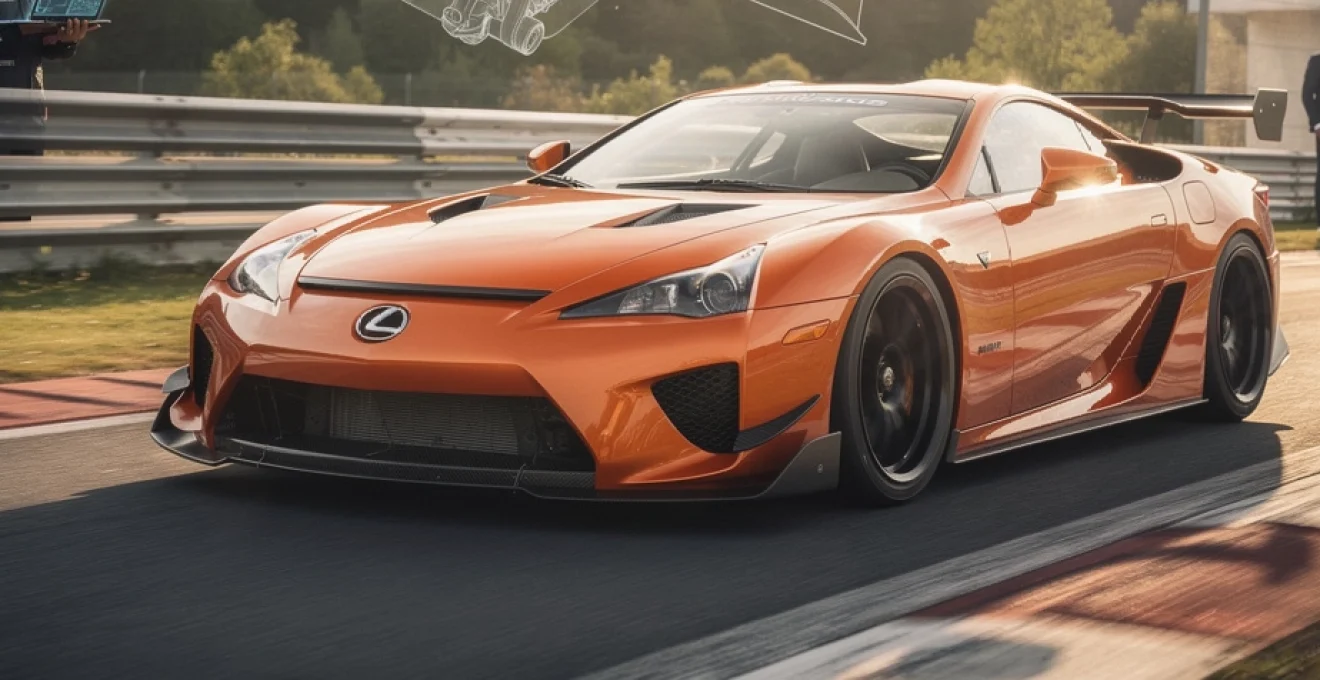
The Lexus LFA Nürburgring Edition represents the pinnacle of Japanese supercar engineering, a machine that transcends the already exceptional standard LFA to deliver track-focused performance that remains road-legal. Developed through relentless testing on the world’s most demanding circuit, this ultra-rare variant demonstrates what happens when a manufacturer refuses to compromise. Only 50 examples were ever produced, making it one of the most sought-after modern supercars. With its carbon fibre aerodynamic enhancements, uprated powertrain, and circuit-specific suspension calibration, the Nürburgring Edition embodies a singular philosophy: create a Nordschleife-ready racing machine that you can legally drive home.
What distinguishes this variant from the standard LFA isn’t merely additional power or cosmetic flourishes. Every modification serves a specific purpose, honed through thousands of testing kilometres on the 12.9-mile Nordschleife circuit. Chief test driver Hiromu Naruse accumulated more seat-time around the legendary German track than any other Japanese driver of his era, refining every aspect of the car’s behaviour. The result is a supercar that posted a production car lap record of 7:14.64 in 2011, a testament to the engineering excellence that defines this extraordinary machine.
Limited production run: 50 units of nürburgring package exclusivity
Lexus announced the Nürburgring Edition nine months before series production commenced in December 2010, establishing from the outset that this would be an exceptionally rare variant. The decision to limit production to just 50 units—representing one-tenth of the total 500-car LFA production run—created immediate collector interest. This scarcity wasn’t merely a marketing strategy; it reflected the specialised nature of the modifications and the target audience of serious driving enthusiasts who would appreciate the circuit-focused enhancements.
Production of the Nürburgring Edition began in January 2012, during the second full year of LFA manufacturing. Buyers faced strict limitations compared to standard LFA customers, who enjoyed almost limitless exterior colour options. The Nürburgring package restricted choices to four finishes: matte black, black, white, or orange. The iconic orange paintwork became synonymous with the edition, offering immediate visual recognition of this ultra-rare variant. Interior specifications were similarly constrained, with three colour schemes available: black and red, black and purple, or all-black. Every Nürburgring Edition featured carbon fibre reinforced plastic centre consoles and door cards, whilst the bucket seats were trimmed in slip-resistant Alcantara rather than leather—a deliberate choice prioritising grip over luxury.
The final LFA rolled off the production line on 14 December 2012, a white Nürburgring Edition adorned with a simple plaque identifying it as chassis number 500. This doubly significant vehicle marked both the conclusion of LFA production and the final Nürburgring package, cementing the edition’s place in automotive history. Of the 50 Nürburgring Editions produced, only 25 were allocated to the United States market, making American-specification examples particularly scarce. Recent auction results demonstrate the collector appeal of these vehicles, with a low-mileage example achieving £1.2 million at RM Sotheby’s Monterey auction, substantially exceeding the original £445,000 retail price.
New Nürburgring Edition customers received extraordinary benefits beyond the vehicle itself. Lexus offered individual instruction on the Nordschleife from one of the circuit’s chief instructors, along with a complimentary one-year Nordschleife driving pass. This gesture acknowledged the car’s intended purpose whilst ensuring owners could safely explore its capabilities on the track that inspired its development. The package represented more than a transaction; it was an invitation into an exclusive club of drivers who understood what made the Green Hell such a perfect proving ground.
Yamaha-engineered 4.8-litre V10 power unit specifications and performance metrics
At the heart of the Nürburgring Edition sits a masterpiece of naturally-aspirated engineering: a 4.8-litre V10 developed in collaboration with Yamaha, the Japanese corporation renowned for
precision both in high-performance engines and musical instruments. In the Lexus LFA Nürburgring Edition, this partnership produced one of the most characterful powertrains ever fitted to a road car. The engine’s lightning-fast response, linear power delivery, and spine-tingling exhaust note were not happy accidents; they were the result of meticulous engineering decisions aimed at making the car feel as sharp and communicative as a race car, yet usable on the road. While many modern supercars rely on turbocharging for outright numbers, this naturally aspirated V10 delivers its performance through revs, refinement and race-bred durability.
For the Nürburgring Edition, Lexus extracted an additional 10 bhp over the standard LFA, taking the total output to around 562 bhp. This modest-sounding increase was strategically targeted to offset the extra aerodynamic drag created by the larger rear wing, front splitter and other track-focused additions. The aim was clear: preserve the LFA’s top speed of over 200 mph while delivering even stronger acceleration and mid-range punch on circuit. Combined with faster shift times for the single-clutch automated manual gearbox—reduced to approximately 0.15 seconds between gears—the Nürburgring Edition feels more urgent and aggressive, especially when driven at the limit on track.
562 bhp at 8,700 rpm: peak power output analysis
The headline figure of 562 bhp (or 563 bhp depending on measurement standards) at 8,700 rpm only tells part of the story. What makes this V10 remarkable is how readily it spins to its 9,000 rpm redline and how consistently it pulls across the rev range. Peak torque sits at around 354 lb-ft, delivered high in the rev band, but the engine’s tractability means you’re not forced to constantly chase the limiter in everyday driving. On the Nürburgring, however, the ability to keep the engine in its upper rev range makes the Lexus LFA Nürburgring Edition feel like a genuine GT racing car that just happens to wear number plates.
In performance terms, the Nürburgring Edition matches the standard LFA’s key benchmarks despite its extra downforce. The 0–62 mph (0–100 km/h) sprint is dispatched in approximately 3.7 seconds, aided by a launch that combines high-rev aggression with precise traction control calibration. Top speed remains in the region of 201 mph (323 km/h), an impressive feat given the additional aerodynamic drag from the fixed rear wing and extended front aero devices. For those used to turbocharged torque surges, the LFA’s power delivery is a revelation: it builds like a superbike, encouraging you to keep the throttle pinned and surf the last 2,000 rpm where the engine feels most alive.
From an engineering perspective, hitting 562 bhp at 8,700 rpm in a road-legal, emissions-compliant engine is no small feat. The specific output—around 117 bhp per litre—places the Lexus LFA Nürburgring Edition firmly in the company of other legendary high-revving engines such as Ferrari’s naturally aspirated V8s and Porsche’s GT department flat-sixes. Yet the LFA’s V10 is arguably even more exotic, with a rev counter that has to be digital because an analogue needle simply couldn’t keep up with the engine’s rate of change. For drivers, this translates into an immediacy that feels more like a race car than a GT.
Titanium valvetrain and forged piston architecture
To reliably sustain repeated laps of the Nordschleife at high rpm, the LFA’s V10 relies on a titanium valvetrain and forged internal components. Titanium valves are far lighter than their steel equivalents, allowing the engine to rev faster and higher without valve float. Paired with robust springs and meticulously engineered cam profiles, this setup ensures precise valve control at speeds where lesser engines would begin to lose composure. If you imagine the valvetrain as the “lungs” of the engine, titanium components essentially allow it to breathe faster and deeper without strain.
The forged piston architecture plays an equally vital role in the Lexus LFA Nürburgring Edition’s reliability and performance. Forged pistons are compressed from a solid billet of aluminium, giving them greater strength and resistance to heat and detonation compared with cast pistons. In practical terms, this means the engine can be run harder, for longer, without compromising durability—a critical requirement for a car that was engineered around flat-out lapping of the Nordschleife. The result is an engine that feels as robust as it does exotic, capable of enduring track abuse that would quickly expose the weaknesses in less thoroughly developed powertrains.
Supporting hardware, including lightweight connecting rods and a carefully balanced crankshaft, completes the high-strength internal package. Each of these components contributes to reducing reciprocating mass, allowing the engine to rev explosively and respond instantly to throttle inputs. It’s this combination of light internals and precision metallurgy that gives the LFA V10 its uniquely “electric” character—press the accelerator and the revs snap upwards with an urgency that even many modern hybrid supercars struggle to match.
Dry-sump lubrication system for nordschleife circuit demands
A key difference between an engine designed for occasional spirited driving and one intended for flat-out circuit use lies in its lubrication system. The Lexus LFA Nürburgring Edition employs a dry-sump lubrication setup, a solution more commonly found in endurance race cars than road-going grand tourers. Rather than storing oil in a traditional sump beneath the crankshaft, a dry-sump system holds it in a separate reservoir, with scavenger pumps continuously circulating oil around the engine. This ensures constant lubrication even under the extreme lateral and longitudinal forces generated on the Nürburgring.
Why is this so important? On a track like the Nordschleife, where sustained high-speed corners and rapid elevation changes are the norm, oil can surge away from critical areas in a conventional wet-sump system. This risks momentary pressure drops that, over time, can cause catastrophic engine wear. In the LFA Nürburgring Edition, the dry-sump design eliminates this risk, maintaining stable oil pressure whether you’re cresting a blind rise or committing to a fast, cambered corner. It’s the mechanical equivalent of ensuring a marathon runner is constantly hydrated, no matter how intense the pace.
The dry-sump configuration brings additional benefits. By removing the need for a deep oil pan beneath the engine, Lexus was able to mount the V10 lower in the chassis, reducing the car’s centre of gravity. This enhances stability, reduces body roll, and improves turn-in response—key attributes for a car optimised for the Green Hell. Furthermore, the consistent oil supply and improved cooling contribute to the engine’s longevity, meaning owners who do take their cars on circuit days can do so with greater peace of mind.
9,000 rpm redline and individual throttle body configuration
One of the defining characteristics of the Lexus LFA Nürburgring Edition is its dizzying 9,000 rpm redline. Reaching such engine speeds in a road car requires more than just strong materials; it demands precise airflow and fuelling control. Here, the LFA’s use of individual throttle bodies—one for each cylinder—sets it apart from many contemporary supercars. Instead of a single large throttle controlling airflow to the entire intake manifold, each cylinder receives its own dedicated butterfly valve, enabling far more accurate control and faster response.
The benefits are immediately apparent from behind the wheel. Throttle response in the Nürburgring Edition is almost telepathic; you barely move your right foot before the engine reacts, a trait that is invaluable when balancing the car on the limit through a fast sequence of corners. On track, this allows you to fine-tune the car’s attitude with minute adjustments, much like a racing driver modulating power to trim understeer or induce a gentle rotation. For road driving, the same precision makes the LFA feel alive at any speed, even if you’re nowhere near the upper reaches of the tachometer.
From an acoustic perspective, the individual throttle bodies contribute to the LFA’s legendary soundtrack, channelling induction noise in harmony with the titanium exhaust system co-developed with Yamaha’s musical division. Owners often describe the experience as orchestral, and it’s no exaggeration—there is a clear sense that each cylinder is “singing” its own note, blending into a high-pitched wail as you approach 9,000 rpm. In an era now dominated by forced induction and noise regulations, the naturally aspirated, free-breathing V10 of the Lexus LFA Nürburgring Edition feels ever more special and irreplaceable.
Nürburgring-specific aerodynamic enhancements and carbon fibre modifications
While the engine defines the character of the Lexus LFA Nürburgring Edition, its aerodynamic package is what unlocks its full potential on the Nordschleife. Compared with the standard car, the Nürburgring Edition features an extensive suite of carbon fibre components designed to increase downforce, sharpen stability and improve high-speed cornering grip. Rather than chasing a higher top speed for marketing headlines, Lexus focused on usable performance—where extra downforce at 150 mph through a sweeping bend matters far more than an extra 5 mph on a straight.
The majority of these enhancements are crafted from carbon fibre reinforced plastic (CFRP), the same lightweight yet incredibly strong material used for the LFA’s chassis and body. CFRP allows complex shapes to be formed without the weight penalty of traditional metal components, meaning Lexus could sculpt the airflow with precision while maintaining the car’s low kerb weight. The result is a Lexus LFA Nürburgring Edition that looks visibly more aggressive than the standard car, but every protrusion, vent and wing has been justified in the wind tunnel and on track.
Fixed carbon fibre rear wing with adjustable angle configuration
Perhaps the most immediately recognisable feature of the Nürburgring Edition is its fixed carbon fibre rear wing. Replacing the standard LFA’s retractable spoiler, this GT-style aerofoil is mounted high in the airstream to capture cleaner, less turbulent air. The design increases rear downforce significantly, helping to press the driven wheels into the tarmac at high speed and providing greater stability under heavy braking. For a car capable of over 200 mph, this extra rear-end security is essential when you are braking into fast corners or cresting undulating sections of the Nordschleife.
Crucially, the rear wing features an adjustable angle of attack, allowing owners and track engineers to fine-tune the aerodynamic balance. Increasing the angle generates more downforce at the cost of additional drag, a trade-off that can be optimised depending on circuit layout and driver preference. On a fast track with long straights, you might choose a slightly lower angle for higher top speeds; on a tight, technical circuit, you could dial in more rear downforce for maximum grip and confidence. It’s a level of adjustability more often seen on dedicated race cars than limited-run road-legal supercars.
Visually, the fixed rear wing also serves as a clear visual identifier of the Nürburgring Edition. In combination with the distinctive orange paintwork often associated with this package, it signals to knowledgeable enthusiasts that this is no ordinary LFA. But unlike some aftermarket wings that prioritise drama over function, the LFA Nürburgring’s rear aero is backed by extensive testing and development on the very circuit that gives the car its name.
Front splitter and diffuser optimisation for downforce generation
Balancing the additional rear downforce, the Lexus LFA Nürburgring Edition receives a deeper carbon fibre front splitter and reworked front-end aero. This extended chin spoiler creates a sharper division between the airflow passing over and under the car, reducing lift at the front axle and improving steering feel at high speed. At its outer edges, the splitter curves upwards into small winglets and canards that further manipulate the airflow, increasing front grip and helping the car “bite” into corners with greater precision.
Underneath the car, the airflow is managed by a functional rear diffuser that works in conjunction with the front splitter to generate ground effect. As air accelerates beneath the LFA, the diffuser’s shape helps expand and slow the flow at the rear, creating a low-pressure area that effectively sucks the car towards the tarmac. This is similar in principle to how an inverted aircraft wing operates, but applied horizontally beneath the chassis. The benefit for the driver is tangible: improved stability during high-speed lane changes, better traction when exiting corners, and a more planted feel over crests and compressions.
These aerodynamic refinements were not designed in isolation. Lexus engineers used extensive wind-tunnel testing and real-world validation at the Nürburgring to ensure that the front splitter, canards, underbody panels and diffuser worked together as an integrated package. For owners, this means you get a Lexus LFA Nürburgring Edition that feels cohesive and composed rather than nervous or aero-sensitive, even as speeds climb deep into triple digits.
Weight reduction through carbon-reinforced polymer bodywork
The LFA platform was already built around carbon fibre reinforced plastic, but the Nürburgring Edition doubles down on the lightweight philosophy. By extensively using CFRP for its aerodynamic add-ons and interior trim, Lexus managed to maintain an impressively low kerb weight despite adding larger wings, splitters and structural reinforcements for high-speed stability. In performance terms, every kilogram saved contributes to sharper acceleration, more responsive braking, and reduced tyre and brake wear on track days.
Compared with traditional steel or even aluminium panels, CFRP offers a dramatic weight advantage while retaining rigidity. Think of it as the automotive equivalent of replacing a heavy wooden beam with a lightweight carbon composite—strength is preserved or even enhanced, but the mass is drastically reduced. In the Lexus LFA Nürburgring Edition, this translates into a car that changes direction with the agility of a much smaller machine, an attribute that becomes particularly noticeable in the tight, technical sections of the Nordschleife.
Inside, the use of carbon fibre centre consoles, door cards and seat shells helps keep weight in check while also lowering the car’s centre of gravity. The Alcantara-trimmed bucket seats, while luxurious in their own right, are slimmer and lighter than traditional leather chairs, again in service of performance. The result is that, even in Nürburgring specification with its added aero hardware, the LFA remains a relatively lightweight proposition compared with many modern supercars packed with complex hybrid systems and heavy sound insulation.
Mesh grille deletion and bonnet venting for thermal management
One of the subtler but highly functional changes on the Lexus LFA Nürburgring Edition is the deletion of the traditional mesh grille in favour of more open apertures and targeted venting. On a circuit as demanding as the Nordschleife, thermal management is just as crucial as outright horsepower. Long climbs, extended full-throttle sections and repeated heavy braking put immense strain on cooling systems, and any compromise here can quickly lead to reduced performance or even mechanical damage.
By opening up the front intake area and optimising the path of incoming air, Lexus ensured that radiators, intercoolers for ancillary systems and brake ducts receive a steady flow of cool air. Bonnet vents assist by allowing hot air to escape efficiently from the engine bay, preventing heat soak and stabilising under-bonnet temperatures during long stints. It’s a similar principle to what we see in GT3 racing cars, where elaborate venting patterns are designed not just for style but for effective evacuation of heat.
In day-to-day driving, most owners will never push the Lexus LFA Nürburgring Edition to the point where its thermal systems are fully taxed. However, for those who do take advantage of the car’s intended purpose on track, these cooling enhancements offer a significant layer of reassurance. You can lap harder, for longer, with greater confidence that the car will maintain consistent performance instead of gradually backing off as temperatures rise.
Circuit-tuned suspension geometry and damping calibration
Underneath its dramatic carbon bodywork, the Nürburgring Edition features a bespoke suspension setup honed specifically for high-speed track work. Compared with the standard LFA, the Nürburgring package introduces stiffer springs, revised damper valving and a lower ride height, all aimed at delivering sharper turn-in and greater mid-corner stability. If the standard LFA can be thought of as a road car that is happy on track, the Nürburgring Edition inverts that formula: it is fundamentally a track car that happens to be civil enough for road use.
To make the most of the Nordschleife’s complex mix of corners, cambers and surfaces, Lexus engineers focused not just on absolute grip but on predictability. The suspension geometry has been tuned to provide progressive breakaway characteristics, giving the driver ample warning as the tyres approach their limits. In practical terms, this means you can lean on the chassis with confidence, knowing that any slide or rotation will be controllable rather than sudden. For an ultra-rare car that many owners may only experience at eight-tenths, this forgiving nature is invaluable.
Recalibrated torque vectoring differential settings
To further enhance cornering performance, the Lexus LFA Nürburgring Edition benefits from a recalibrated rear differential. While not a fully active torque-vectoring system in the modern hybrid sense, the LFA’s electronically controlled limited-slip differential can adjust locking characteristics based on inputs such as throttle position, steering angle and wheel speed. For the Nürburgring Edition, these parameters were refined to optimise traction and rotation on high-speed circuits.
On corner entry, the system allows a degree of freedom to help the car rotate, reducing understeer and enabling a cleaner line into the apex. As you transition back onto the throttle, the diff progressively locks to maximise traction and minimise inside wheel spin. The effect is subtle but tangible: the rear of the car feels more eager to follow the front, particularly in medium- to high-speed corners where maintaining momentum is crucial. It’s akin to having a skilled co-driver constantly fine-tuning power distribution across the rear axle.
For drivers who plan to use their Lexus LFA Nürburgring Edition on circuit days or private track events, understanding how this differential behaves can unlock significant lap time. Smooth inputs and consistent throttle application allow the system to work with you, while abrupt, jerky movements can unsettle the balance. Once you adapt your driving style to the car’s preferences, you’ll find that the Nürburgring Edition rewards precision and commitment in equal measure.
Stiffer spring rates and anti-roll bar specifications
Another cornerstone of the Nürburgring Edition’s dynamic personality is its uprated springs and anti-roll bars. Compared with the standard LFA, the springs are stiffer to better control body movement under the high lateral loads experienced on circuit. This reduces pitch under braking and squat under acceleration, keeping the chassis level and the tyres more evenly loaded. As a result, the car feels more tied down and responsive, with less delay between your steering input and the car’s reaction.
The anti-roll bars—front and rear—are similarly recalibrated to fine-tune the balance between front-end bite and rear stability. By carefully choosing bar thickness and material, Lexus engineers achieved a setup that resists excessive roll without making the ride intolerably harsh on real-world roads. It’s a delicate compromise; too much stiffness and the car would skip over bumps and kerbs, too little and it would lean excessively through fast transitions. In the Nürburgring Edition, that compromise is skewed towards track sharpness, but remains surprisingly usable on smooth tarmac.
Of course, the inevitable trade-off is a firmer ride in everyday use. Owners who plan to drive their Lexus LFA Nürburgring Edition primarily on public roads should be prepared for a more focused, less cosseting experience than in a standard LFA. That said, for enthusiasts who cherish feel and feedback above isolation, the stiffer springs and anti-roll bars are exactly what make the Nürburgring Edition feel more alive at the steering wheel.
Ride height reduction and track-focused alignment parameters
Visually, one of the telltale signs of the Nürburgring package is the car’s slightly lower stance. The suspension has been dropped by approximately 10 mm compared with the standard LFA, reducing the centre of gravity and improving aerodynamic efficiency. This seemingly modest change pays dividends on the Nordschleife, where even small improvements in weight transfer and body control can shave valuable tenths off a lap time. With less roll and pitch, the tyres maintain a more optimal contact patch, enhancing grip and braking stability.
In conjunction with the reduced ride height, the Lexus LFA Nürburgring Edition runs more aggressive alignment settings than its standard counterpart. Increased negative camber on the front and rear axles helps the tyres bite into the tarmac during hard cornering, while carefully chosen toe settings enhance stability on straights and responsiveness on turn-in. These parameters are similar in philosophy to what you might find in a factory GT3 race car, albeit dialled back slightly to remain acceptable for road use.
Owners who are serious about circuit driving can further fine-tune these settings within the range recommended by Lexus, tailoring the car to specific tracks or driving styles. However, even in the factory Nürburgring configuration, the combination of lower ride height and focused alignment gives the car a purposeful, hunkered-down appearance that telegraphs its intentions clearly: this is a Lexus LFA built first and foremost for speed and precision.
7:14.64 nürburgring nordschleife lap time achievement
All of these engineering decisions—engine, aero, suspension and tyres—culminated in a headline-grabbing achievement: a 7:14.64 lap of the Nürburgring Nordschleife, set in August 2011. Driven by professional racer Akira Iida, the Lexus LFA Nürburgring Edition used standard production specification, including factory-fit Bridgestone tyres, to secure what was at the time the fastest recorded lap for a production road car. Importantly, the run was independently timed and verified, reinforcing the credibility of both the car and the manufacturer.
To put that 7:14.64 lap time into context, it placed the LFA Nürburgring Edition in the same performance bracket as some of the most revered European supercars of its era and beyond. Even today, in a world dominated by hybrid hypercars and all-wheel-drive torque monsters, a sub-7:20 Nordschleife lap remains an elite benchmark. That the LFA achieved this with a naturally aspirated V10, rear-wheel drive and no hybrid assistance underscores just how advanced its chassis and aero package were.
What makes the record even more impressive is the nature of the track itself. The Nordschleife’s 73 corners, blind crests and variable surfaces present a challenge far removed from the smooth, predictable layout of modern circuits. Maintaining concentration for over seven minutes at such a pace demands not only a highly skilled driver but also a car that communicates clearly and behaves predictably at the limit. The Lexus LFA Nürburgring Edition’s ability to lap repeatedly at high speed without thermal fade or mechanical distress was a direct validation of the exhaustive development work carried out over the preceding seven years.
For enthusiasts and collectors, the 7:14.64 lap time is more than just a number—it’s a tangible proof of concept. It confirms that the Nürburgring Edition is not merely a cosmetic special or limited-edition marketing exercise, but a genuine performance upgrade with real-world benefits on the very circuit that inspired its creation. When you see an LFA Nürburgring Edition today, you’re looking at a car that has literally earned its name on the tarmac of the Green Hell.
Market valuation: £750,000+ current collector pricing and auction results
In the years since production ended, the Lexus LFA Nürburgring Edition has gone from an already rare supercar to a bona fide blue-chip collectible. With just 50 units built worldwide (and only around half of those officially delivered to the US), supply is permanently fixed while demand continues to grow. As more enthusiasts recognise the car’s significance as one of the last great naturally aspirated V10 supercars, values have climbed accordingly. Where early examples traded hands for modest premiums over their original list price, today’s market has moved decisively into seven-figure territory for the very best cars.
Recent high-profile auctions have reinforced this upward trend. An ultra-low-mileage 2012 Lexus LFA Nürburgring Edition achieved approximately $1.6 million (around £1.2 million) at RM Sotheby’s Monterey sale, comfortably exceeding its pre-sale estimate. Another standard LFA with delivery mileage recently sold for over $800,000, underscoring how the entire LFA range is benefiting from renewed collector interest. For Nürburgring Editions specifically, well-documented cars with under 5,000 miles and desirable colour combinations—such as orange over black Alcantara—are now commonly valued in the £750,000 to £1,200,000 bracket, depending on provenance and condition.
Several factors explain this appreciation. Firstly, the broader collector car market has shown a growing appetite for analog, driver-focused supercars in an increasingly electrified age. Secondly, the LFA’s extraordinary engineering story, limited production and glowing critical reception (including high praise from influential figures like Jeremy Clarkson) have cemented its status as a modern icon. Finally, the Nürburgring Edition’s direct association with a verified Nordschleife record gives it a performance pedigree that few rivals can match. For many collectors, it ticks the same boxes as historically significant Ferraris and Porsches, but with the added allure of Japanese precision and rarity.
For prospective buyers considering a Lexus LFA Nürburgring Edition as an investment, due diligence is essential. Verifying build numbers, colour specifications, mileage and service history can make a substantial difference to long-term value. Cars that have been sympathetically exercised and properly maintained often command a premium over delivery-mileage “garage queens”, as mechanical components benefit from regular use. Looking ahead, many market analysts expect values to remain strong or even climb further, particularly as emissions regulations make it increasingly unlikely that we will see another naturally aspirated V10 of this calibre from Lexus—or anyone else.