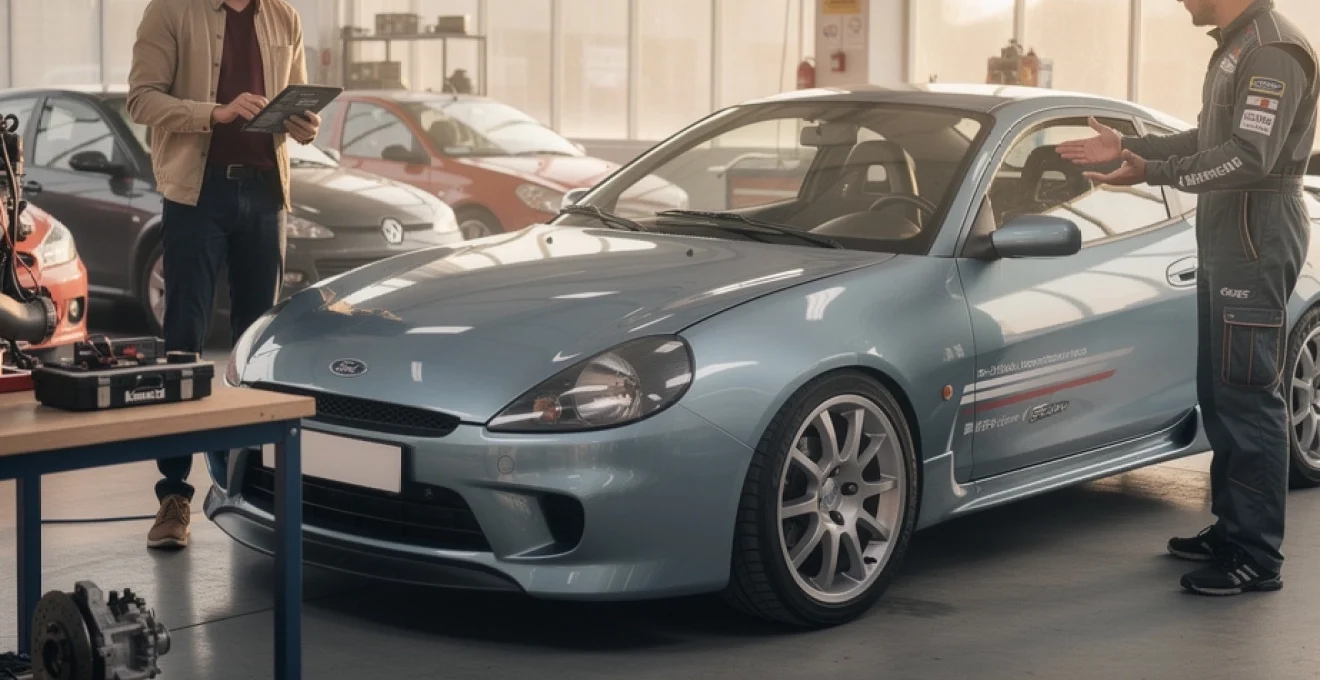
The Ford Puma represents a remarkable chapter in automotive history, serving as a testament to Ford’s engineering prowess during the late 1990s. This distinctive coupé emerged at a time when manufacturers were exploring creative interpretations of their existing platforms, transforming humble supermini foundations into something genuinely special. The Puma’s legacy extends far beyond its modest production run, influencing Ford’s design philosophy and establishing benchmarks that continue to resonate with driving enthusiasts today.
Built between 1997 and 2002, the Puma demonstrated how thoughtful engineering could elevate a mainstream platform into a driver’s paradise. The collaboration between Ford’s European design team and Yamaha’s engine expertise created a vehicle that punched well above its weight class. While many manufacturers were content with superficial styling exercises, Ford invested heavily in chassis development, suspension tuning, and powertrain optimisation to create a genuinely engaging driving experience.
The significance of the Puma extends beyond its immediate commercial success. This compact coupé served as a proving ground for technologies and design philosophies that would later influence the acclaimed Focus and subsequent Ford performance models. Its impact on the small sports car segment was profound, setting new standards for handling dynamics and build quality that competitors struggled to match.
Ford puma 1.7 Zetec-S engine specifications and performance analysis
Yamaha-developed 1679cc Inline-Four engine architecture
The heart of the Ford Puma’s appeal lay in its sophisticated powerplant, a 1679cc inline-four engine developed through a strategic partnership with Yamaha Motor Corporation. This collaboration represented a significant departure from Ford’s traditional approach to small-displacement engines, incorporating advanced metallurgy and precision engineering techniques typically reserved for higher-performance applications. The engine featured a lightweight aluminium cylinder head with optimised port geometry, contributing to both power output and thermal efficiency.
Yamaha’s involvement extended beyond surface-level consultation, with the Japanese manufacturer contributing their expertise in engine dynamics and combustion chamber design. The result was an engine that demonstrated exceptional refinement throughout its rev range, with particular emphasis on high-rpm performance characteristics. This collaboration established a template for future Ford performance engines, demonstrating the benefits of leveraging external expertise while maintaining internal engineering control.
127 BHP power output and torque delivery characteristics
The Zetec-S engine produced a peak output of 123 bhp at 6,300 rpm, with maximum torque of 116 lb-ft delivered at 4,500 rpm. These figures, while modest by contemporary standards, represented a significant achievement for a naturally aspirated 1.7-litre unit in the late 1990s. The power delivery curve was carefully calibrated to provide strong mid-range performance while maintaining excellent drivability in urban environments.
The engine’s torque characteristics were particularly noteworthy, with 80% of peak torque available from 3,000 rpm onwards. This broad torque band contributed significantly to the Puma’s engaging driving dynamics, allowing drivers to maintain momentum through challenging road sections without constant gearchanges. The power-to-weight ratio of approximately 120 bhp per tonne enabled impressive performance figures, including a 0-60 mph acceleration time of 9.2 seconds and a top speed of 126 mph.
Variable intake manifold technology and DOHC configuration
The Zetec-S engine incorporated sophisticated variable valve timing technology, utilising oil pressure-actuated cam phasing to optimise intake timing across the rev range. This system, similar in concept to Honda’s VTEC technology, allowed the engine to deliver both low-rpm tractability and high-rpm performance. The dual overhead camshaft configuration featured lightweight camshafts with optimised lobe profiles, contributing to the engine’s free-revving characteristics.
The intake manifold design featured variable-length runners that adjusted according to engine speed and load conditions. At lower rpm, longer runner lengths enhanced torque production, while shorter paths improved high-rpm breathing. This technology was relatively advanced for its time, demonstrating Ford’s commitment to extracting maximum performance from the naturally aspirated configuration. The system’s electronic control unit continuously monitored engine parameters to ensure optimal valve timing under all operating conditions.
Combined with the engine’s relatively low internal friction and carefully balanced rotating assembly, these systems made the Ford Puma 1.7 feel eager to spin right up to the redline without the harshness typical of many small-capacity engines of the era. For drivers, the result was an unusually linear and predictable delivery: you could hear and feel the engine come on cam, yet it never felt peaky or temperamental. This blend of flexibility and willingness is a key reason why the Ford Puma 1.7 coupé still stands out as one of the most rewarding small sports cars to drive.
Fuel injection system and ECU mapping parameters
To fully exploit the advanced mechanical package, Ford equipped the Puma 1.7 with a multipoint electronic fuel injection system governed by a sophisticated ECU for its time. The engine management unit continuously monitored inputs from manifold pressure, throttle position, crankshaft and camshaft position, intake air temperature and lambda sensors to fine-tune both fuel delivery and ignition timing. This closed-loop control allowed the Zetec-S engine to meet tightening Euro emissions standards without compromising the engaging driving experience.
ECU mapping for the Ford Puma 1.7 was calibrated to prioritise throttle response and drivability over outright fuel economy, yet real-world consumption figures around 35–40 mpg were entirely achievable with sympathetic driving. Part-throttle enrichment strategies ensured smooth response during low-speed manoeuvres, while more aggressive ignition advance at higher loads gave the engine its crisp, almost motorcycle-like response when worked hard. For tuners and enthusiasts, this relatively open ECU architecture later became a playground, with remaps and piggyback systems unlocking modest gains while retaining the engine’s renowned reliability, provided servicing and correct oil grades were maintained.
Chassis dynamics and handling characteristics of the racing puma platform
Macpherson strut front suspension geometry
Underpinning the Ford Puma’s reputation as a driver’s car is a chassis that went far beyond the standard Fiesta recipe. At the front, a MacPherson strut layout was retained, but key parameters such as camber, caster and roll centre height were reworked to deliver sharper turn-in and more consistent grip over uneven surfaces. Uprated springs, revised damper valving and a thicker anti-roll bar all contributed to a front end that felt both precise and communicative, encouraging you to lean on the car through fast direction changes.
On the Racing Puma, this philosophy was taken even further. A wider front track, combined with bespoke aluminium front wings to cover the increased wheel offset, allowed engineers to dial in more aggressive geometry without compromising stability. Think of it as the same basic suspension sketch, but redrawn with bolder lines and finer shading. The end result was a coupé that felt remarkably stable under hard braking and mid-corner load, with steering feedback that made it easy to place the car to the nearest inch on a B-road or circuit apex.
Control blade independent rear suspension setup
Although based on the Fiesta platform, the rear suspension of the Ford Puma benefitted from extensive tuning to deliver the playful yet secure handling balance enthusiasts still rave about. In standard form the Puma used a torsion-beam style semi-independent setup, but Ford’s engineers effectively transformed its behaviour through bushing specification, axle stiffness and damper calibration. The result mimicked many of the benefits of a more complex independent rear suspension, offering good wheel control and progressive breakaway characteristics.
The Racing Puma further exploited this foundation with a significantly wider rear track and stiffer springs and dampers. In practice, this gave the limited-edition model a more neutral balance, with the rear axle keen to follow the front rather than simply trail behind it. If you imagine the standard Puma as an eager terrier on a lead, the Racing Puma is the same dog trained to heel perfectly beside you, ready to adjust its line with subtle throttle inputs. This made the car particularly rewarding on smoother circuits, where its extra stiffness could be fully exploited without the compromise of poor road surfaces.
Steering rack ratio and electronic power assistance calibration
One of the standout features of the Ford Puma 1.7 coupé is its steering, often singled out as a benchmark even by modern standards. The rack employed a relatively quick ratio, meaning modest steering inputs translated into meaningful changes of direction, but never so abruptly that the car felt nervous. Crucially, Ford calibrated the power assistance to bleed away with speed, so motorway cruising felt stable and well-weighted while low-speed manoeuvres remained light and effortless.
In the Racing Puma, the steering feel became even more intense thanks to the combination of wider tyres, altered geometry and stiffer suspension. You feel more of the road surface through the rim, but it remains a conversation rather than an argument, giving you confidence to explore the limits of grip. For drivers used to modern electric power steering systems that can feel artificially filtered, the direct, hydraulic setup in the Puma is a revelation. It is a reminder that a relatively simple mechanical system, tuned with care, can provide more natural feedback than many far more complex modern arrangements.
Brake system configuration with ABS and EBD integration
Stopping power in the standard Ford Puma 1.7 was more than adequate for its modest kerb weight, with ventilated front discs and solid rear discs backed up by an ABS system featuring electronic brakeforce distribution. The tuning of this system was particularly well-judged: it intervened only when necessary, allowing keen drivers to modulate pedal pressure and trail brake into corners without the intrusive pulsing common in many contemporary systems. Pedal feel was firm yet progressive, inspiring confidence during repeated hard stops.
The Racing Puma took braking hardware to another level. Large 295 mm front discs were clamped by four-pot Alcon calipers, borrowed from motorsport technology and tuned for fast road and track use. Combined with grippy 215-section tyres, this setup delivered deceleration figures that would not embarrass much more powerful modern performance cars. However, as with any high-performance braking system, maintenance quality is paramount. Prospective buyers today should check for caliper condition, disc thickness and fluid change history; when properly looked after, the Racing Puma’s braking performance remains one of its most compelling attributes.
Design evolution from ford fiesta platform to distinctive coupé silhouette
Visually, the Ford Puma 1.7 coupé is a masterclass in how to disguise humble origins. While it shares its basic floorpan and much of its internal structure with the fourth-generation Fiesta, the exterior design transforms those bones into something far more dramatic. The so-called “New Edge” styling language, first seen on the Ka and later refined on the Focus, reached one of its purest expressions in the Puma’s compact proportions, with taut surfacing, fared-in headlamps and a kicked-up rear quarter that gave the car a purposeful stance even at rest.
From a practical standpoint, this evolution from supermini to coupé was not merely cosmetic. The sloping roofline and wide haunches were carefully engineered to improve aerodynamics and high-speed stability, while still accommodating a usable rear bench and a surprisingly generous boot. Interior designers took the Fiesta dashboard and elevated it with aluminium-effect trims and the now-iconic solid alloy gear knob, instantly changing the cabin ambience. For many buyers in the late 1990s, stepping into a Puma felt like entering a scaled-down sports car rather than a dressed-up hatchback, and that emotional connection is a big part of the car’s enduring appeal.
Production timeline and manufacturing at ford niehl assembly plant
The Ford Puma’s production story is closely tied to Ford’s European operations in Germany. Assembly took place primarily at the Ford Niehl plant in Cologne, a facility better known for building volume models but selected for the Puma due to its flexibility and established quality control processes. Production began in mid-1997 with the launch of the 1.7-litre model and continued until 2001–2002 depending on market, with special editions like the Thunder marking the run-out phase.
Over its five-year life cycle, approximately 133,000 Ford Pumas were produced worldwide, a modest figure by Ford standards but significant within the niche compact coupé segment. The Racing Puma, converted by Tickford in the UK using partially completed shells from the main plant, represented an even smaller subset, with around 500 road cars ultimately reaching customers despite an initial plan for 1000 units. This relatively low production volume, combined with the widespread attrition caused by rust, is one of the reasons why clean, original Ford Puma 1.7 coupés and Racing Puma variants are increasingly regarded as modern classics by collectors and enthusiasts.
Racing puma limited edition variants and collectibility assessment
Thunder specification package and quicksilver metallic paint options
Towards the end of the Puma’s life, Ford introduced a series of special editions designed to maintain interest and celebrate the model’s achievements. Among these, the Thunder specification stands out as the most desirable of the mainstream variants. Typically finished in distinctive colours such as Magnum Grey or Moondust Silver, with some markets offering a Quicksilver-style bright metallic finish, the Thunder combined visual upgrades with extra standard equipment to create a more premium feel without compromising the core driving experience.
Thunder models generally featured multi-spoke alloy wheels, leather upholstery, upgraded audio systems and, in many cases, factory air conditioning as standard. For buyers today, a well-preserved Ford Puma Thunder offers one of the most complete ownership propositions: you get the engaging dynamics of the 1.7-litre coupé, a higher equipment level and a specification that is already regarded as collectible. As rust and neglect thin the ranks of ordinary examples, these better-appointed versions are increasingly sought after by enthusiasts who want a usable classic with a little extra showroom sparkle.
Recaro interior appointments and momo steering wheel integration
The true halo of the range, however, was the Racing Puma, which received a suite of interior upgrades that underlined its motorsport-inspired brief. Most notable were the deep-bolstered Recaro (or Sparco-branded in some markets) bucket seats trimmed in blue Alcantara, designed to hold the driver and passenger firmly in place during enthusiastic cornering. These seats, combined with colour-matched door inserts and unique trim details, created an environment that felt closer to a homologation special than a humble Fiesta derivative.
Complementing the seats, a compact Momo-style steering wheel (in some cars an actual Momo-branded item, in others a Ford design clearly influenced by Italian wheels) provided a thicker rim and improved grip. Together, these components enhanced the tactile interface between driver and machine, reinforcing the Puma’s reputation as a “gloves-off” driver’s car. For collectors, original interior components are a key indicator of authenticity; worn or replaced seats, aftermarket wheels or removed trim can significantly affect the desirability and value of both Thunder and Racing Puma models.
Current market valuation and enthusiast community recognition
Market values for the Ford Puma 1.7 coupé have long lagged behind its dynamic reputation, making it one of the performance bargains of the used car world. As of the mid-2020s, usable examples of the standard 1.7 can still be found from around £1000–£2000 in the UK, with truly exceptional, low-mileage cars and well-preserved Thunder editions commanding in the region of £3000–£4000. Project cars remain plentiful and cheap, but the cost of proper rust repair and mechanical recommissioning often exceeds their purchase price, a reality any prospective buyer should keep firmly in mind.
At the other end of the spectrum, the Racing Puma has moved decisively into modern-classic territory. Values for tidy cars now frequently exceed £15,000, with the very best, well-documented examples nudging or surpassing £20,000. This appreciation reflects not just the car’s rarity but also its growing recognition among enthusiasts as a pivotal model in Ford’s performance lineage. Active owners’ clubs, online forums and social media groups provide a wealth of advice, parts sourcing tips and event opportunities, making it easier than ever for newcomers to the Ford Puma 1.7 community to get involved and keep these charismatic coupés on the road.
Contemporary rivals and segment positioning against peugeot 206 GTi and renault clio sport
When new, the Ford Puma 1.7 coupé occupied a fascinating niche between traditional hot hatchbacks and more image-led small coupés. While cars like the Vauxhall Tigra and Fiat Barchetta chased style and open-top glamour, the Puma targeted the keen driver who might also be considering a Peugeot 206 GTi or Renault Clio Sport. On paper, the French hot hatches often boasted more power and marginally quicker straight-line performance, but numbers tell only part of the story. On a tight, twisting road, the Puma’s lighter weight, sharper steering and finely honed chassis allowed it to keep – and often set – the pace.
Against the 206 GTi, the Ford Puma 1.7 offered a more communicative front end and a more exploitable balance at the limit, trading a little outright pace for greater finesse and friendliness. Compared with the Renault Clio Sport, particularly the early 172 models, the Puma felt less raw and more approachable, almost like a well-sorted rear-wheel-drive car translated into front-wheel-drive form. For enthusiasts today, this positioning still holds true: if you prioritise steering feel, chassis feedback and the joy of working a naturally aspirated engine, the Puma remains a compelling alternative to its more obvious hot hatch contemporaries. The fact that it wears a distinctive coupé body only adds to its charm in a world increasingly dominated by anonymous crossovers.