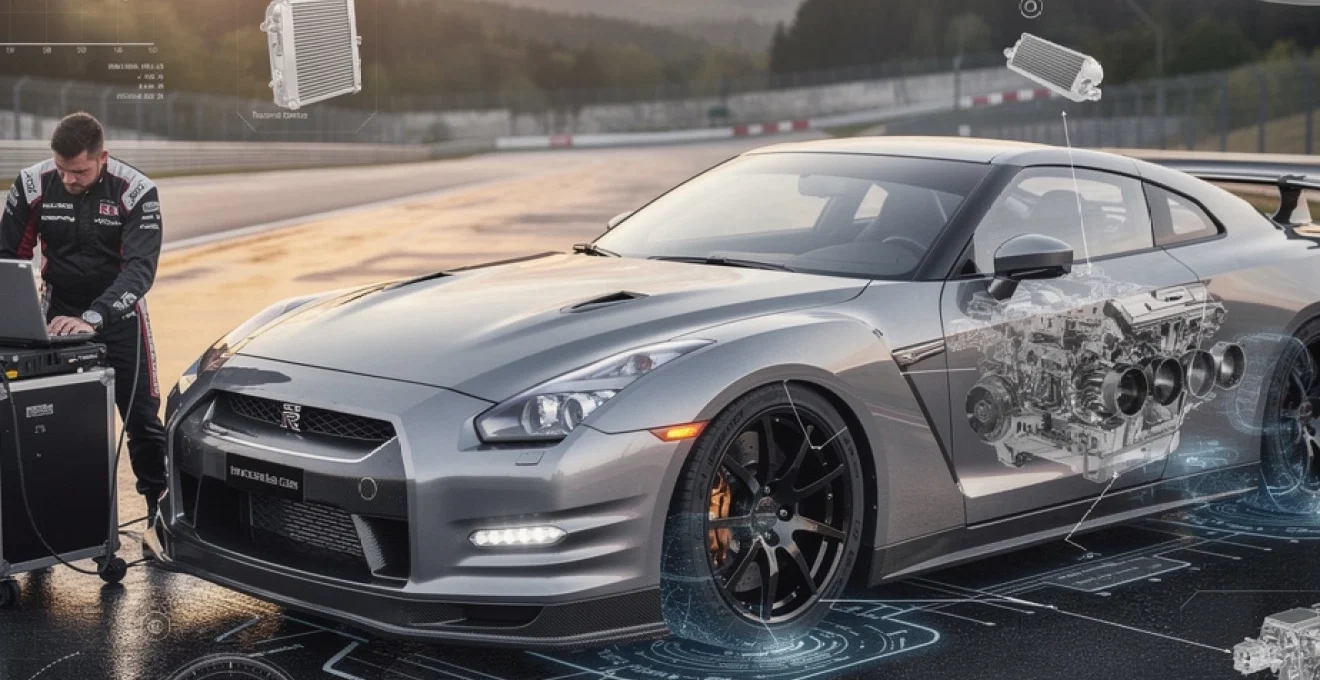
More than a decade after its revolutionary debut, the 2014 Nissan GT-R R35 remains a formidable presence in the high-performance automotive landscape. This Japanese engineering marvel continues to challenge supercars costing twice its price, delivering astonishing acceleration and circuit capability that defies its relatively modest sticker price. The 2014 model year brought significant refinements to an already impressive package, addressing concerns about refinement whilst maintaining the raw performance that made the GT-R a legend. But in an era of rapidly evolving automotive technology and increasingly capable rivals, does the 2014 R35 still deserve its “Godzilla” moniker? The answer lies in examining the intricate engineering that underpins this technical tour de force, from its hand-built powerplant to its sophisticated all-wheel-drive system and track-honed chassis dynamics.
VR38DETT Twin-Turbo powerplant: engineering analysis and Real-World output
The beating heart of the 2014 GT-R is the VR38DETT engine, a 3.8-litre V6 twin-turbocharged masterpiece that represents some of the finest engineering to emerge from Nissan’s Yokohama facility. This powerplant exemplifies the philosophy that displacement and forced induction can coexist harmoniously, delivering both low-end torque and high-revving performance characteristics typically associated with naturally aspirated engines. The meticulous attention to detail in its construction is immediately apparent to anyone who lifts the bonnet, where polished intake plenums and precision-routed pipework showcase engineering as art.
Hand-built 3.8-litre V6 architecture and Plasma-Sprayed bore technology
Each VR38DETT engine is assembled by a single technician at Nissan’s Yokohama engine plant, a manufacturing approach more commonly associated with exotic Italian marques than mainstream Japanese manufacturers. The technician responsible affixes a commemorative plaque to the engine, creating a tangible connection between craftsman and machine. The block employs plasma-sprayed bore technology, eliminating traditional cylinder liners in favour of a thermal coating applied directly to the aluminium block. This innovative approach reduces weight whilst improving thermal transfer characteristics, allowing the engine to maintain optimal operating temperatures even under sustained high-load conditions. The open-deck block design facilitates superior cooling, though it does impose limitations on extreme tuning applications without additional reinforcement.
Sequential Twin-Turbo configuration and boost pressure characteristics
Unlike many modern turbocharged engines that employ a single twin-scroll turbocharger, the VR38DETT utilises a sequential twin-turbo setup with individual IHI turbochargers feeding each cylinder bank. This configuration minimises turbo lag whilst providing tremendous top-end power delivery. The turbos are mounted high in the engine bay, positioned to receive maximum exhaust gas velocity and minimise heat soak into surrounding components. Boost pressure peaks at approximately 0.9 bar (13 psi) in standard specification, though the robust internals can accommodate significantly higher pressures with appropriate fuelling and engine management modifications. The factory intercooler system routes pressurised air through generously sized heat exchangers, maintaining intake temperatures even during repeated high-performance runs.
545 PS power delivery and torque curve analysis at 6,400 RPM
For the 2014 model year, Nissan quoted official figures of 545 PS (537 bhp) at 6,400 rpm and 628 Nm (463 lb-ft) of torque available from 3,200 to 5,800 rpm. These numbers represent a modest increase over earlier iterations, achieved through revised turbocharger mapping and exhaust flow optimisation. The torque curve is remarkably flat, providing relentless acceleration across a broad rev range that makes the GT-R feel turbine-smooth in its power delivery. Peak torque arrives early and sustains through the mid-range, creating an urgency to acceleration that few naturally aspirated engines can match. The engine pulls strongly to its 7,000 rpm redline, exhibiting none of the breathlessness that afflicts some forced-induction powerplants at elevated engine speeds.
Factory detuning claims versus dyno-proven wheel horsepower figures
On paper, the 2014 Nissan GT-R’s 545 PS headline figure positions it neatly among contemporary supercars, but owners and tuners have long suspected that Nissan’s official numbers are conservative. Independent dyno sessions frequently record between 470 and 500 bhp at all four wheels in standard form, depending on the dyno type and drivetrain losses assumed. Factor in a typical 15–18 per cent loss through the GR6 dual-clutch transaxle and ATTESA E-TS Pro all-wheel-drive system, and you end up with a crank output that looks closer to 570–600 bhp. In real-world terms, the GT-R’s in-gear acceleration and repeatable launches often embarrass cars with ostensibly higher quoted power outputs, reinforcing the notion that “factory detuning” is part engineering prudence, part marketing understatement.
This discrepancy becomes even more apparent when you compare the 2014 R35’s performance to competitors on the road or at the drag strip. Stock GT-Rs regularly record 0–60 mph times in the 2.7–2.9 second range and quarter-mile passes in the high 10s to low 11s, on street tyres and without exotic fuels. Such figures are more consistent with a car producing nearer 600 bhp than the brochure suggests. Nissan’s approach provides a useful margin of safety for engine longevity and emissions compliance, while also leaving considerable headroom for aftermarket tuners. For you as a potential owner, it means the standard 2014 GT-R delivers performance that feels stronger than the numbers imply, and that any mild tuning work yields disproportionately impressive gains.
GR6 Dual-Clutch transmission and ATTESA E-TS pro AWD system performance
Of course, extracting the most from the VR38DETT would be impossible without a drivetrain capable of coping with its torque and deploying it intelligently. The 2014 Nissan GT-R’s GR6 six-speed dual-clutch transmission and ATTESA E-TS Pro all-wheel-drive system form the other half of the car’s performance equation, turning raw output into real-world speed and stability. Unlike many rivals that adapted existing gearboxes, Nissan engineered a bespoke rear-mounted transaxle layout specifically for the R35. This unconventional arrangement, combined with sophisticated electronic control, is what allows the GT-R to deliver brutal launch control starts and tenacious traction in almost any conditions.
Six-speed transaxle integration and launch control programming
The GR6 gearbox is mounted at the rear in a transaxle configuration, linked to the engine via a carbon-composite prop shaft. A second shaft sends power forward to the front differential, creating a compact yet complex drivetrain layout that helps achieve near-ideal front-to-rear weight distribution. Inside the GR6, two wet multi-plate clutches alternate between odd and even gears, allowing for pre-selection and near-seamless shifts under load. For the 2014 model year, Nissan refined the shift logic and clutch engagement maps, improving low-speed smoothness while retaining the lightning-fast gear changes that have become a GT-R hallmark.
Launch control has been a defining – and sometimes controversial – feature of the Nissan R35 GT-R since launch. Earlier versions were infamous for their aggression, prompting concerns about long-term drivetrain durability. The 2014 calibration represents a more mature compromise. The electronics carefully manage clutch slip, engine torque and wheelspin to catapult the car off the line with repeatable ferocity, yet with reduced shock loading compared to the earliest systems. Used correctly, it enables consistent sub-three-second 0–60 mph runs, even in less-than-ideal conditions. For owners, the key is understanding that launch control is a tool to be respected rather than abused; treat it as a party trick for occasional use rather than every-traffic-light entertainment.
Electronic torque split distribution and yaw rate feedback mechanisms
The ATTESA E-TS Pro all-wheel-drive system is at the core of the GT-R’s reputation for devastating cross-country pace. Rather than a fixed torque split, the system uses an electronically controlled multi-plate clutch pack to vary power between the front and rear axles, typically running 100 per cent rear-drive in steady-state cruising and progressively sending torque forward as conditions demand. What makes the 2014 Nissan GT-R particularly impressive is how quickly this system can respond, drawing on inputs from wheel-speed sensors, steering angle, throttle position, lateral and longitudinal acceleration, and yaw rate.
Yaw rate feedback – essentially measuring how quickly and in what direction the car is rotating – allows the control unit to compare the vehicle’s actual behaviour with the driver’s steering input. If the car begins to understeer or oversteer, the ATTESA system can adjust torque distribution in milliseconds to help stabilise the chassis. Think of it as an invisible co-driver subtly shuffling power between the axles to keep you on your intended line. On wet roads or bumpy back lanes, this technology is what makes the GT-R feel improbably secure at speeds that would have you backing off in a traditional rear-wheel-drive supercar. You still need to respect physics, but the safety net is much wider than you might expect.
R-mode, comfort, and snow drive mode calibration differences
Beyond raw hardware, the 2014 GT-R offers a suite of drive modes that tailor its character to conditions and driver preference. Three toggle switches on the centre console allow independent adjustment of the transmission, suspension and stability control, with the primary presets being R-Mode, Comfort and Snow. In Comfort, the GR6 shifts are smoother and earlier, the dampers relax, and the stability systems intervene more readily. This is the mode you will likely use for daily commuting or long motorway journeys, where the GT-R feels surprisingly civilised for something capable of a 7:18 Nürburgring lap.
Engage R-Mode and the car’s alter ego emerges. Gear changes become sharper and occur closer to redline, the Bilstein DampTronic dampers firm up, and the stability systems allow a greater degree of slip before stepping in. It is in this configuration that the R35 feels most like a track-focused weapon, communicating more road texture and responding more eagerly to driver inputs. Snow mode, by contrast, softens throttle response, locks in gentler shift strategies and biases the torque split forward to maximise stability on low-friction surfaces. It is a reminder that the 2014 Nissan GT-R is not just a fair-weather toy; with the right tyres and Snow mode engaged, it can be a genuinely usable all-weather performance machine.
Nürburgring nordschleife lap times: 2014 R35 against contemporary rivals
Few metrics carry as much weight in the performance car world as a Nürburgring Nordschleife lap time. The 2014 Nissan GT-R entered the fray with a headline-grabbing claim: a production-car lap in the low seven-minute range, putting it door-to-door with established European royalty. While lap-time comparisons are always subject to debate – weather, tyres, drivers and minor spec variations all play a role – they remain a useful benchmark for understanding where the GT-R sits in the performance hierarchy. In this arena, the 2014 R35 still punches well above its price point, particularly when measured against all-wheel-drive rivals.
Production model 7:18 benchmark versus porsche 991 turbo S performance
Nissan’s oft-quoted 7:18 Nordschleife lap was achieved in a near-production GT-R with minor tweaks, closely mirroring the 2014 specification. Around the same period, Porsche’s 991 Turbo S – a car renowned for its clinical speed – recorded laps in the low 7:20s depending on configuration and conditions. On paper, then, the Nissan GT-R 2014 is operating in the same rarefied performance band as a far more expensive German supercar. Out on track, drivers often describe the GT-R’s pace as “teleportational”, with its combination of brutal acceleration, prodigious grip and confidence-inspiring all-wheel drive making the Green Hell feel almost manageable.
Does this mean the 2014 GT-R is unequivocally “faster” than a 991 Turbo S? Not quite – the nuances of driver preference, tyre choice and specific circuit sections all matter. The Porsche counters with even sharper low-speed traction and a more compact footprint, while the Nissan responds with astonishing high-speed stability and late-braking capability. What is clear, however, is that the R35 more than holds its own against contemporary rivals that often cost 50–100 per cent more. For enthusiasts looking for Nürburgring-level capability without supercar pricing, the 2014 Nissan GT-R remains a compelling proposition.
Track-focused suspension geometry and bilstein DampTronic damper response
The GT-R’s Nürburgring lap time is not just a function of power; it is the result of a carefully honed chassis and suspension package. The 2014 model benefits from revised suspension geometry and updated Bilstein DampTronic dampers, with sensors monitoring wheel speed, body movement and steering input to adjust damping force in real time. At moderate speeds, the system allows more compliance to absorb bumps and maintain tyre contact, but as lateral loads build, it rapidly firms up to control body roll and pitch. The result is a car that can attack kerbs and compressions without being deflected off line, giving you the confidence to push harder lap after lap.
Compared with earlier R35s, the 2014 Nissan GT-R feels more composed over bumpy surfaces, particularly at the kind of speeds encountered on fast circuits and autobahns. The car resists the float and nervousness that can afflict softer setups, yet it does not cross the line into track-only harshness. If you have ever driven a car that wallows and then suddenly snaps when grip is exceeded, you will appreciate how the GT-R’s progressive, well-controlled damping makes it predictable at the limit. This is a key part of what makes the 2014 GT-R still feel like a performance beast today; you can actually access a large portion of its capability without feeling like you are constantly walking a tightrope.
Brembo six-piston monoblock caliper braking performance analysis
Hauling nearly 1,740 kg of all-wheel-drive supercar down from high speed, lap after lap, is no trivial task. The 2014 GT-R relies on a Brembo braking system with six-piston monoblock calipers up front and four-piston units at the rear, clamping large ventilated and drilled discs. Monoblock construction improves stiffness, ensuring a firm, consistent pedal feel even when the brakes are pushed to their thermal limits. On track, the system delivers impressive repeatability, with fade-resistant performance that is more akin to a dedicated GT car than a road-biased grand tourer.
In independent testing, stopping distances from 100 km/h typically fall in the 34–36 metre range, putting the GT-R firmly among the best in its class. Where the 2014 Nissan GT-R further distinguishes itself is in how confidence-inspiring the brakes feel under real-world conditions. You can trail-brake deep into corners, using the pedal not just to scrub speed but also to rotate the car and help it tuck into the apex. For owners planning track days, high-temperature pads and fluid can unlock an even greater performance envelope, but the factory package is more than adequate for spirited driving. In an era when some performance cars rely heavily on regenerative systems or complex brake-by-wire setups, the GT-R’s relatively straightforward yet highly effective hardware is part of its enduring appeal.
Aerodynamic refinements and computational fluid dynamics development
Aerodynamics play a critical role in making the 2014 Nissan GT-R both fast and stable, particularly at the high speeds it can achieve on track and autobahn. From the outset, Nissan invested heavily in wind-tunnel testing and computational fluid dynamics (CFD) simulation to shape the R35’s distinctive profile. The result is a car with a drag coefficient of around 0.27–0.28, depending on specification, while still generating meaningful downforce at speed. For the 2014 model year, subtle refinements to underbody panels, cooling ducts and spoiler profiles improved both stability and cooling efficiency without resorting to exaggerated wings or vents.
Rather than chasing headline downforce figures that might compromise drag or everyday usability, Nissan’s engineers aimed for what they describe as “aerodynamic balance”. The front splitter, side sills and rear diffuser work together to manage airflow under the car, reducing lift and helping to keep the chassis planted at high speed. At the same time, carefully positioned ducts feed air to the brakes and radiators, addressing the thermal challenges that come with repeated hard use. You can think of the GT-R’s aero package as a well-tailored suit rather than a flamboyant costume: it may not shout about its capabilities, but the closer you look – and the faster you go – the more its subtle effectiveness becomes apparent.
2014 model year updates: Carbon-Fibre rear spoiler and chassis reinforcements
The 2014 model year brought a series of incremental yet meaningful updates that further sharpened the Nissan R35 GT-R’s performance and usability. Among the most notable was the introduction of a carbon-fibre rear spoiler on certain trims and markets, a change inspired in part by learnings from the GT-R Nismo programme. This lightweight component not only reduces mass high up on the car, lowering the centre of gravity, but also offers a more rigid mounting structure. The stiffer spoiler can maintain a more consistent angle of attack at speed, enhancing rear downforce and stability during high-speed lane changes or fast sweepers.
Beneath the skin, Nissan also implemented additional chassis reinforcements for 2014. Strategic bracing around the engine bay and transmission tunnel, along with revised structural adhesives, increased overall torsional rigidity. On the road, this translates to more precise steering response and improved suspension effectiveness, as the dampers and springs work against a more stable platform. Owners often describe the 2014 GT-R as feeling “tighter” and more cohesive than earlier cars, especially when pushing hard on challenging roads. Importantly, these changes were achieved without a noticeable penalty in ride comfort, reinforcing the idea that the 2014 model represents a sweet spot in the R35’s development arc.
Aftermarket tuning potential: litchfield type 25R and switzer P800 packages
One reason the 2014 Nissan GT-R continues to attract enthusiasts is its immense tuning potential. From mild ECU calibrations to four-digit horsepower builds, the R35 platform has proven itself remarkably robust when modifications are approached intelligently. Two packages that encapsulate this potential are Litchfield’s Type 25R in the UK and Switzer Performance’s P800 in the US, both of which transform the GT-R into something genuinely hypercar-quick while retaining road manners. For many owners, these well-developed solutions offer a more reliable path to power than piecemeal bolt-ons.
What makes the 2014 GT-R such a strong base for tuning is the combination of its stout VR38DETT bottom end, capable GR6 drivetrain and sophisticated engine management. Even modest upgrades – intake, exhaust, and a carefully developed remap – can see power climb into the 600–650 bhp range on standard turbos, with minimal impact on reliability if supporting modifications are in place. As we step through the key areas of tuning potential, it becomes clear why this model year remains a favourite among GT-R specialists worldwide.
ECU remapping capabilities with COBB accessport and EcuTek ProECU
For many owners, ECU remapping is the logical first step in extracting more performance from the 2014 Nissan GT-R. Tools such as the COBB Accessport and EcuTek ProECU give tuners granular control over ignition timing, fuel delivery, boost pressure and a host of ancillary parameters. The factory ECU is sophisticated but not impenetrable; with the right software and expertise, it can be recalibrated to take advantage of higher-octane fuel, freer-flowing exhausts and upgraded intakes. On an otherwise stock car, a well-developed Stage 1 tune can yield gains of 60–80 bhp at the wheels, along with a noticeable increase in mid-range torque.
Beyond simple power gains, remapping also allows refinement of drivability. Throttle response can be sharpened, torque limits in lower gears relaxed, and transmission shift points optimised for different use cases. Some tuners even offer multiple maps accessible via steering wheel buttons or cruise control stalks, enabling you to switch between pump-fuel, race-fuel and valet modes on the fly. The key, as ever, is to work with a reputable specialist who understands both the hardware and the GT-R’s protective strategies. A careless tune can quickly push the VR38DETT beyond safe limits, whereas a carefully developed calibration will feel like a factory upgrade – just with a lot more shove.
Upgraded turbocharger options: garrett GTX3076R and BorgWarner EFR series
For those seeking power levels beyond what the factory IHI turbochargers can reliably deliver, upgraded turbos are the next logical step. Popular choices for the 2014 GT-R include Garrett GTX3076R-based kits and BorgWarner EFR series options, both of which offer increased airflow and efficiency across a broader operating range. The challenge in turbo selection is balancing ultimate power potential against response; larger compressors and turbines can support four-digit horsepower numbers, but if they do not spool until high in the rev range, the car may feel lethargic in everyday driving.
Hybrid solutions – effectively upgraded turbos that retain the stock footprint – aim to preserve as much low-end response as possible while offering headroom for 800–900 bhp on suitable fuel. Full-frame setups with twin Garrett GTX or BorgWarner EFR units can push well beyond that, especially when paired with forged engine internals and high-flow fuel systems. When executed properly, a turbo-upgraded 2014 Nissan GT-R delivers acceleration that borders on surreal, with 100–200 km/h times dipping into the three-second bracket. However, it is worth asking yourself how and where you will use that performance; on public roads, traction and sanity often become the limiting factors long before horsepower does.
Transmission limits and dodson motorsport ProMax clutch pack solutions
As power levels climb, attention inevitably turns to the GR6 dual-clutch transmission. While robust in standard form, the factory clutch packs and gearsets have practical limits, particularly when subjected to repeated hard launches and drag-strip use. Many specialists regard 650–700 lb-ft of torque at the wheels as the upper safe limit for a stock transmission if longevity is a priority. Push beyond that, and you are likely to encounter clutch slip, gear wear or even catastrophic failure over time.
Dodson Motorsport has become a go-to name for strengthening GT-R gearboxes, with its ProMax clutch packs and upgraded gearsets designed specifically to handle high-power applications. A typical transmission build for a serious 2014 GT-R might include billet baskets, reinforced selector forks, improved bearings and revised cooling, alongside the ProMax clutches. Not only does this increase torque capacity well into the four-digit horsepower realm, it also improves shift speed and consistency. If your goal is a reliable 800+ bhp Nissan GT-R 2014 that can endure drag launches and track abuse, investing in a properly built GR6 is not optional – it is essential insurance.
Four-digit horsepower builds: engine block sleeving and forged internals
At the extreme end of the tuning spectrum lie the four-digit horsepower builds that have made the R35 a legend in drag and roll-racing circles. While the stock VR38DETT bottom end is impressively strong, sustained use above 700–750 bhp begins to expose its limitations, particularly around cylinder wall strength and rod integrity. To address this, high-end engine builders typically begin by fitting ductile iron sleeves into the aluminium block, increasing wall thickness and resistance to distortion under high boost. Forged pistons with upgraded ring packs, along with H-beam or I-beam forged connecting rods, complete the core strengthening package.
Complementary upgrades include high-capacity oil pumps, improved head studs, performance camshafts and ported cylinder heads to enhance airflow. With the right combination of hardware, fuel (often E85 or race fuel) and engine management, 2014 GT-Rs have been known to produce 1,200–1,500 whp or more. At this level, the car becomes something of a different animal – astonishingly fast in a straight line, yet requiring meticulous maintenance and a realistic understanding of its operating envelope. If your ambition is simply to enjoy a brutally quick yet usable Nissan GT-R 2014 on the road and occasional track day, a more modest 600–800 bhp build will almost certainly deliver a better balance of performance, reliability and running costs.