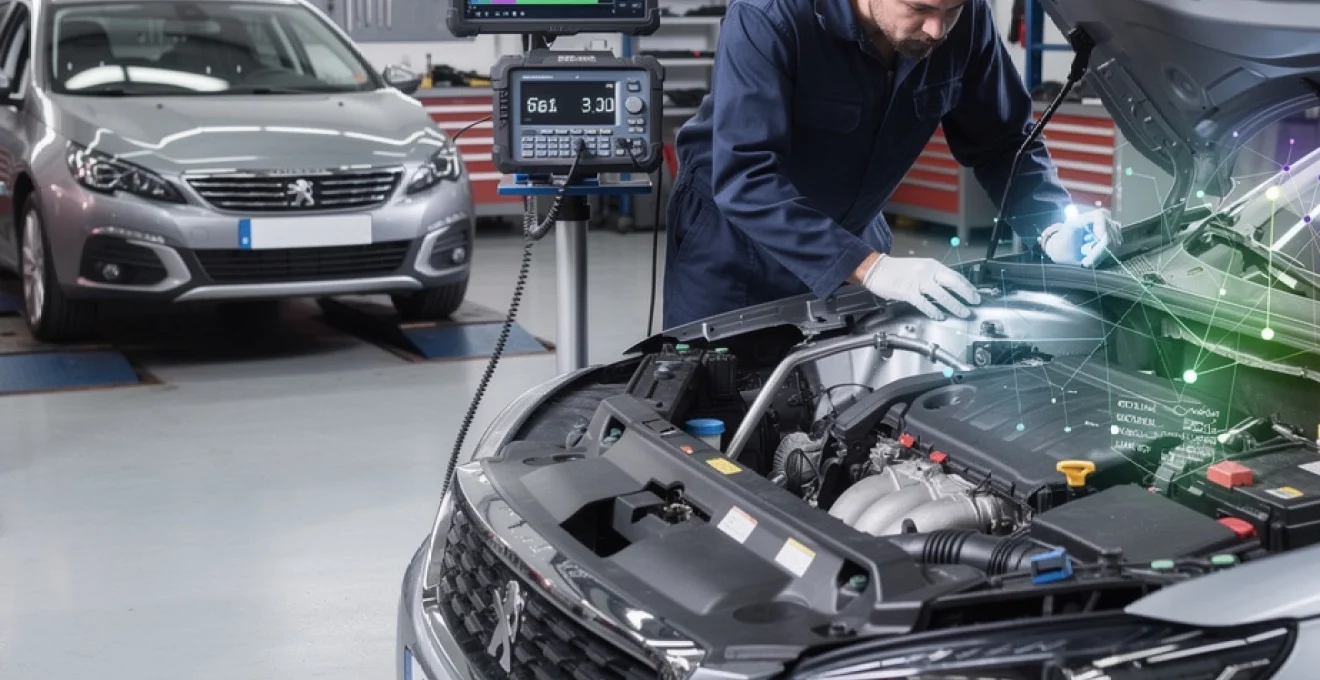
The P1337 diagnostic trouble code represents one of the most perplexing challenges facing Peugeot technicians and vehicle owners across the UK. This manufacturer-specific fault code, predominantly affecting models such as the 307, 308, RCZ, and 3008, typically manifests as cylinder 1 misfiring accompanied by reduced engine performance and activation of limp mode. Unlike standard OBD-II codes, P1337 requires specialised diagnostic expertise and sophisticated understanding of PSA Group’s proprietary engine management systems. The complexity of this fault often leads to misdiagnosis, resulting in unnecessary component replacements and frustrated vehicle owners seeking reliable solutions.
Understanding peugeot P1337 diagnostic trouble code structure
OBD-II protocol classification and P1337 Manufacturer-Specific designation
The P1337 code falls within the P1000-P1999 range, designating it as a manufacturer-specific powertrain code rather than a standardised OBD-II diagnostic trouble code. This classification means that P1337’s interpretation varies significantly between automotive manufacturers, with PSA Group implementing their own unique definition for this particular fault identifier.
Within Peugeot’s diagnostic framework, P1337 specifically relates to cylinder 1 combustion irregularities, often interpreted as “Misfire Cylinder 1” or “Combustion Fault Cylinder 1”. However, the underlying causes extend far beyond simple ignition system failures, encompassing complex interactions between fuel delivery systems, engine timing mechanisms, and electronic control unit communications.
ECU communication networks in peugeot 307, 308, and 3008 models
Modern Peugeot vehicles utilise sophisticated electronic control unit networks that continuously monitor engine performance parameters. The engine management system evaluates crankshaft position sensor data, comparing expected versus actual engine speed fluctuations to detect misfiring conditions. When cylinder 1 exhibits combustion irregularities exceeding predetermined thresholds, the ECU triggers P1337 code storage.
The diagnostic protocol involves real-time analysis of multiple sensor inputs, including camshaft position sensors, mass airflow meters, and lambda sensors. This comprehensive monitoring approach enables precise fault localisation but also increases the complexity of accurate diagnosis, particularly when multiple systems exhibit concurrent malfunctions.
PSA group diagnostic standards and code hierarchy
PSA Group’s diagnostic methodology prioritises fault codes based on their potential impact on vehicle safety and emissions compliance. P1337 typically receives high priority classification due to its association with engine misfiring, which directly affects exhaust emissions and catalyst efficiency. This prioritisation means that P1337 often appears as the primary fault code even when multiple engine management issues exist simultaneously.
Understanding the hierarchical structure of PSA diagnostic codes proves essential for accurate troubleshooting, as secondary faults may provide crucial diagnostic information often overlooked during initial code reading procedures.
CAN bus architecture impact on P1337 code generation
The Controller Area Network (CAN) bus architecture in modern Peugeot vehicles enables rapid communication between various electronic control modules. When cylinder 1 misfiring occurs, multiple ECUs receive notification through CAN bus messaging, potentially triggering additional fault codes related to emission control systems, fuel injection management, and ignition timing control.
This interconnected communication system means that P1337 diagnosis requires comprehensive system analysis rather than isolated component testing. Intermittent CAN bus communication errors can also cause false P1337 code generation, highlighting the importance of thorough electrical system evaluation during diagnostic procedures.
Technical analysis of P1337 root causes in peugeot vehicles
Engine control module sensor circuit malfunctions
Crankshaft position sensor failures represent the most common underlying cause of P1337 code generation in Peugeot vehicles. These sensors, typically located near the engine flywheel or crankshaft pulley, provide critical timing information for ignition and fuel injection systems. Sensor circuit degradation,
Sensor circuit degradation, loose connectors, or intermittent wiring faults can all distort the RPM signal the ECU relies on to identify cylinder 1 combustion events. When the crankshaft or camshaft signal is noisy or out of phase, the ECU may think cylinder 1 has misfired even when ignition and fuelling are technically sound. This is why some owners report replacing coils, spark plugs, and even injectors without resolving the P1337 code. In severe cases, a failing sensor can also cause hard starting, stalling, or random misfires across multiple cylinders. Thorough testing of the sensor signal using an oscilloscope or high-quality scan tool is therefore essential before condemning ignition components.
Camshaft position sensors also play a key role, especially on variable valve timing (VVT) engines such as the THP 1.6 and PureTech 1.2 found in the Peugeot 308 and 3008. If the camshaft signal drifts relative to the crankshaft due to sensor failure or timing issues, the ECU’s internal model of where cylinder 1 should fire becomes inaccurate. This mis-synchronisation can trigger a cylinder 1 misfire detection algorithm, even when combustion is occurring. On engines where LPG conversion has been added, slight timing discrepancies can be amplified, leading to intermittent P1337 codes that only appear at idle or under light load.
Wiring harness degradation in HDi diesel engines
Although P1337 is more commonly associated with petrol engines, HDi diesel models can also suffer from wiring harness degradation that leads to misleading or spurious misfire-related codes. In the Peugeot 307 and 308 HDi, engine looms routed close to hot components or subject to vibration can develop broken strands inside the insulation. This kind of damage is often invisible to the naked eye but causes intermittent voltage drops and signal interference, particularly affecting crankshaft and camshaft sensor circuits.
Owners often first notice the issue as an occasional hesitation, followed by the engine management light and a stored P1337 or similar combustion-related DTC. Because diesel engines do not use spark plugs or ignition coils, technicians must instead focus on injector wiring, rail pressure sensor circuits, and ECU grounds. Corroded connectors, especially in damp UK climates, are a frequent culprit. A careful wiggle test of the harness while monitoring live data or oscilloscope traces can reveal dropouts that would otherwise be missed by static resistance checks.
Lambda sensor bank 1 performance issues
On many Peugeot petrol engines, Bank 1 lambda (oxygen) sensor feedback is integral to how the ECU validates combustion quality on each cylinder. If the upstream lambda sensor on Bank 1 responds slowly, becomes contaminated, or drifts out of calibration, the ECU may incorrectly interpret mixture variations as repeated misfires on cylinder 1. This is especially true at idle, where even a slight fuelling imbalance can cause a rough running feel and trigger the P1337 cylinder 1 misfire code.
Real-world cases from Peugeot 307 and 3008 owners show that a failing lambda sensor can coexist with borderline ignition coils and worn spark plugs, making diagnosis more complex. The ECU might overcompensate the air-fuel ratio, leading to lean spikes that primarily affect cylinder 1 due to intake manifold design or injector spray pattern. When that happens, you may see P1337 stored alongside generic mixture codes such as P0170 or catalyst efficiency codes like P0420. Before replacing expensive components, it is wise to check lambda sensor response time, switching frequency, and voltage range using a professional scan tool or oscilloscope.
Fuel injection system pressure regulation failures
Fuel pressure irregularities can also lie at the heart of some P1337 incidents, particularly on direct-injection engines such as the 1.6 THP and 1.2 PureTech. The high-pressure fuel pump, pressure regulator, and rail pressure sensor must work in harmony to ensure consistent delivery to each cylinder. When rail pressure briefly drops below target at idle or during load transitions, cylinder 1 might be the first to display misfire symptoms due to rail design or injector location, prompting the ECU to log P1337.
In practice, these issues might present as a lumpy idle, sudden loss of power, or the familiar “Engine Fault – repair needed” message on the cluster, followed by the cooling fan running at high speed even with a cold engine. Some technicians mistakenly chase ignition faults in these scenarios, but live data will often reveal oscillating fuel pressure or an out-of-range pressure sensor reading. Because UK fuel often contains ethanol blends and vehicles frequently operate in stop-start city conditions, high-pressure pump wear and injector fouling are becoming more common contributors to P1337 misfire complaints.
Advanced diagnostic procedures using professional scan tools
Lexia-3 PP2000 interface P1337 code interpretation
While generic OBD-II scanners and smartphone apps like Torque can read and clear Peugeot P1337 codes, they rarely provide the full manufacturer-specific description and guided tests you need. The Lexia-3 PP2000 interface, designed for PSA vehicles, offers deeper access to Peugeot ECUs, including enhanced misfire counters, freeze-frame data, and component actuation tests. Using this tool, a technician can see exactly under what conditions P1337 was set: engine speed, load, coolant temperature, fuel trim status, and even which operating mode the ECU was in.
Interpreting this extra data correctly often makes the difference between accurate diagnosis and endless parts swapping. For instance, if P1337 repeatedly appears only at hot idle with stable fuel trims, the fault may point towards a marginal coil or mechanical compression issue on cylinder 1. However, if the code is logged during cold starts with unstable RPM and multiple companion codes, sensor synchronisation or timing belt alignment should be investigated first. By leveraging the full capabilities of Lexia-3 PP2000, you can build a clear picture of how and why the ECU decided that cylinder 1 misfire thresholds had been exceeded.
Peugeot planet system live data analysis techniques
Beyond basic code reading, Peugeot Planet (and its successor DiagBox) allows you to stream and record live data parameters from the engine ECU. When tackling recurring P1337 misfire issues, this live data becomes invaluable. You can monitor crankshaft synchronisation status, individual cylinder misfire counters, injector correction values, ignition advance, and lambda sensor feedback in real time. Watching how these values change under different conditions helps identify whether cylinder 1 is truly misfiring or whether the ECU is being misled by faulty inputs.
One effective technique is to log a short drive cycle including cold start, idle, light acceleration, motorway cruising, and return to idle. Does the misfire counter for cylinder 1 spike only when the engine returns to idle after a run? That pattern could suggest valve leakage, carbon build-up, or timing issues rather than a coil fault. Live data can also reveal subtle anomalies such as one injector requiring more correction than the others, pointing towards fuelling imbalance. When you compare these readings across multiple Peugeot models (307, 308, RCZ, 3008), patterns become easier to see and common root causes of P1337 become more obvious.
Multi-parameter monitoring during engine load testing
Static idling tests only show part of the story. To fully understand a persistent Peugeot P1337 fault code, technicians should perform controlled load tests while monitoring multiple parameters. This can be done on a rolling road (dyno) or on the road with a safe, repeatable acceleration routine. By observing engine speed, load, ignition timing, knock correction, fuel pressure, and lambda sensor readings together, you can see how cylinder 1 behaves when the engine is stressed.
Think of it like a medical stress test: some heart problems only show up when a patient is exercising, and some misfires only appear when the engine is under load. If P1337 is only present at idle and disappears under load, mechanical compression and timing alignment need closer inspection. Conversely, if misfires increase with boost or high load on turbocharged engines, you may be dealing with marginal coils, weak spark plugs, or fuel starvation at higher pressures. Recording this multi-parameter data and reviewing it afterwards helps avoid the trap of chasing a single sensor value in isolation.
Step-by-step P1337 troubleshooting protocol
To bring structure to what can otherwise become a guessing game, it is useful to follow a clear troubleshooting protocol for Peugeot P1337. Begin with the basics: verify the customer complaint, confirm the presence of P1337 with a reliable scan tool, and check for any related codes such as general misfire (P0301), fuel trim, or sensor faults. Note freeze-frame data to capture the exact operating conditions when the ECU last detected the cylinder 1 misfire. Clearing the codes and reproducing the fault on a controlled test drive allows you to see whether the issue is intermittent or consistently repeatable.
Next, perform a visual inspection and simple checks that take minutes but can save hours of work. Are the ignition coil connectors secure and free of oil or water ingress? Do the spark plugs show signs of fouling, abnormal electrode wear, or incorrect gap? Is there any evidence of rodent damage or chafed wiring near the engine harness, especially in older Peugeot 307 and 308 models? If you find obvious issues at this stage, correcting them before moving on can often resolve the P1337 code without the need for deeper diagnostics.
- Step 1: Confirm the P1337 cylinder 1 misfire code and review freeze-frame data.
- Step 2: Inspect and, if necessary, temporarily swap ignition coils and spark plugs between cylinders to see if the misfire follows the component.
- Step 3: Perform a compression test and, where possible, a leak-down test to assess mechanical health of cylinder 1.
- Step 4: Use live data to evaluate fuel trims, injector operation, and lambda sensor behaviour at idle and under load.
- Step 5: Check crankshaft and camshaft position sensor signals, timing belt/chain alignment, and wiring integrity.
After completing these steps, you should have narrowed the problem to one of three broad areas: ignition-related, fuelling-related, or mechanical/timing-related. For example, if swapping coils and plugs moves the misfire to another cylinder, the component is clearly at fault. If compression is significantly lower on cylinder 1 and improves with a small amount of oil added to the cylinder, piston ring wear is suspect. If both ignition and mechanical tests pass but live data shows irregular injector activity or fuel pressure drops, attention should turn to the injection system. Following this structured approach reduces the risk of expensive misdiagnosis and repeated visits for the same P1337 code.
Professional repair solutions and component replacement guidelines
Once you have confidently identified the root cause of the Peugeot P1337 code, the next step is to select appropriate repair solutions and follow sound replacement practices. For ignition-related issues, replacing a single failed coil on modern Peugeots (such as the 308 or 3008) may fix the immediate misfire, but many experienced technicians recommend replacing the full set if the vehicle has high mileage. Coils tend to age together, and when one fails, the others are often not far behind. Similarly, spark plugs should always be renewed as a matched set, using the correct heat range and gap specified by Peugeot.
For sensor failures, especially crankshaft and camshaft position sensors, always choose OE or high-quality OEM-equivalent parts. Cheap aftermarket sensors may produce noisy or out-of-spec signals, resulting in recurring P1337 misfires and other drivability issues. When replacing timing belts or chains, meticulous alignment is critical; as seen in real-world cases, a cambelt installed one tooth out can generate persistent cylinder 1 misfire codes even though the engine appears to run reasonably well. Taking the time to double-check timing marks and using locking tools where specified can prevent costly repeat work.
- Follow Peugeot’s torque specifications and tightening sequences for coils, sensor brackets, and timing components.
- After replacing injectors or high-pressure fuel components, always check for leaks and verify rail pressure using live data.
- When addressing wiring harness damage, repair using proper soldering and heat-shrink techniques or fit a replacement loom section rather than temporary tape fixes.
- On vehicles with LPG conversions, coordinate repairs with the LPG installer to ensure both ECUs (petrol and LPG) are calibrated correctly.
In some severe cases, especially where P1337 has been ignored for a long time, continuous misfiring can damage the catalyst or lead to valve and piston crown issues. If compression tests reveal significant mechanical damage, you may be faced with cylinder head overhaul or even engine replacement. While this is rare on newer models, documented cases on older 307 and 308 vehicles highlight the importance of addressing misfires promptly. Working with a reputable Peugeot specialist, rather than relying on generic “parts changers”, increases the likelihood of a cost-effective and lasting repair.
Post-repair validation and ECU adaptation procedures
After completing repairs related to a Peugeot P1337 fault code, thorough post-repair validation is essential to confirm that the root cause has been resolved. Start by clearing all stored and pending codes, then perform a structured road test that mirrors the conditions under which the misfire originally occurred. Monitor cylinder 1 misfire counters, fuel trims, and sensor data using a professional scan tool during cold start, idle, part-throttle, and full-load operation. If the misfire counter remains at zero and no new codes are logged, you can be confident that the engine is now operating correctly.
Many modern Peugeot ECUs require adaptation or relearn procedures after key components have been replaced. For example, some models support ignition coil recognition, injector coding, or throttle body adaptation routines that help the ECU fine-tune control strategies. Using Peugeot Planet or DiagBox, follow the guided procedures to reset learned parameters such as fuel trims or idle control if recommended by the service documentation. This is particularly important on direct-injection and turbocharged engines, where precise control is crucial for emissions compliance and long-term reliability.
Finally, consider advising the vehicle owner on preventive maintenance to avoid recurrence of P1337 or related misfire codes. Regular spark plug replacement intervals, timely cambelt or timing chain servicing, and prompt attention to any new engine warning lights can all extend the life of the ignition and fuel systems. In the UK context, where short urban journeys and cold, damp weather are common, encouraging occasional longer drives to allow the engine to reach full operating temperature can also help keep combustion chambers and exhaust components cleaner. By combining accurate diagnosis, professional repair, and sensible aftercare, P1337 need not remain the “mystery misfire” that so many Peugeot owners dread.