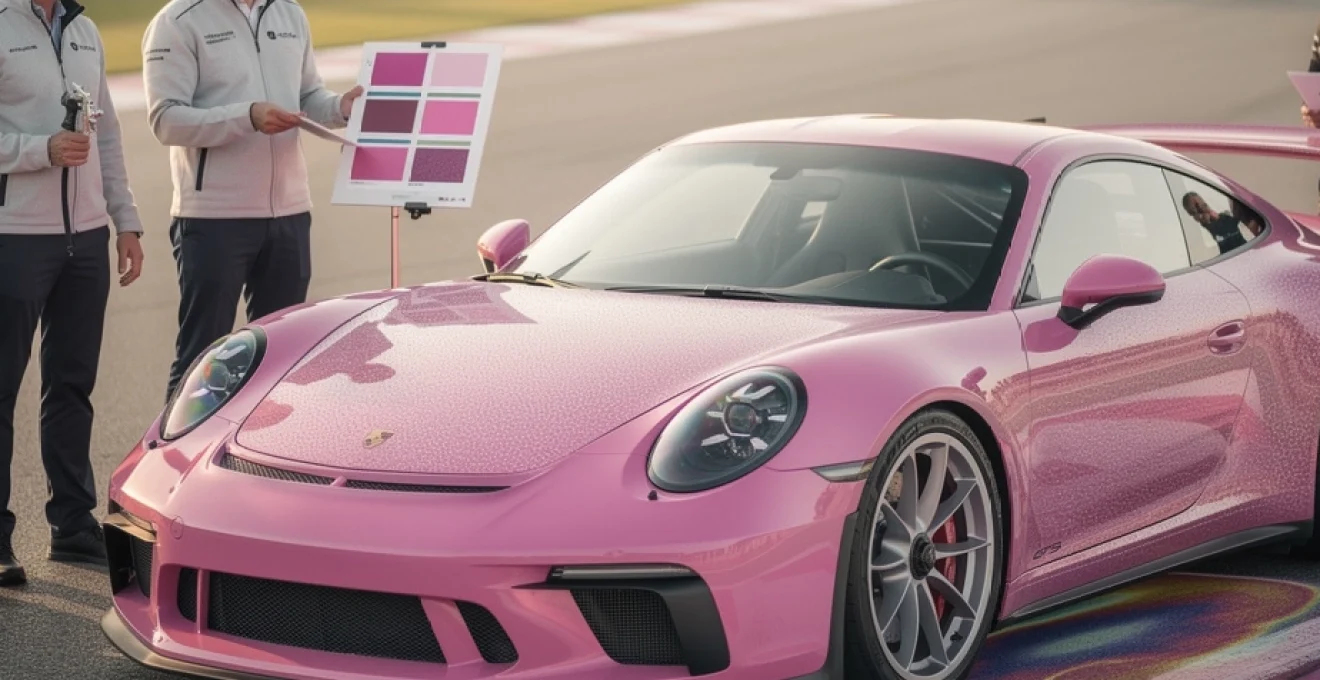
The Porsche 911 GT3 has always represented the pinnacle of track-focused engineering, combining decades of motorsport heritage with cutting-edge technology. When wrapped in an audacious pink finish, this already exceptional machine transforms into something truly extraordinary. Pink Porsche GT3 models challenge conventional automotive aesthetics whilst maintaining the uncompromising performance standards that define the nameplate. The bold colour choice reflects a growing trend amongst enthusiasts who view their vehicles as personal statements rather than conforming to traditional racing liveries.
This striking aesthetic approach doesn’t merely serve vanity; it represents a deeper philosophical shift in automotive culture. Today’s discerning owners increasingly seek individualisation options that set their machines apart from the ubiquitous silver, black, and white vehicles dominating modern roads. The pink GT3 phenomenon exemplifies how contemporary automotive design embraces both technical excellence and emotional expression, creating vehicles that perform as brilliantly as they captivate onlookers.
Pink paint technology and manufacturing process for porsche GT3 models
Porsche’s PTS (paint to sample) programme and custom colour development
Porsche’s Paint to Sample programme represents one of the most sophisticated custom colour systems in the automotive industry. This exclusive service allows customers to specify virtually any colour imaginable, provided it meets Porsche’s stringent quality and durability standards. The PTS process begins with colour matching technology that can recreate shades from various sources, whether vintage Porsche colours, fashion samples, or completely bespoke creations. Each PTS order requires approximately 6-8 weeks additional production time, reflecting the meticulous attention to detail involved in creating these unique finishes.
The technical complexity of achieving consistent pink shades across different lighting conditions presents unique challenges. Pink pigments often contain red and white base compounds that can shift dramatically under various illumination sources. Porsche’s colour engineers must balance these elements whilst ensuring the finish maintains its vibrancy throughout the vehicle’s lifecycle. Advanced spectrophotometry equipment measures colour accuracy to within microscopic tolerances, guaranteeing that each pink GT3 meets exacting standards regardless of production timing or facility location.
Solid versus metallic pink finishes: technical composition analysis
Solid pink finishes utilise concentrated pigment particles suspended in high-grade polymer resins, creating deep, saturated colours with minimal light reflection. These formulations typically contain between 15-25% pigment concentration, significantly higher than standard automotive paints. The absence of metallic flakes allows for more consistent colour reproduction but requires exceptional surface preparation to achieve the mirror-like finish expected on premium vehicles. Solid pink paints demand precise application techniques, as any imperfections become immediately apparent against the uniform colour field.
Metallic pink variants incorporate aluminium or synthetic mica flakes alongside traditional pigments, creating dynamic visual effects that shift with viewing angles and lighting conditions. These formulations typically contain 8-12% metallic content, carefully calibrated to enhance the pink base without overwhelming its character. The multi-layered application process involves base coat, colour coat, and clear coat stages, each requiring specific curing temperatures and humidity levels. Modern metallic pink formulations often incorporate nano-scale particles that enhance depth perception whilst maintaining colour stability under extreme temperature variations.
Ruby star NEO and rubystone red NEO: factory pink variants
Porsche’s Ruby Star NEO represents the manufacturer’s most successful attempt at offering a factory pink option that balances boldness with sophistication. This colour combines deep magenta undertones with subtle metallic highlights, creating a finish that appears almost burgundy in low light whilst revealing its true pink character under direct illumination. The NEO designation indicates the latest generation of this colour formula, incorporating improved UV-resistant compounds and enhanced scratch resistance compared to earlier versions.
Rubystone Red NEO occupies the spectrum between traditional red and pink, offering customers a compromise that maintains some conventional appeal whilst embracing unconventional aesthetics. This shade utilises advanced pearlescent technology that creates subtle colour shifts ranging from deep rose to bright coral depending on environmental conditions. Both factory variants undergo extensive testing in Porsche’s Arizona proving grounds, where extreme temperatures and UV exposure simulate decades of real-world use in accelerated timeframes.
The development of factory pink variants required over 18
over 18 months of iterative testing and reformulation, with particular focus on how these vibrant hues behave on high-speed, track-focused platforms like the Porsche 911 GT3. Engineers had to ensure that these bold colours did not introduce additional weight, interfere with sensor calibration for modern driver-assistance systems, or compromise the car’s ability to dissipate heat efficiently during prolonged circuit sessions.
UV resistance and colour stability in high-performance applications
High-intensity pink finishes on a Porsche GT3 face far greater environmental stress than standard road car colours. Vehicles that see regular track use are exposed to intense UV radiation, elevated brake and engine temperatures, and frequent heat cycling between hot laps and cool-down periods. To combat this, Porsche utilises advanced UV absorbers and hindered amine light stabilisers (HALS) within both the base coat and clear coat systems. These additives slow down pigment degradation and resin yellowing, helping the pink paint maintain its original saturation and clarity over years of demanding use.
Laboratory testing subjects sample panels to xenon-arc weathering chambers that simulate years of sun exposure in a matter of weeks. Pink tones are particularly scrutinised because red-based pigments can be more susceptible to fading compared with neutral greys or silvers. Porsche’s paint engineers monitor colour drift using Delta E values, typically targeting a deviation of less than 1.0 over a simulated five-year period, a threshold that is virtually imperceptible to the human eye. For owners of a pink Porsche GT3, this translates into a finish that looks as dramatic at its 100th track day as it did when it first left the factory.
Heat resistance is equally critical for colour stability in motorsport-oriented applications. Under heavy use, body panels adjacent to exhaust outlets and rear brake ducts can experience surface temperatures exceeding 80°C. The paint system on a GT3 is formulated to withstand intermittent peaks up to around 120°C without blistering, discolouration, or loss of gloss. In practice, this means that even on a hot summer track day, your bold pink GT3 finish retains its integrity rather than chalking or dulling prematurely.
Aerodynamic performance impact of colour choice on GT3 track dynamics
Heat absorption coefficients: pink versus traditional racing liveries
From an aerodynamic perspective, the colour of a Porsche 911 GT3 has negligible direct influence on drag coefficients or downforce figures. However, when we examine heat absorption and its knock-on effects, paint colour becomes more than just a cosmetic choice. Darker colours, including deep magenta and some saturated pinks, can absorb more solar radiation than lighter tones or classic white racing liveries. This increased heat absorption can slightly raise surface temperatures across the body, which in turn may influence tyre warm-up rates and air density around the vehicle.
Laboratory measurements of solar reflectance values show that highly saturated pink finishes often sit between traditional Guards Red and darker blues in terms of heat absorption. While the difference may only amount to a few degrees Celsius on body panels, in a finely tuned track environment these margins can matter. For example, a warmer bonnet surface can raise under-hood temperatures, potentially affecting intake air temperature by 1–2°C. Although small, this can marginally influence power output in a naturally aspirated GT3 engine that already operates near its thermodynamic limits.
For owners who plan extensive track use in hot climates, pairing a pink Porsche GT3 with complementary thermal management strategies can mitigate these minor effects. Parking under shade between sessions, using reflective car covers in the paddock, and carefully managing tyre pressures to account for slightly higher surface temperatures all help maintain consistent performance. In cooler or overcast conditions, the heat absorption characteristics of a pink livery may actually aid quicker tyre warm-up on out-laps, offering a subtle advantage compared to lighter colours.
Weight distribution analysis of multi-layer paint systems
When discussing a track-focused car like the Porsche 911 GT3, even grams of additional weight are scrutinised. Custom pink finishes, particularly those created through the Paint to Sample programme, can sometimes involve complex multi-layer systems. These may include tinted primers, special effect mid-coats, and thicker clear coats designed to maximise depth and gloss. While each individual layer is measured in microns, the cumulative effect over an entire body shell and aero package can add up to 1–2 kg compared with a simple solid colour.
Does this extra mass meaningfully affect weight distribution or lap times? In most real-world scenarios, the answer is no. The additional paint weight is spread evenly across the body, meaning front-to-rear and side-to-side balance remain virtually unchanged. On a chassis dyno or corner-weight scale, any differences introduced by a bespoke pink GT3 finish fall well within the adjustment range of suspension setup. Porsche engineers calculate paint thickness precisely and maintain strict tolerances to ensure each GT3 leaves the factory with predictable handling characteristics regardless of colour choice.
If you are pursuing every last tenth of a second on track, you may wonder whether a more complex metallic pink system could compromise performance versus a simpler solid shade. In practice, the difference is comparable to adding a half-full water bottle to the glovebox. Driver consistency, tyre condition, and ambient temperatures will overshadow any marginal impact from paint mass. For most owners, the emotional and aesthetic reward of a unique pink GT3 far outweighs the almost immeasurable weight penalty of its vibrant finish.
Thermal management considerations for track-focused applications
Thermal management on a Porsche 911 GT3 centres on cooling air routing, radiator capacity, and efficient evacuation of hot air from the engine bay and brakes. The colour of the car, including pink variants, does not directly alter these engineered systems. However, as we saw with heat absorption, surface temperature can influence how heat radiates from the body. Think of the car as a finely tuned heat exchanger where every surface plays a minor role in how quickly the vehicle sheds warmth between stints.
On a hot track day, a pink GT3 subjected to intense sunlight may exhibit slightly higher panel temperatures on the roof, bonnet, and engine cover compared with a white car. This can increase the thermal load on components such as insulation materials, rubber seals, and plastic trims over time. Porsche anticipates such stresses by using heat-resistant materials around the rear engine compartment and high-temperature clear coats that maintain gloss even after repeated heat cycling. For enthusiasts who frequently drive in desert or tropical climates, opting for a ceramic coating with heat-reflective properties can offer an extra layer of thermal protection.
From a practical standpoint, managing a pink Porsche 911 GT3 for track use involves the same best practices you would apply to any GT3. Allow sufficient cool-down laps before returning to the pits, avoid shutting the engine off immediately after a hard session, and monitor oil and coolant temperatures closely. You might also consider scheduling sessions earlier in the morning or later in the afternoon to reduce peak solar load on the paint surface. These strategies protect not only the engine and brakes, but also help preserve the long-term vibrancy of the car’s pink finish.
Visibility and safety implications on circuit racing environments
One area where colour choice delivers a clear performance benefit is visibility. A bright pink Porsche GT3 stands out instantly amid a sea of white, grey, and dark-coloured track cars. In multi-class racing or busy track days, enhanced visibility can improve safety by making your braking points and trajectory more obvious to other drivers. Marshals and instructors also find it easier to track a distinctively coloured car, which can be advantageous during coaching sessions or when responding to on-track incidents.
From a human-factors perspective, the eye is naturally drawn to high-saturation hues that contrast with the environment. On a typical circuit lined by green grass, grey tarmac, and concrete barriers, a pink GT3 creates a sharp visual contrast that reduces the risk of being “lost” in another driver’s peripheral vision. This is especially relevant in poor light conditions, such as dawn, dusk, or light rain, when darker cars can blend into the background more easily. While not a substitute for proper lighting and reflective decals, a vivid pink livery contributes another layer of passive safety.
Could the boldness of a pink Porsche GT3 be distracting to other drivers? In practice, most track participants are used to seeing colourful liveries, sponsor graphics, and contrasting decals. Rather than causing distraction, a distinctive colour often encourages other drivers to give a slightly wider berth, subconsciously recognising the car as unique or potentially higher-value. For you as the owner, this added track presence can be both a safety asset and a source of satisfaction, reinforcing the sense that your pink GT3 is unlike anything else in the paddock.
Historical context of bold colour choices in porsche motorsport heritage
Porsche’s willingness to experiment with bold colours predates the modern fascination with pink GT3 models. The most famous example is arguably the 1971 917/20 “Pink Pig”, a Le Mans prototype painted in a butcher-style diagram with different cuts of meat labelled in German. This whimsical livery, finished in an unapologetic shade of pink, has since become an icon of motorsport culture. It demonstrated early on that Porsche was unafraid to challenge conservative expectations about what a serious racing car should look like.
Throughout the 1970s and 1980s, Porsche customer and works teams adopted a wide variety of bright liveries, from the Martini Racing stripes to the Rothmans blue-and-white schemes. While many of these used more traditional racing hues, special one-off designs often incorporated vivid magentas, fuchsias, and rose tones for promotional events and endurance races. These experimental liveries laid the psychological groundwork for modern enthusiasts who choose a pink Porsche 911 GT3 as a nod to the brand’s colourful past. When you see a Ruby Star NEO GT3 today, you can trace its lineage back to that audacious 917/20 charging down the Mulsanne Straight.
In the 1990s and early 2000s, Porsche’s road car palette expanded to include bolder shades like Rubystone Red, Riviera Blue, and Signal Green. Many of these colours found favour with track-day regulars and privateer racers seeking to distinguish their cars in crowded paddocks. The modern Paint to Sample programme essentially formalises this tradition, allowing contemporary owners to recreate rare historical colours or invent entirely new pink hues. In this sense, a pink Porsche 911 GT3 is not a break from heritage but an evolution of Porsche’s long-standing culture of visual experimentation.
Market analysis: pink GT3 resale values and collector appeal
From a market perspective, the question many enthusiasts ask is straightforward: does a pink Porsche 911 GT3 hold its value? Data from specialist auction houses and premium classifieds over the past few years suggests that rare, well-specified colours often command a premium over standard finishes. Limited-production GT3 models in Paint to Sample colours, including pink and magenta tones, frequently sell faster than their more conservatively painted counterparts. This is particularly true when the colour is paired with desirable options such as carbon-ceramic brakes, bucket seats, and Clubsport packages.
In the collector car world, rarity and story often drive demand. A pink GT3 satisfies both criteria: production numbers for such bold colours are typically low, and each car carries a narrative about the original owner’s willingness to step outside the norm. As younger collectors enter the market, there is a visible shift toward vibrant, Instagram-friendly colours that photograph well and stand out at events. For these buyers, a pink Porsche 911 GT3 is not an eccentric choice but a strategic one that aligns with contemporary tastes and online culture.
Of course, colour can also narrow the potential buyer pool. Some traditionalists still prefer understated silvers and blacks, especially for long-term garage collections. This polarisation means that resale outcomes for a pink GT3 can be more extreme: when the right buyer appears, the car may sell at a notable premium, but it may also take longer to find that buyer. To maximise resale value, owners should maintain comprehensive service records, avoid non-reversible cosmetic modifications, and consider professional paint protection to keep the pink finish in near-factory condition. In the high-end Porsche market, condition and specification often matter as much as, if not more than, the colour itself.
Famous pink porsche 911 GT3 examples and celebrity ownership
High-profile examples have played a major role in popularising the idea of a pink Porsche GT3. Social media influencers, professional drivers, and celebrities have all been spotted with bespoke pink 911 track weapons, turning these cars into viral sensations. When a well-known content creator documents the build process of a Paint to Sample pink GT3, from factory order to first track day, it sparks a wave of interest among fans. These highly visible builds normalise the once-radical idea of pairing a hardcore motorsport chassis with a playful, unconventional colour.
In recent years, several custom tuning houses and Porsche specialists have unveiled pink GT3 projects at major automotive events. These cars often combine eye-catching liveries with performance upgrades, demonstrating that a pink Porsche can be every bit as serious on track as a car finished in traditional racing colours. Some professional racers have also commissioned pink liveries for charity events or awareness campaigns, using the striking hue to draw attention to social causes. This blend of motorsport credibility and social relevance reinforces the pink GT3’s status as a modern icon.
For potential buyers, seeing celebrities and respected enthusiasts embrace pink GT3 builds provides reassurance that the colour is more than a passing fad. It indicates a growing cultural acceptance of expressive, individualistic car choices at the highest performance levels. Whether you are inspired by a famous Ruby Star NEO build circulating on YouTube or a unique Paint to Sample creation unveiled at a concours event, these public examples help validate the decision to choose pink for your own Porsche 911 GT3.
Maintenance and care protocols for vibrant automotive finishes
Owning a pink Porsche 911 GT3 carries specific responsibilities if you want to preserve the car’s bold appearance. Vibrant colours, especially those with red and magenta pigments, can be more sensitive to improper washing techniques and harsh chemicals. Using a pH-neutral shampoo, soft microfibre wash mitts, and the two-bucket method helps minimise swirl marks and micro-scratches that are more visible on saturated finishes. Regular decontamination with gentle iron removers and clay bars keeps the paint surface smooth, enhancing gloss and clarity under strong sunlight.
Protection is especially important for pink paint on a track-focused Porsche. High-speed debris, rubber marbles, and brake dust can quickly damage unprotected clear coats. Many GT3 owners opt for paint protection film (PPF) on vulnerable areas such as the front bumper, bonnet, side skirts, and rear haunches. Modern PPF products offer self-healing properties and UV resistance, acting like an invisible sacrificial layer over the paint. Complementing PPF with a high-quality ceramic coating on exposed panels adds hydrophobic behaviour, making post-track-day cleaning faster and reducing the risk of etching from insects or tar.
Storage and sun exposure management also play key roles in keeping a pink Porsche GT3 looking fresh. Whenever possible, park the car in a shaded or indoor environment to limit prolonged UV exposure. If you must leave the car outside for extended periods, a breathable, UV-resistant car cover helps shield the paint from direct sunlight and environmental contaminants. Periodic professional inspections by a detailer experienced with high-end, vibrant finishes can catch early signs of oxidation or clear coat wear, allowing for corrective polishing before more invasive repairs are required.
Finally, consider establishing a maintenance schedule that aligns with how you actually use your pink GT3. A car that sees monthly track days and frequent spirited driving will require more frequent inspections, decontamination, and sealant or ceramic top-up applications than a purely weekend cruiser. By combining meticulous wash routines, robust surface protection, and sensible storage practices, you can ensure that your pink Porsche 911 GT3 remains as visually striking as the day it first turned heads—whether that is in the pit lane, on a mountain pass, or parked centre stage in your garage.