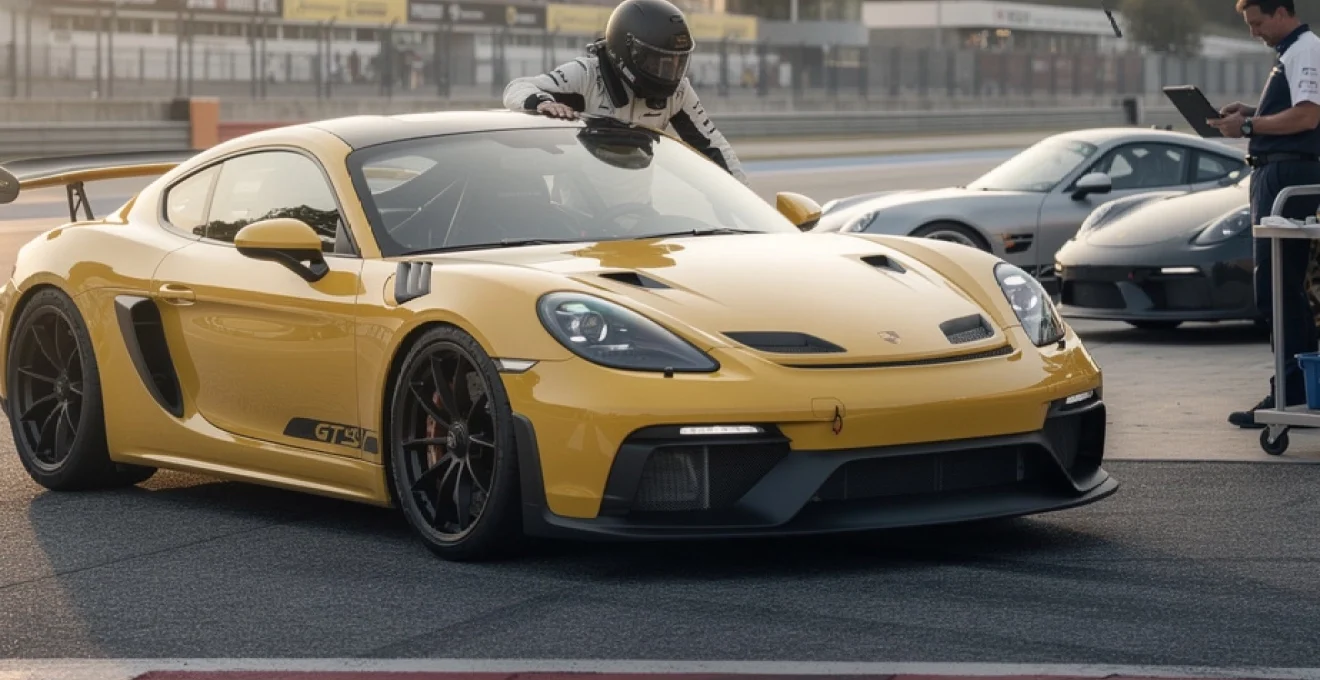
When Porsche’s GT department finally unleashed the 718 Cayman GT4 RS in 2022, it marked the culmination of decades of engineering restraint. This machine represents Porsche’s ultimate expression of mid-engine perfection, combining the legendary 4.0-litre naturally aspirated flat-six from the 911 GT3 with the inherently superior chassis balance of a mid-mounted powerplant. The GT4 RS doesn’t just blur the lines between road and track capability—it obliterates them entirely, creating what many consider the purest driving experience available from Stuttgart today.
The development story reads like automotive folklore. For years, Porsche’s engineers secretly harboured dreams of transplanting their most celebrated engine into the Cayman’s midships layout. When Wolfgang Hatz, former head of R&D, received a prototype GT4 RS as a birthday gift—complete with a butchered 981 chassis to accommodate the GT3’s oil tank—the project’s potential became undeniable. That prototype demonstrated the intoxicating combination of mid-engine balance and naturally aspirated fury that would eventually captivate senior management and green-light production.
Porsche 718 cayman GT4 RS technical specifications and performance engineering
The GT4 RS represents a masterclass in performance engineering, where every component serves the singular purpose of delivering maximum driver engagement. At its heart lies a detuned version of the 992 GT3’s powerplant, producing 493 horsepower and 332 lb-ft of torque—figures that place it firmly in supercar territory while maintaining the mechanical purity that defines Porsche’s naturally aspirated engines.
4.0-litre naturally aspirated Flat-Six engine architecture
The engine’s architecture tells a story of motorsport evolution spanning decades. Derived directly from Porsche’s racing programmes, this powerplant features individual throttle bodies for each cylinder, creating the instantaneous throttle response that modern turbocharged engines simply cannot match. The 9,000-rpm redline isn’t merely a number—it’s a testament to the engine’s race-bred internals, including solid valve lifters and a dry-sump lubrication system that ensures consistent oil supply during high-g cornering.
What sets the GT4 RS apart from its 911 GT3 sibling is its unique intake configuration. Air rushes into the engine bay through intakes positioned where rear quarter windows typically reside, creating an auditory experience that places you directly in the engine’s breathing rhythm. This arrangement produces 10 horsepower less than the GT3 due to the more tortuous exhaust routing required by the mid-engine layout, but the sacrifice in peak power delivers gains in driver immersion that transcend mere numbers.
PDK Seven-Speed Dual-Clutch transmission calibration
The PDK transmission receives specific calibration for the GT4 RS, with gear ratios borrowed from the 991.2 GT3 RS to maximise the engine’s potential. Unlike the standard GT4’s overdrive seventh gear, the RS uses seventh as its top-speed gear, enabling the car to reach its 196-mph maximum velocity while keeping the engine within its optimal power band. This shorter gearing transforms the driving experience on public roads, allowing you to explore the engine’s full 9,000-rpm range without achieving licence-threatening speeds.
The transmission’s downshift calibration deserves particular recognition. Each gear change arrives with a mechanical violence that seems to defy physics—the crankshaft spinning up with such ferocity that it becomes an integral part of the driving experience. The paddles provide tactile feedback that connects you directly to the gearbox’s mechanical operation, creating a sense of involvement rarely found in modern automated transmissions.
Michelin pilot sport cup 2 R tyre compound analysis
The standard Michelin Pilot Sport Cup 2 tyres measure 245/35 ZR20 front and 295/30 ZR20 rear, sizes that maximise the available contact patch within the constraints of the 718’s body width. The optional Cup 2 R compound pushes grip levels into track-focused territory, though at the
limit of what is usable on the road. On a warm, dry surface the GT4 RS feels almost glued to the tarmac, with the Cup 2 R’s softer outer shoulders and stickier compound delivering exceptional lateral grip and braking performance. The trade-off, as you would expect with such a track-orientated tyre, is quicker warm-up requirements and reduced performance in standing water or low temperatures, so owners who regularly drive in mixed conditions may want a second wheel set with more road-biased rubber.
From an engineering standpoint, the Cup 2 R gives the GT4 RS the consistency needed for repeated hot laps. The tyre’s stiffer carcass construction supports precise steering feedback, while its heat-resistant compound resists the greasy feel you often experience after a few hard laps on lesser tyres. This consistency was a key factor in the car’s 7:04 Nürburgring time, allowing Porsche’s test drivers to lean on the chassis lap after lap without chasing fluctuating grip levels.
PASM adaptive dampers and ball-joint suspension geometry
The 718 Cayman GT4 RS employs Porsche Active Suspension Management (PASM) with a 30 mm lower ride height compared with a standard Cayman, but the hardware goes much deeper than simply stiffer springs. Every major suspension joint is replaced with motorsport-style ball joints, virtually eliminating compliance that can muddy steering feedback and delaying the onset of geometry changes under load. The result is a chassis that feels as if it pivots around your hips, changing direction with a precision more akin to a racing prototype than a road car.
PASM itself offers two primary damping maps, but each is carefully tuned for the GT4 RS’s dual road-and-track remit. In the softer setting, vertical body movements are tightly controlled without becoming punishing on well-surfaced roads, allowing the car to traverse longer journeys without fatigue. Switch to the firmer setting on circuit and the body control tightens appreciably, curbing pitch and roll to the point where weight transfer becomes a deliberate tool you can wield rather than something you react to. For the committed track driver, the coil springs, anti-roll bars and alignment can all be further adjusted, enabling a personalised setup tailored to specific circuits or driving styles.
Track-focused aerodynamic package and motorsport-derived components
While the engine often steals the headlines, the Porsche 718 Cayman GT4 RS would not reach its performance envelope without an aggressive aerodynamic package. Porsche claims up to 25 per cent more downforce than the already serious 718 Cayman GT4 at equivalent speeds, achieved through a holistic approach that balances front and rear aero loads. Much of this knowledge flows directly from Porsche’s GT3 Cup and GT3 RS programmes, where efficiency and stability at 250 km/h-plus are non-negotiable requirements.
Fixed carbon fibre swan neck rear wing configuration
The most visually striking element is the fixed carbon fibre rear wing, mounted using a swan neck configuration. Instead of supporting the wing from below, the swan neck design mounts from the top, leaving the underside—the most aerodynamically critical surface—free from interference. This ensures cleaner airflow and more stable downforce, particularly under high yaw angles during quick direction changes. The wing itself is manually adjustable through several angles of attack, allowing owners to trade maximum straight-line speed for extra downforce on tighter tracks.
The wing’s carbon fibre reinforced plastic (CFRP) construction minimises weight high up on the chassis, helping maintain a low centre of gravity. In practice, the aerodynamic load it generates is easy to sense. At road-legal speeds you feel a subtle increase in rear-axle calm as velocity builds, while on track the car exhibits unwavering stability through high-speed sweepers. That confidence encourages you to carry more speed, turning what could be a nervous, edgy experience into something that feels planted and predictable.
Front splitter and underbody aerodynamic channelling
Complementing the rear wing is a front splitter that protrudes deeper than on the GT4 and can be set in multiple positions. This splitter works in tandem with reprofiled front bumper ducts and sculpted underbody panels to manage the airflow beneath the car. By accelerating air under the front axle and channelling it toward the rear diffuser, the GT4 RS generates genuine ground-effect downforce rather than relying solely on appendages to push the car into the tarmac.
These elements are not there purely for high-speed figures on a spec sheet. On circuit, you feel the nose keying into the surface with a tenacity that invites you to brake later and trail more confidently into apexes. The car reacts faithfully even over compressions and crests, where lesser aero setups might unload the tyres and induce nervousness. In this sense, the 718 Cayman GT4 RS behaves less like a conventional road car and more like a track-day special that just happens to wear number plates.
Lightweight CFRP body panels and weight distribution
Weight reduction is another pillar of the GT4 RS concept, and Porsche has turned liberally to carbon fibre reinforced plastic to shed kilograms where they matter most. The front bonnet and front wings are formed from CFRP, while the rear window uses thinner glass and the cabin benefits from reduced sound insulation and lighter carpets. Even the interior door pulls are replaced by fabric straps, saving grams while underlining the motorsport intent.
All told, these measures contribute to a kerb weight around 35 kg lighter than a PDK-equipped GT4, with Porsche suggesting a gross saving closer to 60 kg before some heavier RS-specific hardware is added back in. Crucially, much of the removed mass sits at the extremities of the car, improving polar moment of inertia and allowing the GT4 RS to rotate more eagerly. Combined with the inherent advantages of a mid-engine layout, the result is a weight distribution that feels almost perfectly neutral when loaded up through a corner.
Gt3-derived brake cooling ducts and thermal management
With repeated track use in mind, the GT4 RS borrows heavily from the 911 GT3’s approach to braking and cooling. Enlarged front brake discs—now 390 mm compared to the GT4’s 380 mm—are fed by dedicated cooling ducts that channel air directly to the disc and pad interface. Optional Porsche Ceramic Composite Brakes (PCCB), with 410 mm front rotors, further reduce unsprung mass while significantly increasing resistance to fade during extended lapping sessions.
Thermal management extends beyond the brakes. Enlarged openings in the front bumper and wheel arches help extract hot air from the radiators, while carefully positioned vents behind the front wheels reduce pressure build-up in the arches and minimise front lift. The engine’s dry-sump lubrication system, combined with high-capacity coolers, ensures that vital fluids remain within optimal temperature windows, even when the car is run near its 9,000 rpm ceiling for lap after lap. For drivers planning regular track days, this cooling robustness translates into more consistent performance and fewer compromises in ambient heat.
Circuit performance benchmarking against porsche 911 GT3 and cayman GT4
Given its specification, the obvious question is how the Porsche 718 Cayman GT4 RS stacks up against the marque’s own benchmarks: the 911 GT3 and the 718 Cayman GT4. On paper, the GT4 RS sits tantalisingly close to the GT3, with 493 hp versus the GT3’s 503 hp and an identical 3.4-second 0–62 mph time. Around the Nürburgring Nordschleife, the GT4 RS laps more than 23 seconds quicker than the standard GT4, clocking a time of just over seven minutes and four seconds on Michelin Pilot Sport Cup 2 R tyres.
So why does the 911 GT3 still maintain a marginal edge on the stopwatch? The answer lies in a combination of tyre footprint, aero capacity and differential technology. The 911 platform allows for wider tyres, giving the GT3 a larger contact patch under peak load. Its more advanced rear-axle steering and electronically controlled differential also enable more aggressive corner exit strategies, particularly in slow- to medium-speed bends. Nevertheless, from behind the wheel, the gap feels smaller than the lap times suggest, especially on tighter circuits where the GT4 RS’s compact dimensions and mid-engine agility come to the fore.
Compared with the regular Cayman GT4, the RS feels like an entirely different car rather than a simple evolution. Shorter gearing means the engine spends more time in its ferocious upper rev band, while the more sophisticated aero package transforms high-speed stability. On a typical track day, a skilled driver in a GT4 RS will find lap times dropping by several seconds per lap relative to a GT4, but the greater revelation is how much more engaging the RS feels at eight-tenths. You do not need to drive it at the ragged edge to appreciate its capability; the feedback and precision are present in every steering input and every brush of the throttle.
Interestingly, Porsche’s Andreas Preuninger has described the GT4 RS as prioritising “racing fun” over absolute lap-time supremacy. This philosophy is evident in its slightly more playful balance compared with a GT3, particularly when you begin to explore the outer limits of grip. The car will happily adopt a mild slip angle on corner exit, rewarding smooth, precise inputs rather than punishing them. For many drivers, that blend of speed and approachability is exactly what makes the GT4 RS feel like the ultimate driver’s Porsche on track.
Driver engagement through analogue controls and mechanical feedback systems
In an era when many high-performance cars lean heavily on digital interfaces and configurable drive modes, the Porsche 718 Cayman GT4 RS stands out for its almost old-school focus on analogue interaction. You sit low in fixed-back bucket seats, facing a compact steering wheel wrapped in Race-Tex, with large, clearly marked paddles behind it. Physical buttons handle most of the essential functions, from climate control to stability system settings, reducing the need to dive into sub-menus on the modest 7.0-inch infotainment display.
What truly defines the GT4 RS, however, is the quality of its mechanical feedback. The steering—electrically assisted but beautifully calibrated—transmits road texture and load build-up with an honesty that few modern systems can match. You feel not only what the front tyres are doing, but also how weight is shifting across the chassis as you transition from braking to turn-in to power. The brake pedal is firm and linear, offering a race-car-like sense of modulation that inspires confidence to brake later and trail more assertively without fear of sudden ABS intervention.
The noise and vibration characteristics also contribute massively to engagement. With the intake placed inches behind your head, every throttle application is accompanied by a surge of induction roar that swells from a gruff baritone to a metallic wail as the needle sweeps toward 9,000 rpm. It is more than a soundtrack; it is a real-time data stream about engine load and throttle position. You could almost drive the GT4 RS on sound alone, much like a musician playing by ear rather than watching sheet music.
Even the PDK gearbox, often criticised in lesser applications for isolating drivers, becomes a central part of the interaction. Upshifts are instantaneous but carry a distinct mechanical jolt that reminds you of the forces at play, while downshifts arrive with sharp, perfectly timed throttle blips. If you choose to let the transmission think for itself in Sport or Sport Plus, it displays an uncanny ability to select the right gear for corner entry and exit; yet the system never fights you if you decide to override its decisions with manual inputs. For drivers who usually prefer a manual gearbox, the GT4 RS’s PDK is one of the few dual-clutch systems that still feels deeply involving.
Technology is present, of course—Porsche Stability Management (PSM), Porsche Torque Vectoring (PTV) and PASM all work tirelessly in the background—but their calibration is subtle. With PSM in its relaxed mode, you can still enjoy a degree of slip and rotation before electronic guardians gently rein things in. Switch them fully off on track and the GT4 RS becomes an unfiltered tool that rewards skill and punishes sloppiness, yet its underlying balance means it never feels spiteful. For anyone seeking a car that sharpens their driving rather than dulls it, this analogue-meets-digital blend is a compelling proposition.
GT4 RS market positioning within porsche’s mid-engine sports car hierarchy
Within Porsche’s broader line-up, the 718 Cayman GT4 RS occupies a fascinating niche. It represents both the pinnacle of the combustion-powered mid-engine platform and a sort of swansong, arriving just as Porsche prepares to transition the next-generation 718 to electric power. Priced significantly above the standard Cayman and Cayman S, and a healthy margin beyond the regular Cayman GT4, the GT4 RS is not intended as an entry point into the brand. Instead, it targets enthusiasts and collectors who value driving purity over everyday practicality.
From a hierarchy standpoint, the GT4 RS runs parallel to the 911 GT3 rather than directly below it. While the 911 retains flagship status—and a higher price tag—the GT4 RS offers a distinct proposition: mid-engine balance, more compact dimensions and a slightly more playful chassis at the limit. In many markets, customer demand has outstripped supply since launch, with build slots tightly controlled and lightly used examples trading at a premium on the secondary market. That trend is likely to continue as the car’s production window closes and the reality of an electric successor draws nearer.
For buyers cross-shopping within the Porsche range, the question becomes less “Is the GT4 RS better than a GT3?” and more “Which experience do I want to live with?” If your priority is ultimate track pace and a car that sits squarely at the top of Porsche’s motorsport tree, the 911 GT3 or GT3 RS still make a strong case. But if you are drawn to the clarity of a mid-engine layout, the intimacy of that cabin induction roar, and the feeling of driving something that pushes the Cayman concept to its logical extreme, the GT4 RS is uniquely compelling.
Looking ahead, the GT4 RS is poised to become one of those landmark models enthusiasts talk about in the same breath as the 997 GT3 RS or 911 R—cars that captured a particular moment in Porsche history when engineering ambition, driver engagement and regulatory freedom aligned. As the last word in petrol-powered mid-engine Caymans available from the factory, it anchors the top of Porsche’s mid-engine sports car hierarchy today and is almost certain to occupy a coveted place in the brand’s heritage tomorrow. For drivers who value sensation over spec sheets, it may well be the ultimate driver’s Porsche.