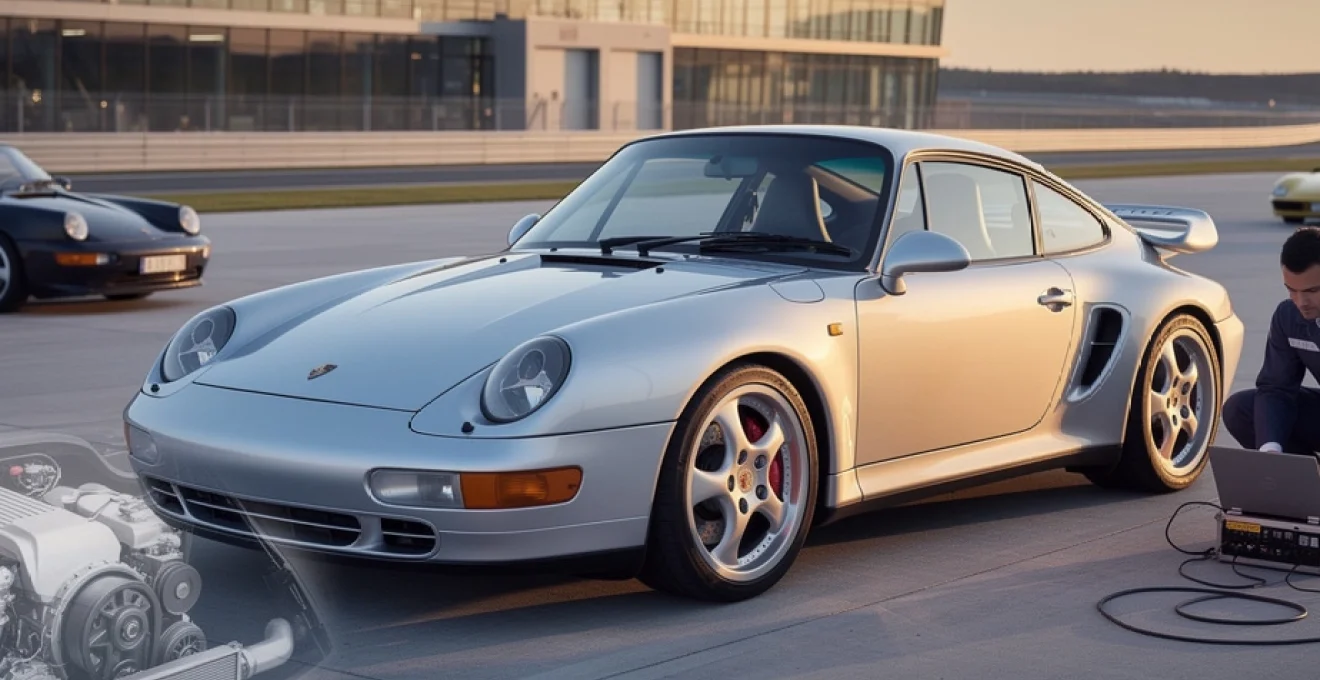
The Porsche 911 (993) Turbo stands as the ultimate culmination of five decades of air-cooled engineering excellence, representing the final chapter in one of automotive history’s most celebrated powertrains. Launched in 1995, this remarkable machine combined the raw mechanical purity of traditional Porsche engineering with groundbreaking technologies that would define the modern supercar era. The 993 Turbo didn’t merely serve as a bridge between old and new; it established itself as the definitive expression of what an air-cooled 911 could achieve when engineering constraints were pushed to their absolute limits.
What makes the 993 Turbo particularly significant is its role as the world’s second daily-drivable supercar, following Honda’s revolutionary NSX. This achievement wasn’t accomplished through compromise but rather through meticulous engineering that enhanced both performance and usability simultaneously. The 993 Turbo delivered genuine supercar performance whilst maintaining the reliability and comfort necessary for everyday driving, fundamentally changing expectations for high-performance vehicles.
993 turbo engineering evolution from 964 predecessor
The transformation from the 964 Turbo to the 993 Turbo represented one of the most comprehensive engineering overhauls in 911 history. Porsche’s engineers addressed virtually every limitation of the previous generation whilst simultaneously introducing revolutionary technologies that would influence supercar design for decades to come. The 964’s notorious handling characteristics, particularly its unpredictable lift-off oversteer that earned it the “Widowmaker” moniker, demanded fundamental changes to the entire vehicle architecture.
Twin-turbocharged M64/60 Flat-Six architecture refinements
The heart of the 993 Turbo’s transformation lay in its completely redesigned M64/60 engine architecture. Unlike the single-turbo configuration of its predecessor, Porsche implemented a sophisticated twin-turbo setup that dramatically improved both power delivery and thermal efficiency. This new arrangement featured two smaller KKK K16 turbochargers instead of a single large unit, reducing turbo lag whilst increasing overall boost pressure capability.
The cylinder heads received extensive modifications to accommodate the new turbocharging system, with larger intake and exhaust ports optimised for improved airflow. Porsche engineers redesigned the combustion chambers to handle higher compression ratios whilst maintaining detonation resistance under boost conditions. The crankcase itself was strengthened with additional ribbing and improved bearing surfaces to handle the increased stress from 408 horsepower output.
KKK K16 turbocharger integration and boost management
The twin KKK K16 turbochargers represented a significant advancement in forced induction technology for the 993 Turbo. Each turbocharger was specifically sized to optimise response whilst maintaining high-end power delivery, with maximum boost pressure reaching 0.8 bar (11.6 psi). The turbochargers featured ceramic turbine wheels that reduced rotational mass and improved thermal resistance compared to traditional metal alternatives.
Boost management became considerably more sophisticated with the introduction of electronic wastegate control. This system continuously monitored engine parameters including throttle position, engine speed, and intake air temperature to optimise boost pressure delivery across the entire rev range. The result was remarkably linear power delivery that eliminated the abrupt power surges characteristic of earlier turbocharged 911s.
Varioram variable intake system implementation
The Varioram system represented one of Porsche’s most innovative engineering solutions for the 993 generation. This variable-length intake manifold technology automatically adjusted runner length based on engine speed and load conditions, optimising airflow characteristics across the entire operating range. At lower engine speeds, longer intake runners enhanced low-end torque production, whilst shorter runners maximised high-rpm breathing efficiency.
Implementation of Varioram in the turbocharged application required careful coordination with boost pressure delivery. The system’s butterfly valves were precisely calibrated to work in harmony with turbocharger operation, ensuring smooth power delivery without disrupting boost response. This integration contributed significantly to the 993 Turbo’s exceptional drivability characteristics.
Motronic M5.2 engine management system calibration
At the core of the 993 Turbo’s character was its Bosch Motronic M5.2 engine management system, which coordinated fuel injection, ignition timing, boost control, and knock regulation into a single, highly adaptive package. Compared with the 964’s earlier Motronic units, M5.2 offered faster processing speeds and more precise sensor integration, allowing Porsche to extract 408 hp and 398 lb-ft of torque with impressive reliability. Closed-loop lambda control, dual knock sensors, and fine-grained ignition maps meant the system could react in milliseconds to changing load and temperature conditions, protecting the air-cooled flat-six from detonation even at sustained high boost. For owners, this meant a Porsche 993 Turbo that felt both brutally fast and remarkably civilized, whether commuting in traffic or accelerating hard on an autobahn.
Another key advantage of the M5.2 calibration was its ability to smooth out the torque curve and make the 993 Turbo feel more like a naturally aspirated performance car than a traditional “on/off” boost monster. Fuel and spark maps were carefully developed to match the Varioram intake transitions and the twin K16 turbocharger response, ensuring that mid-range surge blended seamlessly into top-end power. The ECU also supported onboard diagnostics (OBD II in later markets), enabling technicians to log faults and live data in ways that were impossible on earlier air-cooled 911s. In practice, this meant easier troubleshooting, more consistent performance over time, and a platform that tuners could later exploit with remaps and hardware upgrades while still retaining factory-level drivability.
Air-cooled metzger engine technology and thermal dynamics
Behind the 993 Turbo’s performance lay the culmination of Hans Mezger’s legendary air-cooled engine architecture. Air cooling places far greater demands on thermal management than water-cooled designs, so every fin, duct, and oil passage on the 993 Turbo was engineered with ruthless attention to heat flow. The result was an engine capable of repeated high-load operation that would cripple lesser designs, yet still compact and lightweight enough to preserve the classic rear-engine balance. When you consider that this same basic M64 block underpinned everything from road-going Turbos to GT2 race cars producing up to 600 hp, you begin to appreciate just how advanced the 993’s thermal engineering really was.
In everyday use, this air-cooled Porsche 993 Turbo behaved almost like a modern water-cooled performance car, starting cleanly in all weather and maintaining stable operating temperatures in traffic or on track. That composure was no accident; it was the product of decades of incremental refinement applied to cooling fins, oil circuits, and airflow management. For enthusiasts today, understanding these thermal dynamics is not just academic. If you plan to drive your 993 Turbo hard, or modify it for more power, you are working with a platform that was already engineered very close to the edge of what an air-cooled engine can safely manage—so respecting the original cooling concept is crucial.
Cylinder head design and cooling fin optimization
The 993 Turbo’s cylinder heads were a masterclass in balancing airflow and heat rejection. Porsche revised the fin geometry and spacing compared with the 964, increasing surface area while optimizing the angle of the fins relative to the cooling air stream generated by the large engine-mounted fan. Like a well-designed heatsink in a high-performance computer, these fins had to shed energy quickly without adding unnecessary mass. The challenge was even greater on the turbocharged engines, where exhaust gas temperatures and combustion pressures were substantially higher than in naturally aspirated 993s.
Internally, the heads featured improved coolant (in this case, oil and air) pathways around the valve seats and combustion chambers to minimize hot spots under sustained boost. The combustion chamber shape and valve seat materials were also selected to cope with the increased thermal load, allowing the Metzger flat-six to run higher boost and more advanced ignition timing without sacrificing durability. For owners, this sophisticated head design translates into two clear benefits: strong top-end performance that doesn’t fade with heat soak, and long-term reliability even when the engine is pushed hard on hot days or during extended track use. It’s one reason why well-maintained 993 Turbo engines regularly exceed 150,000 miles before needing major internal work.
Oil cooling circuit engineering with dual radiator configuration
Because air alone cannot carry away all the heat generated by a high-boost flat-six, the 993 Turbo relies heavily on its oil cooling circuit. Porsche adopted a dual-radiator configuration, combining a large front-mounted oil cooler with an auxiliary unit in the front fender to increase total cooling capacity. Oil is pumped from the crankcase through these radiators, where airflow at the nose of the car strips away thermal energy before the oil returns to lubricate and cool the engine internals. In effect, the oil circuit acts like the “liquid cooling system” in a water-cooled car—only here, it must handle both lubrication and a major share of heat rejection.
The engineering behind this system is more complex than it appears. Flow rates, thermostat opening temperatures, and pressure regulation all had to be calibrated so that the oil reached optimal operating temperature quickly yet never exceeded safe limits under maximum load. Porsche also optimized the routing of oil galleries around the crankshaft, piston cooling jets, and turbocharger bearings, ensuring that the hottest components received fresh, cooled oil first. For today’s 993 Turbo owner, this makes regular oil changes with the correct high-quality synthetic a non-negotiable maintenance task. If you are considering track days or more boost, upgrading or refreshing the oil coolers, lines, and thermostats is one of the most effective ways to safeguard the engine.
Intercooler system architecture and heat dissipation
The 993 Turbo’s air-to-air intercooler system is another cornerstone of its thermal strategy, dramatically reducing intake charge temperatures before the air reaches the cylinders. Nestled beneath the fixed rear wing, each side of the twin-turbo system feeds a dedicated intercooler, which is positioned to take advantage of the low-pressure area and airflow over the rear deck. As compressed air from the K16 turbochargers passes through the intercooler cores, heat is shed to the outside air, increasing charge density and reducing the risk of knock. The effect is similar to breathing cool mountain air instead of hot desert air—denser oxygen means more power and safer combustion.
Porsche carefully designed the ducting, shrouds, and wing profile to maximize air throughput over these intercoolers, particularly at high speed where the 993 Turbo spends much of its time when driven as intended. Compared to earlier 911 Turbo generations, this architecture greatly reduced heat soak during repeated acceleration runs and track sessions. For modern enthusiasts seeking more power from their air-cooled 993 Turbo, intercooler upgrades are often among the first modifications, but it’s important to maintain proper sealing and ducting so that airflow is directed through the cores rather than around them. Done correctly, improved intercoolers can significantly lower intake temps and allow modest boost increases without compromising reliability.
Thermal management strategies for High-Performance applications
When you combine air cooling, turbocharging, and sustained high-speed running, thermal stability becomes the limiting factor long before the mechanical components reach their structural limits. Porsche’s strategy on the 993 Turbo was multi-layered: increased fin area, expanded oil cooling, efficient intercoolers, and robust engine management working together as a cohesive system. The Motronic M5.2 ECU, for example, continuously adjusted ignition timing and boost pressure in response to intake air and oil temperature readings, pulling timing and lowering boost if conditions approached the danger zone. This kind of dynamic protection was revolutionary for an air-cooled supercar in the mid-1990s.
From a practical standpoint, these thermal management strategies are the reason a well-cared-for Porsche 993 Turbo can be driven daily or tracked on weekends without constant fear of overheating. However, owners who increase boost, fit smaller pulleys, or drive extensively in very hot climates must respect the original margins Porsche engineered into the system. Simple precautions—such as allowing turbo cool-down idling after hard runs, ensuring all cooling ductwork is intact, and monitoring oil temps on spirited drives—go a long way toward preserving engine health. Think of it as giving a marathon runner proper hydration and recovery time; the 993 Turbo can perform extraordinary feats, but only if its thermal limits are understood and respected.
Chassis dynamics and All-Wheel drive system integration
Underneath its iconic wide body, the 993 Turbo featured one of the most sophisticated chassis packages of its era, combining a re-engineered suspension with an all-wheel drive system inspired by the 959. This was a decisive break from the older 930 and 964 Turbo philosophy, which relied heavily on rear traction and driver bravery to manage the car’s prodigious power. By contrast, the 993 Turbo aimed to make its 400+ horsepower accessible to a wider range of drivers, on a broader range of roads and in all weather conditions. The result was a Porsche 911 that Car & Driver famously found not only devastatingly fast, but also the most usable and confidence-inspiring supercar in its 1995 comparison test.
What does this mean for you as an enthusiast or potential buyer? It means that the Porsche 993 Turbo is one of the few classic supercars that can genuinely be enjoyed as a daily driver without feeling like you are constantly wrestling the car. The multi-link rear suspension, refined steering, and all-wheel drive integration work together to provide a planted, predictable feel that still retains the classic 911 playfulness at the limit. For many, this balance of everyday stability and engaging dynamics is exactly what makes the 993 Turbo such a compelling proposition even three decades after its debut.
Viscous coupling differential technology and torque distribution
The 993 Turbo’s all-wheel drive system used a viscous coupling unit instead of the more complex, heavier three-differential layout seen on the 964 Carrera 4. Borrowed conceptually from the 959, this setup sent the majority of torque to the rear wheels under normal driving, preserving the traditional 911 feel, but could funnel up to around 35–40% of power to the front axle when rear wheel slip was detected. The viscous coupling, filled with a silicone-based fluid, stiffens as rotational speed differences between front and rear increase, progressively locking the driveline and transferring torque where grip is available.
In practice, this meant that the Porsche 993 Turbo could deploy its power out of tight corners and on slippery surfaces with far more confidence than any earlier Turbo. Rather than the sudden, sometimes terrifying breakaway associated with rear-drive “Widowmaker” 911 Turbos, the 993 communicated its limits more gradually, giving the driver time to react. For modern owners, the viscous coupling is also relatively low-maintenance compared with active center differentials, though it does benefit from periodic inspection as the fluid can degrade over time. If you plan to enjoy your 993 Turbo year-round, including in wet or cold conditions, this AWD system is one of the key reasons the car remains so trustworthy.
Macpherson strut front suspension geometry modifications
At the front, the 993 retained a MacPherson strut layout but with substantial geometry revisions compared with the 964. Porsche adjusted caster, camber, and steering axis inclination to improve straight-line stability and steering feedback at high speeds, critical for a car capable of nearly 180 mph. The front subframe and mounting points were also stiffened, reducing flex and sharpening initial turn-in response. Combined with wider front track and optimized anti-roll bar tuning, this gave the Porsche 993 Turbo markedly more precise front-end bite without making it nervous on rough roads.
One of the underrated strengths of the 993 platform is how compliant it feels over poor surfaces despite its performance capability. The carefully tuned front suspension geometry works with relatively tall-sidewall tires by modern standards to filter out harsh impacts while still telegraphing grip levels clearly through the steering wheel. For enthusiasts who drive on real-world roads rather than billiard-smooth circuits, this balance is invaluable. If you are considering suspension upgrades, quality dampers and bushings that respect the original geometry generally yield the best results; aggressive lowering or extreme camber settings can quickly unravel the carefully engineered harmony that makes the 993 Turbo so rewarding to drive.
Multi-link rear suspension LSA design principles
The real revolution in the 993 Turbo’s chassis came at the rear axle, where Porsche introduced the LSA (Lightweight, Stable, Agile) multi-link suspension mounted on an alloy subframe. This replaced the traditional torsion bar setup and semi-trailing arm layout that had defined 911s for decades, and it fundamentally changed how the car behaved at and beyond the limit. By decoupling wheel control from springing and using multiple links to manage toe and camber changes under load, Porsche was able to drastically reduce the infamous lift-off oversteer that had made earlier Turbos so unforgiving.
In dynamic terms, the LSA rear suspension allowed the 993 Turbo to remain more neutral as the driver rolled off the throttle mid-corner, with the rear wheels maintaining a more consistent contact patch and toe angle. This translated into greater stability during high-speed direction changes and under braking into corners, without erasing the rear-engine traction advantage on corner exit. For today’s owners, a properly set up 993 Turbo still feels remarkably modern in the way it puts power down and responds to weight transfer. Fresh bushings, high-quality dampers, and correct alignment are crucial to preserving this character; neglect in these areas is one of the main reasons some older cars feel nervous or unpredictable compared with their factory-new behavior.
Brembo brake system specifications and big red caliper performance
Given its performance, the Porsche 993 Turbo required brakes that could match its acceleration and top speed. Porsche partnered with Brembo to equip the car with large, cross-drilled ventilated discs clamped by the now-iconic “Big Red” four-piston calipers. Up front, 322 mm discs offered substantial thermal mass and cooling capacity, while the rear setup was similarly oversized to maintain balance under heavy deceleration. ABS was standard, tuned to work harmoniously with the all-wheel drive system to ensure maximum stability during panic stops or late-braking maneuvers on track.
These brakes were so effective that they set a benchmark for 1990s supercars, repeatedly hauling the 993 Turbo down from high triple-digit speeds with minimal fade in period testing. For modern owners, the system remains more than adequate for spirited road use and occasional track days, provided quality pads, fluid, and discs are used. Many enthusiasts opt for higher-friction pad compounds or stainless steel braided lines to improve pedal feel, but wholesale changes are rarely necessary unless you are building a dedicated track car. As with everything on the 993 Turbo, the factory brake package was engineered with a wide margin of safety, contributing to the car’s reputation as a supercar you can actually drive hard without constant mechanical anxiety.
Aerodynamic package and bodywork specifications
The Porsche 993 Turbo’s bodywork wasn’t just about visual drama; it was a carefully honed aerodynamic package designed to provide stability and cooling at speeds approaching 180 mph. Compared with the narrow-body Carreras, the Turbo featured significantly widened rear arches to accommodate broader tires and the multi-link rear suspension, as well as reshaped front and rear bumper covers optimized for airflow. The integrated front spoiler and deeper front apron helped reduce front-end lift, while directing more air to the front oil coolers and brakes. At the rear, the fixed “whale tail” style wing wasn’t only a styling cue—it housed the intercoolers and generated downforce over the driven axle.
Drag coefficient for the 993 generation hovered around 0.33 for standard Carreras, and the wider, more aggressively vented Turbo body sat in a similar range despite its extra hardware. Porsche’s goal was not the absolute lowest drag, but a balanced combination of reduced lift, efficient cooling, and predictable high-speed behavior. You can think of the 993 Turbo’s aero package like a tailored suit: every curve and vent is there for a reason, enhancing function while still looking timeless. For those considering aftermarket body modifications, it’s worth remembering that poorly developed wings or splitters can upset this balance, increasing lift or reducing cooling performance. OEM or well-proven components are usually the safest route if you want to enhance appearance without compromising the carefully engineered aerodynamics.
Production timeline and special editions analysis
The 993 generation was produced from 1994 to 1998, with the 993 Turbo arriving in 1995 for the 1996 model year. Over its production run, approximately 5,978 standard 993 Turbos were built, making it rare but not unobtainably so in the context of classic supercars. The car debuted with a 3.6-liter twin-turbocharged M64/60 engine producing 408 hp, all-wheel drive, and a six-speed manual transmission—the only gearbox available on the Turbo. This combination positioned the 993 Turbo as a flagship model that bridged Porsche’s analog past and more electronically managed future.
As production continued, Porsche expanded the Turbo lineup with even more exclusive variants. These models not only added power and cosmetic differentiation but also highlighted the flexibility of the underlying platform. For collectors and enthusiasts today, understanding the nuances of each version—standard Turbo, Turbo S, and ultra-low volume specials—can make a significant difference in valuation and desirability. If you’re exploring the Porsche 993 Turbo market, it’s essential to verify build sheets, option codes, and provenance to confirm whether a car is an original example or a later conversion.
One of the most coveted derivatives is the 993 Turbo S, introduced for the 1997 and 1998 model years and built in very limited numbers by Porsche Exclusive. Power was increased to around 450 hp through larger turbochargers, revised engine management, and a freer-flowing exhaust system. Visually, the Turbo S stood out with additional air intakes, unique rear wing elements, and often high-spec interior trims, cementing its status as the ultimate factory air-cooled 911 Turbo. Unsurprisingly, these cars now command substantial premiums over standard Turbos, often trading well into the high six-figure range when presented in pristine condition.
Beyond the Turbo S, the 993 generation also gave rise to some extraordinary low-volume and one-off creations. The 993 Turbo Cabriolet, for example, combined 993 bodywork with 964 Turbo running gear in a run of just 14 units built before the official Turbo coupe launched. Even rarer were the 993 Speedsters—only two were factory-produced, including one for Ferdinand Porsche himself and another originally delivered to Jerry Seinfeld. While not all of these specials were Turbos in the strict mechanical sense, they contribute to the mystique and desirability surrounding the 993 era as a whole, reinforcing its reputation as the last truly hand-built, bespoke-feeling 911 generation.
Market performance and contemporary supercar comparisons
In today’s market, the Porsche 993 Turbo sits firmly in the realm of blue-chip modern classics. According to recent auction data and valuation guides, well-maintained standard Turbos typically command between $150,000 and $250,000 USD, depending on mileage, originality, and specification. Exceptional low-mileage or highly optioned examples, particularly in rare colors, can push beyond this range, while Turbo S models often exceed $400,000 and may climb higher in the right circumstances. Compared with many contemporaries from the 1990s—such as the Ferrari F355, Dodge Viper, or Lotus Esprit—the 993 Turbo has shown stronger and more consistent appreciation, driven by its status as the last air-cooled 911 Turbo and its reputation for usability.
How does it stack up as a supercar compared to its mid-’90s rivals? Period tests put the 993 Turbo’s 0–60 mph time as low as 3.7 seconds, with a top speed around 180 mph, matching or beating many costlier exotics of the day. Car & Driver’s famous “Supercar Olympics” pitted the 993 Turbo against icons like the Honda/Acura NSX-T, Ferrari F355, Dodge Viper RT/10, and Lotus Esprit S4S—and the Turbo emerged as the overall winner thanks to its blend of crushing performance, all-weather traction, and everyday comfort. While some rivals offered more drama or rawness, few could match the Porsche’s combination of reliability, build quality, and practicality. For you as a potential buyer or enthusiast, this means the 993 Turbo is not just fast on paper; it is a car you can realistically use and enjoy without treating every drive as a high-risk event.
Looking ahead, the long-term value outlook for the Porsche 993 Turbo appears robust, though, as with all collector cars, markets can fluctuate. The key factors underpinning its desirability—final air-cooled status, limited production, daily-driveable performance, and strong motorsport lineage—are unlikely to change. If you’re considering purchasing one, focus on finding the best possible example you can afford: full service history, documented mileage, and evidence of proactive maintenance on critical systems such as the turbochargers, oil cooling, and suspension. While the initial outlay is substantial, ownership costs for a well-sorted 993 Turbo can be surprisingly manageable compared with some Italian exotics of the same era.
Ultimately, when we compare the 993 Turbo not only to its 1990s peers but also to modern supercars, its appeal becomes even clearer. No current production car can replicate the unique combination of air-cooled character, analog steering feel, and compact dimensions that define the 993. Modern 911 Turbos are undoubtedly quicker and more refined, but they are also larger, heavier, and more insulated from the driver. If what you want is a genuine daily-drivable supercar that still feels raw and mechanical—something that engages all of your senses every time you turn the key—the Porsche 911 (993) Turbo remains one of the most compelling options on the market, and a fitting final chapter in the story of the air-cooled 911.