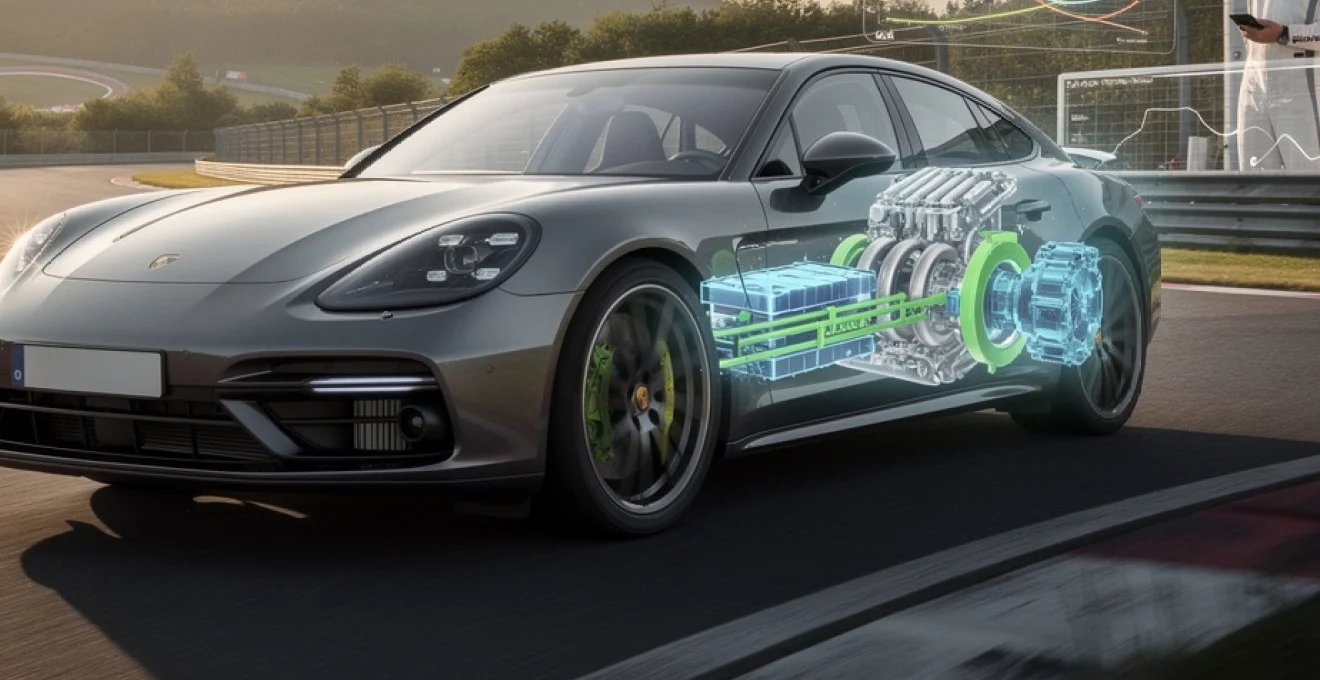
The automotive landscape has witnessed a remarkable transformation in recent years, with luxury performance sedans evolving beyond traditional combustion engines to embrace sophisticated hybrid technologies. At the forefront of this revolution stands the Porsche Panamera Turbo S E-Hybrid, a flagship vehicle that redefines what’s possible when German engineering excellence meets cutting-edge electrification. This remarkable machine represents the pinnacle of Porsche’s four-door performance offerings, delivering an extraordinary 771 horsepower while maintaining the refinement and practicality expected from a luxury grand tourer.
What makes the Panamera Turbo S E-Hybrid particularly compelling is its ability to function as both a whisper-quiet electric vehicle for urban commuting and a ballistic missile capable of reaching 202 mph when the situation demands it. This dual personality is achieved through meticulous engineering that seamlessly integrates a powerful V8 engine with advanced electric motor technology, creating a powertrain that challenges preconceptions about hybrid performance vehicles.
Porsche 4.0-litre Twin-Turbo V8 engine architecture and performance metrics
The heart of the Panamera Turbo S E-Hybrid lies in its sophisticated 4.0-litre twin-turbo V8 engine, a masterpiece of modern internal combustion engineering that produces 591 horsepower on its own. This powerplant represents years of development and refinement, incorporating advanced metallurgy and precision manufacturing techniques that enable it to withstand the extreme pressures and temperatures generated during high-performance operation. The engine block utilises lightweight aluminium construction with cast iron cylinder liners, providing the optimal balance between weight reduction and durability that’s essential for sustained high-speed performance.
Porsche’s engineers have implemented numerous innovations to maximise both power output and efficiency. The combustion chambers feature a carefully optimised shape that promotes complete fuel burn while minimising knock tendency, allowing for higher compression ratios and more aggressive ignition timing. Direct fuel injection operates at pressures exceeding 200 bar, ensuring precise fuel metering and excellent atomisation even under extreme load conditions. This attention to detail in the fundamental engine architecture provides the robust foundation necessary for the hybrid system’s remarkable performance capabilities.
Variable turbine geometry technology and boost pressure optimisation
The turbocharging system represents a significant departure from previous Panamera iterations, transitioning from twin-scroll to single-scroll turbochargers to meet stringent Euro 7 emission standards. This change initially might seem counterintuitive from a performance perspective, but Porsche’s engineers have cleverly optimised the system to reduce catalyst warm-up times while maintaining exceptional power delivery. The variable turbine geometry technology allows for precise control of exhaust gas flow, optimising boost pressure across the entire engine speed range and virtually eliminating turbo lag.
The boost pressure management system can generate up to 1.2 bar of manifold pressure, contributing significantly to the engine’s impressive torque output of 590 lb-ft. Advanced boost control algorithms continuously monitor engine parameters and adjust turbine geometry in real-time, ensuring optimal performance while protecting critical engine components from excessive stress. This sophisticated approach to forced induction enables the V8 to deliver linear power delivery that remains strong even above 6,000 rpm, a characteristic that’s often challenging to achieve with turbocharged engines.
Central turbocharger positioning between cylinder banks configuration
One of the most distinctive features of Porsche’s V8 architecture is the central positioning of the turbochargers between the cylinder banks, often referred to as the “hot-V” configuration. This layout offers several critical advantages, including reduced plumbing complexity, improved throttle response, and more compact overall dimensions. The shortened exhaust paths between the cylinder heads and turbochargers minimise heat loss and reduce the volume of exhaust gas that must be accelerated to spin the turbine wheels, resulting in faster boost build-up and improved transient response.
The central turbocharger mounting also enables more efficient packaging within the engine bay, allowing for better weight distribution and improved accessibility for maintenance. Advanced thermal management becomes crucial with this configuration, as the turbochargers operate in an extremely high-temperature environment. Porsche has implemented sophisticated cooling strategies, including dedicated coolant circuits for the turbochar
gers, as well as additional heat shielding around the “hot-V” area, to manage these thermal loads. This ensures long-term reliability even when the Porsche Panamera Turbo S E-Hybrid is driven hard on track or used for sustained high-speed cruising on the autobahn.
By concentrating the turbochargers centrally, Porsche also creates a more aerodynamically efficient front-end packaging solution, freeing up space for larger cooling radiators and intercoolers. These components are critical when the hybrid system is delivering peak outputs and the V8 is operating under continuous high load. The result is a powertrain layout that not only enhances performance but also supports the car’s broader goal of combining powerful acceleration with everyday efficiency and durability.
630 PS peak power output and 820 nm torque delivery characteristics
When combined with the electric drive system, the latest evolution of the Panamera Turbo powerplant delivers up to 630 PS (around 621 horsepower) from the combustion engine alone in certain configurations, with system outputs reaching 771 horsepower and up to 1,000 Nm of torque in the newest Turbo S E-Hybrid specification. Earlier versions already impressed with 820 Nm, but the continual refinement of the engine and hybrid calibration has pushed these figures further while maintaining drivability. What matters on the road is how this torque is delivered: the plateau arrives early in the rev range and remains almost flat, giving the Panamera the effortless surge you expect from a supercar in tuxedo form.
This torque-rich delivery means that even gentle throttle inputs translate into confident forward motion, whether you’re overtaking on a country road or merging onto a motorway. In Sport and Sport Plus modes, throttle mapping becomes more aggressive, sharpening the car’s responses and allowing the V8 to spin freely beyond 6,000 rpm. The combination of high peak power and sustained torque ensures that the Porsche Panamera Turbo S E-Hybrid can repeatedly accelerate from low to high speeds without feeling strained, even when fully loaded with passengers and luggage. For drivers, this translates into a sense of deep reserves – a feeling that the car always has more performance in hand than you are likely to use.
Engine management system integration with porsche communication management
The control brain behind this sophisticated powertrain is Porsche’s latest engine management system, which works in close coordination with the Porsche Communication Management (PCM) interface. Rather than operating in isolation, the engine ECU collaborates with the hybrid controller, transmission module, and chassis systems to anticipate driver demands and road conditions. For example, data from the navigation system and optional InnoDrive predictive cruise control can be used to pre-condition the powertrain for upcoming gradients, speed limits, or overtaking opportunities, making power delivery feel almost intuitive.
Through the PCM, drivers can view real-time information on power distribution between the V8 engine and the electric motor, energy flow, and hybrid operating status. This level of transparency helps you understand how your driving style impacts efficiency and performance, and it encourages more intelligent use of the different drive modes. Over-the-air software updates and app-based connectivity also allow Porsche to refine control strategies over the vehicle’s lifecycle, ensuring that the Panamera Turbo S E-Hybrid remains at the cutting edge of hybrid performance technology. This deep integration between engine management and infotainment is a prime example of how digitalisation is reshaping high-performance luxury cars.
Electric motor integration and porsche E-Performance hybrid system
While the V8 provides the emotional core of the Porsche Panamera Turbo S E-Hybrid, the electric drive system is what transforms it into a truly modern performance sedan. Porsche’s E-Performance philosophy focuses not only on efficiency but also on using electrification to enhance responsiveness and everyday usability. Rather than simply bolting an electric motor onto the drivetrain, the company has engineered a tightly integrated hybrid system where combustion and electric power complement each other with minimal compromise.
The result is a driving experience where you can glide silently through city streets in electric-only mode, yet summon instant torque and supercar-level acceleration as soon as both systems work together. This duality is one of the Panamera Turbo S E-Hybrid’s defining traits. It allows owners to use the car as a near-zero-emission commuter during the week, while still enjoying track-capable performance on weekends. In practice, you begin to see the hybrid system less as an efficiency add-on and more as a sophisticated performance enhancer that broadens the car’s capabilities.
Permanently excited synchronous motor specifications and 136 PS output
At the heart of the electric side of the drivetrain is a permanently excited synchronous motor (PSM) integrated directly into the housing of the 8-speed PDK transmission. In earlier Panamera Turbo S E-Hybrid models, this motor delivered 136 PS (about 134 horsepower) and 400 Nm of torque, while the latest generation pushes output even further to around 190 PS in some specifications. Regardless of exact rating, the key advantage of the PSM lies in its ability to provide near-instantaneous torque from zero rpm, filling in any gaps in the V8’s power delivery and eliminating the sensation of turbo lag.
The electric motor is sandwiched between the combustion engine and the transmission, using a separating clutch that allows the Panamera to decouple the V8 for pure electric driving. This compact, coaxial arrangement keeps weight centred and helps maintain the Porsche Panamera Turbo S E-Hybrid’s excellent weight distribution. Because the motor is integrated within the gearbox casing, power transfer losses are minimised, and the system can react in milliseconds to changes in throttle position or drive mode. For drivers, this means crisp, seamless transitions between electric and hybrid operation – you rarely notice when the V8 fires up unless you’re listening for it.
Lithium-ion battery pack 17.9 kwh capacity and cell chemistry analysis
Energy for the electric motor is stored in a high-voltage lithium-ion battery pack mounted low in the chassis, behind the rear axle. Earlier versions of the Panamera Turbo S E-Hybrid featured a 17.9 kWh (gross) pack, while the latest generation has increased capacity to around 25.9 kWh, reflecting broader industry trends toward larger, more capable batteries in plug-in hybrids. The pack uses advanced nickel-rich cell chemistry, balancing high energy density with robust thermal stability – a crucial factor in a performance application where power draw and charge rates can be intense.
A sophisticated battery management system (BMS) continuously monitors cell temperature, voltage, and state of charge, adjusting cooling and charging profiles to maximise both performance and longevity. Liquid cooling channels ensure each module operates within an optimal temperature window, even during aggressive use such as repeated acceleration runs or long downhill recuperation phases. For you as an owner, this means consistent electric-only range over time, as well as confidence that the high-voltage system is designed with long-term durability in mind – an important consideration given the Panamera’s positioning as a long-distance grand tourer.
Electric-only range performance and WLTP certification standards
Despite its focus on performance, the Porsche Panamera Turbo S E-Hybrid delivers a meaningful electric-only range that can cover most daily commutes without engaging the V8. Depending on the exact model year and battery specification, WLTP-certified electric range sits between roughly 40 and 88 kilometres (around 25 to 55 miles). These figures are achieved under the Worldwide Harmonised Light Vehicles Test Procedure (WLTP), a globally recognised standard that better reflects real-world driving than earlier test cycles.
In practical terms, drivers who regularly charge at home or the office can complete urban and suburban journeys using predominantly electric power, significantly reducing fuel consumption and local emissions. When you do exceed the electric range, the system switches to hybrid operation seamlessly, maintaining high overall efficiency. Many owners find that, with strategic charging and intelligent use of drive modes, their average fuel usage in the Porsche Panamera Turbo S E-Hybrid drops well below that of a conventional V8 sedan, without sacrificing performance when they need it. This is where the “powerful and efficient” promise truly comes to life in day-to-day use.
Recuperation strategies and regenerative braking energy recovery
An essential part of the Panamera’s efficiency toolkit is its advanced recuperation system, which recovers kinetic energy during deceleration and feeds it back into the high-voltage battery. Instead of wasting energy as heat in the brakes, the electric motor operates as a generator when you lift off the throttle or apply the brake pedal lightly. Depending on conditions, recuperation output can reach up to around 80–88 kW in the latest models, substantially extending electric range and improving overall energy efficiency.
Porsche has carefully calibrated the brake pedal feel so that the transition between regenerative and mechanical braking is almost imperceptible to the driver. You still get a firm, confidence-inspiring pedal, but much of the everyday slowing is handled electrically. This not only saves fuel; it also reduces wear on the ceramic or steel brake components – an indirect but valuable efficiency benefit. If you frequently drive in stop-and-go traffic or hilly regions, you’ll notice how often the energy flow diagram in the PCM shows power flowing back into the battery instead of out of it, turning everyday driving into an ongoing process of energy recycling.
Hybrid drive modes: E-Power, hybrid auto, and sport plus calibration
The Porsche Panamera Turbo S E-Hybrid offers a suite of hybrid drive modes, allowing you to tailor the car’s behaviour to your journey and driving style. In E-Power mode, the car prioritises electric-only operation, engaging the V8 only when you demand full performance or when the battery reaches a low state of charge. This is ideal for city centres and low-speed zones, where silent running and zero local emissions are most beneficial. The system will even pre-warm the catalytic converters during electric operation to ensure the V8 meets emissions targets the instant it comes online.
Hybrid Auto mode is the default for mixed driving, automatically blending combustion and electric power to maximise efficiency. Here, the car decides when to use the engine, when to coast, and when to recuperate, based on parameters like traffic, topography, and your throttle inputs. For more spirited driving, Sport and Sport Plus modes shift the calibration dramatically. The V8 is kept running, the electric motor is used aggressively for boost rather than conservation, and the transmission and suspension adopt their most dynamic settings. In Sport Plus, the system even maintains a higher minimum battery charge to ensure that full electric boost is always available for maximum acceleration. This sophisticated multi-mode approach means the same car can feel like a refined EV one moment and a track-ready weapon the next.
Porsche doppelkupplung PDK transmission and all-wheel drive dynamics
Translating the combined power of the V8 and electric motor to the road is Porsche’s renowned 8-speed Doppelkupplung (PDK) dual-clutch transmission, paired with an intelligent all-wheel drive system. For the hybrid Panamera, the PDK has been significantly reinforced to cope with the immense instant torque of the electric motor and the substantial combined outputs. Clutch packs, gearsets, and lubrication circuits have all been uprated, ensuring that the gearbox remains smooth and reliable even when subjected to repeated launch-control starts or prolonged track sessions.
One of the key advantages of the PDK in the Porsche Panamera Turbo S E-Hybrid is its ability to pre-select the next gear, shifting with lightning speed and minimal interruption of power. This is especially noticeable under full acceleration, where gear changes are almost seamless, keeping the car pinned in its optimal power band. The Porsche Traction Management (PTM) all-wheel drive system works in tandem with the PDK, using an electronically controlled multi-plate clutch to vary torque distribution between the front and rear axles in real time. Under normal conditions, the system favours the rear wheels for a more traditional Porsche driving feel, but it can send substantial torque to the front when slip is detected or maximum traction is needed.
This dynamic torque vectoring through the driveline means the Panamera feels both secure and agile, even in poor weather. On wet or snowy roads, the car finds surprising grip when accelerating out of junctions or corners, while on dry tarmac it delivers the kind of rear-biased balance that keen drivers appreciate. Combined with the hybrid powertrain’s instant torque, the PDK and all-wheel drive system ensure that the Porsche Panamera Turbo S E-Hybrid can deploy its staggering performance in a controlled, confidence-inspiring way, rather than feeling overwhelming or unruly.
Advanced chassis technologies and porsche active suspension management
While raw power is a major part of the Panamera Turbo S E-Hybrid’s appeal, its chassis technology is what makes that performance usable in the real world. Porsche has equipped the car with some of the most advanced suspension and control systems available on any four-door vehicle today. The goal is not just outright grip, but also the ability to combine sports car agility with luxury-car comfort – a balance that few rivals manage to achieve.
Central to this is the integration of adaptive air suspension, Porsche Active Suspension Management (PASM), rear-axle steering, and Porsche Torque Vectoring Plus (PTV Plus). Together, these systems constantly monitor body movements, wheel loads, steering inputs, and road conditions, then adjust damping, ride height, and torque distribution in milliseconds. The result is a car that can flow smoothly over rough surfaces one moment, yet corner with remarkable flatness and precision the next. If you’ve ever wondered how a 5.3-tonne super sedan can feel nimble on a tight, twisty road, the answer lies in this highly coordinated network of chassis technologies.
Air suspension with PASM electronic damper control
The standard three-chamber air suspension is a key enabler of the Porsche Panamera Turbo S E-Hybrid’s dual personality. Each wheel features an air spring with multiple chambers, allowing the system to vary spring rates depending on the selected drive mode and driving situation. In Comfort-oriented settings, the suspension uses a softer configuration to absorb road imperfections and isolate occupants from rough surfaces. Switch to Sport or Sport Plus, and the system progressively stiffens, reducing body roll and pitch during hard cornering and braking.
Porsche Active Suspension Management (PASM) adds electronically controlled dampers that continuously adjust damping force based on data from accelerometers, steering angle sensors, and wheel speed sensors. Think of PASM as the “shock absorber brain” that decides how firm or soft each damper should be at any given moment. For example, when you hit a mid-corner bump, the system can briefly soften the relevant damper to maintain contact with the road, then firm up again to preserve stability. This rapid adaptability gives the Panamera an almost uncanny ability to stay composed over challenging surfaces, whether you’re pushing on a mountain road or simply cruising on a patchy motorway.
Porsche torque vectoring plus and rear-axle steering integration
To further sharpen the handling of the Porsche Panamera Turbo S E-Hybrid, Porsche offers Porsche Torque Vectoring Plus (PTV Plus) and standard rear-axle steering on many configurations. PTV Plus uses targeted braking of the inside rear wheel in corners to help rotate the car and reduce understeer. At the same time, an electronically controlled rear differential lock optimises traction when you accelerate out of bends. It’s a bit like having a skilled co-driver fine-tuning the car’s attitude in every corner, helping you carry more speed with less steering input.
Rear-axle steering adds another layer of agility and stability. At lower speeds, the rear wheels steer in the opposite direction to the fronts by a small angle, effectively shortening the wheelbase and making the large Panamera feel more manoeuvrable in tight spaces and city streets. At higher speeds, the rear wheels steer in the same direction as the fronts, increasing stability during lane changes and fast sweepers. The net effect is that the car seems to shrink around you when you want to dart through traffic or tackle a twisty road, yet it feels planted and secure when covering long distances at autobahn velocities. Once you’ve experienced it, you’ll quickly understand why rear-axle steering has become a hallmark of modern high-performance Porsches.
Carbon ceramic brakes PCCB system and thermal management
A car as powerful and heavy as the Porsche Panamera Turbo S E-Hybrid needs serious braking capability, which is why Porsche equips it with Porsche Ceramic Composite Brakes (PCCB) as standard in many markets. These carbon-ceramic discs measure up to 440 mm at the front and 380 mm at the rear, clamped by multi-piston calipers that provide immense stopping power. Compared with conventional steel brakes, PCCB offers significantly reduced fade under repeated hard use, lower unsprung mass, and a longer service life – all key benefits in a high-performance hybrid sedan.
Thermal management is at the core of the PCCB system’s effectiveness. The discs are cross-drilled and internally ventilated to dissipate heat quickly, while the calipers and pads are designed to tolerate the extreme temperatures generated during track sessions or emergency stops from high speeds. Porsche’s stability control and ABS systems are calibrated to work seamlessly with the hybrid recuperation system, blending electronic regeneration and mechanical braking to maximise deceleration without upsetting the car’s balance. For drivers, this means you can brake later and harder with confidence, knowing that the system is engineered to perform consistently lap after lap – an essential trait for a car that can exceed 300 km/h where legal.
Aerodynamic efficiency and lightweight construction principles
Despite its substantial size and complex hybrid drivetrain, the Porsche Panamera Turbo S E-Hybrid has been designed with a keen focus on aerodynamic efficiency and intelligent lightweight construction. Aerodynamics play a crucial role not only in top speed and stability, but also in fuel consumption and electric range. Porsche has sculpted the Panamera’s body to achieve a low drag coefficient, with carefully shaped front air intakes, a smooth underbody, and an active rear spoiler that adjusts its angle depending on speed and driving mode.
Optional features such as the Carbon Aerokit further enhance downforce and aerodynamic balance for track-oriented drivers. This package includes a more pronounced front splitter, side skirts, and a reworked rear diffuser, all made from lightweight carbon fibre. At around 200 km/h, the kit can add significant downforce, improving high-speed cornering grip and stability. Yet even without these options, the Panamera’s active aero elements continually optimise airflow to strike the right balance between low drag in efficiency-focused modes and increased downforce when you select Sport Plus and push the car harder.
In terms of construction, Porsche relies heavily on an aluminium-intensive body structure combined with high-strength steels in key load-bearing areas. This multi-material approach allows engineers to place strength where it’s most needed – such as around the passenger cell and suspension mounting points – while removing weight elsewhere. Components like the bonnet, doors, and suspension arms are often made from aluminium or forged alloys, helping to offset the mass of the hybrid system. Additional lightweight elements, including forged centre-lock wheels and optional carbon-ceramic brakes, reduce unsprung mass, improving both ride quality and responsiveness.
It’s worth noting that in a high-performance plug-in hybrid like the Porsche Panamera Turbo S E-Hybrid, “lightweight” is always a relative concept. The car is still heavier than a non-hybrid equivalent, but by trimming kilograms wherever possible and optimising weight distribution, Porsche ensures that the dynamic character remains distinctly sporting. When you consider how stable and agile the Panamera feels at speed, you quickly appreciate how much work has gone into making every gram count.
Real-world performance testing and nürburgring nordschleife benchmarks
Laboratory figures and spec-sheet numbers only tell part of the story; what truly defines the Porsche Panamera Turbo S E-Hybrid is how it performs in the real world. Independent tests have recorded 0–60 mph times as low as 2.5 seconds and quarter-mile runs around 10.5 seconds, placing the Panamera firmly in supercar territory despite its four-seat, four-door layout. Rolling acceleration is equally impressive, with 50–70 mph passes taking just a couple of seconds – ideal for rapid overtakes on the motorway or fast B-roads.
Perhaps the most convincing demonstration of the Panamera’s capabilities comes from its exploits at the Nürburgring Nordschleife. In 2024, a near-production Panamera Turbo S E-Hybrid set a lap time of 7:24.172 minutes on the 20.832-kilometre circuit, claiming the record for the fastest combustion and hybrid-powered luxury saloon on the famous German track. To put that into perspective, this time rivals that of dedicated sports cars from just a few years ago, underlining how far four-door performance has progressed. The record car used optional Michelin Pilot Sport Cup 2 tyres and the Carbon Aerokit, but was otherwise representative of what a customer can order.
What does this mean for you as a driver away from the racetrack? It means the Porsche Panamera Turbo S E-Hybrid has vast performance reserves that translate into confidence and security in everyday scenarios. Long mountain descents, high-speed autobahn runs, or quick detours along a favourite backroad are handled with the same composure that allowed the car to lap the Nordschleife at such pace. At the same time, WLTP-rated efficiency figures, impressive electric range, and a wealth of driver assistance technologies ensure that living with this car day-to-day is as practical and stress-free as owning a conventional luxury sedan – with the added excitement of knowing that you’re at the wheel of one of the most capable performance hybrids on sale today.