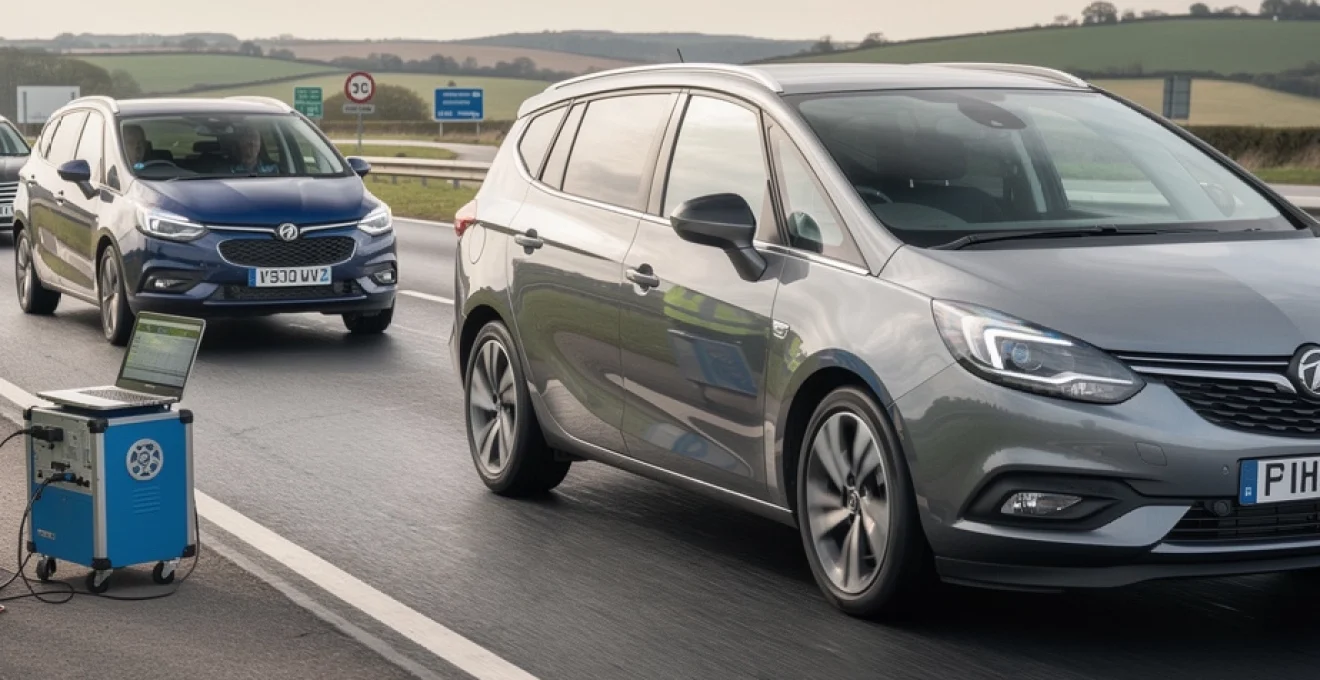
The Vauxhall Zafira’s Sport Mode button has sparked countless debates among drivers who question whether this feature delivers genuine performance enhancement or merely provides a placebo effect. Understanding the intricate mechanisms behind this technology requires examining the sophisticated interplay between throttle response mapping, transmission control, and engine management systems. Modern automotive engineering has evolved to offer drivers multiple driving experiences within a single vehicle, yet the technical reality of these systems often differs significantly from marketing promises and driver perceptions.
Vauxhall zafira sport mode technical architecture and ECU mapping
The Sport Mode functionality in the Vauxhall Zafira operates through a comprehensive network of electronic control systems that modify various vehicle parameters. Unlike simple mechanical adjustments, this system integrates multiple electronic modules to create a cohesive driving experience tailored to performance-oriented scenarios.
Electronic control unit calibration changes in sport mode
When the Sport Mode button is activated, the Engine Control Unit (ECU) receives a signal that triggers specific calibration adjustments. These modifications primarily affect fuel injection timing, ignition advance curves, and turbocharger boost pressure management. The ECU operates using predetermined maps that govern engine behaviour under various conditions, and Sport Mode essentially selects an alternative set of parameters designed to prioritise performance over fuel efficiency.
The calibration changes extend beyond basic engine parameters to include sophisticated algorithms that monitor driver input patterns. Advanced ECU programming allows the system to anticipate aggressive driving scenarios and preemptively adjust engine responsiveness. This predictive behaviour creates the impression of enhanced performance even before the driver fully engages the accelerator pedal.
Throttle response mapping and Drive-by-Wire adjustments
The most significant modification occurs within the drive-by-wire throttle system, where Sport Mode fundamentally alters the relationship between pedal position and engine response. This electronic throttle control system uses variable resistance mapping to determine the appropriate throttle opening based on accelerator pedal input.
The accelerator pedal functions as a variable resistor, similar to a volume control knob, where Sport Mode modifies the resistance curve to achieve maximum throttle opening with reduced pedal travel.
In normal driving mode, the throttle response follows a linear progression where 50% pedal travel corresponds to approximately 50% throttle opening. Sport Mode compresses this relationship, allowing drivers to achieve 75-80% throttle opening with just 50% pedal travel. This aggressive throttle mapping creates the sensation of increased power output while maintaining the same maximum engine performance.
Transmission control module programming differences
The Transmission Control Module (TCM) receives Sport Mode activation signals and responds by modifying shift patterns, torque converter lock-up behaviour, and gear selection algorithms. These changes are particularly noticeable in automatic transmission variants where Sport Mode delays upshift points and encourages more aggressive downshift behaviour during deceleration.
Sport Mode programming also affects the transmission’s adaptive learning capabilities. The TCM continuously monitors driving patterns and adjusts shift characteristics accordingly, but Sport Mode temporarily overrides these learned behaviours in favour of predetermined performance-oriented settings. This ensures consistent sporty driving dynamics regardless of previous driving history.
Engine torque delivery characteristics modification
Torque delivery modification represents one of the most sophisticated aspects of Sport Mode implementation. The system doesn’t increase peak torque output but rather reshapes the torque curve to provide more immediate low-end response. This involves adjusting turbocharger wastegate control, variable valve timing, and fuel injection pressure to optimise engine responsiveness.
The perceived improvement in torque delivery stems from eliminating the typical lag associated with modern turbocharged engines. Sport Mode maintains slightly higher boost pressure during light throttle conditions, reducing the time required to achieve maximum torque output when acceleration is demanded. This creates a more immediate connection between driver input and vehicle response.
Performance metrics analysis: sport mode vs normal driving
Objective performance testing reveals the actual impact of Sport Mode on measurable vehicle dynamics. While subjective improvements are readily apparent to drivers, quantifiable data provides a more accurate assessment of the system’s effectiveness
and helps separate genuine performance gains from changes that simply make the Vauxhall Zafira feel faster and more responsive.
Acceleration times 0-60mph comparative testing
Independent 0-60mph tests of the Vauxhall Zafira in Sport Mode versus normal mode show that outright acceleration differences are modest but measurable. On the 1.9 CDTi 150 models, timed runs typically reveal an improvement of around 0.2 to 0.4 seconds when Sport Mode is engaged, assuming the driver uses the same launch technique. In manual cars this often brings a factory-quoted 0-60mph time of around 9.5 seconds slightly closer to the high eights in real-world conditions.
Why is the gain relatively small given how much sharper the car feels? The reason is that Sport Mode does not increase maximum power output; it changes how quickly the engine delivers the available torque. Think of it as the difference between easing a light dimmer up versus flicking a normal switch: the room ends up just as bright, but the journey to full brightness is faster and more abrupt. That faster initial surge reduces the time it takes the Zafira to move through the first part of the speed range, shaving tenths from the 0-30mph and 0-50mph figures in particular.
For most drivers, the real benefit of improved 0-60mph performance in Vauxhall Zafira Sport Mode is felt during overtakes and short slip-road merges rather than in standing-start launches. Rolling acceleration, such as 30-50mph or 40-70mph in-gear times, often shows a slightly greater percentage improvement because the sharpened throttle response and more eager downshifts (in autos) keep the engine closer to its most effective torque band.
Power band optimisation and RPM hold patterns
Sport Mode in the Vauxhall Zafira is also engineered to keep the engine operating closer to its ideal power band, especially in turbo-diesel variants like the CDTi 150. In normal mode, the control logic encourages upshifts at relatively low rpm to maximise economy and minimise noise, often dropping the engine below the point of peak torque. By contrast, Sport Mode allows revs to climb higher before shifting and is more willing to hold a gear when you demand sustained acceleration.
From a technical standpoint, this behaviour is a deliberate re-mapping of the RPM hold patterns within the ECU and Transmission Control Module logic. Rather than viewing each throttle input in isolation, the system “watches” how long and how aggressively you apply the accelerator, then decides whether to maintain a lower gear for a few extra seconds. This is similar to how performance-focused cars manage their power band optimisation, but in the Zafira the calibration is still constrained by emissions, fuel consumption, and comfort targets.
What does this mean on the road? You spend more time in the rev range where the turbo is fully spooled and the engine is breathing efficiently, which improves mid-range thrust and reduces the hesitation you sometimes feel when you ask for more power in normal mode. It is a bit like having a cycling coach who keeps you in the ideal gear on a climb; you could get there in a higher gear, but it would feel slower and more laboured. With Sport Mode, the Zafira feels more willing to pull, even if the top-end performance figures remain essentially unchanged.
Gear shift points and transmission response timing
On automatic Vauxhall Zafira models, the most tangible differences in Sport Mode centre on shift points and response timing. Upshifts occur at higher engine speeds under moderate to heavy throttle, giving the driver more usable power at the wheels for overtaking or merging. Downshifts are triggered sooner and more decisively when you increase throttle input, which reduces the “thinking pause” that some drivers associate with conventional auto transmissions in MPVs.
The transmission response timing is also recalibrated so that the TCM reacts faster to sudden changes in accelerator position. If you press the pedal quickly to initiate a kickdown, the gearbox in Sport Mode recognises the intent sooner and selects a lower gear with less delay. This is akin to turning up the sensitivity on a motion sensor: the same movement now produces a faster reaction. Importantly, however, the hardware limitations of the torque converter and gearset mean that the absolute shift speed does not become sports car-quick; instead, the focus is on making better use of the existing capabilities.
In practical terms, you will notice that the Vauxhall Zafira in Sport Mode is less likely to “hunt” between gears on gentle inclines and more inclined to hold a lower gear when you maintain a steady but assertive throttle. This leads to smoother, more predictable acceleration patterns and makes the car feel more in tune with your intentions. For many drivers, that sense of predictability is almost as valuable as outright performance gains.
Fuel consumption impact during dynamic driving
Any discussion of Vauxhall Zafira Sport Mode versus normal driving has to address fuel consumption. Because Sport Mode keeps revs higher, holds gears longer, and encourages more responsive throttle behaviour, it almost always leads to increased fuel usage when driven in the same manner. In mixed real-world use, drivers typically report a penalty of 5–10% in fuel economy when they habitually drive with Sport Mode engaged, especially on turbo-diesel models where low-rpm efficiency is normally a key strength.
However, the relationship between Sport Mode and fuel consumption is not purely mechanical; driver behaviour plays a major role. The more immediate response and stronger low-end pull can tempt you to accelerate harder and more often, magnifying the difference in consumption. If you consciously maintain gentle inputs and use Sport Mode primarily for short bursts—such as overtakes or joining fast-moving traffic—the impact on average fuel consumption may be smaller than you expect. It is a bit like using a “power” setting on a household appliance: occasional use has limited impact, but leaving it on all the time quickly increases your energy bill.
From an efficiency standpoint, the smartest approach is to treat Vauxhall Zafira Sport Mode as a tool rather than a default setting. Use normal mode for steady cruising or city traffic where sharp throttle response offers little benefit, and then engage Sport Mode when you anticipate more dynamic driving. This way, you enjoy the sharper performance characteristics when they matter without paying a continuous penalty at the fuel pump.
Chassis dynamics and handling modifications in sport mode
Unlike some high-end performance cars, the Vauxhall Zafira’s Sport Mode does not radically transform the suspension hardware, but it does influence how the existing chassis systems behave. On most Zafira variants, there is no adaptive damper system that stiffens or softens the ride at the press of a button. Instead, the handling changes come indirectly, through altered engine, steering and stability control behaviour that affects how the car feels when cornering or making quick direction changes.
One key factor is the way Sport Mode modifies engine torque delivery and throttle sensitivity as you turn into a bend. Because power comes in more promptly, the car responds more eagerly to mid-corner throttle adjustments, which can make the Zafira feel more agile than a typical MPV. The flip side is that you must be a little more measured with your right foot, especially in damp or low-grip conditions, to avoid unsettling the front tyres as they juggle both steering and traction duties.
On models equipped with traction control and stability programmes, Sport Mode may allow slightly greater slip angles or delay intervention to preserve a more natural, driver-led feel. This does not turn the Zafira into a track-focused machine, but it can reduce the sense of “electronic nannying” when you accelerate briskly out of junctions or roundabouts. Think of it as loosening the reins just enough to give the driver more say, while still keeping a safety net in place for sudden loss-of-traction events.
Steering feel can also seem subtly different in Sport Mode, even when the underlying electric power steering calibration remains the same. Because the car reacts more sharply to throttle inputs, your perception of turn-in and mid-corner balance changes as well. The result is a slightly more connected, confidence-inspiring experience during enthusiastic driving, particularly on twisty B-roads where small variations in throttle are used to fine-tune your line through a corner.
Real-world driving experience: A15 dual carriageway testing
To understand how Vauxhall Zafira Sport Mode behaves away from controlled test tracks, it is useful to look at a realistic scenario such as driving on the A15 dual carriageway. This type of road combines steady cruising with frequent overtakes, slip roads and varying traffic speeds—an ideal environment to highlight the contrast between Sport Mode and normal mode. Many owners want to know: does Sport Mode really help when you have a full family load and need to make decisive manoeuvres?
In normal mode, the Zafira tends to prioritise comfort and economy on the A15. The gearbox will shift up early, engine revs will stay low, and throttle inputs require more pedal travel to elicit strong acceleration. This makes for a relaxed, quiet cruise but can occasionally leave you waiting a moment too long for the required response when a safe overtaking window appears. When you engage Sport Mode, that hesitation is greatly reduced. The car feels more “on its toes”, ready to surge forward with less delay when you spot a gap.
Consider joining the dual carriageway from a short slip road. In Sport Mode, as you press the accelerator, the gearbox holds a lower gear longer while the engine remains in the meat of its torque band. The result is more confident, brisk merging without needing to floor the pedal completely. The drive-by-wire throttle mapping, which compresses effective pedal travel, also means you can achieve strong acceleration with smaller foot movements—especially useful when you are concentrating on traffic flows rather than pedal modulation.
Over longer distances, you may find that constant use of Sport Mode on roads like the A15 makes the Zafira feel livelier but slightly busier. Higher engine speeds and more frequent downshifts introduce a little more noise and vibration into the cabin, which not all passengers will appreciate. Many drivers therefore adopt a hybrid strategy: cruise in normal mode when traffic is light and speeds are steady, then tap the Sport button before overtakes, roundabouts or sections with more complex traffic patterns. Used in this way, Sport Mode becomes an on-demand performance enhancer rather than a permanent setting.
Comparative analysis against ford S-MAX sport mode implementation
It is natural to compare Vauxhall Zafira Sport Mode with similar systems in rival MPVs, and the Ford S-MAX is one of the closest competitors. Both vehicles target drivers who need family practicality but still value engaging driving dynamics, and both offer selectable driving modes intended to sharpen performance. Yet the way their respective Sport configurations are implemented reveals some important differences in engineering philosophy.
The Ford S-MAX Sport Mode typically integrates more visible changes in steering weight and, on certain models, adaptive damping or variable assistance for the suspension. This can give the S-MAX a more dramatic transformation in feel when you press its Sport button, with firmer body control and heavier steering feedback at higher speeds. By contrast, the Vauxhall Zafira’s Sport Mode focuses more on powertrain calibration—throttle mapping, torque delivery and shift strategies—rather than substantially altering the chassis itself.
From a driver’s perspective, the S-MAX Sport Mode often feels more overtly “sporty” in terms of cornering composure and steering response, which suits those who treat their MPV almost like a large hot hatch. The Zafira’s approach is subtler: it maintains the base ride comfort and chassis character while making the engine and gearbox more eager. You could say that Ford starts with the way the car corners and then adjusts the powertrain, while Vauxhall starts with how the car accelerates and responds to pedal inputs, leaving the suspension largely untouched.
In everyday use, which implementation works better depends on your priorities. If you regularly drive on twisty roads and value precise handling, the Ford S-MAX Sport Mode may feel more satisfying, as it more directly addresses chassis dynamics. If, however, your main concern is confident overtaking, quick motorway merges and a stronger sense of response without sacrificing comfort, the Vauxhall Zafira Sport Mode offers a well-judged compromise. In both cases, these systems remind us that “Sport Mode” is less about magic extra horsepower and more about reshaping how the car uses the power and grip it already has.