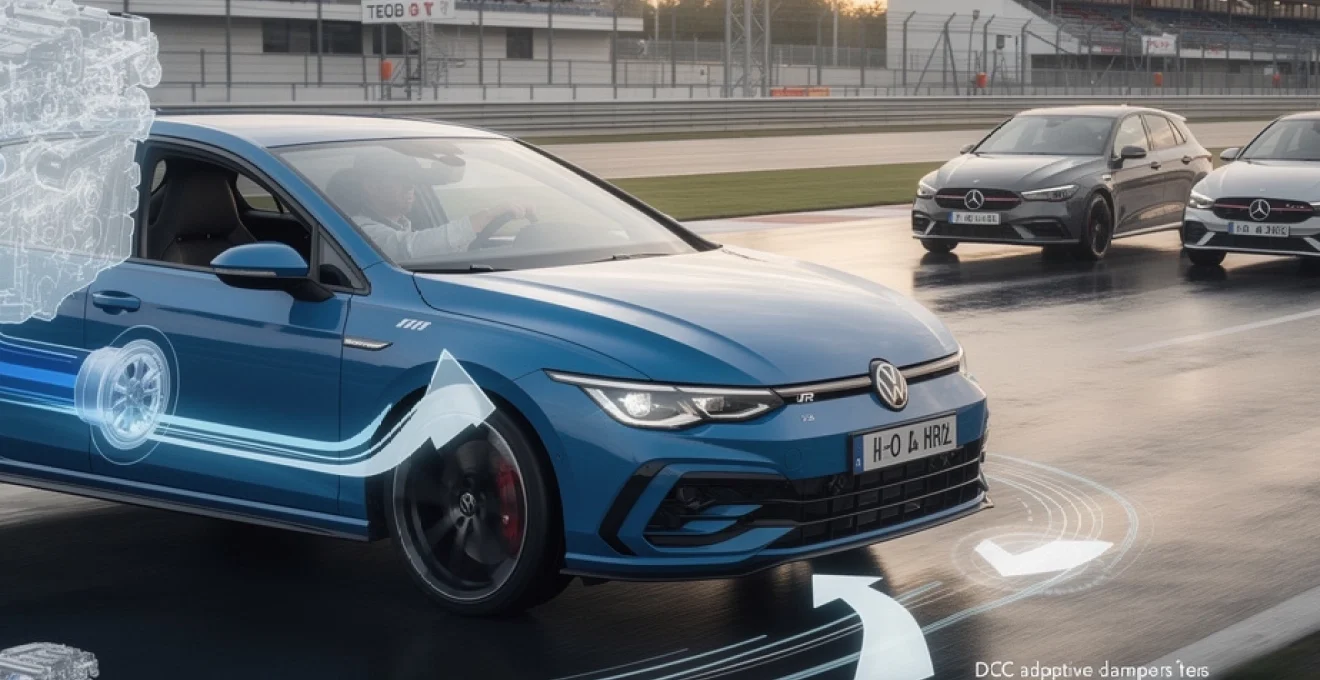
The Volkswagen Golf R Mk8 represents the pinnacle of hot hatch engineering, blending everyday practicality with genuine supercar-rivalling performance. After decades of evolution from the original R32, this latest iteration pushes the boundaries of what you can expect from a family hatchback. With 320 PS delivered through an advanced all-wheel-drive system and sophisticated adaptive suspension, the Golf R continues to set benchmarks in the premium hot hatch segment.
This generation faces unprecedented competition from rivals like the Mercedes-AMG A45 S and Audi RS3, yet Volkswagen’s engineers have responded with their most technologically advanced R model to date. The combination of the proven EA888 engine architecture with cutting-edge torque vectoring and adaptive damping creates a driving experience that seamlessly transitions from mundane commuting to track-day heroics.
EA888 2.0-litre TSI engine performance and power delivery
The heart of the Golf R Mk8 remains Volkswagen’s celebrated EA888 2.0-litre turbocharged four-cylinder engine, now in its fourth evolutionary generation. This powerplant has been extensively refined to deliver 320 PS (316 bhp) and 420 Nm of torque, representing a significant increase over previous iterations. The engine’s architecture incorporates numerous technological advances that enhance both performance and efficiency, making it one of the most sophisticated four-cylinder units in production today.
320 PS turbocharged Four-Cylinder output characteristics
The Golf R’s power delivery showcases the maturity of modern turbocharging technology, with peak power arriving at 5,600 rpm and maintaining strength through to 6,500 rpm. This broad power band ensures exceptional flexibility across the rev range, eliminating the traditional turbo lag associated with earlier forced-induction engines. The torque curve peaks early at just 2,100 rpm and sustains its full 420 Nm output until 5,500 rpm, creating an almost diesel-like tractability that makes overtaking effortless.
420 nm peak torque distribution across rev range
The substantial torque output represents a 20 Nm increase over the previous generation, achieved through enhanced turbocharger efficiency and optimised combustion chamber design. This improvement translates directly into real-world performance benefits, particularly during mid-range acceleration scenarios that define everyday driving. The torque delivery feels remarkably linear, avoiding the aggressive surge that can overwhelm traction systems in less sophisticated all-wheel-drive vehicles.
Variable valve timing and direct injection technology
Volkswagen’s implementation of variable valve timing on both intake and exhaust camshafts allows the EA888 to optimise breathing across all operating conditions. The direct injection system operates at pressures exceeding 200 bar, enabling precise fuel metering that improves both power output and emissions performance. This technology combination allows the engine to achieve impressive fuel economy figures despite its substantial performance capabilities.
Intercooler efficiency and boost pressure management
The Golf R employs an advanced air-to-air intercooling system that maintains consistent intake temperatures even during sustained high-performance driving. The turbocharger develops maximum boost pressure of approximately 1.4 bar, carefully managed by sophisticated engine control systems that prevent knock and protect internal components. This thermal management proves crucial during track sessions, where sustained performance demands exceptional cooling efficiency.
4motion All-Wheel drive system and torque vectoring dynamics
The Golf R’s 4Motion all-wheel-drive system represents one of the most advanced traction management technologies available in the hot hatch segment. Unlike simpler Haldex-based systems found in many competitors, Volkswagen’s implementation includes sophisticated torque vectoring capabilities that actively enhance cornering dynamics. The system can transfer up to 50% of engine torque to the rear axle under normal conditions, with the ability to send 100% of available rear torque to either wheel through the electronically controlled differential.
Haldex generation 5 coupling mechanism
The latest Haldex coupling responds within milliseconds to changing traction conditions, pre-emptively engaging
clutches based on inputs from wheel-speed sensors, throttle position and yaw rate. In normal driving the system runs with a front‑biased torque split to minimise fuel consumption, but the moment slip is detected or the driver selects a more aggressive drive mode, hydraulic pressure ramps up in the Haldex unit and progressively locks the rear axle. The result is a far more proactive all‑wheel‑drive system than older, reactively engaged Haldex generations, giving the Volkswagen Golf R Mk8 a planted, confidence‑inspiring feel even when you push hard on a cold, damp B‑road.
Electronic differential lock performance on track
Complementing the Haldex coupling is Volkswagen’s XDS+ electronic differential lock, which uses selective braking of the inside wheels to curb understeer and tighten the Golf R’s line through a corner. On track you sense this as a subtle nudge that helps the car rotate, rather than the crude, speed‑sapping intervention some systems deliver. Because XDS+ is fully integrated with the ABS and ESC systems, it can work continuously without overheating the brakes in typical fast‑road use, although extended track sessions will naturally generate more heat. For drivers who enjoy occasional circuit days, the balance between neutrality and stability is impressive, making the Golf R feel smaller and more agile than its 1,500‑plus‑kilogram kerbweight suggests.
Drive mode selector impact on AWD distribution
The Golf R Mk8’s character changes markedly depending on which drive mode you choose. In Comfort, the 4Motion system prioritises efficiency, keeping most of the torque at the front and only sending power rearwards when slip is predicted or detected. Switch to Sport or Race and the software becomes more assertive, pre‑loading the rear axle and allowing a rear‑biased torque distribution that you can actually feel when accelerating out of slower bends. The headline modes, however, are Nürburgring and Drift (where fitted with the Performance Pack), which further relax stability thresholds and allow greater yaw angles. While you may never use Drift mode on the road, it underlines how much freedom the torque vectoring system offers when you really want to explore the limits.
Wet weather traction control and ESC integration
In poor conditions the Golf R’s blend of traction control, ESC and 4Motion hardware is arguably its biggest real‑world advantage over front‑wheel‑drive hot hatches. The car constantly monitors steering angle, wheel slip and lateral acceleration, trimming ignition and gently pulsing individual brakes long before you sense things getting out of shape. In heavy rain, for example, you can deploy much more of the EA888’s 420 Nm without triggering wheelspin or torque steer, which makes long winter journeys less tiring. You also have the option of reducing ESC sensitivity or switching to ESC Sport when you want a bit more freedom, though the system will still step in to save you from major mistakes – a reassuring safety net when you’re experimenting with the Golf R’s impressive reserves of grip.
DCC adaptive dampers and vehicle dynamics control
Central to the Volkswagen Golf R Mk8’s ability to play both sensible family hatchback and genuine driver’s car is the optional DCC (Dynamic Chassis Control) adaptive damping system. Where traditional hot hatches are locked into a single compromise setting, DCC offers a spread of adjustment from genuinely supple to track‑ready firm at the swipe of a finger. The system continually varies damper force at each corner in response to road inputs, steering movement and body motions, working in tandem with the variable‑ratio steering rack and 4Motion software. The result is a car that feels tied down and controlled when you’re pressing on, yet remains comfortable enough for daily commuting or long‑distance motorway trips.
What’s particularly impressive is the granularity of the DCC settings in the Golf R. Rather than simply offering a soft and a hard mode, the Individual menu lets you fine‑tune damping across a broad continuum, so you can, for instance, pair a relaxed suspension setting with a sharp throttle map and more permissive ESC calibration. Many owners find that a softer damper setting combined with the more aggressive engine and gearbox responses of Race or Nürburgring mode gives the best blend of traction and comfort on broken UK tarmac. Think of it like having a toolbox of chassis setups at your disposal – once you’ve experimented a little, you can store a personalised profile that suits your favourite back road.
Vehicle Dynamics Manager (VDM) sits over the top of all this hardware, acting as the conductor of the Golf R’s dynamic orchestra. VDM coordinates inputs from DCC, the progressive steering, the rear torque vectoring differential and the electronic differential lock to achieve a desired behaviour, whether that’s maximum stability in Comfort or enhanced agility in Race. For example, if you tip the car into a fast bend, VDM can simultaneously firm the outside dampers to control roll, sharpen the steering ratio as you add lock and send more torque to the outside rear wheel to help pivot the car. You don’t see any of this happening, of course, but you feel it as a cohesive, confidence‑boosting response that makes the Golf R easier to place and more predictable at speed.
Interior technology integration and digital cockpit setup
Slide into the Golf R Mk8’s cabin and it’s immediately clear that this hot hatch leans heavily on digital technology. The traditional analogue dials have been replaced by Volkswagen’s 10.25‑inch Digital Cockpit Pro, which offers a range of R‑specific layouts including central rev counters, performance data and torque distribution graphics. You can configure the cluster to prioritise navigation, driver assistance information or classic gauge views, depending on whether you’re tackling a long journey or a Sunday morning blast. It’s a level of customisation that helps the interior feel tailored to your needs, rather than simply an up‑gunned version of the standard Golf.
To the driver’s right sits the central touchscreen, which in later Mk8 models was upgraded to a larger and faster‑responding unit with improved menu logic. From here you control the majority of the Golf R’s systems, from drive modes and DCC settings to ambient lighting and audio. While the move to touch‑sensitive sliders for climate and volume controls has divided opinion, the latest software updates have improved responsiveness and added back‑lighting to make them easier to use at night. Once you’ve set up a few custom shortcuts – for example, a direct link to your preferred Individual driving profile – everyday interaction becomes much more intuitive, even if some drivers will still miss physical knobs and buttons.
Connectivity is another pillar of the Golf R’s interior tech package. Wireless Apple CarPlay and Android Auto mirror your smartphone’s apps onto the central display, while multiple USB‑C ports keep devices charged on the move. Selected markets also benefit from integrated online services such as real‑time traffic, over‑the‑air updates and, more recently, experimental voice assistance powered by large‑language‑model AI. While you may not buy a hot hatch for its infotainment features, the reality is that many owners spend more time commuting than corner‑carving, so having a modern, well‑connected cabin makes the Golf R easier to live with day to day.
Semi‑autonomous driver assistance rounds out the technology story. Adaptive cruise control with stop‑and‑go, lane keeping assistance, traffic sign recognition and blind‑spot monitoring all come as standard or are widely available in most markets. Used judiciously, these systems take some of the drudgery out of heavy traffic and long motorway drives, helping to justify the Golf R’s position as a do‑it‑all performance car. Just be aware that some features, such as Lane Assist, default to “on” at each start‑up, so you may find yourself diving into menus or using shortcuts to disable them if you prefer a more old‑school driving experience.
Track performance metrics against audi RS3 and Mercedes-AMG A45 S
On paper, the Volkswagen Golf R Mk8 sits a rung below its most extreme German rivals, the Audi RS3 and Mercedes‑AMG A45 S. Both competitors boast power outputs north of 400 PS and use more exotic engine configurations – a charismatic five‑cylinder in the RS3 and a highly strung 2.0‑litre in the A45 S. Yet when you look beyond headline numbers and examine real‑world performance, the gap is narrower than you might expect. Independent tests regularly see the Golf R recording 0‑62 mph times in the mid‑four‑second bracket, sometimes beating its official 4.7‑4.8 second claim in favourable conditions, thanks to its strong launch control calibration and broad torque spread.
In-gear acceleration is where the Golf R’s 420 Nm really shines. From 30‑70 mph – a useful benchmark for overtaking – it hangs tenaciously onto the RS3 and A45 S, despite the power deficit. The EA888’s anti‑lag style turbo pre‑loading, introduced on special editions like the Golf R 20 Years and later rolled into mainstream models, keeps boost on tap when you lift off briefly, so response when you get back on the throttle feels almost instantaneous. On a damp circuit or a cold track day, that exploitable performance can actually make the Golf R easier – and therefore quicker – to drive than its more powerful rivals, because you can deploy a higher percentage of the engine’s potential more of the time.
Lap times tell a similar story. Around technical, medium‑speed circuits where traction and agility matter more than outright power, the Golf R often laps only a second or two behind an A45 S or RS3, despite the latter cars’ significant outputs and wider rubber. Much of this is down to the balance engineered into the R’s chassis: the rear torque vectoring differential helps the car rotate naturally into corners, while the adaptive dampers maintain excellent body control over kerbs and compressions. You might not set fastest time of the day at an open pit‑lane event, but you’ll likely be one of the most consistent drivers out there, which is often more satisfying.
Of course, the Audi and AMG fight back with a broader sense of drama. The RS3’s five‑cylinder soundtrack and the A45’s crackling, overrun theatrics give them a theatre the Golf R can’t quite match, even when fitted with the optional Akrapovič titanium exhaust. And if your focus is pure lap‑time chasing, both offer more aggressive factory setups with stiffer bushings and track‑oriented tyres. Yet it’s worth asking yourself how often you’ll truly exploit that last second on a circuit compared with how often you’ll appreciate the Golf’s subtler, more rounded performance on real roads. For many enthusiasts, the VW’s combination of speed, sure‑footedness and day‑to‑day refinement strikes a sweeter overall balance.
Real-world ownership costs and reliability assessment
Running a Volkswagen Golf R Mk8 day to day inevitably costs more than owning a regular Golf, but the hit may be smaller than you expect given the performance on offer. Official combined fuel economy figures hover in the mid‑30s mpg (around 7.5–8.0 l/100 km) depending on wheel size and specification. Drive gently on the motorway and you can genuinely see over 40 mpg thanks to tall gearing and efficient turbocharging, but enthusiastic use of the 320 PS engine will quickly drag that into the low‑20s. For many owners, a real‑world average in the low‑30s is a realistic expectation, which is acceptable for a car able to sprint to 62 mph in under five seconds in independent testing.
Insurance and tax sit where you’d expect for a high‑output, all‑wheel‑drive hot hatch. Group ratings are towards the upper end of the hatchback spectrum, and in markets like the UK, the Golf R’s list price can push it into higher first‑year VED and “expensive car supplement” bands. On the flip side, strong demand and historically robust residual values have made the Golf R a popular choice for PCP and lease customers, often resulting in monthly payments that compare favourably with less powerful alternatives. If you’re financing, it’s worth getting quotes on a few different trim levels, as pricey options like Akrapovič exhausts and leather upholstery rarely add their full value back at resale.
Servicing intervals are typically set at 12 months or 15,000 km (10,000 miles), with manufacturer‑branded service plans available in many regions to spread the cost. Because the EA888 engine is widely used across the Volkswagen Group, parts availability is good and most dealers are very familiar with its quirks. That said, items like premium tyres and larger brake components will inevitably cost more to replace than those on a standard Golf. If you plan regular track days, budgeting for upgraded brake fluid, more frequent pad changes and perhaps a spare set of wheels and tyres is sensible, both for safety and to preserve your road setup.
Reliability is a more nuanced topic. The underlying EA888 engine and 4Motion hardware have a generally solid reputation when maintained correctly, but early Mk8 Golfs – including the R – attracted criticism for software gremlins, particularly around the infotainment system and driver‑assistance electronics. Many of these issues have been addressed through over‑the‑air or dealer‑applied updates, yet it’s still wise to ensure any used example you’re considering has had the latest software installed. As ever with performance cars, how a Golf R has been driven and maintained matters as much as the badge on the grille: a well‑serviced example with evidence of regular oil changes and careful warm‑up is likely to be far more dependable in the long run than a neglected, heavily modified car with patchy history.
Ultimately, if you go in with your eyes open to the higher consumable costs and take the time to find a properly maintained car, the Volkswagen Golf R Mk8 can be a surprisingly sensible way to enjoy near‑supercar pace in a compact, everyday‑usable package. It’s this blend of real‑world usability, strong performance and reasonable ownership costs that keeps the R near the top of many hot‑hatch shortlists, even as rivals chase ever more extreme power outputs and track credentials.