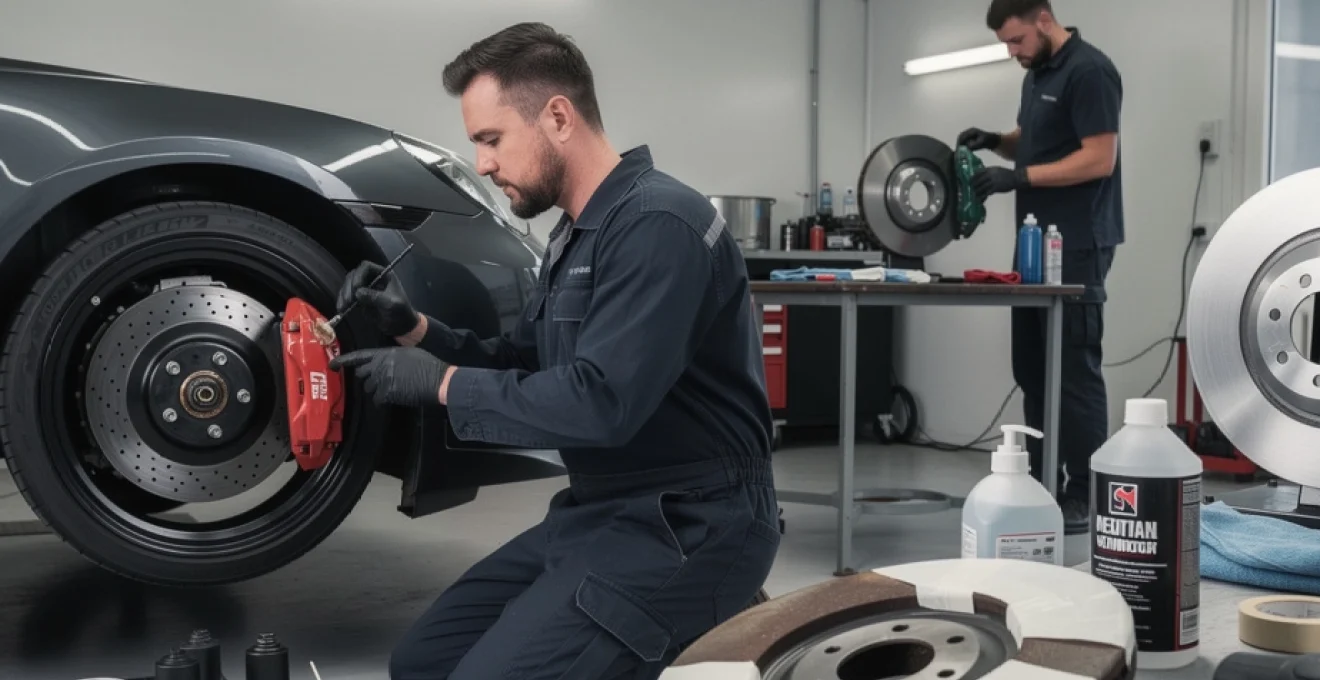
Brake disc corrosion represents one of the most persistent aesthetic and functional challenges facing vehicle owners, particularly in regions where road salt and moisture accelerate deterioration. The non-friction surfaces of brake rotors—including the central hub, outer edges, and ventilation vanes—are highly susceptible to oxidation, creating unsightly rust that can compromise structural integrity over time. Selecting the appropriate paint or coating for these components requires careful consideration of thermal properties, chemical resistance, and application methodology. Unlike conventional automotive paints, brake disc coatings must withstand extreme temperature fluctuations, resist brake fluid contamination, and maintain adhesion under centrifugal forces while avoiding any interference with braking performance. Understanding the distinct formulation chemistries, temperature thresholds, and surface preparation requirements becomes essential for achieving durable, professional-quality results that protect your investment whilst maintaining the clean, factory-fresh appearance that enthusiasts demand.
High-temperature brake caliper paint: ceramic vs enamel formulations
The fundamental distinction between ceramic and enamel-based brake paints lies in their molecular structure and thermal performance characteristics. Ceramic formulations utilise silicon-based compounds that undergo a chemical transformation when exposed to heat, creating a glass-like matrix that bonds to the substrate at a molecular level. These coatings typically offer superior heat resistance, often withstanding temperatures exceeding 650°C without discolouration or degradation. Enamel paints, conversely, rely on synthetic resins that cure through solvent evaporation, forming a harder but less thermally stable film that performs adequately for standard road applications but may yellow or blister under sustained high temperatures.
When evaluating paint options for your brake components, you’ll find that ceramic coatings generally command premium pricing due to their advanced chemistry and manufacturing complexity. However, this investment delivers tangible benefits in longevity and appearance retention. Enamel formulations remain popular for budget-conscious applications and vehicles subjected primarily to moderate driving conditions. The choice between these technologies should align with your intended use case—track-focused vehicles demand ceramic protection, whilst daily drivers often achieve satisfactory results with quality enamel products.
VHT FlameProof coating: withstanding 900°C operating temperatures
VHT FlameProof represents the pinnacle of extreme-temperature coating technology, originally developed for exhaust manifolds and headers exposed to combustion gases. This silicone-ceramic hybrid formulation maintains structural integrity at temperatures approaching 900°C, far exceeding the thermal demands of even aggressive track driving. The coating’s unique chemistry creates a flexible ceramic matrix that expands and contracts with the substrate, preventing the cracking and flaking commonly associated with rigid paints subjected to thermal cycling. Whilst this temperature rating exceeds the requirements for brake disc hubs—which typically experience maximum temperatures between 300-500°C even during spirited driving—the substantial thermal headroom ensures absolute resistance to discolouration.
Application of VHT FlameProof requires meticulous surface preparation and controlled curing protocols. The manufacturer specifies a gradual heat-cycling process that incrementally raises the coated component’s temperature, allowing complete solvent evacuation and ceramic cross-linking. For brake applications, this curing occurs naturally during the first several driving cycles, though you should avoid aggressive braking during the initial 160 kilometres to prevent premature coating failure. The resulting finish exhibits a semi-gloss appearance with exceptional resistance to brake fluid, hydraulic oils, and cleaning solvents.
Foliatec brake caliper paint system: Two-Component polyurethane technology
Foliatec’s two-component system employs advanced polyurethane chemistry that delivers remarkable durability through chemical cross-linking rather than mere solvent evaporation. When you mix the base resin with the isocyanate hardener, a chemical reaction initiates that continues even after application, creating molecular bonds of exceptional strength. This technology, borrowed from industrial coating applications, produces a finish that resists chipping, chemical attack, and thermal degradation whilst maintaining colour stability under sustained temperatures up to 300°C. The system’s performance characteristics position it ideally for caliper applications, though it works equally well on non-friction disc surfaces.
Unlike single-component products, Foliatec requires precise mixing ratios and offers a limited working time once components are combined—typically 2-3 hours depending
on ambient temperature. You should therefore plan the job so that all components are cleaned, masked and ready before activating the hardener. Once cured, the polyurethane film forms a dense, glossy layer that shrugs off road salt, brake dust and most wheel cleaners. For enthusiasts seeking a long-term solution that can match or exceed many OEM painted calipers, this two-part technology offers one of the most durable options you can apply at home, provided you are comfortable with careful mixing and methodical brush work.
Hammerite direct to rust: Single-Stage application for road salt protection
Hammerite Direct to Rust remains a popular choice for DIY brake disc hub painting thanks to its simplicity. This alkyd-based enamel incorporates anti-corrosive pigments and can be applied directly over lightly rusted surfaces, provided they are sound and properly keyed. Whilst it is not a dedicated high-temperature brake paint, practical experience on road cars shows that the non-friction areas of the discs rarely exceed its thermal comfort zone during normal driving. For many owners, the ability to wire-brush, degrease and apply a single-stage coating in an afternoon outweighs the ultimate heat resistance offered by more specialised products.
You should, however, understand the limitations of this approach. Hammerite will tolerate occasional heat spikes but may soften or discolour if exposed to repeated heavy braking, track days or mountain driving with sustained descents. Think of it as a robust weatherproof jacket rather than a fireproof race suit: ideal for typical daily use, less appropriate for extreme performance environments. To maximise adhesion and longevity, remove loose scale, feather any existing coatings and allow generous drying time between coats—rushing this stage is the most common reason for premature peeling around the disc hat and outer edge.
POR-15 engine enamel: chemical resistance against brake fluid contamination
POR-15 Engine Enamel sits at the intersection of high-temperature performance and outstanding chemical resistance, making it particularly relevant when painting components near hydraulic systems. Engine bays routinely expose coatings to fuel, oils and coolant; consequently, this enamel is formulated to resist softening when contaminated by brake fluid mist or spills. Applied correctly over an appropriate primer, it cures to a rock-hard gloss finish that can withstand continuous temperatures of around 260°C, with short-term peaks above this threshold. For the non-swept portions of brake discs, this margin proves more than adequate even in demanding conditions.
If you are already using the POR-15 system—for example, rust encapsulator on suspension arms or subframes—integrating the engine enamel for disc hubs can create a consistent visual and protective package. The key is to avoid applying excessively thick layers, which may be tempting when chasing a deep gloss. Just as too many coats of clear on bodywork can chip more easily, an overbuilt film on brake components is more prone to cracking under thermal cycling. Two medium coats, allowed to flash off properly, typically provide the ideal balance between coverage, flexibility and chemical resilience around the brake assembly.
Brake disc Heat-Resistant coatings: protecting Non-Friction surfaces
When discussing what paint you should use for brake discs, it is vital to separate the functional friction surface from the aesthetic and protective non-friction areas. The swept area where the pad contacts the rotor must remain bare metal; any coating here will be rapidly abraded away and can temporarily reduce braking efficiency until removed. Instead, your focus should fall on the disc hat, outer circumference and, in the case of ventilated rotors, the internal vanes. These regions are where corrosion not only spoils appearance but can also contribute to imbalance, noise and even difficulty in removing wheels or discs later in the vehicle’s life.
Heat-resistant coatings tailored to these areas act almost like sunscreen for your rotors: they do not alter the fundamental performance of the underlying metal, but they slow the oxidation and staining caused by weather, road salt and moisture. Modern formulations balance temperature tolerance with flexibility, recognising that cast iron expands and contracts significantly as it heats and cools. A paint that is too rigid may look perfect after application yet begin to craze and flake after a few hard stops, while a coating that is too soft will pick up contamination and discolour within months. The products considered in this section address these competing demands in different ways, giving you a toolkit to match coating choice to usage profile.
G2 caliper paint vs brembo OEM specifications: temperature threshold analysis
G2 caliper paint is frequently promoted as a premium option for enthusiasts seeking an OEM-like finish with DIY convenience. Rated for continuous exposure around 288°C (550°F), it sits comfortably within the range observed on performance calipers during spirited road use. How does that compare with Brembo’s own specifications? Bench and track testing of high-performance systems indicates that quality caliper coatings are typically engineered for sustained temperatures in the 250–300°C range, with momentary spikes above 400°C at the pad interface, which the thicker metal body helps to buffer.
From a practical standpoint, this means that G2’s temperature capabilities broadly align with the heat loads experienced by many factory Brembo-equipped vehicles in real-world driving. When you apply it to brake disc hats and non-friction faces, you are operating even further within its comfort zone, as rotor hubs generally run cooler than the caliper body. In other words, if a coating is trusted to remain stable on a bright red performance caliper, it will typically perform impeccably on a cast iron bell or outer disc edge. The implication for your paint choice is simple: you can safely prioritise aesthetics (colour, gloss level, ease of cleaning) once you have confirmed a product’s temperature rating falls within these known OEM envelopes.
Zinc-rich primer applications for cast iron rotor hubs
Zinc-rich primers introduce a different protective mechanism compared with conventional brake disc paints. Rather than acting solely as a barrier, the high metallic zinc content provides sacrificial protection, corroding preferentially to the underlying cast iron. This galvanic principle has long been used in marine and industrial environments, and its adaptation to rotor hubs makes particular sense for vehicles that see harsh winter conditions. When applied beneath a compatible high-temperature topcoat, a zinc primer can significantly delay the onset of rust creep at stone chips and exposed edges.
However, you must treat zinc primers with respect when working around precision brake components. Excessive film build on mating surfaces—such as the hub face where the disc mounts, or the wheel’s seating area—can gradually compress and lead to loss of clamping force over time as the soft zinc layer deforms. To avoid this, apply the primer sparingly and mask off any interfaces where metal-to-metal contact is critical. Think of zinc as a sacrificial under-shirt beneath your main coat of paint: invaluable in the right place, but not something you want trapped between a torque-critical joint like the disc and hub.
Anodised vs Powder-Coated aluminium bell treatments for performance rotors
Two-piece performance rotors often feature aluminium bells bolted to cast iron friction rings, and these bells are commonly either anodised or powder-coated. Anodising converts the surface of the aluminium into a controlled oxide layer, which is then optionally dyed to achieve colour. The resulting finish is thin, hard and tightly bonded to the metal, offering excellent corrosion resistance with minimal impact on dimensional tolerances. For brake bells, this is particularly important around bolt holes, spigots and mounting faces where even small variations in thickness can affect fitment.
Powder coating, on the other hand, deposits a thicker, polymer-based layer that is baked to form a durable, often glossier shell. Whilst powder offers an attractive, highly customisable appearance and good chip resistance, its extra film build can be problematic if not carefully masked around critical dimensions. For track-focused applications where repeated heat cycling is the norm, anodising is usually preferred due to its superior temperature stability and resistance to softening. If your use case is primarily cosmetic—show cars or lightly driven road vehicles—powder coating can provide a rich, uniform colour that complements painted calipers and bodywork, as long as application standards match motorsport expectations.
Duracoat aerosol systems: avoiding friction surface contamination
DuraCoat-style aerosol systems are attractive for home users because they integrate advanced resins and hardeners into an easy-to-spray format. Designed originally for firearms and industrial equipment, these coatings offer a fine balance of abrasion resistance, chemical resilience and moderate heat tolerance. When repurposed for brake disc hubs and outer edges, they provide a tidy, uniform finish with far better durability than generic hardware-store rattle-can paints. The main risk is not the product itself, but overspray reaching the friction surface or ABS tone rings, where even a thin layer can cause judder, squeal or signal disruption until fully worn away.
How do you mitigate this? The answer lies in meticulous masking and controlled spray technique. Use high-temperature masking tape to cover the swept face of the disc, and consider cutting a circular mask from thin card or plastic that nests inside the pad track area. Spray in light, controlled passes from a shallow angle, effectively “aiming” at the hat and edges rather than flooding the entire assembly. Think of it like airbrushing scale model brake discs: precision and patience matter far more than brute force. If any overspray does reach the braking surface, remove it immediately with solvent and a clean cloth rather than assuming it will simply burn off on the first drive.
Surface preparation protocols for brake component painting
Even the best high-temperature brake disc paint will fail prematurely if applied over contamination or loose corrosion. Surface preparation is where most DIY brake painting projects succeed or fail, and yet it is the step that is most often rushed. New discs arrive coated in an oily corrosion inhibitor; used rotors accumulate a mixture of rust, road film and previously applied products. Your objective is to create a clean, mechanically keyed surface that allows the coating to bite into the metal. This process may feel tedious, but it is the single most powerful way to ensure that your freshly painted hubs still look good several winters from now.
From a workflow perspective, it is wise to treat preparation like a mini assembly line. Remove the disc, mount it securely on a workbench or spare hub, and address each step—degreasing, mechanical cleaning, final wipe, masking—in sequence. Have all your materials ready: solvents, brushes, abrasives and clean lint-free cloths. As with bodywork, you are building a foundation; if you would not spray a car panel over sanding dust and silicone, you should not paint brake components over rust bloom and oily fingerprints. Investing an extra hour in preparation can add years to the coating’s useful life, particularly in climates where road salt is aggressively applied.
Acetone degreasing vs IPA cleaning: removing corrosion inhibitor coatings
Many owners are surprised at how much residue remains on “new” brake discs after a quick wipe. Manufacturers commonly apply a waxy or oily inhibitor to prevent flash rust during storage and shipping, and this film can be stubborn to remove. Acetone and isopropyl alcohol (IPA) are the two most accessible solvents for DIY use, each with strengths and weaknesses. Acetone is more aggressive, cutting through heavy oils and waxes quickly, but it evaporates extremely fast and can be harsh on certain plastics or painted wheel surfaces. IPA is gentler and safer around rubber components, yet may require multiple passes to fully strip thick inhibitors.
Which should you use when preparing to paint brake discs? For bare metal rotors removed from the vehicle, acetone usually offers the most efficient route to a completely grease-free surface. Work in a well-ventilated area, wear appropriate gloves and use fresh, clean cloths; once they become saturated with dissolved inhibitor, you will simply smear contaminants around rather than removing them. Reserve IPA for lighter cleaning tasks or for a final wipe-down before coating, much like a panel wipe in bodywork preparation. If in doubt, perform a simple water-break test: after degreasing, mist the surface with clean water; if it sheets uniformly rather than beading, you have likely removed the majority of oily residues.
Wire brushing technique for ventilated disc hat surfaces
On used brake discs, rust management becomes just as important as degreasing. The non-swept areas often display surface corrosion that must be mechanically removed before applying paint. A wire brush—either hand-held or mounted in a drill—remains one of the most effective tools for this task. For ventilated rotors, where the vanes and hat surfaces present complex geometry, a cup or wheel brush on a low-speed drill allows you to chase rust into crevices without gouging the metal. The goal is not to polish the disc to a mirror finish but to return it to sound, tightly adhering metal with a uniform texture.
To avoid creating low spots or sharp edges, keep the brush moving and let the bristles do the work rather than applying heavy pressure. Imagine you are sanding wood with the grain rather than hacking at it with a chisel; steady, controlled passes produce a more even surface that paint can grip. After brushing, blow away dust with compressed air if available, or wipe thoroughly with a clean cloth and solvent. Pay particular attention to the interface between the hat and the friction ring, as corrosion in this area can creep under the coating if not fully addressed, leading to premature flaking along the boundary.
Masking methodology: protecting ABS sensor rings and mounting faces
Masking is often viewed as a cosmetic step, but in the context of brake disc painting it directly affects safety and serviceability. The hub mounting face, wheel seating area and any ABS or wheel speed sensor rings must remain free of paint. Even a thin coating can compress over time, subtly altering bolt torque or introducing run-out, while overspray on tone rings may interfere with magnetic or optical sensors. High-temperature masking tapes and simple templates can help you protect these critical zones without adding unnecessary complexity to the job.
A practical approach is to start by masking the disc’s friction surface with a circular band of tape, then add smaller pieces to cover bolt holes, centre bores and any exposed sensor elements. For the hub face, some technicians prefer to avoid painting right up to the boundary altogether, instead leaving a narrow ring of bare metal where the disc contacts the hub. You can achieve this by placing a slightly undersized round mask on the rear face before spraying or brushing. Think of it as trimming the edges of wallpaper: taking an extra few minutes to define clean, safe boundaries now will save you dealing with stuck wheels, distorted torque readings or ABS fault codes later on.
Application techniques for drilled and slotted performance rotors
Drilled and slotted rotors present additional challenges when you are deciding what paint to use for brake discs. The very features that improve pad de-gassing and water evacuation—holes, slots and complex vane designs—also create opportunities for paint to pool, clog or form uneven films. If you simply spray the entire rotor indiscriminately, you risk partially filling cooling passages or leaving unsightly runs that are visible through open-spoke wheels. The goal is to treat these performance rotors like precision components, applying just enough coating to protect and beautify without compromising their engineered functionality.
One effective strategy is to apply paint selectively with a small brush or foam applicator to the hat and outer circumference while leaving the drilled and slotted areas to self-clean through pad contact. By working from the centre outwards, you maintain fine control over where the coating lands, much like carefully painting the lugs and centre caps on alloy wheels rather than misting the entire assembly. If you prefer to use aerosol products for their uniform atomisation, keep the can at a greater distance and use light, sweeping passes, allowing the first coat to “map out” surface tension before committing to additional layers. This helps prevent material from bridging across holes or accumulating at the leading edges of slots.
Curing requirements: heat cycling painted brake components
Once you have applied your chosen brake disc paint, curing becomes the final critical step before subjecting the system to full operating loads. Some products, such as VHT FlameProof and certain ceramic-based coatings, require defined heat cycles to complete their cross-linking chemistry. Others, like polyurethane and enamel formulations, will air-dry to the touch yet continue to harden over several days. Regardless of chemistry, the common thread is that premature exposure to extreme temperatures or aggressive braking can cause blistering, discolouration or micro-cracking in a still-soft film.
A practical curing protocol for road vehicles involves two stages. First, allow the coating to air cure for the manufacturer’s recommended period—typically 24 hours for single-component paints and up to 48 hours for two-pack systems. Then, during the first driving cycles, adopt a bedding-in approach similar to that used for new pads and discs: perform a series of gentle stops from moderate speeds, allowing the brakes to cool between applications. This staged heat input acts like a controlled oven, progressively driving off remaining solvents and encouraging the coating to stabilise. Think of it like tempering steel rather than quenching it; slow, deliberate heating yields a tougher, more resilient final structure than a single brutal heat shock.
Dupli-color vs Rust-Oleum: comparative durability under track conditions
Among DIY-friendly brands, Dupli-Color and Rust-Oleum frequently appear on shortlists when owners research what paint to use for brake discs and calipers. Both manufacturers offer high-temperature enamel products marketed for engines and brake hardware, and both have loyal followings. Yet their performance diverges notably under sustained track conditions, where repeated high-energy stops push coatings toward their thermal and mechanical limits. Informal testing by enthusiasts, combined with anecdotal reports from track-day users, paints a useful comparative picture even in the absence of fully standardised lab data.
Dupli-Color’s dedicated caliper and engine enamels generally exhibit better colour stability and chip resistance when repeatedly cycled through high temperatures, particularly in ceramic-enhanced versions. Rust-Oleum’s high-heat paints, while robust for road use and occasional spirited driving, are more prone to dulling and edge lifting around the hottest areas of the disc hat and caliper body during frequent track sessions. If your vehicle will see regular circuit use, Dupli-Color or a comparable motorsport-oriented coating tends to be the safer long-term choice, especially when combined with meticulous surface preparation and proper curing. For daily drivers and occasional back-road runs, Rust-Oleum remains a cost-effective option that can deliver years of service, provided you respect its more modest thermal comfort zone and reapply as necessary when cosmetic degradation appears.