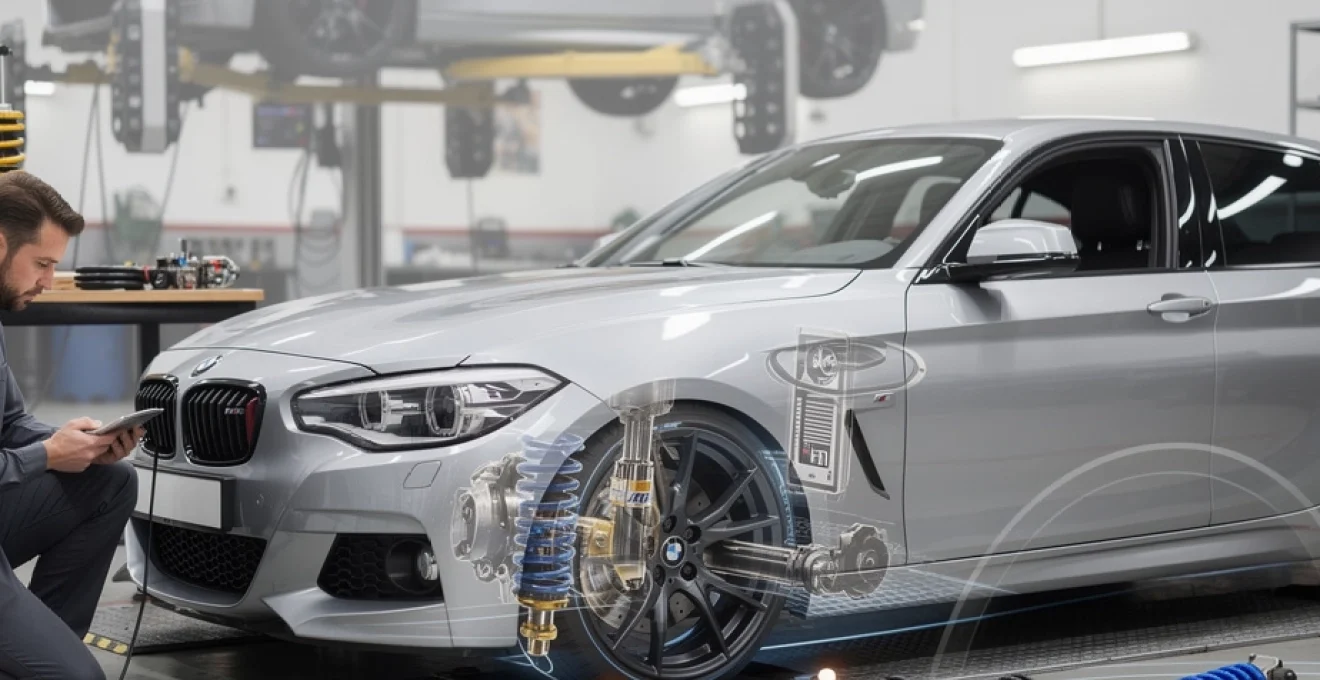
The BMW F20 1 Series represents a significant achievement in compact performance engineering, particularly when equipped with factory adaptive suspension systems. For enthusiasts seeking to lower their vehicles whilst maintaining these sophisticated damping technologies, the landscape of compatible modifications has evolved considerably. Understanding the intricate relationship between electronic damper control and altered chassis geometry isn’t merely an academic exercise—it’s essential knowledge that separates successful suspension upgrades from costly mistakes that compromise both performance and safety.
Modern adaptive suspension systems function as integrated mechanical and electronic ecosystems, where every component communicates within precisely calibrated parameters. When you introduce aftermarket lowering components into this ecosystem, you’re fundamentally altering variables that BMW’s engineers spent thousands of development hours perfecting. The challenge isn’t simply achieving a lower stance; it’s doing so whilst preserving the electronic damping functionality that makes adaptive suspension such a desirable feature. With Height Adjustable Spring (HAS) kits now offering viable alternatives to traditional coilovers, F20 owners face more choices than ever—but also more potential pitfalls.
Understanding adaptive suspension technology in BMW F20 models
BMW’s adaptive suspension systems in the F20 chassis represent some of the most sophisticated damping technologies available in the compact performance segment. These systems continuously monitor driving conditions and adjust damper characteristics in real-time, delivering performance that static suspension setups simply cannot match. Before attempting any lowering modifications, you need to understand exactly how these systems operate and what makes them vulnerable to improper alterations.
Electronic damping control (EDC) architecture and functionality
Electronic Damping Control forms the foundation of BMW’s adaptive suspension strategy in F20 models equipped with this technology. The EDC system employs electronically adjustable shock absorbers containing electromagnetic valves that regulate hydraulic fluid flow within the damper. These valves can alter their orifice size in milliseconds, changing the damper’s resistance to compression and rebound forces. When you select Comfort mode, the control module opens these valves wider, allowing easier fluid flow and softer damping. Switch to Sport mode, and the valves constrict, increasing resistance and delivering firmer control.
The system’s intelligence extends beyond simple mode selection. EDC continuously processes input from multiple sensors, adjusting individual dampers independently based on real-time conditions. This means your front-left damper might be in a relatively soft state whilst the rear-right operates in a firmer configuration—all determined by acceleration forces, steering inputs, and road surface irregularities. The control module updates these parameters up to 500 times per second, creating a dynamic response that anticipates driver intent and road conditions simultaneously.
Continuous damping control (CDC) vs adaptive M suspension systems
BMW’s terminology can prove confusing, as different markets and model years reference similar technologies with varying names. Continuous Damping Control represents an earlier iteration of adaptive technology, whilst Adaptive M Suspension incorporates more aggressive calibrations and typically includes specific M division hardware. Both systems share fundamental operating principles—electronically controlled dampers responding to sensor inputs—but their calibration philosophies differ significantly.
Adaptive M Suspension in F20 M135i and M140i variants features sportier baseline settings even in Comfort mode, with Sport and Sport Plus modes delivering progressively firmer responses. The dampers themselves often incorporate different valving and may use alternative fluid formulations optimised for higher performance thresholds. This distinction matters when selecting lowering components, as M Suspension variants already operate with reduced suspension travel compared to standard EDC-equipped models. Further reducing this travel through aggressive lowering increases the risk of damper stroke issues and potential component damage.
Sensor integration: accelerometers and steering angle monitoring
The effectiveness of adaptive suspension relies heavily on comprehensive sensor networks that feed data to the damper control module. Accelerometers mounted at strategic chassis locations measure vertical, lateral, and longitudinal forces, providing the system with precise information about vehicle dynamics. These sensors detect everything from road surface irregularities to weight transfer during braking and cornering. The steering angle sensor adds another critical data stream, allowing the system to anticipate damping requirements before dynamic forces develop.
When you alter ride height significantly, you’re changing the geometric relationship between sensors and the forces they’re calibrated to measure, potentially introducing measurement errors that affect dam
damper behaviour.
This does not mean that lowering an F20 with adaptive suspension automatically confuses the sensors, but it does narrow the window in which the system can operate as designed. The more extreme the drop, the more you push the accelerometers and steering angle inputs outside the assumptions in the factory calibration. This can manifest as harsher reactions to bumps, odd behaviour in mixed Comfort/Sport driving, or inconsistent stability control interventions. When planning an F20 lowering setup, you should always balance aesthetic goals with the need to preserve accurate sensor interpretation of body movements.
Dynamic damper control module communication protocols
At the heart of the adaptive system sits the Dynamic Damper Control (DDC) module, acting as the traffic controller between sensors, dampers, and higher-level ECUs. In BMW F20 models, this module communicates over the CAN bus, exchanging data with the DSC (Dynamic Stability Control), the engine ECU, and the iDrive interface. Each driving mode you select is essentially a predefined map that alters target damping curves, response thresholds, and intervention speeds.
When you lower the car, you are not changing the communication protocol itself, but you are changing the real-world conditions the DDC software expects. For example, the module assumes a certain relationship between ride height, suspension travel, and damper stroke when calculating how aggressively to firm up the shocks during rapid weight transfer. If you significantly reduce available travel with aggressive lowering springs or coilovers, the DDC may reach its limits more quickly, causing the system to respond abruptly. Understanding this interaction helps explain why some lowered F20s feel “crashy” in Sport mode despite having premium components installed.
Additionally, the DDC module monitors damper current draw and valve response to detect faults. Aftermarket components with different electrical characteristics, or damaged wiring during installation, can cause communication errors or fault codes. This is why high-quality lowering solutions for adaptive suspension often include resistors, interface modules, or full replacement dampers designed to mimic OEM behaviour at the electrical level, even if the mechanical characteristics are very different.
Mechanical implications of lowering F20 chassis geometry
Lowering a BMW F20 is not just a visual modification; it fundamentally alters the suspension geometry and the way the chassis interacts with the road. Whilst many owners focus on the immediate benefits of a reduced centre of gravity and sharper turn-in, the mechanical trade-offs are equally important. The F20’s MacPherson strut front and multi-link rear axle have been engineered around a specific ride height, damper stroke, and bump stop engagement profile. Deviating from this baseline requires a clear understanding of how much lowering is appropriate for both daily use and spirited driving.
The most important mechanical factors to consider include suspension travel, camber and toe changes, and the way anti-roll bars are preloaded at a lower ride height. Get these elements wrong and you can end up with a car that looks great in photos but feels nervous at high speed, eats tyres prematurely, or bottoms out over every speed bump. When you combine lowering with adaptive suspension, these geometry changes also influence how the EDC system interprets body motion, amplifying the consequences of poor setup.
Suspension travel reduction and compression stroke limitations
Every suspension system needs a certain amount of vertical travel to manage bumps, dips, and weight transfer without hitting the bump stops too early. On the F20, especially in Adaptive M Suspension variants, BMW already uses a relatively firm spring and damper setup with limited stroke to deliver a sporty feel. Lowering springs that reduce ride height by 30–40 mm inevitably eat into the available compression travel, bringing the suspension closer to the bump stops in normal driving. The result can be a car that feels firm but controlled on smooth tarmac, yet quickly becomes uncomfortable on broken surfaces.
From a mechanical standpoint, frequent contact with the bump stops effectively makes the suspension progressively stiffer as the road gets rougher. This can trick you into thinking the adaptive dampers are misbehaving, when in reality the issue is simply a loss of usable stroke. For EDC-equipped F20 models, this reduced travel also means the damper’s internal valves operate more often near their extremes, increasing wear and the risk of seal failure over time. When planning an F20 lowering setup with adaptive suspension, you should prioritise solutions that preserve as much functional stroke as possible, such as moderate drops or matched spring-damper kits.
This is also why some premium height adjustable spring kits include shorter, re-engineered bump stops. By tuning the length and density of the bump stop, manufacturers can delay hard contact and make the transition into the end of travel more progressive. Think of these components as the “crash pads” of your suspension; if they are constantly in play because the car is too low, both comfort and damper longevity will suffer, regardless of how advanced your adaptive system may be.
Camber angle alterations and tyre contact patch dynamics
Another critical effect of lowering a BMW F20 is the change in static and dynamic camber angles. As you drop the ride height, the front MacPherson struts and rear multi-link arms swing through their arcs, increasing negative camber. A small increase can be beneficial, improving cornering grip and reducing understeer thanks to a more favourable tyre contact patch at high lateral loads. However, excessive negative camber, especially at the rear, can lead to accelerated inner shoulder wear and reduced traction in straight-line braking.
When you combine adaptive suspension with more negative camber, you also change how the EDC system interprets grip and slip at each wheel. A heavily lowered F20 with overly aggressive camber settings might feel sharp on a smooth track but nervous on wet or uneven roads, as the tyres operate on a smaller effective contact patch in everyday conditions. For a road-focused build, aiming for a moderate drop and sensible alignment targets—often in the region of -1.0° to -1.5° front and -1.5° to -2.0° rear—strikes a good balance between performance and tyre life.
Have you ever noticed a lowered car that follows road ruts or tramlines more than stock? That behaviour often comes from a combination of increased camber, altered toe, and a lower scrub radius. After lowering your F20, a precise four-wheel alignment is not optional; it is essential. Tell your alignment specialist that the car has adaptive suspension and specify your use case (daily road, occasional track, winter driving) so they can choose settings that complement both the new ride height and the adaptive damping characteristics.
Anti-roll bar preload changes with reduced ride height
Anti-roll bars (ARBs) play a major role in controlling body roll and balancing understeer/oversteer behaviour in the F20 platform. At the factory ride height, the ARB drop links are mounted such that the bar is effectively “neutral” when the car sits level on its wheels. Lowering the chassis without adjusting link lengths can introduce preload into the bars, meaning they are already twisted at static height. This preload changes the initial roll resistance and can create an imbalance between the front and rear axles.
On an adaptive suspension F20, the interaction between ARB preload and damper control can be complex. For example, if the front bar is effectively preloaded because of a large drop, the adaptive dampers may not need to firm up as much in Sport mode to control roll, but the car may feel harsher over single-wheel bumps. Conversely, a heavily preloaded rear bar can make the car feel more agile on turn-in but also more likely to step out under lift-off, especially in low-grip conditions. If your F20 lowering project includes a significant drop, adjustable drop links or correctly designed lowering kits that respect ARB geometry are worth considering.
Think of the ARB as a torsion spring connecting left and right wheels. If you twist that spring at rest by lowering the car without compensating, one side is already “pushing back” before you even begin to corner. The adaptive system will still respond to body motions, but it will be doing so on top of a biased baseline. For drivers who want predictable handling in all modes—from Comfort on the motorway to Sport on a B-road—keeping ARB preload within sensible limits is just as important as choosing the right springs.
Macpherson strut geometry modifications in F20 front axle
The F20’s front MacPherson strut design is compact and efficient, but it is also sensitive to ride height changes. Lowering alters the position of the steering knuckle relative to the strut top mount, which in turn affects roll centre height, bump steer characteristics, and scrub radius. A moderate drop can lower the centre of gravity and slightly raise the front roll centre, improving response. However, an excessive drop can push the roll centre far below the car’s centre of gravity, increasing body roll leverage and making the front end feel less stable mid-corner.
Bump steer—changes in toe angle as the suspension compresses and rebounds—can also become more pronounced on a lowered F20. In practice, this may feel like the car darts slightly when you hit a bump mid-corner or under hard braking on uneven surfaces. The adaptive dampers will try to stabilise the chassis, but they cannot correct for inherent geometric issues. This is why some track-focused F20 builds with significant lowering use roll centre correction kits or modified control arms to bring the geometry back into an optimal window.
For road-focused F20 owners with adaptive suspension, the sweet spot is usually a modest drop that improves looks and initial turn-in without pushing the MacPherson geometry too far away from BMW’s baseline. If you find yourself chasing a “slammed” stance, ask whether the loss in stability, steering feel, and tyre life will be worth the trade-off—especially when the adaptive system was designed around a much more conservative ride height.
Adaptive damper calibration challenges with aftermarket lowering springs
Once you understand how tightly integrated the adaptive system is with the F20’s mechanical layout, it becomes clear why generic lowering springs can be a mixed blessing. Springs from well-known brands such as Eibach and H&R can deliver excellent results, but they were not always designed with BMW’s adaptive algorithms in mind. On an EDC-equipped F20, the wrong combination of spring rate, drop, and bump stop length can make the adaptive modes feel indistinguishable from one another—or worse, make Sport mode almost unusable on real roads.
The main calibration challenges come from three areas: mismatched spring rates versus damper curves, altered damper stroke and sensor correlation, and potential conflicts within the electronic control logic. If you want to keep your adaptive suspension functional and enjoyable, it is vital to treat lowering springs not as cosmetic parts but as core components that must work in harmony with the factory dampers and control modules.
Eibach Pro-Kit and H&R sport spring compatibility issues
Eibach Pro-Kit and H&R Sport springs are among the most popular lowering options for the BMW F20. The Pro-Kit typically offers a more conservative drop and focuses on maintaining close-to-OEM ride quality, whilst H&R Sport springs often deliver a more aggressive stance and firmer feel. On non-adaptive cars, both can perform very well. On EDC or Adaptive M Suspension F20 models, however, differences in spring rate and lowering amount have a more direct impact on how the electronic dampers behave across Comfort and Sport modes.
For instance, combining Adaptive M Suspension with H&R Sport springs on an F20 M135i or M140i can push the system closer to its travel limits, especially at the front axle. The higher spring rate can work against the softer damping curves in Comfort, making the car feel underdamped and slightly floaty over larger undulations, yet overly harsh in Sport as the system tries to rein in body motion with limited stroke. By contrast, Eibach Pro-Kit springs tend to sit within a safer window for EDC calibration, at the cost of a less dramatic visual drop.
Does that mean you should avoid H&R or similar sport springs altogether on an adaptive F20? Not necessarily, but you should go in with realistic expectations and, ideally, speak to owners running the exact same combination of chassis, engine, and suspension package. Pay close attention to reported issues such as frequent bump stop contact, bottoming over speed bumps, or adaptive modes that feel overly similar. These are signs that the new static ride height and spring behaviour are stretching the EDC system beyond its comfort zone.
Damper stroke sensor recalibration requirements
On many modern BMWs, including F20 variants with adaptive suspension, the system infers damper position and stroke partly from internal sensors and partly from body motion data. In most cases, there is no straightforward workshop procedure to “recalibrate” the adaptive dampers for a new ride height in the same way you would recalibrate steering angle or headlight levelling sensors. The software expects the car to sit within a narrow ride height band defined by the factory springs and, optionally, the OEM M Sport or Adaptive M options.
However, certain related systems, such as automatic headlight levelling or ride height-dependent stability control thresholds, may require recalibration after a significant drop. On some F20 models, diagnostic software can be used to reset adaptation values or verify that ride-height-related sensors fall within acceptable ranges. If these values drift too far due to extreme lowering, you can see symptoms like incorrect headlight aim, premature DSC interventions, or error messages related to chassis control systems.
From a practical standpoint, if you lower your F20 by more than about 30 mm and notice odd behaviour from adaptive systems, it is worth booking a session with a BMW specialist who can interrogate live data and adaptation values. While they may not be able to “tell” the DDC module that the car is now 35 mm lower, they can confirm whether related subsystems are still operating within safe parameters. Think of this as giving the car a check-up after major surgery; even if you cannot change the DNA of the adaptive dampers, you can ensure the supporting systems understand what has changed.
Electronic control unit mapping conflicts and error codes
Another concern when altering an adaptive suspension F20 is the potential for error codes and fault messages. The DDC and DSC modules continuously monitor damper current draw, valve response times, and correlation between expected and measured body movements. If the system detects values outside its normal envelope—perhaps due to excessively stiff springs, altered wiring resistance, or damaged connectors—it may log faults or, in rare cases, shut down adaptive functionality and revert to a fail-safe mode.
Common fault codes can include messages related to “dynamic damper control malfunction” or “chassis function limited.” In many cases, these are triggered by wiring damage during spring installation, such as stretched or pinched damper cables. However, severe mismatches between spring behaviour and damper control can also contribute to the system flagging implausible data. This is one reason why plug-and-play compatible solutions, such as reputable height adjustable spring kits or full DDC coilovers, often integrate electronics specifically tuned not to trigger these conflicts.
To minimise the risk of mapping conflicts on a lowered F20 with adaptive suspension, ensure that all installation work respects cable routing and connector integrity, and that any added components (such as canceller modules or aftermarket dampers) come from manufacturers with proven compatibility. If you do encounter error codes after lowering, do not simply clear them and hope for the best. Use a BMW-capable diagnostic tool to read the fault memory, check live values, and verify that the adaptive system still operates within the parameters it was designed for.
Coilover systems: KW V3 and bilstein B16 PSS10 solutions
For F20 owners who want more control than simple lowering springs can provide, coilover systems offer a compelling route. Premium kits like KW V3 and Bilstein B16 PSS10 allow independent adjustment of ride height and damping, giving you the ability to fine-tune both stance and behaviour. When combined with an EDC delete or DDC-compatible variants, these systems can either replace or integrate with the factory adaptive suspension. The key is understanding how each approach affects both performance and electronic functionality.
Compared with fixed-rate springs on OEM dampers, high-quality coilovers bring more consistent behaviour across different road conditions and driving styles. They are particularly attractive if you occasionally track your F20 or demand a very specific handling balance. However, they also represent a bigger commitment: once you move beyond the OEM adaptive dampers, you are stepping into a world where setup knowledge, correct adjustment, and regular maintenance become more important than ever.
Electronically adjustable damping in KW DDC coilovers
KW’s DDC coilover range is designed specifically for cars like the BMW F20 that come with factory adaptive suspension. Instead of forcing you to abandon electronic control, KW offers systems that can either plug into the OEM EDC wiring or use their own standalone controller. In the plug-and-play version, the KW DDC ECU interprets the same commands that would normally go to the BMW dampers, adjusting its own valves accordingly. This means you can still switch between Comfort and Sport modes using the factory buttons.
Mechanically, KW DDC coilovers replace both the springs and dampers with components designed from the ground up to work together at lower ride heights. The dampers use internal valve technology optimised for performance driving, while the springs are matched to ensure sufficient travel and bump stop management even when the car is significantly lower than stock. Because KW designs the system holistically, many of the compatibility issues seen with generic lowering springs on OEM dampers are eliminated.
For F20 owners who want to maintain an OEM-style user experience while achieving a more serious suspension upgrade, KW DDC represents a strong middle ground. You gain the benefits of a true coilover—height adjustability, better stroke management, and tailored damping curves—without giving up the convenience of in-cabin mode selection. The trade-off is cost: DDC systems sit at the premium end of the market, but for many adaptive suspension enthusiasts, they are the closest thing to having a factory-engineered “Stage 2” setup.
Rebound and compression adjustment ranges
Whether you choose KW V3, Bilstein B16 PSS10, or another high-end coilover for your F20, understanding rebound and compression adjustment is crucial. Rebound controls how quickly the damper extends after being compressed, which affects body control and ride comfort. Compression (or bump) adjustment influences how much resistance the damper offers when encountering a bump or during weight transfer. On kits like KW V3, these two parameters are often adjustable independently, giving you a wide tuning window for different tyres, road conditions, and driving styles.
Bilstein’s B16 PSS10 system, on the other hand, typically provides a single adjustment dial that alters both rebound and compression in predefined steps. This makes setup more straightforward for road users, as each click represents a balanced change in overall firmness. For an adaptive F20 owner transitioning to mechanical coilovers, this can feel more intuitive than juggling multiple settings. The key is to start from the manufacturer’s recommended baseline for the F20 chassis and make small, methodical changes rather than diving straight into the firmest settings.
Think of rebound and compression adjustments like tone controls on a high-end audio system. Too much of either, and the “sound” becomes harsh or fatiguing; too little, and the car feels vague and uncontrolled. With adaptive suspension you previously relied on the ECU to choose these settings for you. With coilovers, you become the engineer. Keeping a log of your settings and impressions after each change is a simple but powerful way to dial in a setup that suits both your F20 and your driving environment.
OEM adaptive suspension interface retention strategies
When upgrading to coilovers on an EDC-equipped F20, you must decide whether to retain, bypass, or fully replace the adaptive control interface. One common approach is to install traditional coilovers and use EDC delete modules or coding to prevent error messages. This effectively turns your car into a non-adaptive model from a suspension standpoint, though all other electronics continue to function. The advantage is simplicity; the disadvantage is that you lose on-the-fly damping adjustment and any resale appeal tied to factory adaptive suspension.
A more sophisticated strategy involves using coilover systems that interface directly with the OEM controls, such as KW DDC Plug & Play or similar solutions. In these setups, the coilover ECU responds to BMW’s mode requests, so your Comfort and Sport buttons still work, albeit with different underlying damping maps. For many F20 owners, this offers the ideal blend of tunability and day-to-day convenience, as the car behaves like a more focused version of stock rather than an entirely different animal.
If you are unsure which route to take, ask yourself how often you actually switch adaptive modes today and how important retaining factory integration is to you. Do you value the clean look and feel of the OEM interface, or are you comfortable with an aftermarket controller or smartphone app? There is no single right answer for every F20, but understanding the interface options will help you choose a suspension solution that aligns with how you genuinely use the car.
Diagnostic procedures and fault code resolution
Lowering an F20 with adaptive suspension adds another layer of responsibility: ensuring that all electronic systems continue to function correctly after the modifications. Even if the car feels fine on the road, hidden fault codes or marginal sensor readings can indicate underlying issues that may surface later. A structured diagnostic process helps you catch these problems early, protecting both your investment in suspension parts and the long-term health of the adaptive system.
The ideal time to run diagnostics is immediately after installation and again after a short bedding-in period, typically 500–1000 km. Use a BMW-capable diagnostic tool—such as ISTA, Rheingold, or a high-quality aftermarket scanner—to read fault memories in the DDC, DSC, and related modules. Pay particular attention to codes related to damper valves, ride height plausibility, steering angle, and yaw/acceleration sensors. Clearing codes without understanding their cause is a missed opportunity to identify improper routing, pinched wiring, or components that are operating on the edge of their design envelope.
If you encounter persistent adaptive suspension errors after lowering your F20, start with the basics: visually inspect each damper’s wiring harness, connectors, and grommets for damage. Confirm that all plugs are fully seated and that no cables are under tension at full lock or full suspension droop. Next, compare live damper current values between corners; a significantly higher or lower reading on one corner may indicate a faulty valve or wiring issue. In some cases, swapping components side-to-side (where physically possible) can help isolate the problem.
Another useful step is verifying that related systems, such as steering angle and wheel speed sensors, report plausible values. A miscalibrated steering angle sensor, for example, can confuse both DSC and DDC, leading to seemingly unrelated suspension warnings. If your F20 has been lowered substantially, ask your workshop to check any ride-height-dependent adaptations in the headlight levelling and stability systems. When all subsystems agree on the car’s status, the adaptive dampers are far more likely to behave predictably, even at a new ride height.
Optimal lowering specifications for EDC-equipped F20 variants
With so many variables at play—spring rates, damper stroke, geometry, and electronics—the concept of an “optimal” lowering specification for an EDC-equipped F20 must be grounded in realistic use cases. For a daily driven 1 Series that occasionally sees spirited driving, most specialists recommend a conservative drop in the region of 20–30 mm front and rear. This range generally preserves adequate suspension travel, keeps alignment within manageable bounds, and allows the adaptive system to continue operating as BMW intended, with a clear distinction between Comfort and Sport modes.
For owners seeking a more aggressive stance or occasional track use, a drop of up to 35–40 mm can work, but only with carefully matched components—ideally a well-engineered height adjustable spring kit or a quality coilover tuned for the F20 chassis. Beyond this point, you enter a territory where bump stop contact, geometry distortion, and adaptive calibration compromises become more pronounced. It is here that coilovers with corrected stroke and, if needed, geometry correction components start to make more sense than simple springs on OEM dampers.
In practice, the best way to determine your own optimal lowering target is to start with your priorities. Do you value ride comfort and factory-like adaptability above all else? Then stay at the milder end of the scale and choose springs designed specifically for adaptive suspension. Do you want a sharper, more track-biased F20 and are willing to invest time in setup? Then a high-quality coilover, possibly with OEM interface retention, can justify a slightly more ambitious drop. In all cases, pairing the new ride height with a professional alignment and basic diagnostic check is the final step that turns a simple lowering job into a well-resolved suspension upgrade.