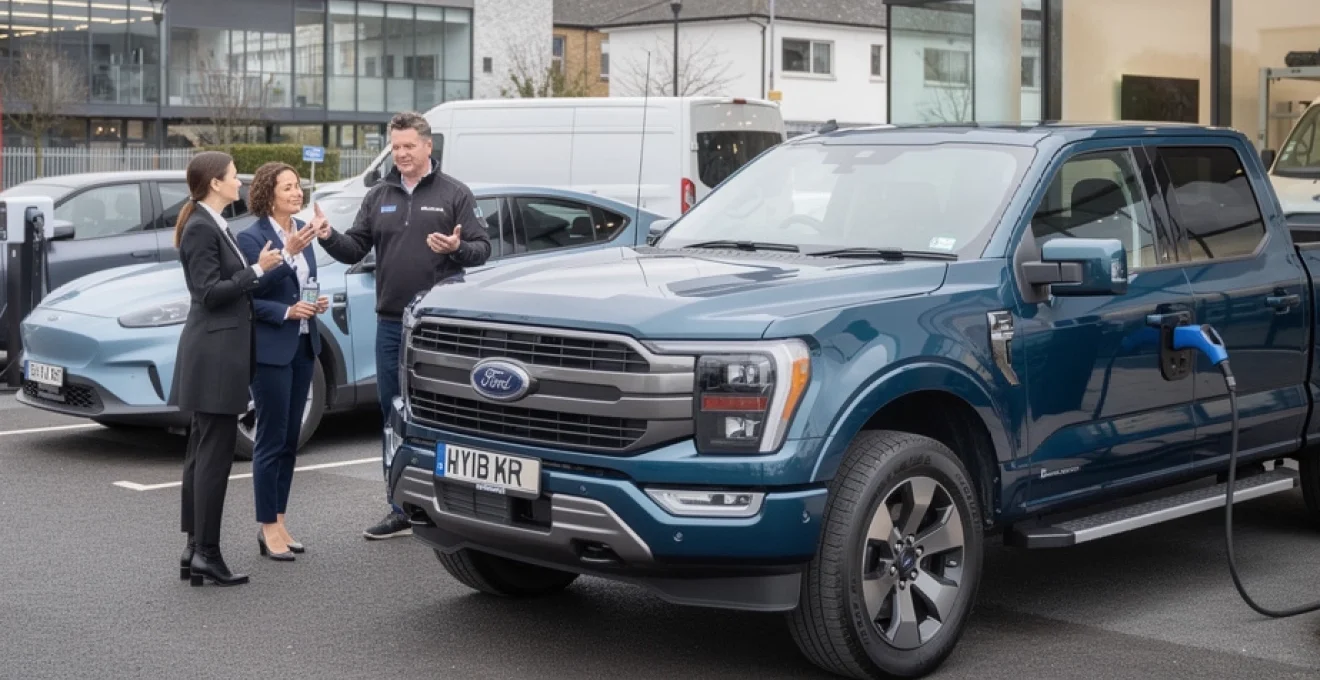
The electric vehicle revolution has transformed the automotive landscape across Europe, yet one of America’s most iconic electric trucks remains conspicuously absent from British roads. The Ford F-150 Lightning, which has captured significant attention in the United States market since its 2022 launch, represents a fascinating case study in regional market dynamics and regulatory complexity. This battery-powered version of America’s best-selling pickup truck offers impressive capabilities, including up to 320 miles of range and the ability to power an entire home during outages, yet British consumers face considerable challenges in accessing this innovative vehicle.
Understanding the availability of the F-150 Lightning in the UK requires examining multiple layers of automotive regulation, market strategy, and consumer demand patterns that differ significantly between North American and European markets.
Ford F-150 lightning official UK market availability status
Ford has not officially introduced the F-150 Lightning to the UK market through its conventional dealer network, making it impossible to purchase this electric pickup truck through standard retail channels. This absence stems from Ford Europe’s strategic focus on different vehicle segments that better align with European consumer preferences and regulatory requirements. The company’s European division has prioritised commercial electric vehicles like the Transit E-Series and passenger cars such as the Mustang Mach-E, which demonstrate stronger market demand across the continent.
The decision to exclude the F-150 Lightning from official UK sales reflects broader market realities about pickup truck adoption in Britain. Unlike the United States, where pickup trucks account for approximately 20% of all vehicle sales, the UK market shows minimal demand for full-size pickup trucks, with most consumers preferring compact SUVs, hatchbacks, and estate cars for their daily transportation needs. This fundamental difference in consumer behaviour influences manufacturer decisions about which models justify the substantial investment required for European market certification and localisation.
Ford’s official position regarding UK availability remains unchanged since the Lightning’s initial launch, with no announced plans for right-hand drive production or European market adaptation. The company has consistently emphasised its commitment to electrification in Europe through different vehicle platforms that better match regional preferences and infrastructure capabilities.
Right-hand drive configuration and UK homologation requirements
The absence of right-hand drive configuration represents one of the most significant barriers preventing UK sales of the Ford F-150 Lightning. Converting a vehicle designed specifically for left-hand drive markets involves extensive engineering modifications that extend far beyond simply relocating the steering wheel. The entire dashboard architecture, electrical systems, HVAC components, and safety systems require comprehensive redesign to accommodate right-hand drive specifications while maintaining optimal functionality and safety standards.
DVSA type approval process for electric pickup trucks
The Driver and Vehicle Standards Agency (DVSA) requires comprehensive type approval for all vehicles sold in the UK market, a process that becomes particularly complex for electric pickup trucks not originally designed for European standards. The F-150 Lightning would need to undergo extensive testing to demonstrate compliance with UK-specific regulations covering everything from electromagnetic compatibility to pedestrian protection systems. This process typically requires 12-18 months of testing and documentation, representing a significant investment for manufacturers targeting relatively small market segments.
Euro NCAP safety rating certification timeline
European safety standards differ substantially from their American counterparts, necessitating separate crash testing and safety certification processes. The F-150 Lightning would require Euro NCAP testing to achieve the safety ratings expected by UK consumers and mandated by insurance providers. This testing process alone can cost manufacturers upwards of £500,000 per vehicle model, not including the additional costs of any design modifications required to achieve acceptable safety ratings in European testing scenarios.
WLTP range testing compliance for UK market
The Worldwide Harmonised Light Vehicle Test Procedure (WLTP) represents another critical hurdle for American electric vehicles entering the UK market. The F-150 Lightning’s EPA-rated range figures would require complete re-testing under WLTP conditions, which typically produce different results due to varying test parameters and environmental conditions. This testing must be conducted by certified European facilities using vehicles specifically configured for European markets, adding both time and expense to the certification process.
Charging infrastructure compatibility with CCS2 standards
The F-150 Lightning currently uses the CCS1 charging standar
— the North American Combined Charging System with the original Type 1 AC connector. By contrast, the UK and wider European market use the CCS2 standard, which combines DC fast charging pins with a Type 2 AC connector. Any Ford F-150 Lightning imported into Britain therefore needs either a hardware retrofit, an adapter solution approved by the manufacturer, or access to specialist charging infrastructure configured for CCS1. While some import specialists can facilitate these modifications, they add cost and complexity and may limit full compatibility with the fastest public chargers available on the UK’s high‑power networks.
Home charging presents fewer issues because most AC wallboxes simply supply power through a tethered or untethered cable that can be matched to the vehicle’s inlet. However, if you want to use the F-150 Lightning as intended with frequent high‑speed DC charging on long journeys, you will need to carefully research where CCS1-compatible chargers are available or whether your chosen importer can provide a safe and compliant CCS1-to-CCS2 conversion. This is a key consideration if you are wondering whether you can realistically live with a Ford F-150 Lightning in the UK rather than just occasionally enjoy it.
Ford europe electric vehicle strategy and market positioning
To understand why the F-150 Lightning is not officially sold in Britain, it helps to look at Ford Europe’s overarching electric vehicle strategy. Rather than stretching engineering and regulatory resources across every possible niche, Ford has chosen to focus on the segments with the highest demand and the clearest policy support in Europe: compact and midsize vans, crossovers, and family EVs. This means capital is being directed towards platforms that can be sold in high volumes across many European markets, including the UK, instead of niche products like a full‑size American electric pickup.
Ford has publicly committed to offering an all‑electric passenger car range in Europe by the mid‑2030s, with interim targets that rely heavily on models that are already successful or have strong potential in urban and suburban environments. While enthusiasts may be eager to see the Ford F-150 Lightning cruising British roads, the reality is that Ford’s European business case is currently dominated by vehicles like the Transit Custom, E-Transit, Puma, and Mustang Mach‑E. These models better align with European road sizes, emissions regulations, and total cost-of-ownership expectations for both private and fleet buyers.
Transit E-Series commercial EV priority focus
At the core of Ford Europe’s electrification plan is the Transit E‑Series, including the E‑Transit and E‑Transit Custom. These electric vans tap into a huge and growing market for zero‑emission commercial vehicles, driven by urban clean air zones, corporate sustainability targets, and government incentives. For many fleets, an electric van offers immediate, measurable savings in fuel and maintenance costs, making it far easier to justify than a lifestyle‑oriented electric pickup truck.
From Ford’s perspective, every engineering hour spent adapting the F-150 Lightning to UK regulations is an hour not spent refining its electric van range, where demand is higher and margins can be healthier thanks to fleet contracts. The Transit E‑Series also benefits from strong brand recognition; tradespeople and delivery companies already trust the Transit badge, making the switch to an electric version more straightforward. In effect, Ford is prioritising the vehicles that keep European cities moving every day over a halo product that would appeal to a relatively small number of UK buyers.
Mustang Mach-E success metrics in european markets
The Mustang Mach‑E is another pillar of Ford’s electric strategy in Europe, and its performance helps explain why the F-150 Lightning sits on the sidelines. Since its introduction, the Mach‑E has consistently ranked among the more popular midsize electric SUVs in several European countries, including the UK, Germany, and Norway. It competes directly with models like the Tesla Model Y, Volkswagen ID.4, and Hyundai Ioniq 5, all of which inhabit a segment that Europeans have embraced enthusiastically.
By focusing on the Mustang Mach‑E and its successors, Ford is targeting a large pool of buyers who want a practical, premium-feeling EV that fits comfortably on European roads and in typical parking spaces. The Mach‑E’s success provides real-world data on charging behaviour, range expectations, and price sensitivity across European markets. This data then feeds into Ford’s future product planning. When the company analyses these metrics against the relatively niche appeal of full‑size pickups, it becomes clear why the Mustang Mach‑E gets the investment, while the F-150 Lightning remains effectively a US‑centric product with limited European experiments, such as the Norwegian launch.
Cologne electric vehicle centre production capacity
Ford’s Cologne Electric Vehicle Centre in Germany is a flagship facility dedicated to producing next‑generation EVs for European customers. The plant, which has received multi‑billion‑euro investment, will build several new electric crossovers based on Volkswagen’s MEB platform and Ford’s own future architectures. Production capacity here is finite, and Ford must decide which models will deliver the best return on investment and meet its emissions reduction targets across the EU and UK.
Allocating precious manufacturing slots to a right‑hand drive Ford F-150 Lightning would require diverting capacity away from high‑volume vehicles that are specifically designed for Europe. Instead, Ford is using Cologne to serve the mainstream EV market, where demand is strongest. In simple terms, this means we are more likely to see additional electric crossovers and compact SUVs rolling out of Cologne than a European‑spec Lightning anytime soon. For British buyers dreaming of an official UK‑spec F-150 Lightning, the current production strategy suggests a long wait.
UK government van electrification grant scheme alignment
Another major factor behind Ford’s European EV priorities is alignment with UK and EU incentive schemes, many of which are tailored to vans and business vehicles. The UK’s plug‑in van grant and various local authority schemes make it financially attractive for companies to switch from diesel vans to electric alternatives. These incentives do not generally extend to large, US‑style pickup trucks, particularly when they are imported in small numbers and sit outside standard type approval frameworks.
By focusing on the Transit E‑Series and other commercial EVs, Ford can position itself as a key partner for British businesses and public sector fleets trying to cut emissions. This strategic alignment supports steady, predictable sales volumes, which in turn strengthen the business case for further EV investment. While there may be a handful of UK customers willing to pay a premium for an electric pickup like the F-150 Lightning, they do not represent the same policy‑driven opportunity as fleets replacing hundreds or thousands of diesel vans with electric models that qualify for grants and tax advantages.
Alternative electric pickup truck options available in the UK
If you are drawn to the idea of an electric pickup but frustrated by the limited availability of the Ford F-150 Lightning in the UK, you might be wondering what alternatives exist. The electric pickup segment is still in its infancy in Britain, but several manufacturers are actively working on products that could fill this gap in the coming years. Some are closer to market than others, and availability may initially be limited to certain fleet customers or specific European countries.
While none of these contenders perfectly replicate the sheer size and presence of the F-150 Lightning, they offer interesting insights into how different brands are approaching the challenge of building an electric workhorse for European roads. From established names like Isuzu and Mercedes‑Benz to newer players such as Rivian and Tesla, the race to deliver a usable, road‑legal electric pickup truck in the UK is gathering pace, even if the finish line is still a few model years away.
Isuzu D-Max EV development timeline
Isuzu has long been a key player in the UK pickup market with its D‑Max range, which is popular among tradespeople, farmers, and utility companies. In recent years, the brand has confirmed that it is actively working on electrified variants, including plug‑in hybrid and fully electric options, to meet tightening emissions standards. While a production‑ready Isuzu D‑Max EV has not yet reached UK showrooms, reports from industry insiders suggest that a battery‑electric version is on the roadmap for the late 2020s.
For UK buyers who value practicality and reliability over headline‑grabbing performance, an electric D‑Max could be a compelling option. Because Isuzu already designs its pickups with European regulations and right‑hand drive markets in mind, an EV version would likely integrate more seamlessly into existing type approval frameworks than a US‑imported Ford F-150 Lightning. The trade‑off, of course, is that the D‑Max EV may be smaller and less powerful than the Lightning, but it should be better suited to UK roads and payload regulations.
Rivian R1T european launch strategy
The Rivian R1T has become one of the most talked‑about electric pickups in the world, thanks to its combination of off‑road capability, luxury interior, and innovative features like the “gear tunnel” storage area. Although Rivian is a US‑based manufacturer, it has made clear its ambitions to expand into Europe. The company has opened facilities in the Netherlands and has explored potential partnerships for European distribution, although specific timelines for right‑hand drive models remain fluid.
In the UK, access to the Rivian R1T currently depends on specialist importers and hire companies rather than an official dealer network. Some firms already offer R1T hire, giving British drivers a rare opportunity to experience a cutting‑edge electric pickup without committing to ownership. If Rivian proceeds with a full European launch, including type approval and potentially a right‑hand drive variant, the R1T could become one of the first American‑style electric pickups to be legitimately and widely available in Britain, posing a direct alternative to the Ford F-150 Lightning for buyers prioritising adventure and technology.
Tesla cybertruck UK Pre-Order status
The Tesla Cybertruck is perhaps the most polarising electric pickup on the planet, with a radically angular design and ambitious performance claims. Tesla initially accepted global pre‑orders, including from UK customers, with a simple refundable deposit process. However, as production has ramped up in North America, the company has quietly adjusted its messaging, and there is still no confirmed timeline for a right‑hand drive Cybertruck or formal UK market launch.
For those considering a Cybertruck as an alternative to a Ford F-150 Lightning, it is important to recognise the uncertainties involved. Even if Tesla eventually brings the Cybertruck to Europe, its sheer size and unconventional design may pose challenges for homologation, pedestrian safety regulations, and practical everyday use on narrow British streets. Until Tesla makes a clear statement about UK availability and type approval, the Cybertruck remains more of a futuristic concept for British buyers than a concrete alternative you can plan around.
Mercedes-benz EQT pickup variant speculation
At the more compact end of the market, there has been ongoing speculation about a potential pickup variant based on the Mercedes‑Benz EQT, itself an electric small van derived from the T‑Class. While Mercedes has not officially confirmed an EQT pickup, the brand does have a history of experimenting with pickup derivatives, as seen with the X‑Class in the past. An electric compact pickup aligned with the EQT platform could theoretically appeal to urban tradespeople who want zero‑emission capability without the bulk of a full‑size truck.
Even if such a model appears, it would occupy a very different niche from the Ford F-150 Lightning. Think of it more as an electric utility vehicle for city deliveries and light‑duty use than a high‑towing, high‑payload truck designed to cross continents. Still, the mere possibility of an EQT‑based pickup underscores a broader trend: European manufacturers are exploring new ways to combine electric drivetrains with practical, open‑bed designs that make sense for local conditions, rather than importing US‑sized solutions wholesale.
Grey market import considerations and legal implications
Given the lack of official UK availability, many enthusiasts who want a Ford F-150 Lightning in Britain turn to grey market imports. This route can indeed put you behind the wheel of an electric F‑Series, but it comes with a range of legal, financial, and practical considerations that you should fully understand before making a commitment. Importing any vehicle not officially sold in the UK is more complex than simply shipping it across the Atlantic and registering it with the DVLA.
First, the vehicle must meet UK roadworthiness and emissions standards, which can involve individual vehicle approval (IVA) inspections and modifications to lighting, mirrors, and even seatbelt anchorage points. Second, insurance for a grey‑import electric pickup can be more expensive and harder to obtain, because underwriters have limited data on repair costs, parts availability, and safety performance in European conditions. Finally, you should consider aftersales support: if your Ford F-150 Lightning needs warranty work or specialised diagnostics, a standard UK Ford dealer may not be willing or able to assist.
There are also potential tax implications. Import duties, VAT, and shipping costs can significantly increase the total price of an F-150 Lightning by the time it is legally on British plates. While some buyers accept these costs as the price of exclusivity, others may find that the final bill exceeds even high‑end European EVs or luxury SUVs. It is therefore wise to work with reputable import specialists, obtain written quotations for all stages of the process, and seek independent legal and financial advice before proceeding. In short, yes, you can buy a Ford F-150 Lightning in the UK via the grey market, but doing so is far from a simple dealership transaction.
Future prospects for american electric pickup trucks in britain
Looking ahead, will we ever see American electric pickup trucks like the Ford F-150 Lightning sold officially in the UK? The answer depends on several evolving factors: UK and EU emissions regulations, consumer demand for pickups, charging infrastructure, and the strategic priorities of manufacturers. As the UK pushes towards its zero‑emission targets for new vehicles in the 2030s, there may be growing pressure on brands to offer a broader range of electric options, including larger and more capable models suitable for towing and heavy-duty work.
At the same time, the economics of developing right‑hand drive, Euro‑homologated versions of US‑centric pickups will only make sense if demand increases materially. If British consumers and fleets continue to favour vans and midsize SUVs over full‑size trucks, Ford and its rivals may choose to keep their electric pickups focused on North America and a handful of niche European markets. However, if businesses begin to demand electric replacements for traditional double‑cab pickups used in construction, utilities, and rural industries, the case for official imports could strengthen significantly.
There is also a broader cultural question: will British drivers embrace American‑style electric pickups as lifestyle vehicles in the same way that US buyers have? As more people experience vehicles like the Rivian R1T and Ford F-150 Lightning through hire fleets, events, and media coverage, perceptions may shift. For now, though, anyone asking “Can you buy a Ford F-150 Lightning in the UK?” must navigate a reality shaped by limited official support, regulatory hurdles, and the need to rely on specialist importers. The landscape is changing fast, and what feels like a niche curiosity today could become a more familiar sight on UK roads in the next decade if market forces and policy incentives align.