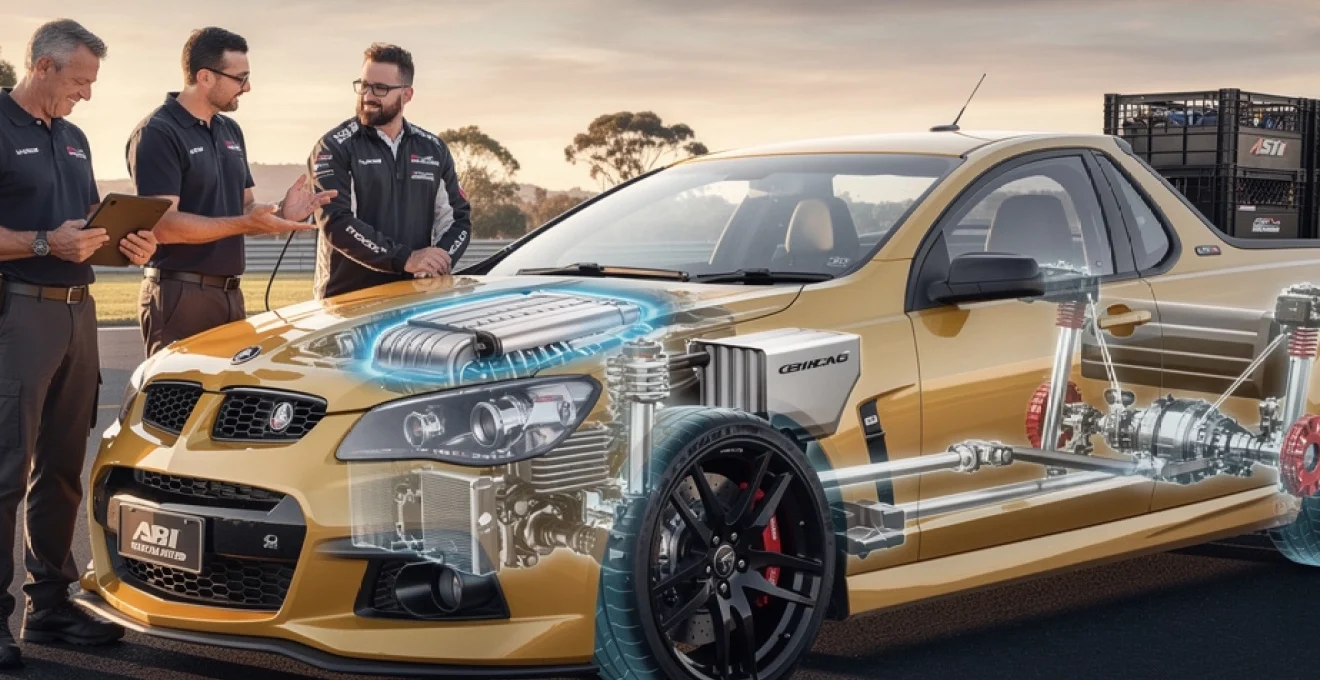
The automotive world has witnessed countless performance vehicles throughout history, but few have captured the imagination quite like the HSV Maloo. This Australian-engineered masterpiece represents something genuinely unique in the global automotive landscape: a genuine supercar-slaying pickup truck that combines 340 kilowatts of raw V8 power with load-carrying capability. Born from Holden Special Vehicles’ ambition to create the ultimate performance utility, the Maloo carved out a niche that conventional thinking suggested couldn’t exist. For those seeking a vehicle that defies categorisation, delivering tarmac-shredding performance whilst maintaining practical load-hauling credentials, this Australian icon stands alone.
With production now ceased following the closure of Holden’s Melbourne manufacturing facility, the Maloo has transitioned from controversial curiosity to sought-after collector’s piece. Understanding the engineering philosophy, performance specifications, and evolutionary development of this remarkable vehicle provides insight into what makes it such a compelling proposition for enthusiasts worldwide.
HSV maloo genesis: from holden special vehicles to performance ute icon
The Maloo nameplate emerged from HSV’s desire to translate sedan performance credentials into utility vehicle format. The Australian vernacular term “maloo” derives from indigenous language meaning “thunder,” a fitting descriptor for what would become one of the most aurally impressive vehicles on public roads. HSV recognised that the Australian market harboured unique appetite for performance utilities, creating an opportunity that mainstream manufacturers overlooked.
VU series launch and initial LS1 V8 powertrain integration
The inaugural VU series Maloo launched in 2000, establishing the fundamental template that subsequent generations would refine. Powered by the venerable LS1 5.7-litre naturally aspirated V8 engine producing 255 kilowatts, this first iteration demonstrated that performance and utility need not exist as mutually exclusive propositions. The LS1 architecture brought proven reliability alongside substantial output, creating a foundation upon which HSV could build increasingly potent variants.
Engineering challenges abounded in adapting high-performance powertrains to utility vehicle architecture. The rear suspension required complete redesign to accommodate both spirited driving dynamics and load-carrying capability. HSV’s suspension engineers developed bespoke damper settings and spring rates that compromised neither performance nor practicality excessively, though payload capacity inevitably suffered compared to standard Holden utilities.
VY through VZ evolution: supercharged configurations and output progression
The VY series introduced in 2003 brought evolutionary improvements across powertrain and chassis domains. Power output climbed incrementally as HSV refined engine calibrations and exhaust systems. However, the VZ generation represented a watershed moment with the introduction of forced induction variants. The supercharged LS2 configuration delivered 307 kilowatts, transforming the Maloo’s character from potent to devastating.
This supercharged architecture fundamentally altered the driving experience. Where naturally aspirated variants required high revolutions to access peak performance, forced induction delivered instantaneous torque delivery from minimal engine speeds. The supercharger’s characteristic whine became as integral to the Maloo’s identity as its muscular styling.
E series refinement: LSA 6.2-litre forced induction architecture
The E Series introduced in 2006 brought the most comprehensive overhaul in Maloo history. HSV adopted the LSA 6.2-litre supercharged V8, sharing architecture with Chevrolet’s most potent performance applications. Output reached 325 kilowatts with 550 Newton-metres of torque, positioning the Maloo among genuine sports car territory for straight-line performance. The LSA’s Eaton supercharger utilised more efficient rotor profiles than predecessors, improving thermal management under sustained high loads.
Interior appointments received substantial upgrades during the E Series tenure. HSV recognised that buyers investing substantial sums expected premium materials and technology. The introduction of leather-wrapped surfaces, improved sound insulation, and enhanced infotainment systems elevated the ownership experience beyond previous generations’ somewhat spartan offerings.
GEN-F and GEN-F2
GEN-F and GEN-F2 swansong: final 435kw LSA specifications
The GEN-F and GEN-F2 generations represent the ultimate expression of the HSV Maloo concept. Launched in 2013, GEN-F introduced the LSA 6.2-litre supercharged V8 to the Maloo range in full, delivering outputs of up to 430–435 kilowatts and 740 Newton-metres in top specifications. These figures placed the Maloo firmly in supercar territory, with real-world performance capable of embarrassing many dedicated sports coupes. GEN-F2 refinements focused on durability, cooling, and driveline calibration, ensuring that this wild V8 pickup could sustain repeated high-load use without compromising reliability.
Visual and functional enhancements distinguished these final Maloo models from earlier generations. Wider guards, more aggressive front bumpers, and functional air intakes communicated the underlying performance potential, while updated lighting signatures modernised the overall appearance. Inside, GEN-F and GEN-F2 Maloos benefitted from improved infotainment, enhanced driver information systems, and more sophisticated safety suites, including lane departure warning and blind spot monitoring. As Holden’s local manufacturing end drew near, HSV positioned the Maloo GEN-F2 as a fitting farewell: the last, and most powerful, expression of Australia’s performance ute culture.
LSA supercharged V8 engineering: powertrain architecture and performance metrics
At the heart of the most desirable HSV Maloo variants lies the LSA 6.2-litre supercharged V8, a powertrain shared with iconic models such as the Chevrolet Camaro ZL1. This engine delivers the sort of effortless thrust that defines the Maloo’s character, combining American small-block heritage with Australian calibration expertise. For enthusiasts evaluating a used HSV Maloo or comparing it with modern performance pickups, understanding this LSA architecture is essential. It explains not only the headline 435kW power figure, but also the way the Maloo delivers speed in everyday driving.
The LSA’s engineering is focused on robust, repeatable performance rather than fragile, one-off power figures. Reinforced internals, advanced cooling strategies, and conservative factory tuning leave headroom for reliability and, for those inclined, aftermarket modification. When you consider the Maloo’s dual nature as both a performance car and a utility, this durability focus makes particular sense. It ensures that even when used as a daily driver, towing vehicle, or occasional track toy, the LSA-powered Maloo maintains composure and longevity.
Eaton R1740 TVS supercharger technology and boost delivery
The LSA’s forced-induction capability is built around the Eaton R1740 TVS supercharger, a key contributor to the HSV Maloo’s explosive mid-range performance. This roots-type blower uses four-lobe rotors with a 160-degree twist, improving efficiency and reducing heat compared to older three-lobe designs. In practical terms, that means more consistent power under sustained load, such as spirited mountain driving or extended track sessions. Unlike many turbocharged setups, the Maloo’s supercharged V8 responds almost instantaneously to throttle inputs, delivering boost without perceptible lag.
Boost pressure in factory LSA Maloo applications typically sits in the 9–10psi range, a level chosen to balance output with engine longevity. By integrating an air-to-water intercooler within the supercharger housing, HSV can tightly control intake temperatures even in demanding Australian climates. This integrated design shortens the intake path and reduces latency, much like shortening the distance between a tap and a glass speeds up filling. For owners, the payoff is a consistent feeling of shove whenever you flex your right foot, whether you are overtaking on the highway or launching off the line.
Quad-cam aluminium block construction and thermal management systems
Although commonly referred to as a “simple pushrod V8,” the LSA’s construction and supporting systems are anything but primitive. The engine utilises an aluminium block with deep-skirt design, cross-bolted main caps, and high-strength internals designed to withstand both supercharged pressures and extended high-rpm operation. While it remains a single-cam, two-valve-per-cylinder pushrod layout rather than a literal quad-cam arrangement, HSV’s calibration and ancillary hardware achieve sophistication on par with many multi-cam rivals. Lightweight aluminium architecture also contributes to better front axle weight distribution, a crucial factor in a performance ute.
Thermal management plays a decisive role in maintaining the Maloo’s repeatable performance. Beyond the charge-cooling system integrated into the supercharger, the LSA engine features high-capacity radiators, dedicated engine oil coolers, and, in some specifications, transmission and power steering coolers. Think of this layered cooling approach as a multi-stage air-conditioning system for the powertrain: each component manages heat in its own domain to prevent overall system overload. For drivers in hot regions or those planning track use, these factory systems significantly reduce the risk of heat-related power fade.
Tremec TR6060 six-speed manual versus GM 6L80E automatic transmission dynamics
HSV offered the LSA-powered Maloo with a choice of two transmissions: the Tremec TR6060 six-speed manual and the GM 6L80E six-speed automatic. The manual gearbox appeals to purists, offering a direct mechanical connection and precise gear engagement that suits enthusiastic driving. Its close ratios and solid shift action encourage drivers to explore the engine’s rev range, making every drive an event. For those chasing the most engaging HSV Maloo experience, the TR6060-equipped ute is often considered the enthusiast’s pick.
The 6L80E automatic, however, should not be underestimated. Featuring adaptive shift logic, manual shift modes, and in later models steering wheel-mounted paddles, it offers a compelling blend of convenience and control. In real-world conditions—stop-start traffic, towing, or daily commuting—the automatic often makes more sense, delivering smoother acceleration and optimised fuel use. The torque converter’s ability to multiply torque at low speeds also aids initial launch, an advantage in a rear-drive pickup managing 740Nm through relatively modest rear tyres. When comparing an HSV Maloo manual versus automatic, the decision ultimately hinges on whether you prioritise involvement or effortless speed.
Torque output analysis: 740nm peak performance and real-world application
The headline 740Nm torque figure associated with high-spec GEN-F2 Maloo LSA models defines the driving experience more than the peak power. Unlike naturally aspirated engines that often require high revs for maximum thrust, the supercharged LSA delivers strong torque from as low as 2,000rpm. This broad torque curve makes the Maloo deceptively quick in everyday situations, such as short on-ramps or country-road overtakes. You do not need to chase the redline to access the performance; it is simply there whenever you lean on the throttle.
From a practical standpoint, this abundant low and mid-range torque also supports the Maloo’s utility credentials. Towing moderate loads, carrying gear in the tray, or climbing steep gradients becomes effortless, even with the vehicle loaded. It is similar to having a powerful winch that never feels strained, no matter how tough the task appears. Of course, that same torque demands respect in wet or loose conditions, particularly in manual models without electronic intervention engaged. Sensible throttle modulation and quality tyres become essential for safely exploiting everything the HSV Maloo’s LSA powertrain can offer.
Chassis dynamics and suspension tuning: FE2 sport calibration explained
Delivering supercar-level performance in a pickup chassis requires more than just a powerful engine; it demands a carefully engineered suspension and chassis package. HSV’s FE2 sport calibration is central to the Maloo’s ability to combine handling precision with usable ride comfort. Building on the underlying Holden Commodore ute platform, HSV retuned springs, dampers, and anti-roll bars to cope with both lateral cornering forces and occasional load carrying. The result is a dynamic balance that allows the Maloo to be driven hard on a twisty road yet remain tolerable as a daily driver.
Compared with standard Holden utilities, the Maloo’s suspension sits lower and is significantly firmer, especially at the rear. This reduction in ride height lowers the centre of gravity, aiding turn-in and reducing body roll during enthusiastic driving. Inevitably, there is a compromise in unladen ride quality, particularly over broken surfaces, where the firmer rear can feel busy. For buyers considering a Maloo as both a weekend toy and workhorse, understanding this FE2 calibration helps set realistic expectations about comfort and dynamic capability.
Macpherson strut front and independent rear suspension geometry
Underneath the HSV Maloo lies a sophisticated suspension layout relative to many traditional pickups. The front end uses a MacPherson strut arrangement with coil springs, anti-roll bar, and revised bushings, tuned by HSV to enhance steering response and feedback. By tailoring camber, caster, and toe settings, engineers achieved a balance between stability at high speeds and agility in tighter bends. You can feel this when guiding a Maloo through a series of sweeping corners, where the nose responds faithfully without excessive understeer.
The rear suspension of later-generation Maloo models employs an independent rear architecture derived from the Commodore platform, with HSV-specific spring and damper rates. Independent rear suspension allows each wheel to react to bumps separately, improving grip and composure over uneven roads compared with a traditional live axle. It is akin to giving each leg of a runner its own suspension: the athlete remains more stable and controlled over rough terrain. HSV further reinforced key mounting points to handle the combined demands of performance driving and occasional payload, ensuring durability matched the dynamic ambition.
Magnetic ride control integration across GEN-F variants
Certain GEN-F HSV models, particularly the GTS sedan, introduced Magnetic Ride Control (MRC), an adaptive damping system using magnetorheological fluid within the dampers. While not universally fitted across all Maloo variants, the technology is relevant when comparing Maloo R8 and GTS-derived setups. MRC allows the suspension to alter its damping characteristics in milliseconds by varying an electromagnetic field inside the shock absorber. This gives engineers the ability to tune for both comfort and handling with minimal compromise, adjusting in real time to road conditions and driving style.
For Maloo buyers, understanding MRC highlights how HSV approached chassis tuning across the broader GEN-F range. Even where conventional dampers are used, the learnings from MRC calibration inform spring and damper choices, helping HSV deliver a compliant yet controlled ride. In practice, you notice this as the Maloo remains relatively composed over mid-corner bumps, rather than becoming unsettled or skittish. While a Maloo may not match the GTS for adaptive sophistication, its FE2 settings benefit from the same development philosophy, providing reassuring stability at speed.
Brembo braking package: six-piston front caliper specifications
With up to 435kW and 740Nm on tap, the HSV Maloo demands a braking system worthy of its performance. HSV addressed this with a Brembo package that, in higher-spec variants, includes six-piston front calipers clamping large ventilated discs. These multi-piston calipers distribute clamping force more evenly across the pad surface, improving both stopping power and pedal feel. In emergency braking scenarios, this translates into shorter stopping distances and greater confidence for the driver.
Rear braking hardware generally consists of four-piston calipers with similarly generous disc dimensions, ensuring balanced braking performance across both axles. The combination of high-friction pads, large rotors, and performance-focused ABS calibration enables the Maloo to withstand repeated hard stops, such as on a track day or spirited mountain descent. Imagine trying to slow a loaded freight train with bicycle brakes: the mismatch would be obvious and unsafe. By contrast, the Brembo system equips the Maloo with suitably powerful anchors that match its straight-line acceleration capabilities.
Payload capacity versus performance: engineering the 810kg tray load compromise
One of the most intriguing aspects of the HSV Maloo is how it reconciles performance car dynamics with the practical expectations of a pickup. While the Maloo’s payload capacity is reduced compared with a standard Holden utility, later models still offer tray load ratings of up to approximately 810kg, depending on specification. This figure reflects a deliberate engineering compromise: enough capacity for recreational gear, light trade use, or track-day equipment, but not so much that it undermines the finely tuned suspension. For many buyers, this middle ground is precisely what makes the Maloo so compelling.
To achieve this balance, HSV’s engineers adjusted rear spring rates, damper valving, and bump stop design to cope with both spirited driving and moderate loading. Load a Maloo close to its rated payload and you will notice a more settled rear ride, as the suspension moves into a more neutral operating window. Unladen, the firmer tune prioritises handling, even if that means a slightly fidgety response over poor surfaces. If you plan to use an HSV Maloo as an occasional work vehicle, it is wise to carefully consider average loads and how often the tray will be full versus empty.
From a real-world usability perspective, the Maloo’s tray is perfectly suited to lifestyle and enthusiast activities. Transporting track tyres, tools, camping equipment, or mountain bikes falls well within its comfort zone, especially when combined with the LSA’s towing capability. What it is less suited to is sustained heavy construction work, where a traditional one-tonne ute with softer rear springs and a simpler driveline might be more appropriate. Framed this way, the Maloo is best understood as a performance car that happens to have a usable tray, rather than a full-duty work truck that also happens to be fast.
HSV maloo R8 versus GTS: model differentiation and variant hierarchy
Within HSV’s performance hierarchy, the Maloo R8 and GTS occupy related but distinct positions. The GTS sedan has typically been regarded as the flagship model, showcasing the most advanced technology and highest levels of refinement. The Maloo R8, by contrast, sits as the ultimate expression of the performance ute concept, combining similar powertrain hardware with the practical twist of an open tray. When assessing HSV Maloo R8 versus GTS, it helps to view them as siblings with shared DNA but different missions.
Power outputs between comparable-generation Maloo R8 and GTS variants often differ only marginally, especially in LSA-equipped GEN-F and GEN-F2 models. Where the GTS tends to pull ahead is in chassis technology, with broader application of Magnetic Ride Control, torque vectoring by braking, and more advanced stability control strategies. The Maloo R8, however, benefits from a slightly lower kerb weight and a different weight distribution due to its ute body style. On a tight, technical road, a skilled driver can exploit these differences to make the Maloo feel surprisingly agile despite its commercial-vehicle roots.
In terms of equipment and interior luxury, the GTS usually takes the lead with more comprehensive trim packages, additional driver assistance features, and higher-grade materials. The Maloo R8 remains well-appointed, particularly in later GEN-F iterations, but retains a slightly more utilitarian feel consistent with its pickup format. For buyers cross-shopping between an HSV Maloo and GTS, the decision frequently comes down to practicality and image: do you prefer the sleeper appeal of a super-saloon, or the more extroverted statement of a supercharged V8 ute? In collector circles, both hold strong appeal, yet the Maloo’s rarity outside Australia often gives it a unique desirability.
Collector market trajectory: GEN-F2 final edition valuation and rarity premium
Since Holden’s local manufacturing ended and HSV ceased building new Maloo models, the collector market has taken keen interest in late-gen examples, particularly the GEN-F2 Final Edition. Limited production numbers, combined with the ultimate 435kW LSA specification, have created strong demand among enthusiasts and investors alike. In Australia, auction results over recent years have shown values for low-kilometre, well-documented cars trending upward, in some cases surpassing original retail pricing. For buyers considering an HSV Maloo as both a passion purchase and potential asset, these trends are especially relevant.
Rarity outside Australia further amplifies the Maloo’s appeal in markets such as the UK and New Zealand, where official imports were limited. LSA-powered VXR8 Maloo models, for example, have developed a cult following, attracting buyers who appreciate their combination of supercharged performance and Aussie character. As emissions regulations tighten and V8-powered performance vehicles become scarcer, it is reasonable to expect that well-preserved Maloo GEN-F2 examples will continue to command a premium. However, like any collectible vehicle, condition, originality, and service history play decisive roles in long-term value.
For prospective owners, a pragmatic approach is essential. You should prioritise mechanical health, documented maintenance, and minimal modification over speculative price appreciation alone. Cars used regularly but maintained fastidiously often age better than low-use examples neglected in storage. If you plan to enjoy your HSV Maloo on the road—as its engineers intended—consider investing in quality tyres, regular fluid changes, and professional inspections. In doing so, you not only protect your investment but also ensure that this uniquely Australian blend of supercar performance and pickup practicality can be experienced as originally envisioned, even as values climb.