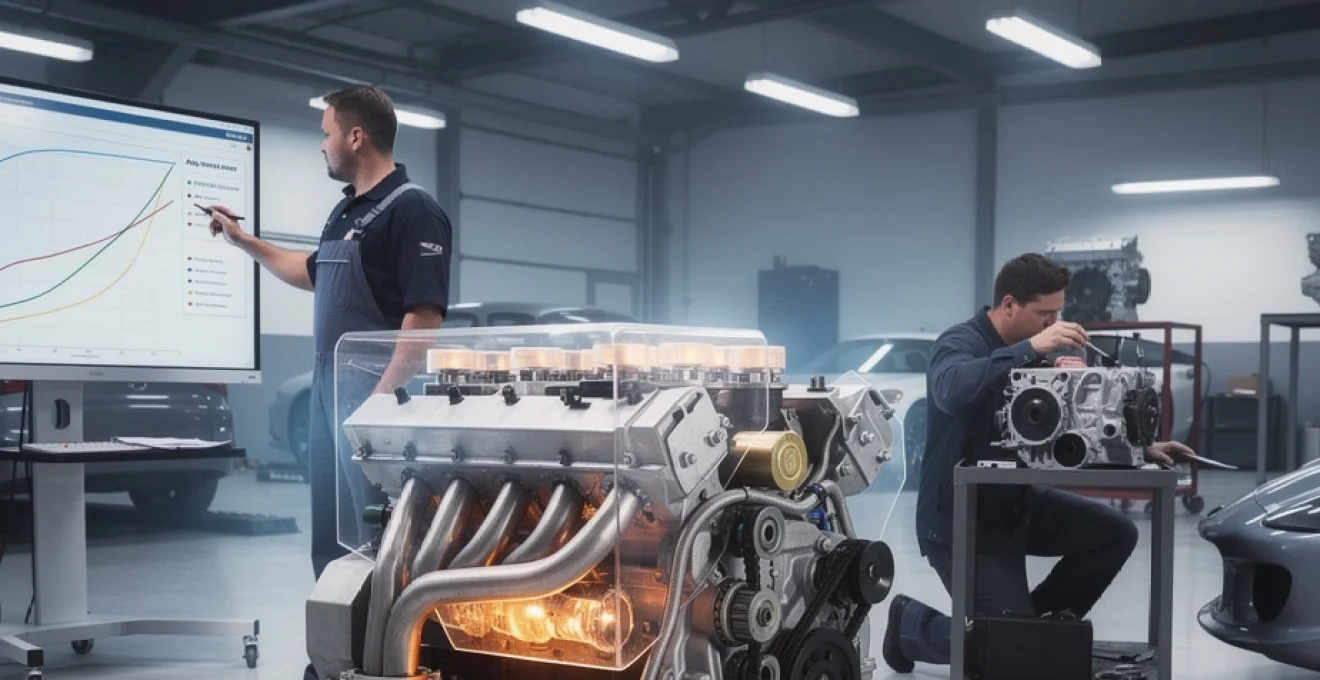
The TVR Speed Six engine stands as one of the most ambitious and controversial powerplants in British automotive history. Introduced in 1999 as TVR’s first fully in-house designed engine, this naturally aspirated inline-six represented the company’s bold move away from dependence on external suppliers like Rover. The Speed Six powered some of TVR’s most iconic models, including the Tuscan, Tamora, T350, and the track-focused Sagaris, delivering exhilarating performance while simultaneously earning a reputation for mechanical complexity that both thrilled enthusiasts and challenged owners.
Understanding the Speed Six’s technical sophistication reveals why it became such a polarising unit among sports car enthusiasts. While critics pointed to reliability concerns and maintenance demands, supporters praised its racing-derived architecture and distinctive sound signature that set it apart from conventional production engines. This engine’s legacy continues to influence discussions about performance engine design, particularly regarding the balance between outright power delivery and long-term durability in low-volume sports car manufacturing.
TVR speed six engine architecture and technical specifications
Inline-six naturally aspirated configuration design principles
The Speed Six’s inline-six configuration represents a carefully considered engineering decision that prioritises both performance characteristics and packaging requirements. Unlike the traditional V8 engines TVR had previously employed, the straight-six layout offers inherent balance advantages through its naturally smooth operation at high RPM ranges. The inline configuration eliminates the need for balance shafts while providing optimal firing intervals that contribute to the engine’s distinctive acoustic signature.
This design philosophy stems from TVR’s racing experience, where engine balance and rev capability proved crucial for competitive performance. The naturally aspirated approach reflects the company’s commitment to throttle response and linear power delivery rather than the torque surge characteristics associated with forced induction systems. Such design choices positioned the Speed Six as a fundamentally different proposition compared to contemporary turbocharged alternatives from European manufacturers.
4.0-litre displacement and Bore-Stroke geometry analysis
The Speed Six employs a 4.0-litre displacement achieved through an 86mm bore and 91mm stroke configuration, creating a slightly over-square design that favours high-RPM operation. This bore-stroke relationship generates a rod-to-stroke ratio of approximately 1.65:1, which represents an optimal compromise between mechanical stress distribution and breathing efficiency at elevated engine speeds. The relatively short stroke design enables the engine to achieve its 7,500 RPM redline while maintaining acceptable piston speeds.
Displacement distribution across the six cylinders provides inherently smooth power delivery compared to smaller displacement alternatives. Each cylinder’s 667cc capacity allows for substantial valve areas and port volumes, contributing to the engine’s impressive specific output figures. The bore spacing and overall engine length were carefully calculated to fit within TVR’s chassis constraints while providing adequate cooling passage design around each cylinder.
Dry sump lubrication system implementation
TVR implemented a sophisticated dry sump lubrication system that reflects the Speed Six’s racing heritage and high-performance aspirations. This system eliminates the traditional oil pan in favour of an external reservoir, allowing for improved oil control during aggressive cornering and acceleration phases. The dry sump configuration also enables a lower engine mounting position, contributing to the vehicle’s low centre of gravity.
The multi-stage oil pump design ensures consistent lubrication pressure across varying RPM ranges and driving conditions. Scavenge pumps efficiently remove oil from the crankcase, preventing oil starvation during sustained high-G manoeuvres. This system proves particularly beneficial during track usage, where conventional wet sump systems might experience oil surge problems that could lead to bearing damage or oil starvation issues.
Variable valve timing technology integration
Advanced variable valve timing technology enhances the Speed Six’s breathing efficiency across its operating range, optimising both low-end torque production and high-RPM power output. The system employs cam phasing mechanisms that adjust intake valve timing based on engine load and RPM conditions. This technology allows the engine to maintain strong mid-range torque while supporting its impressive peak power figures.
Implementation of variable valve timing required sophisticated engine management calibration to coordinate timing adjustments with fuel injection and ignition mapping
to deliver the desired torque curve and emissions compliance. In period, this was a bold step for a low-volume manufacturer, demanding control strategies more often seen on high-end German or Japanese performance engines. For owners today, a correctly calibrated variable valve timing system is crucial to achieving smooth idle quality, tractable low-speed manners and the trademark top-end surge that defines the TVR Speed Six driving experience.
Compression ratio optimisation for performance output
The TVR Speed Six engine operates with a relatively high compression ratio, typically around 11.0:1 depending on the specific tune and model application. This elevated compression level enhances thermal efficiency and contributes significantly to the engine’s strong specific output, often exceeding 90–100 bhp per litre in road trim. The trade-off is that the engine is more sensitive to fuel quality, ignition timing and intake air temperature than lower-compression powerplants.
From a design perspective, the combustion chamber geometry, piston crown shape and valve angles were developed to promote efficient mixture swirl and rapid, controlled flame propagation. When everything is working correctly, this results in crisp throttle response and an eager climb to the redline. However, the same compression ratio leaves little margin for error if the engine runs lean, overheats or is subjected to sustained detonation, which is one reason careful mapping and cooling system health are so important on a Speed Six.
Power output performance characteristics across TVR model range
Tuscan speed six 360bhp power delivery curve
In its early Tuscan application, the 4.0-litre TVR Speed Six engine was rated at approximately 360 bhp, with later “Red Rose” and S variants offering even higher outputs. On paper these figures placed the Tuscan alongside contemporary 911s and Ferrari entry-level models, but the real story lies in how the engine delivers its power. Rather than an abrupt turbo-like surge, the naturally aspirated inline-six builds power progressively, with a pronounced second wind above 4,000 rpm.
Dynamometer graphs from well-maintained Tuscans typically show a broad plateau of torque from around 2,500 rpm, before the power curve rises steeply toward peak output at roughly 7,000 rpm. For the driver, this means you can short-shift and ride the mid-range on the road, yet still access a dramatic top-end rush on track or on clear stretches of motorway. The relatively light kerb weight of the Tuscan amplifies this sensation; even by modern standards, a healthy 360 bhp Speed Six Tuscan feels rapid, with in-gear acceleration that can embarrass many newer turbocharged sports cars.
Sagaris 406bhp high-performance variant modifications
The Sagaris represents the most extreme road-going interpretation of the TVR Speed Six engine, with factory outputs quoted at up to 406 bhp. Achieving this uplift in power required a combination of detail changes rather than a wholesale redesign. Revised cylinder head porting, more aggressive cam profiles, optimised intake and exhaust manifolds and updated ECU calibration all contributed to improved volumetric efficiency at high engine speeds.
Compared with the Tuscan specification, the Sagaris tune shifts the emphasis further toward top-end performance. The engine feels more urgent above 4,500 rpm, with a harder-edged induction note and an even more aggressive crescendo as it approaches the limiter. While peak torque figures did not leap dramatically, the area under the curve at higher revs increased, which is what matters on circuit or during committed driving. In many ways, the Sagaris Speed Six is the closest to a true race engine offered in a production TVR, mirroring the brand’s GT racing efforts of the era.
T350 and tamora power-to-weight ratio comparisons
The T350 and Tamora showcase another of the Speed Six engine’s strengths: its ability to deliver supercar-rivalling power-to-weight ratios in relatively compact, lightweight chassis. With outputs in the 330–350 bhp range depending on model year and tune, both cars typically tip the scales at just over 1,100 kg in standard trim. This yields power-to-weight figures comfortably above 300 bhp per tonne, a benchmark still considered serious in today’s performance car market.
In practical terms, this means that even the “lower powered” Speed Six variants in the T350 and Tamora can achieve 0–60 mph times in the low 4-second bracket, provided traction is managed effectively. Because you are not relying on forced induction, the throttle response is immediate and proportional, making it easier to balance the chassis on the limit. For many enthusiasts, this combination of moderate absolute power and excellent power-to-weight makes the smaller TVR Speed Six models feel even more exploitable than their headline-grabbing Sagaris and Tuscan siblings.
Torque band distribution and peak performance RPM analysis
Across all its applications, the TVR Speed Six engine is characterised by a relatively wide and usable torque band, especially considering its high specific output. Peak torque is generally delivered between 4,000 and 5,000 rpm, with more than 80% of that figure available from as low as 2,500 rpm in a well-tuned example. The result is an engine that will pull cleanly from middling revs in higher gears, yet still rewards drivers who are willing to work the gearbox and keep the needle in the upper half of the rev range.
Peak power is typically achieved between 6,800 and 7,500 rpm depending on tune, and it is in this region that the Speed Six feels most alive. Owners often describe a “step change” in character as the engine transitions from strong mid-range shove to an almost motorcycle-like rush toward the limiter. From a technical viewpoint, this reflects the breathing characteristics of the large-valve, high-lift cylinder head and aggressive cam profiles, which are optimised for high airflow at elevated engine speeds. Understanding this torque and power distribution helps owners drive around the engine’s sweet spots, enhancing both performance and mechanical sympathy.
Common reliability issues and mechanical failure points
While the TVR Speed Six engine delivers impressive performance, its reputation has been shaped just as much by reliability concerns as by outright speed. It is important to recognise that many of the well-publicised failures occurred in early production engines, often before the full suite of running changes and fixes had been implemented by TVR or specialist rebuilders. That said, there are recurring themes and weak points prospective owners and current custodians should be aware of.
One of the most frequently cited issues involves the valvetrain, particularly premature wear of camshafts and finger followers. Early engines suffered from material and lubrication challenges that could lead to accelerated wear, resulting in noisy operation, loss of performance and eventually the need for a top-end rebuild. Improvements in surface treatments, oil specification and clearances have significantly reduced these failures in rebuilt engines, but regular oil changes and warm-up discipline remain critical. In effect, the valvetrain behaves more like that of a race engine than a mainstream production unit, rewarding attentive maintenance.
Bottom-end durability has also been a talking point, with some engines experiencing big-end bearing wear or crankshaft-related issues at relatively low mileages. Contributing factors included high specific output, inconsistent assembly quality in period and, in some cases, sustained high-RPM use without adequate warm-up or cooling system maintenance. Modern rebuilds generally address these concerns through upgraded bearings, improved machining tolerances and more rigorous balancing procedures. When rebuilt and maintained by a reputable specialist, many Speed Six engines now comfortably exceed 50,000 miles between major interventions, which aligns more closely with owner expectations.
Cooling and lubrication-related problems form another category of common reliability issues. Because the TVR Speed Six runs high compression and sees frequent track use, any marginality in radiator efficiency, thermostat operation, water pump performance or oil cooling capacity can quickly lead to overheating or oil breakdown. Symptoms might include fluctuating temperature readings, loss of power under load or, in worst cases, head gasket failure. Addressing these weaknesses often means upgrading radiators, fans and oil coolers, as well as ensuring the dry sump system is properly bled and maintained. Think of the cooling system as life support for the engine; if it is not in top condition, everything else is at risk.
Finally, it is worth highlighting that many reliability complaints stem not from inherent design flaws but from inconsistent assembly and quality control in the original factory environment. Tolerances that would be tightly controlled in a mass-production facility were sometimes left to individual builders in Blackpool, leading to variability from engine to engine. This is why two outwardly similar TVR Speed Six cars can have very different reliability histories. The positive flip side is that a comprehensive rebuild by a trusted specialist can dramatically transform an engine’s durability, often addressing the root causes of earlier failures through better processes and materials.
Speed six engine maintenance requirements and service intervals
Given its race-derived character, the TVR Speed Six engine demands a more disciplined maintenance regime than a typical mainstream performance motor. Owners who treat it like a regular executive saloon powerplant are often those who encounter issues first. Conversely, those who follow specialist guidance on service intervals, warm-up routines and fluids tend to report far more positive long-term experiences. So what does “proper” maintenance actually look like in this context?
Most TVR specialists recommend an annual service schedule, or every 6,000 miles, whichever comes first. This typically includes an engine oil and filter change using high-quality synthetic oil of the correct specification, along with inspections of the dry sump system, coolant, ignition components and valve clearances where applicable. Because many TVRs cover relatively low annual mileages, time-based deterioration of fluids, seals and rubber components can be just as important as mileage when planning maintenance. Skipping services on a low-mileage car is a false economy; the engine still ages even when it is not turning.
Warm-up and driving technique also play a major role in preserving TVR Speed Six reliability. Owners are advised to allow oil temperature to reach operating levels before using high revs, which in practice means keeping the engine below roughly 3,000–3,500 rpm for the first 10–15 minutes of driving. This gives internal clearances time to stabilise and ensures that the valvetrain and bearings receive fully warmed, properly flowing oil. Pushing a cold Speed Six hard is analogous to sprinting from your front door without stretching; you might get away with it for a while, but the risk of damage increases dramatically.
Periodic deeper inspections are also recommended at higher mileages or after intensive track use. These may include compression and leak-down tests, endoscope inspections of cylinder bores, and oil analysis to detect bearing material or other contaminants. Some specialists advocate a preventative refresh of critical components—such as timing chains, tensioners and certain valvetrain items—around the 40,000–50,000 mile mark on engines that see regular spirited use. While this might sound excessive compared to a modern turbocharged daily driver, it aligns with the Speed Six’s position as a high-performance, low-volume engine.
Finally, working with an experienced TVR specialist is perhaps the single best investment an owner can make in long-term Speed Six reliability. Independent garages unfamiliar with the engine’s dry sump system, torque settings or known weak points can inadvertently cause harm, even during routine work. By contrast, a specialist will know the correct service intervals, updated parts and best-practice procedures developed over years of hands-on experience. In a sense, ongoing access to that knowledge and support network is as important as the physical maintenance itself.
Performance tuning and aftermarket enhancement options
Because the TVR Speed Six engine left the factory in a relatively high state of tune, many enthusiasts assume there is little headroom for further performance enhancement. In reality, there is a broad spectrum of tuning and reliability upgrades available, ranging from subtle drivability improvements to full race-spec builds. The key question is not “what is possible?” but rather “what is appropriate for your intended use, budget and appetite for risk?”
At the milder end of the scale, ECU remapping can yield noticeable gains in throttle response, mid-range torque and overall smoothness, especially on engines that have received hardware upgrades such as sports exhausts or improved intake systems. Modern standalone or reprogrammable ECUs allow more precise control over fuel, ignition and variable valve timing parameters than the original factory calibrations. When performed by a TVR-savvy tuner using a rolling road, such mapping can also iron out flat spots or hesitations, making the car easier to drive quickly and more enjoyable in everyday use.
Hardware upgrades typically focus on improving breathing and durability rather than chasing headline peak power figures. High-flow exhaust manifolds and systems, revised airboxes and intake tracts, and carefully optimised cylinder head work can all unlock additional performance. Many specialists also offer upgraded cams that shift the power band higher, though this can reduce low-speed tractability if taken too far. A useful analogy is that of a musical instrument: you can tune a guitar for louder, brighter notes, but at some point you sacrifice subtlety and versatility. The same balance applies to Speed Six tuning.
For owners seeking track-focused performance, more extensive engine builds are possible, including increased capacity variants, fully blueprinted bottom ends, and race-spec valvetrain components. These builds may push output well beyond the 400 bhp mark while also increasing the safe operating rev limit. However, such engines often come with reduced service intervals and a greater expectation of regular inspection, much like a competition engine. They can be thrilling on circuit, but may not be the ideal choice for a road car expected to cover long distances with minimal fuss.
Perhaps the most compelling category of aftermarket enhancement for many TVR Speed Six owners is what might be termed “reliability tuning.” This includes upgraded bearings, improved oil pump designs, enhanced cooling systems, modern gasket materials and revised fasteners. While these modifications may not generate impressive dyno printouts, they contribute directly to peace of mind and long-term ownership satisfaction. In effect, they bring the engine closer to what it might have been if TVR had enjoyed the development budgets and production consistency of a major manufacturer.
Ultimately, the TVR Speed Six engine offers a rich canvas for both performance and reliability-focused modifications. Whether you prioritise outright horsepower, sharper throttle response, track durability or long-distance touring confidence, there is a well-trodden path to follow with guidance from the TVR specialist community. By understanding both the strengths and sensitivities of the design, you can tailor the engine to your preferences while preserving the uniquely visceral character that has made the Speed Six such a memorable part of TVR’s legacy.