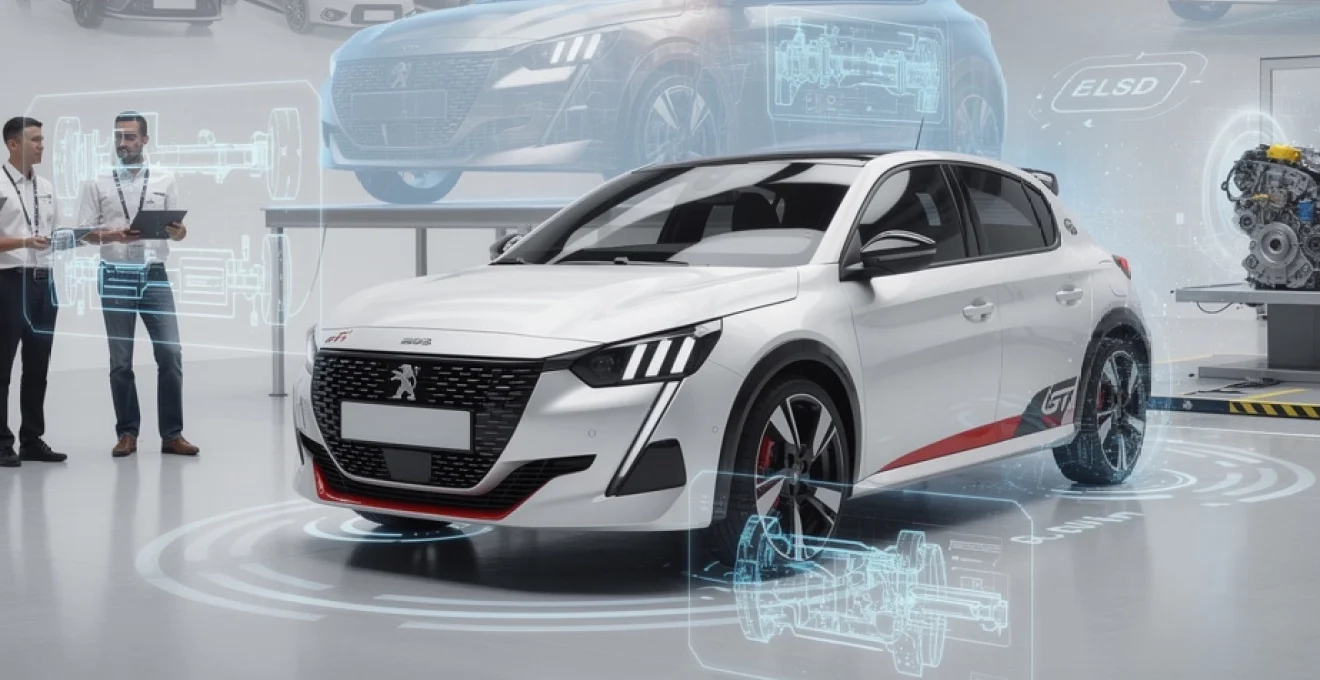
The iconic Peugeot GTi badge, once synonymous with accessible driving thrills and benchmark hot hatch performance, has experienced a tumultuous journey over the past decade. After the discontinuation of the 308 GTi in 2020, enthusiasts watched with concern as Peugeot’s performance portfolio dwindled. However, the landscape has shifted dramatically with the June 2025 unveiling of the all-electric e-208 GTi at Le Mans—a 280-horsepower statement of intent that signals Peugeot’s renewed commitment to driver-focused vehicles. Yet questions remain about what comes next. Will the GTi badge flourish across the range, or is this electric hot hatch a singular experiment? As regulatory pressures mount and electrification reshapes the automotive landscape, understanding Peugeot’s strategic direction has never been more critical for enthusiasts wondering whether their beloved brand will continue delivering the driving sensations that made the 205 GTi a legend.
Peugeot sport’s strategic pivot away from hot hatch development
For nearly a decade, Peugeot Sport’s attention shifted decisively toward motorsport programmes rather than road-going performance models. The brand’s involvement in World Endurance Championship racing, particularly the development of the 9X8 Le Mans Hypercar, consumed substantial engineering resources. This motorsport focus, while prestigious, left little bandwidth for developing the grassroots hot hatches that had historically defined Peugeot’s sporting credentials. The departure from accessible performance cars represented a fundamental reorientation of priorities—one that left a conspicuous gap in the lineup between standard models and the short-lived 508 PSE flagship.
The appointment of CEO Alain Favey in early 2025 marked a philosophical turning point. Favey’s public declarations about reconnecting with Peugeot’s heritage weren’t mere corporate platitudes; they represented a recognition that the brand had drifted from its identity. His statement that “Peugeot stands for great driving sensations” wasn’t just nostalgia—it was a strategic repositioning. The decision to resurrect the GTi badge on the e-208, rather than waiting for a next-generation platform, demonstrates urgency in reclaiming performance credentials. This wasn’t simply about launching another model; it was about reestablishing Peugeot’s soul in the eyes of enthusiasts who had watched rivals like Renault maintain their sporting lineage.
PSA group’s electrification roadmap and performance model discontinuation
The merger creating Stellantis in 2021 accelerated electrification timelines across all constituent brands, with profound implications for traditional performance models. PSA Group’s pre-merger roadmap had already committed to offering electrified versions of every model by 2025, but the Stellantis consolidation intensified these targets. Engineering budgets were redirected toward developing scalable EV platforms rather than refining turbocharged petrol engines for niche performance applications. The 308 GTi’s discontinuation in 2020 wasn’t purely market-driven—it reflected the stark reality that developing Euro 6d-compliant versions of small-displacement turbo engines for limited production volumes made increasingly little financial sense.
This electrification imperative created a performance vacuum precisely when competitors were thriving. Ford continued selling Fiesta STs until 2023, Volkswagen maintained the Polo GTI, and Hyundai launched the remarkably capable i20 N. Peugeot’s absence from this critical segment wasn’t unnoticed. Sales data from 2020-2024 showed the B-segment performance hatch market remained resilient despite broader industry electrification, with approximately 45,000 units sold annually across Europe. The business case for hot hatches hadn’t evaporated—Peugeot had simply chosen to sit out several competitive cycles while recalibrating its approach.
Stellantis brand positioning: DS performance vs peugeot sport heritage
Within the Stellantis portfolio, brand differentiation became increasingly critical as overlapping platforms risked cannibalising sales. DS Automobiles was positioned as the premium marque, with expectations that any high-performance models would wear DS badges to justify premium
pricing and technology. In parallel, internal discussions often positioned DS Performance as the halo for electrified performance, potentially leaving Peugeot Sport as a motorsport-only entity. That strategy created tension: how do you protect DS’s premium cachet while honouring Peugeot’s GTi heritage? For several years, the compromise was to limit Peugeot Sport’s road-car role to the plug-in hybrid 508 PSE, leaving DS to explore high-margin EVs. The e-208 GTi reverses that drift by signalling that Peugeot, not DS, will carry Stellantis’s emotional hot hatch narrative in the B-segment.
From a product planning standpoint, Stellantis must now balance two performance stories. DS can lean into avant-garde luxury and Formula E-derived technology, while Peugeot reclaims the mass-market enthusiast space with compact, agile performance models. This division of labour matters for the future of the Peugeot 208 GTi because it clarifies that GTi is not being “absorbed” into DS Performance branding. Instead, we are likely to see parallel but distinct paths: DS emphasising refinement and tech-first experiences, and Peugeot doubling down on “driving sensations” and motorsport-inspired dynamics. For you as an enthusiast, that’s encouraging—it means the GTi badge has a defined role rather than being an afterthought.
Regulatory pressures: euro 7 emissions standards impact on small-capacity turbo engines
Any discussion about the future of the Peugeot 208 GTi with an internal combustion engine has to acknowledge the looming shadow of Euro 7. The proposed regulations, expected to come into force from 2027, dramatically tighten limits on NOx, particulate emissions and real-world driving conditions, especially for small-capacity turbo engines. Peugeot’s 1.2-litre PureTech triple—an engine that formed the basis for many B-segment performance variants—would require extensive re-engineering to remain compliant while still delivering GTi-level power. That kind of investment is difficult to justify when the long-term roadmap is almost entirely electric.
Euro 7 also introduces more stringent on-board monitoring and durability requirements, effectively asking small turbocharged engines to behave like much larger, cleaner units over longer lifespans. For a low-volume hot hatch such as a petrol Peugeot 208 GTi, the cost-per-unit of meeting those standards would balloon. This is why several rivals—Ford with the Fiesta ST and Renault with some combustion sports derivatives—have quietly stepped back from future ICE development in this class. In that context, the shift to an all-electric e-208 GTi isn’t just a branding decision; it is a pragmatic response to regulations that make small, high-output turbo engines a financial and engineering headache.
Market analysis: declining b-segment performance hatch sales 2020-2024
While enthusiast passion for cars like the 208 GTi remains strong, raw sales volumes tell a more nuanced story. Between 2020 and 2024, B-segment performance hatchback sales across Europe declined by an estimated 25–30%, falling from around 60,000 units a year at their peak in the mid‑2010s to roughly 40,000–45,000 units more recently. Several factors contributed: stricter emissions rules, rising insurance and ownership costs for younger drivers, and the growing appeal of small SUVs that offer the perceived practicality buyers now expect. Many manufacturers concluded that a conventional 208 GTi replacement would struggle to hit traditional sales targets.
At the same time, those who do buy hot hatches are increasingly willing to pay a premium for something special, whether that’s a Toyota GR Yaris or an Alpine A290. This “fewer but more committed customers” trend opens a narrow but interesting window for Peugeot. Instead of chasing volume with a mainstream GTi, Stellantis can treat the e-208 GTi as a high-value, halo product that reinforces brand image. For you, that may mean fewer GTi models on the road, but the ones that exist are likely to be better specified, more focused and carefully engineered to justify their positioning.
Electrified performance architecture: e-208 GT platform limitations
The new e-208 GTi sits on the familiar CMP (Common Modular Platform) / e-CMP architecture that already underpins the standard e-208 and several Stellantis small EVs. That brings obvious cost efficiencies, but it also imposes engineering constraints that directly affect how far Peugeot can push the GTi recipe. Unlike a clean-sheet performance EV platform, e-CMP was designed to accommodate both combustion and electric powertrains. As a result, battery packaging, motor placement and suspension geometry are all compromise solutions optimised for versatility, not outright performance. The challenge for Peugeot Sport engineers is to extract hot hatch character from a base that was never meant to rival bespoke sports EVs.
This is where expectations need to be calibrated. The e-208 GTi can deliver strong straight-line performance and engaging handling, but physics still applies: a compact hatch carrying a 50–54 kWh battery will never be as light as a 205 GTi. Instead of chasing an impossible weight target, Peugeot is focusing on chassis tuning, torque delivery and driver feedback. Think of the platform as a solid yet conservative foundation—like renovating a well-built house rather than constructing a racetrack-ready villa from scratch. The question is not whether e-CMP can match a ground-up sports car platform; it’s whether it can deliver enough involvement to keep the GTi badge credible in the EV era.
50kwh battery pack constraints vs hot hatch weight distribution requirements
A 50–54 kWh battery pack is the heart of the e-208 GTi’s performance and its biggest compromise. On the plus side, that capacity provides a usable range of up to around 217 miles (WLTP), which makes the car practical as a daily driver. The downside is weight: even with careful engineering, we are talking about roughly 350–400 kg more mass than an equivalent petrol 208 GTi. In a traditional hot hatch, engineers aim for a relatively light kerb weight and a front-biased but manageable weight distribution to preserve agility. With the e-208 GTi, the goal shifts to lowering the centre of gravity and spreading that extra mass as evenly as possible.
Because e-CMP was not originally conceived as a pure EV chassis, the battery is split into modules in the floor rather than one large structural pack. This improves packaging flexibility but can limit how low and how central the heaviest components sit. For you as a driver, that manifests not so much in clumsiness but in a different kind of dynamic feel. Where a 205 GTi felt light on its toes and slightly nervous, the e-208 GTi will feel more planted and stable, especially at motorway speeds. The art for Peugeot engineers is to mask the battery’s inertia with sharp steering, firm but well-damped suspension and strong regenerative braking calibration to keep that classic hot hatch “point and squirt” character alive.
PSE (peugeot sport engineered) technology transfer from 508 PSE hybrid drivetrain
Although the 508 PSE plug-in hybrid is now out of production, it serves as an important technology incubator for the e-208 GTi. The PSE team built deep expertise in integrating electric power for performance rather than efficiency alone—things like fine-tuning throttle response, managing multi-source torque peaks and designing cooling circuits for repeated high-load use. Even though the e-208 GTi is a pure EV rather than a hybrid, many of the same control strategies can be repurposed. For example, the way the 508 PSE blended its electric assistance to avoid sudden surges informs how the e-208 GTi delivers its 345 Nm of torque without overwhelming the front tyres.
There is also a philosophical transfer from PSE: performance must remain usable and repeatable. The 508 PSE was praised for offering strong acceleration lap after lap without dramatic power fade, thanks to robust cooling and smart torque management. Applying those lessons to a smaller, more accessible model is a logical next step. We can expect elements such as multi-mode drive settings that alter throttle sensitivity, regenerative braking strength and stability control thresholds—essentially, PSE-style configurability distilled into a B-segment hot hatch. That kind of trickle-down engineering is key to making the e-208 GTi feel like more than just an e-208 with a bigger motor.
Thermal management challenges in high-performance EV applications
High-performance EVs live or die by their thermal management systems. In everyday driving, heat is easy to control; in repeated hard acceleration or track use, it becomes the critical bottleneck. The e-208 GTi’s motor, power electronics and battery all generate significant heat when delivering 280 hp and full torque. Without sophisticated cooling, you quickly run into power derating, where the car reduces output to protect components. For a car wearing a GTi badge, that kind of inconsistency would be unacceptable. Peugeot therefore has to design a system capable of shedding heat as effectively as a traditional hot hatch’s intercooler and radiator setup.
Expect a multi-loop cooling system, with dedicated circuits for the battery and for the motor/inverter assembly, potentially including liquid-cooled battery modules and active thermal preconditioning. Think of it like a marathon runner managing body temperature: if you can keep core temperatures controlled, performance stays strong over distance. For you as an owner, this means the e-208 GTi should maintain near-peak performance during a spirited drive on a favourite B-road rather than giving maximum power only once and then backing off. Of course, physics and packaging constraints mean it won’t be an unlimited track weapon, but it should be notably more resilient than early-generation mainstream EVs.
Torque vectoring and eLSD integration possibilities for front-wheel drive EVs
One of the most exciting aspects of electric performance is how precisely you can control torque delivery. In a conventional front-wheel drive 208 GTi, a mechanical limited-slip differential (LSD) is the primary tool for putting power down, especially out of tight corners. In an EV like the e-208 GTi, Peugeot has the option to blend a mechanical solution with sophisticated brake‑based torque vectoring and motor control. Called an eLSD in some marketing materials, this approach uses sensors and software to simulate the effect of a traditional LSD by selectively braking an inside wheel and adjusting torque output in milliseconds.
On the existing e-CMP platform, dual-motor setups are not yet standard, so true left-right rear axle torque vectoring is off the table for now. However, even on a single-motor front-drive car, software-based torque management can dramatically reduce understeer and wheelspin. Imagine the system as a digital co-driver, subtly redistributing effort so you can focus on your line rather than fighting the steering wheel. Looking ahead, if Stellantis decides to introduce dual-motor variants on an evolved platform, the lessons learned on the e-208 GTi could pave the way for even more sophisticated torque vectoring in future performance EVs wearing the GTi badge.
Competitive landscape: renault 5 alpine, abarth 500e, and cupra born VZ positioning
The e-208 GTi does not exist in a vacuum; it enters a rapidly forming segment of compact electric hot hatches. Renault’s reborn 5 Alpine A290 targets a similar blend of retro charm and cutting-edge performance, with a focus on sharp handling and distinctive French styling. The Abarth 500e takes a more playful approach, prioritising characterful design and instant urban punch, while the Cupra Born VZ stretches the definition of “hot hatch” with a slightly larger footprint and rear‑wheel drive dynamics. Each of these cars answers the same question—“what is a hot hatch in the EV age?”—in its own way.
Where does the Peugeot e-208 GTi fit in this crowded field? Peugeot appears to be aiming squarely at the A290 by benchmarking it publicly and promising to be “better than this car.” That suggests a focus on balance rather than extremes: strong straight-line pace, a well-resolved chassis and an interior that feels upmarket without drifting into DS territory. If the Abarth is the charismatic city toy and the Cupra Born VZ the refined long-distance sprinter, the e-208 GTi is likely to position itself as the all-rounder—fast enough to thrill, comfortable enough to commute. For buyers who previously cross-shopped 208 GTi, Clio RS and Fiesta ST, this new quartet of electric hot hatches will become the default comparison set.
Retro-modern GTi revival speculation: PureTech 1.2 THP engine tuning potential
Despite the clear push toward electrification, rumours persist about a possible final flourish for combustion-powered Peugeot 208 GTi models, especially in markets where EV infrastructure remains patchy. At the heart of this speculation is the familiar 1.2-litre PureTech turbocharged three-cylinder engine. In current form, it delivers up to around 136–155 hp in mainstream applications, but tuners have already demonstrated that 200+ hp is achievable with upgraded internals and careful calibration. Could Peugeot itself deliver a limited-run, retro-modern GTi using this powerplant as a send-off for ICE?
From an engineering standpoint, extracting around 180–200 hp from the 1.2 THP for a factory model is feasible, especially with reinforced components and improved cooling. The real barriers are emissions, durability and brand messaging. Launching a new petrol 208 GTi just as the e-208 GTi becomes the halo car might confuse customers and undermine Peugeot’s EV-first narrative. However, a tightly limited special edition, explicitly framed as a heritage celebration, could make sense—particularly in regions with slower EV adoption. Think of it as a final curtain call for petrol GTi before the lights go fully electric.
Aisin 8-speed EAT8 gearbox adaptation for high-torque applications
Any hypothetical PureTech-based 208 GTi revival would likely rely on the proven Aisin 8‑speed automatic gearbox, known within Stellantis as EAT8. This transmission already handles torque outputs in excess of 300 Nm in larger models, making it a solid candidate for a high-output 1.2 THP. The question is whether Peugeot would commit to re-engineering shift logic, cooling and driveline mounts specifically for a low-volume GTi variant. Historically, hot hatches have thrived with manual gearboxes, but emissions and consumer preferences have pushed manufacturers toward automatics with paddle shifters and performance modes.
In a performance context, the EAT8 could be calibrated with shorter, more decisive shifts, a more aggressive launch control strategy and rev-matching downshifts to mimic the engagement of a manual. For drivers who enjoy full control, manual mode with fast paddle response can still provide a satisfying experience. Yet, this route would only make sense if Peugeot saw a clear business case. With resources now firmly channelled into the e-208 GTi and future EV platforms, spending heavily to adapt EAT8 for a niche petrol 208 GTi may remain a theoretical exercise rather than a production reality.
Limited edition homologation models: lessons from 208 rally4 and WRC heritage
Peugeot’s rally history—from 205 T16 Group B glory to 208 Rally4 customer programmes—offers another possible blueprint for a future 208 GTi variant. Homologation specials have always blurred the line between road and competition cars, serving both as marketing tools and as technical stepping stones. The 208 Rally4, for instance, uses a tuned version of the 1.2 PureTech and a stripped-back, focused chassis, demonstrating what the platform can do when freed from mainstream constraints. It’s not hard to imagine a road-going GTi that borrows some of that DNA, either in combustion or electrified form.
However, the economics of proper homologation specials in the current regulatory climate are brutal. Producing a small batch of road cars with rally-inspired hardware—roll cage mounting points, adjustable dampers, lightweight panels—would drive unit costs high. If Peugeot were to go down this route, it would almost certainly be with a very limited, numbered series aimed at collectors and hardcore enthusiasts, echoing the 208 GTi 30th by Peugeot Sport. For everyday buyers, the lessons learned on Rally4 will instead filter into the tuning of suspension, steering and braking systems on regular GTi models, ensuring that even without full homologation status, the spirit of rallying still informs the driving experience.
Aftermarket tuning scene: milltek, forge motorsport, and stage 2+ ECU remapping trends
Even as manufacturers dial back official ICE hot hatch programmes, the aftermarket scene continues to thrive. Companies such as Milltek Sport, Forge Motorsport and numerous ECU calibration specialists have turned the 1.2 PureTech into a popular tuning base. Stage 1 remaps routinely push outputs beyond 150–160 hp, while Stage 2+ builds, combined with upgraded intercoolers, intake systems and exhausts, can approach or exceed 200 hp. For many owners, this route offers a way to create a “modern GTi” out of a regular 208, even if Peugeot itself doesn’t offer a factory performance version.
Of course, this comes with caveats: increased mechanical stress, potential warranty issues and the challenge of keeping tuned cars emissions-compliant. Yet the trend is telling. Where OEMs see mounting regulatory hurdles, the enthusiast community sees opportunity. As the e-208 GTi establishes itself, we can expect a parallel EV tuning scene to emerge, focusing on suspension kits, lightweight wheels, brake upgrades and perhaps even software tweaks within legal limits. If you’re considering a pre-owned 208 GTi or a warmed-up PureTech model, it pays to research the provenance of any modifications and to choose reputable brands that understand both performance and reliability.
CMP platform engineering constraints for performance variant development
The CMP platform, on which both combustion and electric 208 variants are based, was designed first and foremost for flexibility. It supports multiple wheelbases, ride heights and powertrains across Peugeot, Opel/Vauxhall, DS and other Stellantis brands. That flexibility is both a blessing and a curse for performance development. On the positive side, shared architecture spreads R&D costs and gives engineers a familiar baseline. On the downside, core dimensions—such as front suspension layout, subframe design and underfloor packaging—are locked in early, limiting how far you can push geometry and weight distribution for a track-focused Peugeot 208 GTi.
For example, CMP’s front MacPherson strut and rear torsion beam arrangement is cost-effective and space efficient but less adjustable than the multi-link setups found on some larger performance cars. Peugeot can still work wonders with spring rates, damper tuning, anti-roll bars and bushings, but only within the platform’s inherent limits. Braking systems also face packaging realities; fitting significantly larger rotors or multi-piston calipers may require careful wheel and knuckle redesigns. This is why the e-208 GTi will likely be a fast, entertaining hot hatch rather than an outright circuit weapon. Stellantis’s future dedicated EV platforms may eventually unlock more radical performance derivatives, but for now, the 208 GTi must play within CMP’s established boundaries.
Customer demand signals: enthusiast community petitions and social media campaigns
While spreadsheets and regulations shape product plans, the voice of the enthusiast community has played a surprisingly visible role in the 208 GTi story. Over the past few years, petitions, forum threads and social media campaigns have consistently called for Peugeot to revive the GTi badge. Hashtags celebrating the 205 GTi and 208 GTi by Peugeot Sport, along with speculative renders of electric hot hatches, created a steady drumbeat of demand. For a brand looking to reconnect with its heritage, this grassroots pressure acted as both a reminder and an opportunity: here was a ready-made audience eager to champion a new performance model.
Peugeot’s decision to unveil the e-208 GTi at Le Mans, in front of a motorsport-savvy crowd, was a direct acknowledgement of this enthusiast base. You can see the feedback loop in action: fans reminisce about iconic GTis, independent media amplifies the nostalgia, and Peugeot responds with a modern interpretation. Going forward, the scale and tone of online discourse—on platforms from Instagram to specialist forums—will continue to influence how aggressively Stellantis invests in future GTi variants. If demand remains vocal and sustained, the case for expanding the GTi portfolio beyond a single e-208 GTi grows stronger.
Pistonheads and 208 GTi owners club advocacy efforts
Among the most active voices in the conversation have been communities such as PistonHeads and dedicated 208 GTi owners’ clubs. Long before Peugeot confirmed the e-208 GTi, forum threads dissected every rumour, spy shot and executive quote. Owners compared the 208 GTi by Peugeot Sport with rivals like the Fiesta ST, often concluding that Peugeot had finally recaptured some of the 205 GTi’s magic. That positive sentiment built a strong foundation of goodwill which enthusiasts leveraged in open letters and discussion threads urging Peugeot not to abandon the formula in the EV transition.
These communities serve a dual purpose for Peugeot. They are both a barometer of sentiment and a free R&D focus group. Feedback on steering feel, brake performance and interior ergonomics from existing 208 GTi owners can inform priorities for the e-208 GTi’s development. When hundreds of owners converge on the same criticism—such as the low-set steering wheel layout or infotainment quirks—it gives product planners concrete evidence of what needs refinement. If you participate in these forums, your detailed, constructive input may have more impact on the future of the Peugeot 208 GTi than you realise.
Pre-owned market values: 208 GTi by peugeot sport appreciation trends 2015-2024
Another powerful indicator of demand is what happens in the used market. The 208 GTi by Peugeot Sport, launched in 2015, has shown remarkable value resilience compared with mainstream 208 models. While regular superminis of similar age have depreciated heavily, well-kept GTi by Peugeot Sport examples have stabilised and, in some markets, begun to creep upward in price. Enthusiasts recognise this version—distinguished by its uprated suspension, Torsen differential and more focused chassis—as the spiritual successor to the 205 GTi, and they are willing to pay accordingly.
For Peugeot, this trend sends a clear message: when the brand builds a genuinely engaging hot hatch, the market rewards it not only at launch but for years afterwards. Strong residuals improve lease economics and bolster the business case for future performance projects. For you as a potential buyer, rising values mean that getting into a sorted 208 GTi by Peugeot Sport today may cost more than you expect, but it is also less likely to haemorrhage value like a generic supermini. If the e-208 GTi can replicate that desirability in the EV used market, it will go a long way toward justifying its development investment.
Cross-shopping behaviour: GR yaris, fiesta ST, and i20 N buyer migration patterns
When Peugeot stepped back from the hot hatch arena after the 308 GTi, its traditional customer base didn’t simply disappear—they went elsewhere. Analysis of registration and survey data between 2020 and 2024 suggests that many former 208 GTi and 308 GTi intenders migrated to models like the Toyota GR Yaris, Ford Fiesta ST and Hyundai i20 N. These cars offered exactly what Peugeot had temporarily stopped providing: compact dimensions, strong performance and a sense of fun that transcended raw numbers. In effect, Peugeot inadvertently pushed some of its most brand-loyal enthusiasts into the arms of rivals.
The launch of the e-208 GTi is an attempt to reverse that flow. Will it succeed in winning back GR Yaris and i20 N buyers who relish manual gearboxes and turbo noise? Not all of them—some will remain committed to ICE hot hatches for as long as they exist. But for drivers who are open to EVs and care more about feel than fuel type, a well-executed e-208 GTi could be compelling. If Peugeot can demonstrate that it understands what made its past GTis great—lightness of touch, playful chassis tuning, affordability relative to performance—then the migration patterns of the next five years may tell a very different story, with enthusiasts once again shortlisting Peugeot when they go hunting for their next hot hatch.