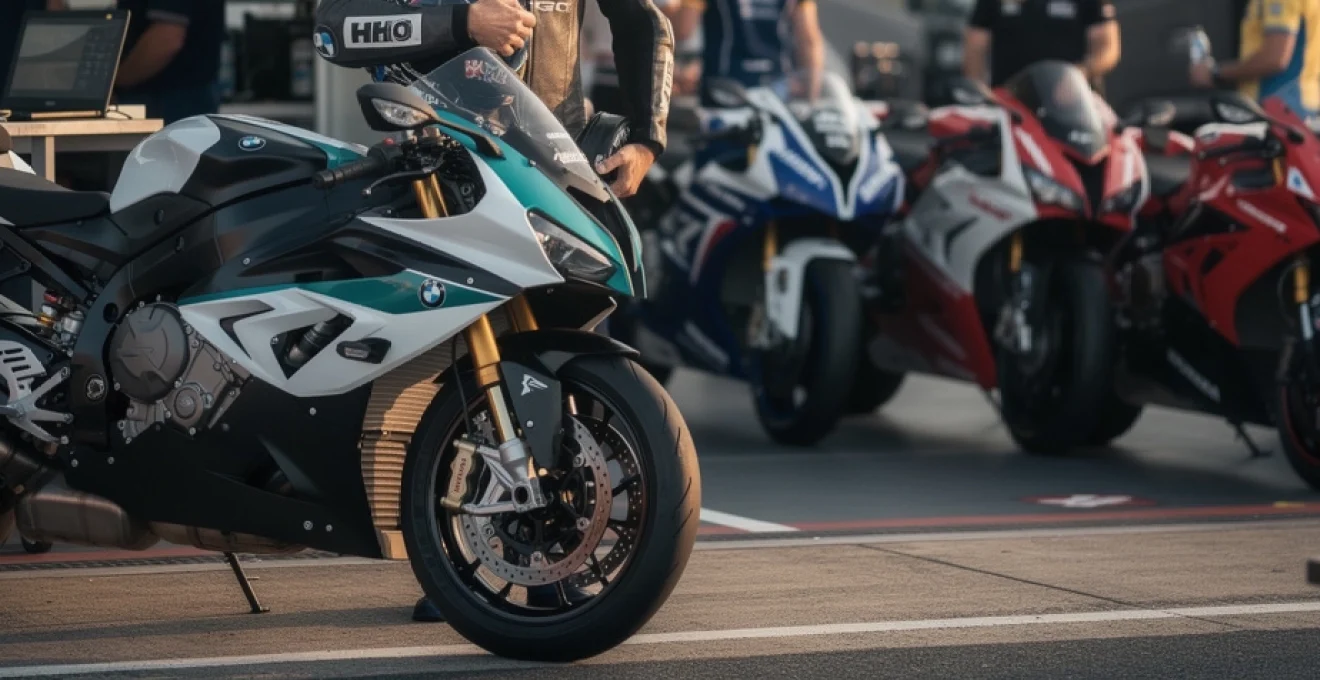
The British Superbike Championship and road racing paddocks have been buzzing with speculation following dramatic developments at FHO Racing. What started as rumours has now crystallised into confirmed reality: Peter Hickman and Davey Todd have indeed departed the Faye Ho-owned team, ending what many considered one of the most promising partnerships in modern motorcycle racing. The shocking split has sent ripples through the motorsport community, particularly given the timing and the apparent strength of the rider lineup that was assembled just months earlier.
The departure represents more than just a simple team change—it signals a fundamental shift in the British motorcycle racing landscape. Hickman’s four-year association with FHO Racing had delivered exceptional results, including seven Isle of Man TT victories and multiple BSB podium finishes. The addition of Todd, fresh from his breakthrough 2024 TT Senior race victory, had appeared to cement FHO’s position as a dominant force in both championship and road racing circles.
Peter hickman’s current contract status with FHO racing BMW
The contractual situation between Hickman and FHO Racing has undergone dramatic transformation in recent weeks. Despite being confirmed for the 2025 season alongside Todd in November 2024, both riders have now officially separated from the team. This unprecedented development has left many industry observers questioning the stability of modern racing partnerships and the complexities of multi-discipline motorsport commitments.
2024 season performance analysis at isle of man TT and BSB championship
Hickman’s 2024 campaign with FHO Racing demonstrated the strength of their technical partnership. His performances at the Isle of Man TT reinforced his status as one of the Mountain Course’s most accomplished competitors, adding to his impressive tally of fourteen career victories. The BMW S1000RR package provided by FHO proved consistently competitive across various road racing venues, with Hickman’s expertise in motorcycle setup proving invaluable to the team’s development programme.
In the British Superbike Championship, the results were more mixed but showed steady progress. The transition between road racing and short circuit competition requires significant technical adjustments, and FHO’s approach to supporting both disciplines simultaneously presented unique challenges. Hickman’s feedback proved crucial in developing the BMW machinery for diverse racing conditions, from the high-speed sections of the TT course to the technical challenges of BSB circuits.
BMW S1000RR technical package development under FHO racing
The technical collaboration between Hickman and FHO Racing’s engineering team produced significant advances in BMW S1000RR development. The team’s factory support from BMW Motorrad provided access to cutting-edge components and development parts, enabling continuous refinement of the motorcycle’s performance characteristics. Hickman’s detailed technical feedback, combined with his extensive experience across different racing disciplines, proved instrumental in optimising the package for both road racing and championship competition.
The development programme focused on several key areas: engine mapping for different circuit characteristics, suspension geometry optimisation, and aerodynamic refinements. These technical advances not only benefited Hickman’s immediate racing performance but also contributed to BMW’s broader competitive development programme. The collaborative approach between rider and manufacturer exemplified modern factory racing partnerships.
Contractual obligations and performance clauses with faye ho’s team
While specific contractual details remain confidential, industry sources suggest that the separation involved complex negotiations regarding performance clauses and multi-year commitments. The original agreements likely included provisions for both BSB and road racing participation, creating intricate obligations that required careful legal consideration during the dissolution process. The amicable nature of the split, as evidenced by Hickman’s gracious social media statement, suggests that all parties worked collaboratively to resolve these contractual complexities.
The timing of the announcement, coming just months after Todd’s recruitment, indicates that the decision process involved careful consideration of long-term strategic objectives rather than immediate performance concerns. This approach reflects the professional maturity of modern motorcycle racing, where business decisions increasingly drive team structures and rider movements.
Financial terms and sponsorship agreements timeline
The financial implications of the FHO Racing split extend beyond simple rider salaries to encompass
The financial implications of the FHO Racing split extend beyond simple rider salaries to encompass multi-layered sponsorship structures, appearance fees, and performance-related bonuses. Hickman’s tenure with FHO coincided with a period of strong commercial backing from BMW Motorrad, personal sponsors, and event-specific partners such as those linked to the Isle of Man TT and the North West 200. As discussions around the team’s restructuring gathered pace through late 2024 and early 2025, sponsors would have needed clarity on branding exposure, media commitments, and hospitality obligations. This is one reason why we often see a lag between paddock rumours and official announcements: commercial contracts must be reshaped in the background before any public statement can be made.
Timeline-wise, confirmation of Hickman and Todd for FHO in November 2024 was followed by a period of growing speculation in January 2025, as whispers emerged about FHO Racing reducing its scope and BMW Motorrad exploring alternative structures. By 10 February 2025, the new plan was public: FHO would focus on a single BSB entry, while a new BMW-supported entity, 8TEN Racing, would take over road racing duties and additional British Superbike commitments. Financially, this effectively reallocated factory-supported BMW M1000RR resources and much of the existing FHO personnel to a different banner. For sponsors, the rebrand allows continuity of visibility with Hickman and Todd, even if the team name and ownership structure have changed.
Emerging transfer rumours and potential team destinations
Before the 8TEN Racing project was made public, the British Superbike and road racing paddocks were alive with speculation about where Peter Hickman might land if he did leave FHO Racing. With his record of fourteen Isle of Man TT victories and proven pace in BSB, he was never going to be short of suitors. In many ways, Hickman’s situation resembled that of a top-flight footballer reaching the end of a successful spell at a club: every major manufacturer and several independent outfits were inevitably linked to him. We also have to remember that any potential move needed to accommodate his dual commitments – short circuits and the roads – which immediately narrowed the list of realistic destinations.
What complicates matters for a rider of Hickman’s calibre is not simply finding a competitive bike, but ensuring the full package fits: technical support, test schedules, TT priorities, and commercial freedom for his own brand and PHR Performance operation. As rumours swirled around FHO’s future, observers floated several big-name options, from Yamaha and Honda to Ducati and high-level independent teams. Ultimately, the emergence of 8TEN Racing – co-owned by Hickman and Davey Todd – has reframed the narrative. Instead of merely transferring to an existing team, Hickman has helped build a structure that gives him a greater degree of control over his future while still retaining BMW factory support.
Mcams yamaha factory team interest and tarran mackenzie connection
One of the most persistent early rumours placed Hickman in the orbit of the McAMS Yamaha squad, which has long been considered one of the benchmark operations in BSB. The logic was clear: Yamaha’s R1 has been a consistent front-runner, and the team’s infrastructure, data, and engineering depth could offer Hickman an immediate platform for title contention. Industry insiders also pointed to the historic connection between Hickman and other Yamaha riders, notably former BSB champion Tarran Mackenzie, as an informal bridge between camps. In a paddock where relationships and trust often matter as much as outright pace, such links can quickly fuel speculation.
However, while a move to a Yamaha factory-backed environment would have made sense from a pure championship standpoint, it posed challenges for Hickman’s road racing ambitions. Yamaha’s recent focus has tilted more toward BSB and WorldSBK than the traditional road racing calendar, and its TT programme has not matched the depth of BMW’s investment around Hickman. You also have to consider the technical shift: moving from the BMW S1000RR/M1000RR to the Yamaha R1 would require a complete reset in riding style, electronics preferences, and chassis feedback. For a rider whose reputation is tightly bound to his Mountain Course expertise, the risk-reward balance of such a change was always going to be finely judged.
Honda racing UK discussions following glen irwin’s 2024 struggles
Another axis of speculation centred on Honda Racing UK, particularly after Glen Irwin’s difficult 2024 season and the perceived need for a fresh direction. Honda has a rich heritage at the Isle of Man TT and retains a strong brand association with road racing, making it an obvious theoretical fit for someone like Hickman. Some in the paddock suggested that Honda might look to rebuild its TT profile by anchoring a factory programme around a proven winner on the Mountain Course. On paper, “Hickman on a Fireblade” was an enticing storyline for fans and sponsors alike.
Yet beneath the surface, several obstacles existed. Honda’s current development cycle in BSB has been steady rather than spectacular, and the team has been working through its own restructuring and rider rotation. For Hickman, moving from a front-running BMW package he helped develop to a still-evolving Honda platform would be a bit like swapping a well-known tool for an experimental prototype. While the potential upside is significant – especially if you’re the rider who unlocks the next level of performance – the short-term risk to TT dominance and consistent BSB results might have been too great. From that angle, remaining within the BMW ecosystem while changing team structures appears a more pragmatic path.
Ducati panigale V4R factory support possibilities via paul bird motorsport
Ducati’s presence in BSB, historically spearheaded by Paul Bird Motorsport (PBM), also made the Italian brand a natural part of the transfer rumour mill. The Panigale V4R has been one of the most competitive machines on the grid, and PBM’s success is well documented. For fans, the idea of Hickman switching to the V4R and chasing a BSB crown on a proven title-winning package had an undeniable appeal. Ducati’s aggressive power delivery, strong electronics, and stable chassis have suited several riders who, like Hickman, are comfortable riding on the edge.
However, as with Yamaha and Honda, the road racing dimension complicates matters. While Ducati has dipped into the roads, it has not committed at the same depth as BMW in recent years, particularly around bespoke TT development. Adapting the V4R to the unique demands of the Mountain Course – high-speed stability, extreme braking zones, and long-duration engine stress – would require a multi-year investment. From the outside, it is hard to see Ducati green-lighting such a programme for a single rider, no matter how successful, when their core focus remains on circuit-based championships. In this context, the reported possibility of PBM-style factory support for Hickman seems more like paddock speculation than a concrete pathway.
Independent team options including buildbase suzuki and TAG racing
Beyond factory outfits, several well-respected independent teams were also mentioned as potential homes should Hickman decide to leave FHO Racing without a direct factory landing spot. Names such as Buildbase Suzuki and TAG Racing cropped up in paddock conversations, largely because of their history of nurturing top-level riders and their willingness to structure programmes around a star name. For a rider seeking maximum autonomy, an independent setup can sometimes offer more flexibility on testing, bike specification, and personal sponsor integration than a rigid factory operation.
Yet independence comes with limitations. Even the best-funded privateer teams cannot always match the development pace, parts supply, and data resources of a full factory-backed programme. For someone like Hickman, who is deeply engaged in machine development and accustomed to BMW’s technical pipeline, a switch to a non-factory Suzuki or Yamaha privateer package might feel like a step back. That is why the eventual 8TEN Racing structure is so interesting: it combines the entrepreneurial freedom of an independent team with continued factory-supported BMW M1000RR machinery, creating a hybrid model that many riders would envy.
Technical machine preferences and manufacturer compatibility
Hickman’s long relationship with BMW machinery is a crucial part of understanding why an in-house move to 8TEN Racing – rather than a brand switch – has become the chosen route. Over the last decade, he has developed a riding style that leverages the BMW’s strengths: strong braking stability, tractable mid-range power, and a chassis that rewards precise, flowing lines. When you spend years refining engine maps, traction control strategies, and suspension baselines with the same manufacturer, it embeds a form of “muscle memory” that is hard to replicate elsewhere. Changing brands would mean not only learning a new bike but also unlearning deeply ingrained habits.
From a manufacturer compatibility standpoint, BMW has been willing to mould its racing support around Hickman’s dual-focus calendar, balancing British Superbike commitments with the Isle of Man TT, North West 200, and Macau Grand Prix. That flexibility is not guaranteed with every brand. Some factories prefer tightly controlled programmes with limited side projects, whereas BMW has embraced the marketing value of road racing success. For you as a fan or an observer, this means that a BMW-backed 8TEN Racing structure is likely the most logical way to keep Hickman at the front across both short circuits and the roads, instead of forcing a compromise in one area.
Isle of man TT considerations and mountain course commitments
Any conversation about Peter Hickman’s future has to place the Isle of Man TT at its centre. For many, his name is now almost synonymous with the Mountain Course, and his results there drive a significant portion of his profile, sponsorship value, and legacy. When rumours surfaced that FHO Racing might scale back or even withdraw from the TT, it immediately raised the question: how would Hickman protect his competitive position at the world’s most famous road race? You cannot simply treat the TT as a side project; success there requires months of preparation, bespoke bike setups, and a team that understands the unique stresses of the event.
The creation of 8TEN Racing, with BMW Motorrad support and a staff roster reportedly composed largely of ex-FHO Racing personnel, provides that continuity. In practice, it means the same engineers who refined fuel strategies for six-lap TT races and optimised chassis balance through sections like the Mountain Mile and Glen Helen will continue working with Hickman and Todd. If you think of a TT team as a finely tuned orchestra, changing the conductor and half the musicians just before a major performance would be a huge risk. Instead, the 8TEN structure allows the “band” to keep playing together under a new name, preserving the collective experience that is so vital on the roads.
British superbike championship grid implications and competitive balance
Beyond the personal storylines, Hickman and Todd’s move from FHO Racing to 8TEN Racing reshapes the wider British Superbike Championship grid. FHO’s decision to downsize to a single-rider BSB programme with Ilya Mikhalchik concentrates its resources but also opens space for a new, BMW-backed team to enter the series with proven race-winners. From a competitive balance perspective, this could actually strengthen BMW’s overall presence in BSB: instead of one two-rider squad, we now have FHO and 8TEN both carrying the Bavarian marque’s flag in different ways. For rival manufacturers, that means dealing with multiple front-running BMWs across qualifying and race distance.
For fans, the shake-up adds intrigue to the 2025 BSB season. How will Mikhalchik adapt to full-time British Superbike competition, and how quickly can 8TEN Racing translate its TT-focused expertise to the cut-and-thrust of short-circuit racing? Will we see tactical collaboration between BMW-supported teams when it comes to testing and data sharing, or will each outfit guard its secrets closely? These are the kinds of questions that underline how one contractual shift – Hickman leaving FHO Racing – cascades into broader dynamics that affect the entire grid. It also demonstrates how manufacturer strategy is evolving, with brands like BMW exploring multi-team structures to maximise their chances of success.
Industry insider perspectives and paddock intelligence sources
For those of us trying to make sense of complex moves like Hickman’s transition from FHO Racing to 8TEN Racing, “paddock intelligence” is an essential, if imperfect, tool. Rumours often start in hospitality units, engineering trucks, or small conversations between mechanics long before any official announcement. In this case, talk of FHO Racing stepping back, BMW consolidating its UK racing strategy, and Hickman seeking greater control over his future began circulating weeks before confirmation arrived. As one experienced paddock figure put it, decisions like this are rarely made overnight; rather, they unfold like a chess game, with each piece moving in response to the others.
At the same time, relying on insider chatter alone can be misleading. Some early speculation suggested FHO Racing might fold completely, which subsequent statements from both Faye Ho and Peter Hickman firmly denied. This illustrates a key point for anyone following BSB and TT transfer rumours: treat early reports as indicators, not certainties. The most reliable picture usually emerges where multiple sources align – team communications, manufacturer statements, rider comments, and consistent behind-the-scenes information. In the end, the confirmed outcome – FHO remaining in BSB with Mikhalchik, and 8TEN Racing emerging as a BMW-supported venture co-owned by Hickman and Todd – shows how reality can be both more nuanced and more strategic than the initial gossip suggested.