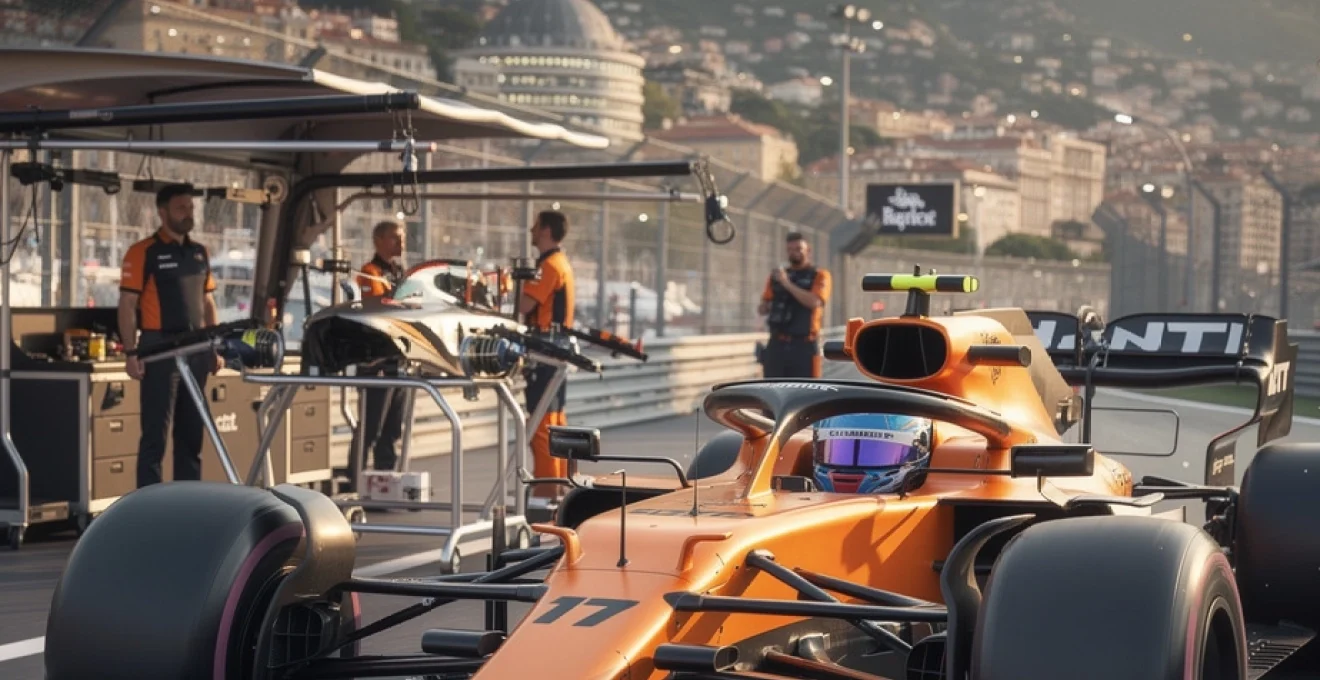
Lando Norris pilots the McLaren MCL39, the team’s latest Formula 1 challenger that helped secure both the Constructors’ Championship and Norris’s maiden Drivers’ Championship in 2025. This cutting-edge machine represents the culmination of McLaren’s technical evolution, incorporating advanced aerodynamics, sophisticated hybrid power units, and state-of-the-art materials science. The MCL39 builds upon the championship-winning MCL38 platform, featuring refined aerodynamic packages and enhanced performance characteristics that have established McLaren as the dominant force in contemporary Formula 1 racing.
Lando norris’ current McLaren MCL60 formula 1 car specifications
The McLaren MCL39 showcases the pinnacle of Formula 1 engineering, representing a significant evolution from previous generations. This sophisticated racing machine integrates multiple advanced systems working in harmony to deliver the performance levels required for championship-winning campaigns. The car’s foundation rests on a carbon fibre monocoque structure that provides exceptional rigidity whilst maintaining the strict weight requirements mandated by FIA regulations.
At the heart of the MCL39’s performance lies its comprehensive technical package, which encompasses everything from the power unit integration to the smallest aerodynamic details. The car measures precisely 5 metres in length and 2 metres in width, conforming to the current technical regulations that govern Formula 1 car dimensions. These specifications ensure optimal aerodynamic efficiency whilst maintaining the safety standards that are paramount in modern motorsport.
Mercedes-amg F1 M14 E performance power unit integration
The MCL39 utilises the Mercedes-AMG F1 M14 E Performance power unit, a sophisticated hybrid system that combines a 1.6-litre V6 turbocharged internal combustion engine with advanced Energy Recovery Systems (ERS). This power unit delivers approximately 1000 horsepower when the ERS-K and ERS-H systems are fully deployed, providing the explosive acceleration that characterises modern Formula 1 performance. The seamless integration between the power unit and McLaren’s chassis design creates a harmonious package that maximises both power delivery and fuel efficiency.
Carbon fibre monocoque construction and safety cell design
McLaren’s monocoque construction represents one of the most advanced safety cells in motorsport, manufactured from multiple layers of carbon fibre that provide exceptional strength-to-weight ratios. The survival cell incorporates the latest FIA safety specifications, including impact-absorbing structures and reinforced areas designed to protect the driver in extreme circumstances. This construction methodology ensures that the MCL39 maintains optimal rigidity for performance whilst providing comprehensive protection through its integrated safety systems.
Aerodynamic package development under 2023 technical regulations
The aerodynamic development of the MCL39 reflects McLaren’s sophisticated understanding of ground effect principles, which form the foundation of current Formula 1 regulations. The car features carefully sculpted bodywork that maximises downforce generation whilst minimising drag penalties, creating the optimal balance between cornering performance and straight-line speed. Advanced computational fluid dynamics and wind tunnel testing have refined every aerodynamic surface, from the front wing endplates to the rear wing configuration.
Pirelli F1 tyre compound compatibility and setup parameters
The MCL39’s suspension and setup parameters are specifically calibrated to optimise performance across Pirelli’s comprehensive tyre compound range, which includes the C1 through C5 specifications used throughout the Formula 1 season. McLaren’s engineers have developed sophisticated setup matrices that allow rapid adaptation to different circuit characteristics and tyre compounds, ensuring that Norris can extract maximum performance regardless of the specific weekend requirements. This adaptability has proven crucial in McLaren’s championship-winning campaigns.
Mclaren MCL60 technical evolution from previous generation cars
The evolution from the MCL38 to the MCL39 represents a significant step forward in McLaren’s technical development trajectory, incorporating lessons learned from the championship-winning 2024 season. Engineers at the McLaren Technology Centre have focused on refining the aerodynamic efficiency whilst enhancing the mechanical platform’s overall performance characteristics. These improvements have resulted in measurable gains across multiple performance metrics, including cornering speeds, straight-
line stability, traction out of slower corners, and overall drivability across a full race distance.
Ground effect floor design improvements over MCL36
One of the most significant technical evolutions from earlier cars such as the MCL36 is the refinement of the ground effect floor on the MCL39. Under the current regulations, much of a Formula 1 car’s downforce is generated by channelling airflow under the floor and through carefully shaped venturi tunnels. McLaren’s aerodynamicists have spent multiple seasons iterating on the floor edge geometry, diffuser volume, and tunnel inlet design to reduce porpoising while maintaining high downforce. Compared with the MCL36, the MCL39 features more sophisticated floor cut-outs and vortex generators that stabilise airflow under varying ride heights, especially over kerbs and in yaw.
For Lando Norris, these ground effect improvements translate into a car that is more predictable at high speed and more compliant through fast direction changes. Where the early ground effect cars could feel like they were “switching on and off” as the aero platform compressed, the MCL39 delivers a more linear build-up of grip, giving Norris greater confidence to attack corners. You can think of the evolution like refining the wings of an aircraft: the basic principle remains the same, but the subtle shaping of surfaces and edges makes all the difference in efficiency and stability. This continuous development has been a key reason why McLaren’s current Formula 1 car has become a benchmark for consistent race pace.
Suspension geometry modifications for enhanced performance
Alongside aerodynamic gains, McLaren has focused heavily on suspension geometry to unlock more performance for Norris from the MCL39. Compared with previous generations, the team has adjusted front and rear suspension kinematics to provide a wider operating window for camber, toe, and ride height changes. Revised pushrod and pullrod layouts, along with repositioned pickup points, allow the engineers to fine-tune mechanical balance without compromising the crucial aero platform under the ground effect floor. The result is a car that can be tailored more precisely to different track layouts and driving styles.
For a driver like Lando, who relies on late braking and strong mid-corner rotation, these suspension changes are vital. A more compliant front end helps him place the McLaren exactly where he wants on corner entry, while improved rear stability gives him the confidence to deploy power early on exit. Suspension geometry is to a Formula 1 car what shoe fit is to a marathon runner: even the best design in the world will underperform if it does not suit the specific demands of the person using it. By evolving the suspension from the MCL36 and MCL38 to the current MCL39, McLaren has given Norris a platform that better matches his natural driving instincts.
Brake-by-wire system implementation and calibration
The MCL39 continues McLaren’s development of a highly refined brake-by-wire system, building on experience from previous chassis. On a modern Formula 1 car, the rear brakes are controlled electronically, working in tandem with the hybrid system’s energy recovery to deliver consistent deceleration. Compared with earlier iterations, the latest system in Norris’s McLaren offers smoother transitions between regenerative and friction braking, especially at the end of long straights and into heavy braking zones. Engineers at the McLaren Technology Centre have invested significant simulation and track time in calibrating this system so that it feels as natural as possible to the driver.
Norris is known for his sensitivity under braking, so a predictable brake pedal is a critical part of his performance toolkit. Any inconsistency in brake response can unsettle the car and cost valuable tenths, particularly in qualifying when he is operating at the absolute limit. The brake-by-wire evolution from older McLaren models to the MCL39 allows for more granular mapping of brake pressure versus pedal travel, giving Lando a consistent “bite point” at every corner. In essence, the system acts like a finely tuned musical instrument: once perfectly calibrated, it allows a skilled driver to “play” the car with precision and confidence.
DRS activation zones and rear wing configuration changes
While DRS (Drag Reduction System) zones are defined by the FIA on each circuit, the effectiveness of DRS depends heavily on the rear wing architecture of the car. The MCL39’s rear wing has been refined from previous designs to maximise the delta between DRS-open and DRS-closed states, without sacrificing stability when running in high-downforce configurations. Compared with the MCL36, McLaren’s engineers have evolved the endplate design, flap geometry, and beam wing interaction to ensure the car sheds drag efficiently when Norris activates DRS.
This development is especially noticeable during qualifying and overtaking manoeuvres, where even a few kilometres per hour of extra top speed can determine track position. For Norris, a well-optimised DRS package means he can attack rivals more decisively into braking zones and defend more effectively when being chased. Have you ever felt the difference between riding a bicycle with and without a strong tailwind? The MCL39’s rear wing and DRS configuration aim to give Norris that “tailwind” effect whenever the rules allow, turning straight-line speed into a strategic weapon during races.
Lando norris’ personalised cockpit configuration in the MCL60
Although every McLaren Formula 1 car must comply with the same safety and dimensional regulations, the cockpit area is highly personalised for each driver, and Lando Norris is no exception. Within the MCL39’s carbon fibre survival cell, his seating position, steering wheel layout, and control mappings have been meticulously tuned to his preferences. The seat itself is a custom-moulded carbon and foam insert, created from a detailed 3D scan of Lando’s body to ensure maximum support under braking and lateral loads that can exceed 5G. This intimate fit helps reduce fatigue over long stints and keeps him locked in place as he makes rapid steering and pedal inputs.
The steering wheel on Norris’s McLaren is effectively a compact control centre, containing multiple rotary dials, paddles, and buttons that govern everything from brake balance to differential settings. While the underlying hardware is similar between him and his team-mate, the layout of functions and the priority of certain controls are tailored to Lando’s habits and decision-making style. For example, functions he adjusts frequently, such as brake bias or engine mode, are positioned where his fingers naturally rest, minimising the cognitive load in high-pressure situations. In practice, this means that when you watch him driving flat-out, he can make complex changes mid-corner without ever taking his eyes off the apex.
Pedal spacing and travel are also carefully configured in the MCL39’s cockpit to match Norris’s preferred feel. The brake pedal is engineered to offer a firm, progressive response that allows him to “lean” on the brakes with millimetre precision, while the throttle pedal provides fine modulation for controlling wheelspin on corner exit. Even the angle of the steering column and the height of the dashboard are adjustable within tight tolerances, ensuring clear visibility of LED shift lights and the central display. This level of personalisation might seem like a luxury, but in a sport where margins are measured in thousandths of a second, a perfectly configured cockpit is a fundamental performance tool rather than an optional extra.
Mclaren F1 team’s constructor championship performance with norris
Lando Norris’s partnership with McLaren has been central to the team’s resurgence as a Constructors’ Championship contender and, ultimately, a champion. After helping to lead the development of cars like the MCL36 and MCL38, Norris entered the 2024 and 2025 seasons as McLaren’s senior driver, guiding the team to back-to-back Constructors’ titles. Across these campaigns, his consistency was remarkable: multiple wins, frequent podiums, and an exceptionally high rate of points finishes meant that McLaren could rely on him to deliver in almost every race. When combined with strong performances from his team-mate, this consistency created the foundation required to outscore rivals such as Red Bull and Ferrari over a 24-race calendar.
From a broader perspective, McLaren’s current success in the Constructors’ Championship is the product of an effective feedback loop between Norris, the engineers, and the simulation teams at Woking. His detailed debriefs after each session help shape development priorities, from front wing updates to power unit integration strategies. You might wonder: how much difference can one driver’s input really make to a 1000-person organisation? In Formula 1, that input can be decisive, because the driver is the only part of the system that directly experiences the car’s behaviour on track. Lando’s ability to translate that feel into clear, actionable feedback has been a major competitive advantage in fine-tuning the McLaren to suit a wide range of circuits.
There is also a psychological component to McLaren’s Constructors’ Championship performance with Norris. As he grew from a highly rated rookie into a World Champion, his leadership within the team evolved as well. Younger mechanics and engineers often cite his work ethic and calmness under pressure as reference points, especially during high-stakes moments like title-deciding weekends. When a team believes in its lead driver and sees that belief repaid with results, it creates a positive culture that attracts talent and encourages innovation. In that sense, the McLaren that Lando drives today is not just a fast car; it is the physical expression of several years of shared ambition and collective progress.
Circuit-specific setup variations for norris’ McLaren across F1 calendar
Although the MCL39 provides a strong baseline, its exact setup can vary dramatically from one Grand Prix to another in order to suit track characteristics and Lando Norris’s driving style. Modern Formula 1 calendars include a mix of traditional circuits, high-speed temples, and tight street tracks, each placing different demands on aerodynamics, suspension, and tyre management. For McLaren, the challenge is to adapt the car’s configuration so that it maximises lap time while keeping Norris comfortable and confident. This involves detailed pre-event simulation work, combined with real-world adjustments during practice sessions as grip levels evolve.
From your perspective as a fan, it might appear that Norris is simply driving the “same” orange McLaren every weekend. In reality, the car he uses at a tight street circuit like Monaco is very different from the package he races at a low-drag venue like Monza. Wing levels, ride heights, differential maps, and even brake cooling configurations are all tweaked to suit the specific energy profile of each lap. Understanding how these circuit-specific variations work gives us a clearer picture of what it means for Lando to extract the maximum performance from his McLaren across an entire Formula 1 season.
Monaco grand prix low-downforce wing configuration
Despite commonly being described as a high-downforce circuit, Monaco actually requires a very particular aerodynamic approach for drivers like Lando Norris. While the MCL39 typically runs substantial wing angles in Monte Carlo to maximise mechanical grip through the slow corners, McLaren’s engineers also work to reduce unnecessary drag on the straights, short though they may be. The car must generate strong downforce at low speeds without becoming nervous over bumps or when riding the kerbs, which is why the floor, front wing, and suspension all receive bespoke setup attention for this race.
For Norris, Monaco is about confidence and rhythm. The steering is often set up with a slightly more responsive feel, allowing him to thread the McLaren through the tight barriers with millimetre precision. Ride heights are tuned to avoid bottoming out through the tunnel and at braking zones, while differential settings are adjusted to balance traction with rotation in the slow hairpins. Because overtaking is so difficult, qualifying performance is crucial, and any small step that allows Lando to carry an extra kilometre per hour through the Swimming Pool or Rascasse can make the difference between a front-row start and being stuck in the midfield.
Monza italian GP maximum speed setup adjustments
At the other end of the spectrum lies Monza, the iconic “Temple of Speed,” where McLaren configures Norris’s car for maximum straight-line performance. Here, the MCL39 is stripped of downforce wherever possible, with trimmed rear wings and simplified front wing elements to minimise drag. The goal is to reach the highest possible top speed on the long straights while keeping enough stability under braking into chicanes like the Rettifilo and Ascari. This low-drag setup makes the car feel more “light” and less planted through the corners, demanding a slightly different driving approach from Lando.
To cope with the reduced downforce, suspension settings at Monza tend to be stiffer in heave but carefully tuned in roll to maintain good kerb-riding capability. Brake cooling is also a major factor, as the repeated heavy stops from over 330 km/h generate extreme temperatures in the discs and calipers. Norris must manage his braking points precisely, as locking a tyre or running wide can destroy a lap time or compromise tyre life over a stint. If you imagine trying to sprint on a polished floor in socks, you get a sense of what it feels like to drive a low-downforce car at Monza: every input must be controlled to avoid sliding beyond the limit.
Singapore marina bay street circuit high-downforce package
Singapore’s Marina Bay Street Circuit presents yet another unique challenge for Norris and his McLaren. The combination of high ambient temperatures, bumpy tarmac, and frequent low- and medium-speed corners makes it one of the most physically demanding venues on the calendar. Here, the MCL39 is usually run in a high-downforce configuration, with large wing angles and a focus on generating grip at relatively low speeds. The ground effect floor is tuned to maintain stability over surface imperfections, while the suspension is softened slightly to enhance traction and ride comfort.
Tyre management is a central priority in Singapore, as the long race distance and intense heat put Pirelli’s compounds under constant stress. McLaren tailors coolant flow, brake duct sizes, and engine modes to keep temperatures within safe operating windows, allowing Lando to push when necessary without triggering overheating issues. Strategically, this track rewards drivers who can maintain concentration and pace for nearly two hours under the floodlights. Norris’s ability to drive smoothly and avoid unnecessary wheelspin or sliding becomes crucial, as even minor mistakes can lead to elevated tyre degradation or contact with the unforgiving barriers that line the circuit.
Future McLaren development roadmap for norris through 2026 regulations
Looking ahead, the McLaren team is already deeply engaged in preparing for the next major shift in Formula 1’s technical landscape: the 2026 regulations. These forthcoming rules will introduce revised aerodynamic frameworks and significantly updated power unit specifications aimed at increasing efficiency and sustainability. For Lando Norris, this means that the McLaren he currently drives is not just a race-winning car, but also a rolling laboratory for concepts that will shape his future challengers. Data gathered from the MCL39’s aero surfaces, energy recovery systems, and tyre interaction is feeding directly into the design of McLaren’s next-generation chassis and power unit integration strategies.
From a development standpoint, McLaren’s roadmap focuses on three core pillars that will support Norris through the transition to 2026: aerodynamic efficiency, hybrid system optimisation, and drivability. Aerodynamic work will increasingly prioritise low-drag solutions that maintain stability in turbulent air, reflecting the new rules’ emphasis on closer racing. On the power unit side, the team is collaborating closely with its engine partner to refine energy deployment strategies and improve electrical power delivery, ensuring that throttle response remains sharp even as fuel flow restrictions evolve. Finally, maintaining and enhancing the car’s drivability for Lando will remain a constant objective, because no matter how advanced the technology becomes, it is ultimately the driver who must feel in control.
For fans wondering how all of this will affect what McLaren Lando Norris drives in F1, the answer is that the spirit of his current championship-winning car will live on in its successor. Lessons learned from the MCL36, MCL38, and MCL39 will inform everything from cockpit ergonomics to suspension layouts in the 2026 machine. The development roadmap is not a sudden reset but a carefully managed evolution, designed to ensure that when the new regulations arrive, McLaren and Norris are not just ready to adapt but prepared to lead. If the recent seasons are any indication, we can expect the collaboration between driver and team to remain one of the most compelling stories on the Formula 1 grid as the sport enters its next era.