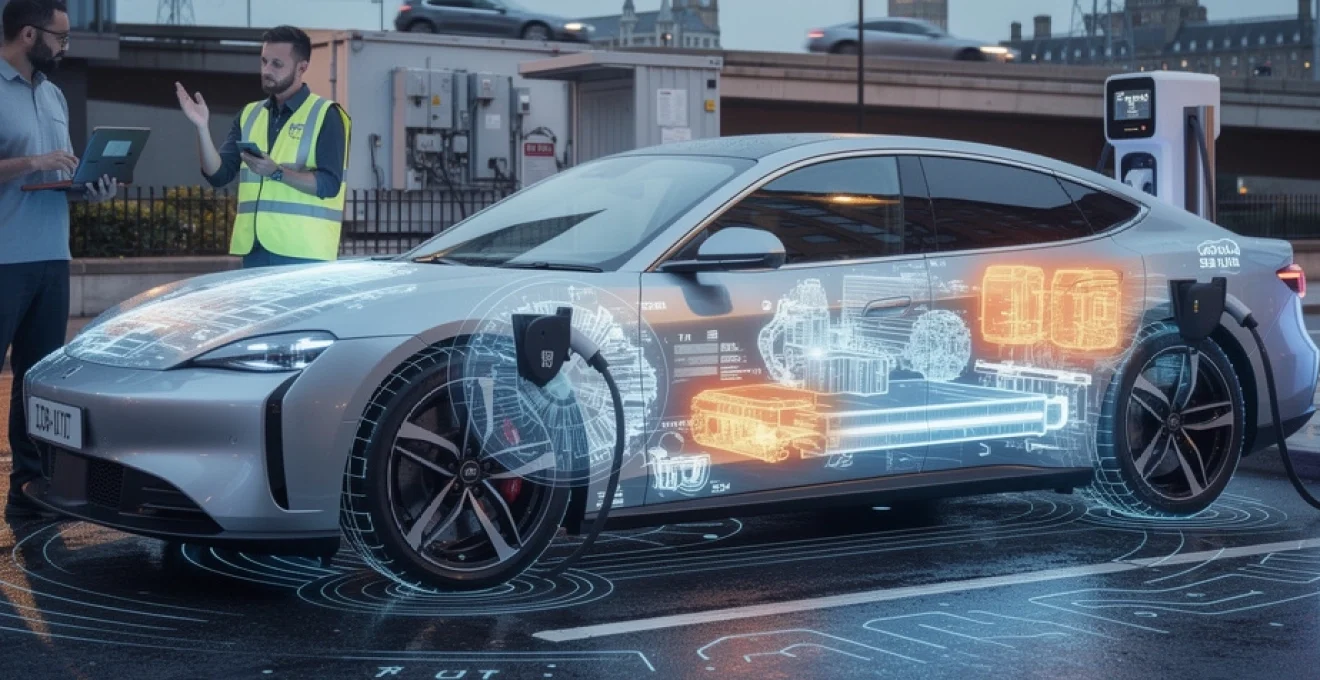
The automotive landscape is experiencing a seismic shift as Chinese technology giant Xiaomi prepares to revolutionise the UK electric vehicle market with its extraordinary SU7 Ultra. This isn’t merely another electric saloon entering an already crowded marketplace—it’s a technological tour de force that has already shattered performance records and redefined value propositions in the premium EV segment. With its tri-motor configuration delivering an astounding 1,548 horsepower and a Nürburgring lap time that leaves established European rivals trailing in its wake, the SU7 Ultra represents Xiaomi’s audacious leap from smartphone manufacturing into automotive excellence. The vehicle’s impending UK arrival, scheduled for 2027, promises to challenge everything British consumers thought they knew about electric performance vehicles, offering Porsche Taycan-beating capabilities at a fraction of the traditional premium price point.
Xiaomi SU7 ultra technical specifications and performance metrics
Tri-motor All-Wheel drive powertrain configuration
The SU7 Ultra’s powertrain architecture showcases Xiaomi’s commitment to engineering excellence through its sophisticated tri-motor arrangement. This configuration employs dual motors on the rear axle working in conjunction with a single front motor, creating an intelligent all-wheel drive system that optimises power delivery across all driving conditions. The rear motors operate independently, allowing for precise torque vectoring that enhances both straight-line acceleration and cornering dynamics. This setup enables the vehicle to automatically adjust power distribution between the front and rear axles, with the ability to send up to 100% of available torque to either end when conditions demand maximum traction.
1,548 horsepower output and torque distribution system
The combined output of 1,548 horsepower places the SU7 Ultra in rarified air, significantly outpacing the Tesla Model S Plaid’s 1,020 horsepower and establishing new benchmarks for electric vehicle performance. This immense power translates to 1,770Nm of torque, delivered instantaneously through the electric drivetrain’s inherent characteristics. The torque distribution system employs advanced algorithms that continuously monitor wheel slip, steering input, and vehicle dynamics to optimise grip and stability. During acceleration runs, the system can modulate power delivery to prevent wheel spin whilst maximising forward momentum, a crucial factor in achieving the vehicle’s claimed sub-2-second 0-60mph time.
Silicon carbide inverter technology and 800V architecture
Xiaomi has integrated cutting-edge silicon carbide (SiC) inverter technology throughout the SU7 Ultra’s powertrain, significantly improving efficiency compared to traditional silicon-based systems. These SiC inverters operate at higher switching frequencies and temperatures whilst generating less heat, resulting in more compact packaging and superior performance. The 800-volt electrical architecture enables rapid charging capabilities and reduces current draw throughout the system, minimising electrical losses and heat generation. This high-voltage platform allows the motors to spin at extraordinary speeds—up to 27,200 RPM—delivering the kind of high-frequency power delivery that contributes to the vehicle’s explosive acceleration characteristics.
CATL qilin battery pack integration and thermal management
The SU7 Ultra utilises CATL’s advanced Qilin battery technology, representing one of the most sophisticated energy storage systems available in production electric vehicles. This cell-to-pack design eliminates traditional battery modules, increasing energy density whilst improving thermal management through direct cooling of individual cells. The thermal management system employs a sophisticated liquid cooling network that maintains optimal operating temperatures across the entire battery pack, crucial for sustaining high-performance driving scenarios. The integrated heat pump system can pre-condition the battery for optimal charging speeds, whilst advanced battery management software continuously monitors cell health and balancing to ensure longevity and consistent performance delivery.
Sub-1.98 second 0-100km/h acceleration capability
Xiaomi’s claimed 0-100km/h acceleration time of 1.98 seconds positions the SU7 Ultra among the quickest production vehicles ever created, regardless of powertrain type. This extraordinary performance stems from the combination of instant electric torque delivery, sophisticated t
traction management, a low centre of gravity thanks to the underfloor battery pack, and sophisticated launch control software that carefully balances torque between all three motors. Independent testing by reviewers such as Mat Watson has recorded 0-60mph in around 2.7–2.8 seconds in real-world conditions, which still places the Xiaomi SU7 Ultra firmly in hypercar territory for straight-line performance. Crucially, this acceleration is repeatable thanks to robust thermal management and power electronics that can sustain high current loads without rapid derating. For UK drivers, this means you are not just buying a one-shot party trick, but an electric saloon capable of delivering supercar-level thrust time and time again.
UK market entry strategy and regulatory compliance framework
WVTA certification process for european homologation
Before the Xiaomi SU7 Ultra can turn a wheel on UK roads as a type-approved production model, it must pass through the European Whole Vehicle Type Approval (WVTA) process. WVTA is the regulatory gateway that ensures vehicles sold across EU and UK markets comply with strict safety, emissions (for combustion cars), cybersecurity, and environmental standards. For a high-performance electric car like the SU7 Ultra, this includes rigorous testing of braking performance, electromagnetic compatibility, battery safety, and functional safety systems such as steering and braking-by-wire. Xiaomi has already signalled its intent by setting up an EV research and development and design centre in Munich, a move clearly aimed at aligning its vehicles with European regulations from the outset.
We can expect Xiaomi to leverage this European hub to validate the SU7 Ultra against UNECE regulations that underpin WVTA, including new rules covering over-the-air updates and advanced driver assistance systems. For UK customers wondering whether a Chinese EV can meet the same standards as established European brands, WVTA acts as a strong reassurance that the car is held to exactly the same benchmarks as a Porsche Taycan or Tesla Model S. The process is not trivial: it involves component-level approvals, system-level validation and whole-vehicle crash testing under harmonised protocols. However, Xiaomi’s significant investment—over £3 billion already sunk into its EV division—suggests the company is fully committed to navigating this regulatory maze ahead of its planned 2027 launch.
Right-hand drive conversion and manufacturing adaptations
One of the most important steps in bringing the Xiaomi SU7 Ultra to the UK is the development of a dedicated right-hand drive (RHD) configuration. Unlike some smaller manufacturers that treat RHD as an afterthought, Xiaomi appears to be approaching globalisation with a platform-based mindset, where steering position, pedal layout and wiring harnesses can be mirrored without wholesale redesign. Even so, converting a complex high-performance EV into RHD involves more than simply moving the steering wheel; critical systems such as the steering column, brake booster, airbag deployment algorithms, and dashboard ergonomics must all be re-engineered.
Manufacturing adaptations will likely be centred around Xiaomi’s Beijing plant, which is already struggling to keep up with Chinese demand for the SU7 and YU7. To accommodate RHD markets such as the UK, Australia and potentially Japan, Xiaomi may need to dedicate specific production runs or even establish satellite assembly capability closer to Europe. For UK buyers this has two implications: initial allocations could be limited, and early cars may command a price premium compared with domestic Chinese models. The upside is that an RHD SU7 Ultra designed with European ergonomics in mind should feel as natural to drive on British roads as any German or British-built EV.
CCS2 charging infrastructure compatibility requirements
To succeed in the UK, Xiaomi must ensure the SU7 Ultra integrates seamlessly with the existing public charging infrastructure. That means supporting the Combined Charging System (CCS2) connector standard used across most of Europe and the UK, rather than the GB/T connectors fitted to Chinese-market vehicles. The good news is that Xiaomi’s 800V architecture is inherently well suited to ultra-rapid DC charging, making it technically straightforward to adopt CCS2 hardware and communication protocols. The car will need to support ISO 15118-based Plug & Charge features and be interoperable with major UK charging networks such as Ionity, Gridserve and BP Pulse.
For you as a prospective owner, this compatibility will translate into the ability to exploit the SU7 Ultra’s headline charging capability—potentially adding over 200 miles of range in just a few minutes—across a growing network of 150kW to 350kW chargers. Xiaomi is also likely to offer comprehensive smart charging features, allowing the car to schedule charging sessions around cheaper overnight tariffs and dynamic pricing. This matters in a market where energy costs can be volatile and where home charging remains the most cost-effective way to run a high-performance EV. If Xiaomi gets the CCS2 integration right from launch, the SU7 Ultra should feel as plug-and-play as a Tesla or Hyundai at virtually any UK rapid charger.
NCAP safety rating pursuit and crash test protocols
Safety credentials are a key concern for UK buyers considering a new Chinese EV, and Xiaomi will be acutely aware that a strong Euro NCAP rating can make or break perceptions. To achieve a five-star Euro NCAP score, the Xiaomi SU7 Ultra must excel in four major areas: adult occupant protection, child occupant protection, vulnerable road user safety, and safety assist technologies. This requires not only robust structural engineering—with extensive use of high-strength steels and well-designed crumple zones—but also a mature suite of driver assistance systems such as autonomous emergency braking, lane keeping assistance and intelligent speed assistance.
Given Xiaomi’s background in consumer electronics and AI, we can expect the SU7 Ultra to lean heavily on sensor fusion, combining LiDAR, radar and high-resolution cameras to deliver advanced collision avoidance. However, Euro NCAP also assesses how these systems behave in real-world edge cases, from night-time pedestrians to oncoming traffic in junction scenarios. Achieving top scores will demand extensive calibration on European roads, which is where the Munich R&D centre becomes strategically vital. For UK drivers this is more than a box-ticking exercise; it is direct evidence that the Xiaomi SU7 Ultra offers crash protection and active safety at least on par with established European premium brands.
Xiaomi automotive manufacturing ecosystem and supply chain analysis
Xiaomi’s move into electric vehicles is underpinned by a vertically integrated manufacturing ecosystem that blends its experience in high-volume electronics with strategic automotive partnerships. At the heart of this ecosystem is its Beijing EV plant, designed for an eventual capacity of up to 300,000 vehicles per year, supported by automated production lines, extensive use of robotics and digital twins for process optimisation. This approach allows Xiaomi to tightly control quality and iterate hardware quickly, in much the same way it does with its smartphones, while still meeting the more stringent durability requirements of the automotive sector.
On the supply chain side, Xiaomi has forged deep links with industry leaders such as CATL for batteries, as well as tier-one suppliers with experience serving German and Japanese OEMs. By combining long-term battery supply agreements with in-house development of key power electronics and electric motors, Xiaomi aims to secure cost advantages and mitigate the risk of component shortages. We have already seen how this strategy has paid off in China, where aggressively priced models like the SU7 and YU7 have forced rivals to rethink their pricing. For UK customers, this manufacturing and supply chain discipline is what makes Porsche Taycan-level performance at a substantially lower price even conceivable.
Of course, rapid growth also introduces challenges. Demand for the Xiaomi SU7 and YU7 has already outstripped production, with reported waiting times of up to 41 weeks for some variants in China. Scaling production for export markets such as Europe will place additional strain on logistics, quality control and aftersales support. To address this, Xiaomi is recruiting experienced automotive executives—from BMW, for example—to help design robust processes for spare parts distribution, service network development and warranty management. If Xiaomi can replicate its smartphone-era agility while embedding traditional automotive reliability, the SU7 Ultra could become one of the most compelling premium EVs available in the UK.
Competitive positioning against tesla model S plaid and porsche taycan turbo S
Performance benchmarking against nürburgring lap records
In the world of high-performance EVs, lap times around the Nürburgring Nordschleife have become a de facto yardstick, and Xiaomi has wasted no time in using this to position the SU7 Ultra. In June 2025, a pre-production SU7 Ultra set a new production EV lap record at the ‘Ring, beating the Tesla Model S Plaid and even eclipsing the time set by the Porsche Taycan Turbo GT. This achievement is more than a marketing headline; it demonstrates that Xiaomi’s tri-motor drivetrain, chassis tuning and aerodynamics package can cope with sustained high-speed punishment over 20.8 kilometres of demanding tarmac.
For UK enthusiasts, the Nürburgring performance suggests the Xiaomi SU7 Ultra will feel at home on circuits closer to home, from Silverstone to Brands Hatch. Reviewers who have driven the car on European roads report steering feel and chassis balance that are reminiscent of the Taycan, albeit with a slightly heavier overall sensation due to the car’s substantial battery pack. Still, when you consider that the SU7 Ultra is reportedly more than 20 seconds a lap quicker around the ‘Ring than a Model S Plaid, it becomes clear that Xiaomi is not simply chasing straight-line numbers. It is targeting all-round dynamic competence, an area in which European brands have traditionally enjoyed a comfortable lead.
Price-to-performance ratio analysis in premium EV segment
Where the Xiaomi SU7 Ultra really unsettles the premium EV market is on price-to-performance ratio. In China, the car is priced at the equivalent of roughly £55,000–£60,000, less than a quarter of the cost of a similarly specified Porsche Taycan Turbo GT and significantly undercutting the Tesla Model S Plaid. Even accounting for import duties, homologation costs and a likely repositioning as a premium product in Europe, analysts expect the UK price to land somewhere around £80,000–£100,000. That would still make the SU7 Ultra meaningfully cheaper than its most direct performance rivals.
If we look at cost per horsepower, the proposition becomes even more striking. With 1,548hp on tap, the Xiaomi SU7 Ultra delivers far more power than a Model S Plaid or Taycan Turbo S, yet at a lower projected price point. For UK buyers weighing up a high-end EV purchase, this creates a compelling value case: you are effectively getting hypercar acceleration, a tech-laden interior and record-breaking track performance for the price of a well-specified premium saloon. The question then becomes less about whether the SU7 Ultra can match its rivals on paper, and more about whether Xiaomi can convince British consumers to trust a newcomer with such a disruptive offering.
Advanced driver assistance systems comparison with autopilot and InnoDrive
The battle between the Xiaomi SU7 Ultra, Tesla Model S Plaid and Porsche Taycan Turbo S is not fought solely on raw power; advanced driver assistance systems (ADAS) are now a major differentiator. Tesla’s Autopilot and optional Full Self-Driving package have long set the benchmark for hands-on lane-keeping and traffic-aware cruise control, while Porsche’s InnoDrive focuses on predictive, route-based driving support. Xiaomi’s answer is its Pilot autonomous driving suite, powered by a combination of LiDAR, high-resolution cameras and radar sensors, all tied together by a powerful central computing platform.
In practical terms, Xiaomi Pilot aims to offer features familiar to UK drivers: adaptive cruise control, lane centring, automatic lane changes on motorways, and intelligent parking assistance. Where Xiaomi may pull ahead is in its use of high-speed connectivity and cloud-based mapping, allowing rapid updates and the potential for region-specific enhancements once it fully understands UK driving environments. For now, it is reasonable to expect that Tesla will retain an edge in long-term data collection and refinement, simply due to its larger global fleet. But Xiaomi’s rapid software development cycles—honed in the smartphone business—could allow it to roll out improvements to the SU7 Ultra’s driver assistance capabilities at an impressive pace.
Battery technology advantages over 4680 cells and 800V competitors
Battery technology is another area where the Xiaomi SU7 Ultra seeks to differentiate itself from rivals like Tesla and Porsche. Tesla’s 4680 cylindrical cells promise structural benefits and improved thermal performance, while Porsche’s Taycan platform uses an 800V architecture similar to Xiaomi’s but relies on a more traditional module-based pack design. The SU7 Ultra’s use of CATL Qilin cell-to-pack technology offers a different path to efficiency, integrating cells directly into the pack structure to maximise volumetric energy density and improve cooling.
This architecture allows Xiaomi to extract more usable capacity from a given physical footprint, helping to deliver claimed ranges approaching 500 miles on the more generous CLTC cycle and highly competitive figures under WLTP conditions. For UK drivers, the practical benefit is simple: you can expect long motorway stints between charges, even when exploiting some of the car’s prodigious performance. Additionally, the combination of Qilin pack design and 800V charging means the SU7 Ultra can accept very high charging rates with reduced risk of overheating or premature degradation. In a market where range anxiety is receding but charging time remains a key concern, Xiaomi’s battery strategy could prove to be a genuine competitive advantage.
Hyperos integration and connected vehicle technology suite
As you might expect from a company built on smartphones and smart home devices, software is central to the Xiaomi SU7 Ultra’s appeal. At the heart of the car’s digital experience lies HyperOS, Xiaomi’s unified operating system designed to connect phones, tablets, wearables and now vehicles into a single ecosystem. In the SU7 Ultra, HyperOS runs on a powerful in-car computing platform that drives the 16.1-inch central touchscreen, digital instrument cluster and expansive head-up display. The result is an interface that feels closer to a flagship tablet than a traditional car infotainment system.
For UK owners already invested in the Xiaomi ecosystem, this means you will be able to unlock the car, pre-condition the cabin, schedule charging and even transfer navigation routes directly from your phone or Xiaomi tablet. HyperOS also supports third-party apps, mirroring functions and—crucially—Apple CarPlay, acknowledging that many British buyers still favour Apple devices. Over-the-air updates will play a major role, allowing Xiaomi to deliver new features, refine driver assistance behaviour and even tweak performance parameters without a visit to the dealership. Think of the SU7 Ultra less as a static machine and more as a constantly evolving piece of connected technology on wheels.
From a practical standpoint, HyperOS aims to reduce complexity for the driver despite the car’s vast array of features. Customisable home screens, widget-style displays for climate, navigation and media, and voice control help ensure that essential functions remain accessible without digging through nested menus. Rear passengers also benefit, with tablet mounts that can connect to the car’s system, turning them into secondary control interfaces for media and climate. For UK families considering the SU7 Ultra as a daily driver, this level of connectivity and integration could be a major selling point, especially when combined with Xiaomi’s aggressive pricing strategy.
UK charging infrastructure readiness and grid integration challenges
The success of the Xiaomi SU7 Ultra in the UK will depend not only on the car itself but also on the readiness of the country’s charging infrastructure. Over the last five years, the number of public chargers in the UK has more than doubled, with rapid and ultra-rapid charge points growing particularly quickly. This expansion is crucial for a high-performance 800V EV like the SU7 Ultra, which can take full advantage of 150kW and 350kW DC chargers to deliver very short charging stops on long journeys. For most owners, however, home charging will remain the primary method of replenishing the battery, especially for those with off-street parking and access to a 7kW wallbox.
Yet, even with improving infrastructure, there are challenges. Rural regions and some motorway corridors still experience patchy coverage or congested chargers at peak times. Additionally, the UK’s ageing grid infrastructure is under increasing pressure as EV adoption accelerates, raising questions about how easily it can accommodate widespread use of ultra-rapid charging. This is where smart charging and vehicle-to-grid (V2G) capabilities—areas where Xiaomi could draw on its IoT expertise—may become increasingly important. If the SU7 Ultra and future Xiaomi models are designed to modulate charging in response to grid conditions or even feed power back into the network, they could help smooth demand and reduce strain on local substations.
For prospective SU7 Ultra owners, the practical takeaway is to think holistically about how the car will fit into your personal charging ecosystem. Installing a smart home charger, taking advantage of off-peak tariffs and planning longer trips around reliable rapid-charging hubs will help you get the most from Xiaomi’s high-performance EV. As the UK moves towards its 2035 ban on new pure combustion car sales, the grid and charging network will continue to evolve, and Xiaomi’s arrival with an 800V, ultra-rapid-charging saloon is likely to accelerate that process. In many ways, the SU7 Ultra is not just testing the limits of electric performance—it is also testing how ready the UK’s infrastructure and energy systems are for the next generation of EVs.